Henry VIII had three legitimate children, all of whom went on to reign for varying periods of time. Mary, the daughter of Katherine of Aragon; Elizabeth, the daughter of Anne Boleyn; and Edward, the son of Jane Seymour.
Then, you’ve got Henry FitzRoy, the son born to one of Henry’s mistresses, Bessie Blount, whom Henry welcomed into his heart. But what about his first son, born at Richmond Palace soon after midnight on New Year’s Day, 1511, who sadly only lived for 52 days?
Table of Contents
How different things might have been if he’d survived and reigned as King? The chances are there’d have been no Mary, Elizabeth, and Edward. Or, if there were, they’d have been illegitimate children, not kings and queens.
And what about the break with Rome? How different would England have been today if baby Henry had lived?
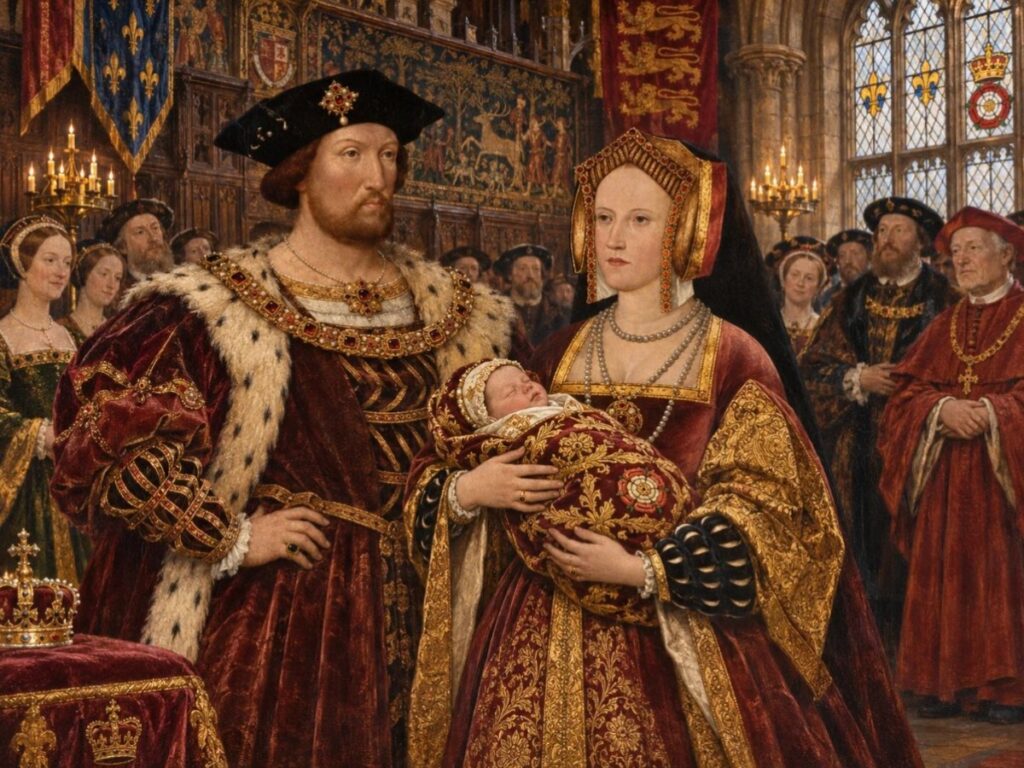
The Baby Boy Born To Henry and Katherine
Henry married Katherine of Aragon in June 1509 when he was only 17. She was pregnant by January 31, 1510, which ended in tears with a stillborn daughter. So naturally, when she fell pregnant a second time, Henry took no chances, and Katherine went to her chamber early and was looked after to ensure a healthy child was born.
It paid off. Just after midnight on January 1, 1511, the couple was blessed with a baby boy.
Bonfires were lit, vessels of wine were set out in the London streets for anyone who wanted a drink, and there were processions to give thanks to God. The king’s chapel singers were even paid for “praying for the Queen’s good deliverance.”
Henry was 19, and Katherine was 25, and they’d done the one thing every royal couple was expected to do. As the king’s eldest son, the boy was Duke of Cornwall from the moment he took his first breath, and in time he’d have been made Prince of Wales.
He was christened on January 5, with the Archbishop of Canterbury and the Earl of Surrey as his godfathers at the font. The king’s book of payments for 1511 records £20 paid to the heralds for “largess at christening of my Lord Prince Henry.” Then Henry rode to Norfolk to give thanks at the shrine of Our Lady of Walsingham, one of the great pilgrimage sites of medieval England, and the same accounts record his offerings there later that month.

The Celebration of the New Young Prince
As you can imagine, Henry couldn’t wait to show off his son. Henry was nothing if not vain, and the opportunity to present his son, and his own virility, was too good an opportunity to miss.
Just 6 weeks after the birth, on February 12, 1511, he held a tournament at Westminster, right beside the palace, and he rode in it himself under the name Coeur Loyall, or Sir Loyal Heart.
No expense was spared, and the king and his companions had the letters H and K in fine gold sewn all over their hose, caps and coats, so many of them that the cloth underneath could “scace appere,” as he puts it.
Full of swagger, Henry told the ladies of the court and his ambassadors they could take the gold letters off the costumes and keep them as gifts. Well, that was a mistake because as soon as the ordinary London folk saw what was happening, they rushed him and stripped him down to his hose and doublet, along with all his companions; so desperate were they to get to the gold.
In the end, the guards had to come and push the crowd back. Luckily, nobody was punished or lost their heads. In fact, according to Hall, it was laughed off, and they proceeded to a great banquet.
The jousts were recorded on the Westminster Tournament Roll, which can still be seen at the College of Arms in London. It’s painted on vellum and is almost 60 feet long, showing Henry tilting in front of Katherine.
The 52 Days of the Young Prince
On February 22, 1511, the eve of St Matthias, the little prince died at Richmond. There’s no record of what killed him, no illness or accident, just the date.
Hall wrote that Henry, “like a wise prince,” took the “dolorous chance” calmly and hid his own grief to comfort his wife, while Katherine, “like a natural woman, made much lamentation.” The king’s kindness eased her sorrow, Hall adds, “but not shortly.”
Henry didn’t skimp on his son’s funeral, and the day after the death, his accounts show £35 13s 4d paid to his almoner “about the interment and burial of my Lord Prince.” On the very same day, he paid 15 trumpeters £26 13s 4d for playing at the jousts only 10 days earlier.
A month later came a further £759 6s 0½d “in full for interment of my Lord Prince,” which was a fair whack of money, even for a king.
The prince was buried at Westminster Abbey, on the north side of the Sanctuary near the entrance to the chapel of St Edward the Confessor. However, if you go today, there’s no evidence of his grave.
When Sir Gilbert Scott built the new High Altar in the 1860s, a small lead coffin of a child turned up near the step in front of it. It may well be Henry’s, and it was left where it lay, so we’ll never know.
The Babies Who Came After
Katherine and Henry kept trying. The historian Alison Weir has pieced together every pregnancy Katherine is known to have had:
- January 1510: a stillborn daughter
- January 1511: Henry, the prince who died that February
- October 1513: a premature son, born while Henry was away fighting in France, who died soon after
- Late 1514: another boy, though the reports disagree on whether he was stillborn or lived for a short time
- February 1516: Mary, the only child who survived
- November 1518: a weak little daughter who died before she could be christened
Henry knew better than most how dangerous childbirth could be. His own mother, Elizabeth of York, died on her 37th birthday in February 1503, 9 days after giving birth, when Henry was 11.
By the end of 1518, Katherine was nearly 33, and there were no more pregnancies.
Seven months later, in June 1519, Henry’s mistress Bessie Blount gave him a healthy boy, Henry FitzRoy. To Henry, FitzRoy was living proof that he could father a son, so the fault had to lie somewhere in his marriage.
Hooked on the Middle Ages? Get more stories like this one in your inbox.
Did Henry VIII Believe He Was Cursed?
Katherine had first come to England to marry Henry’s older brother, Arthur, in November 1501, and Arthur died the following April at 15. To marry his brother’s widow, Henry needed a dispensation from Pope Julius II, and he got one. Katherine always swore that her marriage to Arthur had never been consummated.
The trouble came down to one verse of the Bible. Leviticus 20:21 says that if a man takes his brother’s wife, “they shall be childless.” Henry took that to heart and decided he was cursed, and it was all Katherine’s fault for deceiving him.
He explained himself in public in the summer of 1529, at the court the Pope’s legates held at Blackfriars to judge the marriage. George Cavendish, Cardinal Wolsey’s gentleman usher, recorded the king’s words in his Life of Cardinal Wolsey.
Henry told the court that all his sons by the queen had “died incontinent after they were born,” meaning straight away, and that he feared “the punishment of God.” Mary, a girl of 13 by then, didn’t count in that reckoning.
Katherine had her own explanation. Francis Bacon, writing his history of Henry VII in 1622, says that when she first learned about the divorce, she insisted she had done nothing wrong, and that it was “a judgment of God, for that her former marriage was made in blood.” The blood, Bacon explains, belonged to Edward, Earl of Warwick.
The poor old Earl of Warwick never really stood a chance. He was the son of George, Duke of Clarence, who supposedly died in a vat of wine, but through George, he was the last male Plantagenet with a real claim to the throne.
He was locked in the Tower of London as a boy and never came out; Henry VII made sure of that, and had him executed in November 1499 to ensure there could be no further claims to upset the balance.
However, that wasn’t the only reason for having him executed. Henry was planning to marry his son Arthur to Katherine of Aragon, but her father wouldn’t entertain the idea while Warwick was alive.
So it was off to the chopping block for the Earl of Warwick, leaving Katherine to believe she had blood on her hands, as it was for her marriage to Arthur to happen that the execution took place.
As Katherine was only 13 when this happened, she can hardly be blamed for any of it, but that’s not how she saw it.
Whether she believed it or not, the idea of Henry being cursed has made for plenty of great TV shows and novels. Philippa Gregory’s novel, The King’s Curse, goes into detail, and although it is fictional, who knows if there is a degree of truth in there somewhere.
What If Prince Henry Had Lived?
If Prince Henry had survived, he’d have been 36 when his father, Henry VIII, died. More than likely, he’d have been married with kids of his own, and he’d have become King Henry IX of England.
Nobody can know what Henry IX would have done, but it’s an interesting thought because so much would look different now.
Would Henry VIII Have Stayed with Katherine?
With a healthy heir in the nursery, the main reason for Henry to divorce Katherine disappears. However, Henry would almost certainly still have strayed.
He had affairs with Bessie Blount and Mary Boleyn while he was married to Katherine, and neither affair led to any talk of divorce. Kings had kept mistresses for centuries without trying to destroy the Church to marry them.
That leaves Anne Boleyn. She came home from France in early 1522 to marry her cousin James Butler, a match meant to settle a family dispute over the earldom of Ormond in Ireland. When that fell through, she was secretly engaged to Henry Percy, the heir to the Earl of Northumberland, until his father stopped it.

Without a king desperate for a son, I’m inclined to think Anne would have ended up a countess in Ireland or the north of England, and most of us would barely know her name. She’d have also kept her head, so an added bonus there.
And of course, without Anne marrying Henry there’d have been no Elizabeth I. With Henry IX next in line, neither Edward VI nor Lady Jane Grey would have come anywhere near the crown either.
Mary’s life would have changed most of all. Henry used her as a bargaining chip from the cradle. At 2, she was promised to Francis, the infant Dauphin of France, and at 6 to the Emperor Charles V, Katherine’s nephew and the son of her sister, Joanna of Castile.
With a brother on the throne, Mary would almost certainly have married abroad and lived out her life as a foreign queen or even an empress. England would never have known her as Bloody Mary, and the burnings that gave her that name would never have happened.
Would England Have Stayed Catholic?
Henry started out as the Pope’s champion. In 1521, he wrote a book attacking Martin Luther, the Assertio Septem Sacramentorum, and Pope Leo X rewarded him with the title Defender of the Faith. The letters F D still appear after the monarch’s name on British coins today.
The break with Rome grew out of the divorce. Henry married Anne in 1533, and the Act of Supremacy of 1534 made him Supreme Head of the Church of England in place of the Pope. Without the divorce, Sir Thomas More and Bishop John Fisher wouldn’t have been executed in 1535, and Thomas Cromwell might never have risen as high as he did.
The monasteries would very likely have survived too. Between 1536 and 1540, Henry’s government closed around 800 religious houses, and their lands were sold off.
Luther’s ideas were already sweeping Europe from 1517, mind you, and William Tyndale’s English New Testament was being smuggled into England from 1526. Plenty of German princes turned Protestant without needing a divorce, and a Henry IX could have done the same.
My guess, and it is only an educated guess, is that England would still have had a reformation of some kind, only later, slower, and on very different terms.
No Stuart Kings on the English Throne
This is the what-if I find really interesting. James VI of Scotland became James I of England in 1603 only because all 3 of Henry VIII’s children died without children of their own, which left Margaret Tudor‘s great-grandson as the heir.
If Henry IX had children, the crown would have passed down his line instead. The English and Scottish crowns might never have been joined in 1603, and there’d have been no King James Bible in 1611, at least not by that name.
Even though England has never had a King Henry IX, one man did call himself that. When Bonnie Prince Charlie died in 1788, his younger brother, Henry Benedict Stuart, a Catholic cardinal living in Italy, proclaimed himself King Henry IX. His supporters called him that until his death in 1807, and he was the last of James II’s male line, a Stuart line that only reached the English throne because the Tudors ran out of heirs.
What It Could Have Meant for America
Virginia got its name in 1584, after Elizabeth I gave Sir Walter Raleigh a license to settle land in North America, and it was named in honor of the Virgin Queen. Jamestown, the first permanent English settlement in North America, was named after James I in 1607.
The Pilgrims who sailed on the Mayflower in 1620 were Separatists, people who wanted to break away from the Church of England altogether. That church only existed in its Protestant form because of Henry’s break with Rome.
Even the first flag of the United States carried a trace of the Stuarts. The Continental Union Flag, flown from 1776 to 1777, had the British Union Flag in its corner, a design James I ordered in 1606 to mark the joining of his 2 kingdoms.
England would still have sent ships west, I’m sure of that, but the names on the map, the churches people built, and maybe the people who made the crossing would all have been different.
Or Would It All Have Happened Anyway?
A baby who survived his first winter still had a long way to go in Tudor England. Prince Arthur died at 15 in 1502, Henry FitzRoy at 17 in 1536, and Edward VI at 15 in 1553. Henry VIII himself was badly hurt in a jousting fall in January 1536.
A Henry IX could easily have died young too, and the same crisis might simply have arrived 10 or 20 years later.
Katherine died at Kimbolton Castle in January 1536, so a widowed Henry would have been free to marry again whatever happened. And one son was never much of an insurance policy, as Henry knew from watching his brother Arthur die.
Henry VIII got his son in the end. Edward was born on October 12, 1537, and Jane Seymour died 12 days later. When Henry’s time came, he chose to lie beside her in a vault at Windsor, more than 20 miles upriver from the unmarked spot in Westminster Abbey where his first son may still lie.
Frequently Asked Questions
How long did Henry VIII’s first son live?
Henry VIII’s first son, Henry, Duke of Cornwall, lived for 52 days. He was born at Richmond Palace on January 1, 1511, and died there on February 22, 1511.
What did Henry VIII’s first son die of?
Henry VIII’s first son died of an unknown cause. The chronicler Edward Hall reports the date of his death but gives no illness or accident, and babies died at every level of Tudor society.
Where is Henry VIII’s first son buried?
Henry VIII’s first son is buried in Westminster Abbey, on the north side of the Sanctuary near the chapel of St Edward the Confessor. There’s no marker, but a small lead coffin found near the High Altar step in the 1860s may be his.
Did Katherine of Aragon have any other sons?
Katherine of Aragon had at least one more son, a premature boy born in October 1513 who died soon after, and probably another in late 1514 who was stillborn or lived only briefly. Her only child to survive into adulthood was Mary I.
Why did Henry VIII think his marriage was cursed?
Henry VIII thought his marriage was cursed because Leviticus 20:21 warns that a man who marries his brother’s wife will be childless, and Katherine was the widow of his brother Arthur. By 1529, he was telling a church court that the deaths of their sons showed “the punishment of God.”
Love a good medieval story?
Join our readers and get tales of kings, queens, castles and ordinary medieval lives straight to your inbox.

Kylie Lang is a nationally syndicated travel journalist with bylines on the Associated Press Wire & more, a medieval history writer, and the founder and lead author of Tales of the Middle Ages (talesofthemiddleages.com). She holds a BA (Honours) in History from the University of Kent and is a member of the British Guild of Travel Writers.
Related posts:
 From Heiress to Exile: Katherine Willoughby and the Turmoil of Tudor England
 Katherine Swynford’s Children: How Four Beauforts Put Her Blood on Two Thrones
 What History Got Wrong About Mary Boleyn: The Other Boleyn Sister Who Outlived Them All
 Six Women Who Dodged a Bullet, or Axe, by Not Marrying Henry VIII