
It’s the question every historian throughout history would love to know the answer to. Did Catherine of Aragon marry Henry VIII as a virgin, or did she consummate her wedding to Prince Arthur?
What really happened between Catherine of Aragon and Arthur, Prince of Wales, on their wedding night? It’s one of those historical cliffhangers that still sparks debate more than 500 years later. Did they consummate the marriage or didn’t they? And why does it matter so much?
Table of Contents
I’ll tell you why, because that question shaped the course of English history.
Catherine, a Spanish princess with a strong Catholic faith, found herself married to a teenage boy destined to be King of England whom she’d barely met. Within months, Arthur was dead. Seven years later, she married his brother, Henry, and everything might have gone to plan if Henry hadn’t decided he wanted out.
The easiest way to do that? Claim their marriage was never valid because Catherine had already been with his brother. But Catherine swore it wasn’t true. She insisted she was a virgin when she married Henry, even under intense pressure from the king, the court, and the Church.
So who was telling the truth? One thing’s for sure: It certainly sent the Tudor gossip mill into overdrive. So what really happened when history turned into a royal courtroom drama? Let’s walk through the evidence, the testimonies, and the politics behind it all.

Historical Background
Catherine of Aragon arrived in England in 1501, just 15 years old and already at the center of a political alliance between Spain and England. She married Prince Arthur, heir to the English throne, in a grand ceremony at St. Paul’s Cathedral. It was all very formal and very public. Everyone expected this to be the beginning of a powerful future dynasty.
But five months later, Arthur was dead.
It was sudden and dramatic. Both Catherine and Arthur had fallen seriously ill, most likely from the sweating sickness that swept through Ludlow where they were living. Catherine survived. Arthur didn’t.
So now what? Catherine was a Spanish princess, still technically a member of the English royal family, and still politically important. But was she also a widow who had consummated her first marriage? That one detail would shape everything that followed.
Fast forward to 1509. Catherine married Arthur’s younger brother, Henry, who had just become king. But here’s where things got complicated. According to Catholic law at the time, a man wasn’t supposed to marry his brother’s widow. Unless the first marriage hadn’t been consummated. In that case, it didn’t count in the eyes of the Church.
That’s why Catherine’s virginity became such a big deal. Not just for her reputation, but for the legitimacy of her second marriage and her daughter Mary’s place in the royal succession. Everything rested on whether Catherine and Arthur had ever done more than share a bed.
And when Henry decided he wanted out of the marriage, that question suddenly became the center of a religious and political storm.
The Spanish Princess
There is a great TV show based on Philippa Gregory’s books called The Spanish Princess, which is all about Catherine, Arthur, and Henry. It’s over two seasons, and although it has been highly dramatized, it’s got some good historical references.
The Wedding Night and the Evidence
So, what did happen on that cold November night in 1501 when Catherine of Aragon married Prince Arthur? The pageantry was big. The ceremony was grand. And like all good royal marriages, it ended with a public bedding.
The bedding ceremony was a mix of tradition, performance, and pure awkwardness. After the wedding festivities, Catherine and Arthur were led by a crowd of courtiers into their bedchamber. There would have been music, jokes, nudges, and knowing glances. They were helped into bed by attendants, then the curtains were drawn and the room cleared.
It was meant to symbolically confirm the start of married life, and everyone pretended not to notice the obvious expectation: that sex would follow. It was part theater, part social ritual. But what happened after the doors closed? That part was completely private.
So, how could anyone have known what happened or didn’t happen? Nobody, including Catherine’s ladies, was in the room that night. Catherine had a full household including ladies-in-waiting, servants, and her trusted duenna, Doña Elvira Manuel. But even she wasn’t allowed in the room.

Unfortunately, Doña Elvira, who probably knew more than anyone else, was removed from Catherine’s household shortly after Arthur’s death. She later wrote to Queen Isabella, Catherine’s mum, saying Catherine had arrived back in the household “as intact as she left it.” That line has been used again and again to support Catherine’s claim. But how did she know if she wasn’t in the room on the wedding night? Her report was based on Catherine’s physical condition afterward, and likely Catherine’s own words.
None of Catherine’s ladies claimed to have personal, firsthand knowledge of consummation. Not one of them. The closest we get is Lady Margaret Bryan (who later became governess to Princess Mary), and she didn’t even offer any specific details from the night itself. They simply weren’t witnesses to the act. It was private, as it should have been.
The only evidence suggesting they had sealed the deal was from Arthur the next morning. He reportedly said he’d been “this night in the midst of Spain.” He then asked for ale, boasting about how tiring it had all been and that “marriage was thirsty work.” It sounds like the kind of thing a teenage boy might say just to prove a point, but it’s not exactly rock-solid evidence.
When it comes to sex and teenage boys, reliability isn’t exactly a thing, as we all know.
Arthur’s Health, Teen Nerves, and Anxious Parents
Henry VII, Arthur’s father, was reportedly not too keen on them rushing into anything physical. Arthur was just 15. Slim, pale, and not in the best of health. Catherine’s parents, Isabella and Ferdinand of Spain, fully agreed with Henry. They also had their reservations and thought maybe the young couple should wait a bit. Let them get to know each other, grow up a little, and then see where things stand.
And then there was the wedding itself. Days of celebrations. Feasting. Wine flowing. All the Tudor grandeur you can imagine. By the time they got to the bedding ceremony, it’s entirely possible they were more exhausted than excited. They’d barely spent any time together, didn’t speak the same language (they had Latin in common, but that only gets you so far), and were likely overwhelmed.
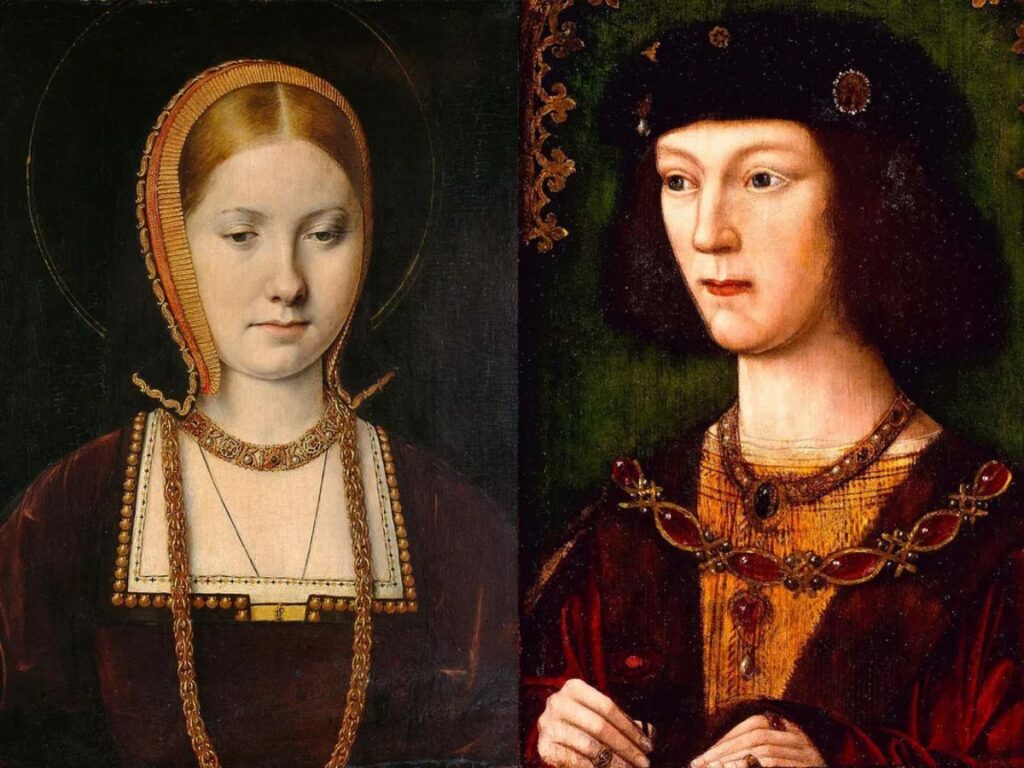
There’s evidence that Henry VII didn’t want Catherine to be sent to live with Arthur once they were wed. He wanted her to stay in London longer after the wedding, another sign that he may not have expected, or even wanted, consummation immediately.
So, with all that in mind, is it really so unbelievable that they didn’t sleep together? That they were left alone, probably exhausted, awkward, and unable to communicate well?
Hooked on the Middle Ages? Get more stories like this one in your inbox.
Henry’s Motives: Why Did He Start Asking Questions?
Henry VIII and Catherine of Aragon looked like a solid royal couple for the first twenty years of their marriage. She was respected, religious, and politically smart. He was young, strong, and famously devoted to her, especially early on. Catherine even acted as regent while Henry was off fighting in France, and she did a pretty impressive job.
So what changed?
In short: time, ego, and no male heir.
By the late 1520s, Catherine was in her forties and had undergone multiple pregnancies. Most ended in miscarriages or stillbirths. Only one child survived, and that was Princess Mary. And that just wasn’t good enough for Henry. He wanted a male heir, not just for pride, but to secure the Tudor dynasty. He believed the lack of a son was a sign that something wasn’t right.

This is where things take a sharp turn.
Henry began to wonder whether marrying his brother’s widow had offended God. He latched onto a verse from Leviticus that said, “If a man shall take his brother’s wife, it is an unclean thing… they shall be childless.” Never mind that the Pope had permitted them to marry in the first place. Now Henry was arguing that the papal dispensation had been a mistake, and that their marriage had been cursed from the start.
But let’s be honest. That religious angle gave him the perfect cover.
Because by then, Henry had fallen for Anne Boleyn. She was young, educated, opinionated, and unlike her sister Mary (who had already been Henry’s mistress), Anne refused to sleep with him unless she was his wife and queen. Henry was obsessed. And Catherine, now in her mid-forties, couldn’t compete with that.
So what did he need to do? Prove that his marriage had never been valid in the first place.
And the easiest way to do that was to claim Catherine had lied. If she had consummated her marriage to Arthur, then her marriage to Henry would have gone against God’s law, regardless of the Pope’s permission. Suddenly, that one night in 1501 became the foundation of Henry’s case to break with Rome, leave his wife, and marry Anne.
Catherine’s Defense: The Queen Who Wouldn’t Back Down
By the time Henry VIII pushed for an annulment, Catherine of Aragon had been Queen of England for nearly two decades. She was respected, devout, and still deeply loved by many in the kingdom.
But now, everything was on the line.
Henry needed the marriage declared invalid. And the only way to do that, in the eyes of the Church, was to prove that Catherine’s first marriage to Arthur had been consummated. Catherine knew exactly what this meant. If she admitted to sleeping with Arthur, her marriage to Henry would be invalid. Their daughter Mary would be declared illegitimate. And Catherine herself would be cast aside.
So she stood firm. In every testimony, confession, and formal interview, Catherine repeated the same thing. She had never slept with Arthur. She had come to Henry’s bed a virgin. And she said it with absolute conviction.

During the legatine court at Blackfriars in 1529, Catherine walked across the court and knelt before Henry, looked him in the eye and said:
“And when ye had me at the first, I take God to be my judge, I was a true maid without touch of man; and whether it be true or no, I put it to your conscience.”
It wasn’t just a performance. Catherine was deadly serious. She was putting her soul, her honor, and her truth in front of everyone, and daring Henry to say otherwise.
He didn’t.
He said nothing. No denial. No accusation. He just sat there.
Even more telling? Catherine gave permission for the Pope’s representative, Cardinal Campeggio, to break the seal of confession and tell the Pope what she’d said in private. That’s not something you do lightly. For a deeply religious woman like Catherine, lying in confession wasn’t just risky. It was unthinkable.
As for the witnesses Henry tried to call, it didn’t go as planned. Most were elderly, vague, or relying on hearsay. One of the more notable examples was the Earl of Shrewsbury. He testified that he had consummated his own marriage at fifteen, so naturally assumed Arthur had done the same. That was it. No firsthand knowledge, no proof, just a personal comparison. Useful? Not really. But it shows how flimsy the so-called evidence actually was.
Despite all the pressure, threats, and political maneuvering behind the scenes, Catherine never once changed her story.
Why the Pope Wouldn’t Grant the Annulment
If Henry VIII thought getting the Pope to cancel his marriage would be a quick fix, he seriously misjudged the situation. What looked like a private marital issue was actually a political nightmare for the Vatican, and the Pope was caught in the middle.
At the heart of it was Charles V, the Holy Roman Emperor. He just happened to be Catherine of Aragon’s nephew, one of the most powerful rulers in Europe, and the Pope wasn’t exactly in a position to upset him. Especially not in the 1520s, when Rome had literally been sacked by Charles’s troops. The Pope had only just been released after being held hostage. So when Henry came asking for an annulment that would publicly humiliate Charles’s aunt, the Pope knew better than to rush into it.
Then there was the legal mess. The Pope had already issued a dispensation years earlier to allow Henry and Catherine to marry. That permission was based on the claim that her first marriage hadn’t been consummated. If the Pope now said the marriage was invalid, he’d basically be admitting that the Church had made a huge mistake, or worse, that he was overriding previous papal authority. Not a good look.
So the Pope stalled.
He sent Cardinal Campeggio to England to investigate. Campeggio met with Catherine, heard her confession, and left convinced she was telling the truth. Catherine even told him he could repeat her words to the Pope himself. No hesitation. No backtracking.
Meanwhile, Henry was getting more desperate. Anne Boleyn was still waiting in the wings, and he was growing increasingly frustrated.
But Rome wouldn’t budge.
The Pope’s refusal to grant the annulment wasn’t because he didn’t believe Henry or thought Catherine was lying. It was because the politics were too dangerous, the precedent too messy, and the pressure from Charles V too strong. It was easier to delay, promise a decision later, and hope the problem would disappear.
But it didn’t.
Instead, it pushed Henry into making one of the most dramatic decisions in English history. If the Pope wouldn’t end the marriage, Henry would end the Pope’s authority in England. And just like that, the road to the English Reformation was wide open.
The Gossip That Never Died: “I Was in Spain Last Night”
Out of everything said about Catherine and Arthur’s wedding night, the one detail people still quote is something Arthur might have said the next morning when he emerged from the bedchamber. “I have been in the midst of Spain last night,” and that marriage was “thirsty work.”
On the surface, it sounds like a teenage boy showing off. Bragging, posturing, trying to sound more grown-up than he really was. And honestly, that’s probably what it was. Arthur was just fifteen, newly married to a glamorous Spanish princess, and suddenly the eyes of the whole court were on him. Of course he wanted to seem like he’d lived up to expectations.
It was gossip. Secondhand stories. And yet, somehow, that one boast got picked up, passed around, and ended up in official court testimony years later. By the time Henry wanted an annulment, Arthur’s words had been turned into supposed proof of consummation.
Never mind that Catherine consistently said nothing happened. Never mind that none of her ladies had seen anything. Never mind that Arthur’s health was fragile and the bedding ceremony came at the end of a long, wine-soaked day. That one boastful line stuck.
And that’s the power of gossip in Tudor England. One careless comment at breakfast ended up shaping the course of European history.
What Happened to Catherine After Henry Broke with Rome
Once Henry decided he didn’t need the Pope’s blessing, everything changed, and not in Catherine’s favor.
In 1533, Henry married Anne Boleyn in a private ceremony, even though he was still technically married to Catherine. The Archbishop of Canterbury, Thomas Cranmer, then declared Henry and Catherine’s marriage null and void. Catherine was stripped of her title as Queen of England and demoted to “Dowager Princess of Wales.” This was a title that linked her back to Arthur and was meant to rub salt in the wound.
Catherine refused to accept it.
She continued to call herself Queen. She signed letters that way, and she expected her household to do the same. Even as she was moved from one remote residence to another, kept apart from her daughter Mary, and increasingly isolated, Catherine never backed down.
She believed her marriage was valid in the eyes of God. She believed Mary was legitimate. And she would not admit to something she claimed wasn’t true, no matter the pressure, no matter the cost.
Henry, meanwhile, made sure to cut her off. Financial support was slashed. Letters between her and Mary were intercepted. Anne Boleyn didn’t want any reminders of Catherine’s reign lingering in court, and Henry was too deep into his new marriage to look back.
Still, Catherine held on.

In her final years, she lived quietly, mostly at Kimbolton Castle, and grew increasingly unwell. But even then, she stayed devout. She fasted, prayed, and stuck to the belief that she was Henry’s rightful wife.
She died in 1536 at the age of 50. Her last letter to Henry, written just days before she passed, wasn’t angry or bitter. It was full of forgiveness, dignity, and grace. She signed off as she always had:
“My eyes desire you above all things.”
That’s the kind of woman Catherine of Aragon was. Stubborn, yes. But loyal, principled, and never one to betray her own truth.
The Question That History Can’t Answer
Ultimately, we’re left with a question that history can’t quite answer.
Did Catherine and Arthur consummate their marriage? Maybe. Maybe not. People have spent centuries digging through letters, testimonies, royal whispers, and secondhand stories. But the truth? Catherine took it with her to the grave.
What we do know is that she never once wavered, not under pressure from the king, not when separated from her daughter, not even when it would have made her life easier to simply say what Henry wanted to hear. She believed in the truth she spoke, and she stood by it until the end.
And maybe that’s the bigger point.

Love a good medieval story?
Join our readers and get tales of kings, queens, castles and ordinary medieval lives straight to your inbox.

Kylie Lang is a nationally syndicated travel journalist with bylines on the Associated Press Wire & more, a medieval history writer, and the founder and lead author of Tales of the Middle Ages (talesofthemiddleages.com). She holds a BA (Honours) in History from the University of Kent and is a member of the British Guild of Travel Writers.
Related posts:
 What History Got Wrong About Mary Boleyn: The Forgotten Sister of Anne, Mistress, Mother, Survivor
 Mary Tudor and Charles Brandon: The Secret Marriage That Rocked Henry VIII’s Tudor Court
 Catherine de Medici: The Ultimate Renaissance Power Player
 The Legend of Excalibur: Was King Arthur’s Sword Real?