
I’ve often wondered what would have happened to me if I’d had my daughter in Tudor England rather than in a modern hospital. Mine was an emergency C-section. I got stuck at 8 centimeters dilated, and it all got rather fraught.
I’ve always assumed that four hundred years ago, they’d have worked to save the baby, and I would have died on the birthing bed. It’s a horrible thought. So it begs the question: how did any woman survive childbirth, even a queen with everything the age could offer at her disposal?
Table of Contents
Childbirth for Tudor queens meant up to 6 weeks of confinement in a darkened, sealed room, no men allowed, only a midwife and her female attendants, and prayers to the Virgin Mary for a safe delivery.
It was dangerous, private, and heavy with the weight of the succession. Jane Seymour, for example, gave Henry the son he’d hunted for years, and she was dead 12 days later.
Why Was Childbirth Such a Big Deal for a Tudor Queen
A queen’s whole worth hung on one thing: producing a healthy son. That made a royal birth a political event. The whole country had a stake in what came out of that chamber, which is a heavy thing to carry when you’re the one doing the pushing.
The trouble was the succession. Every pregnancy was high-stakes could be counted as a disappointment. You only have to look at Catherine of Aragon, the first of the six wives, to see what was riding on it.
Her run of failed pregnancies and stillbirths, with only the little Mary surviving, is the clearest example of a queen doing everything asked of her and still falling short in the one way that counted.
And it was Henry VIII’s obsessive hunt for a male heir that turned all of this up to a fever pitch. This was a man so desperate for a son that when a mistress gave him the boy his queen couldn’t, he ennobled the child on the spot. A queen knew exactly what her body was for in his eyes, and knew what happened to the wives who couldn’t deliver it.
What Was “Taking to Her Chamber”
“Taking to her chamber” was the moment a queen withdrew from the world to wait out the last stretch of her pregnancy. She’d retreat into isolation up to 6 weeks before the due date and not reappear in public until well after the birth.
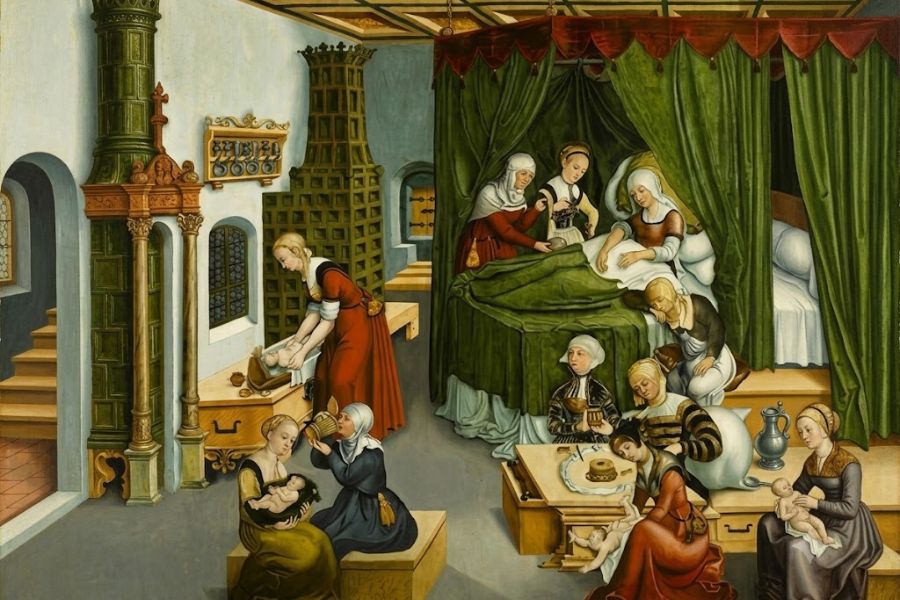
Men were shut out completely, and I mean completely. No male servants, no physicians wandering in, not even the king himself. Only women crossed that threshold. The preparations began early, too, roughly a month before the baby was expected, so nothing was left to the last minute.
The chamber was also a stage, a chance to show off royal wealth and status through the sheer opulence of the hangings and furnishings. Even a woman about to disappear behind a locked door was expected to disappear in style.
What Did the Tudor Birthing Chamber Actually Look Like
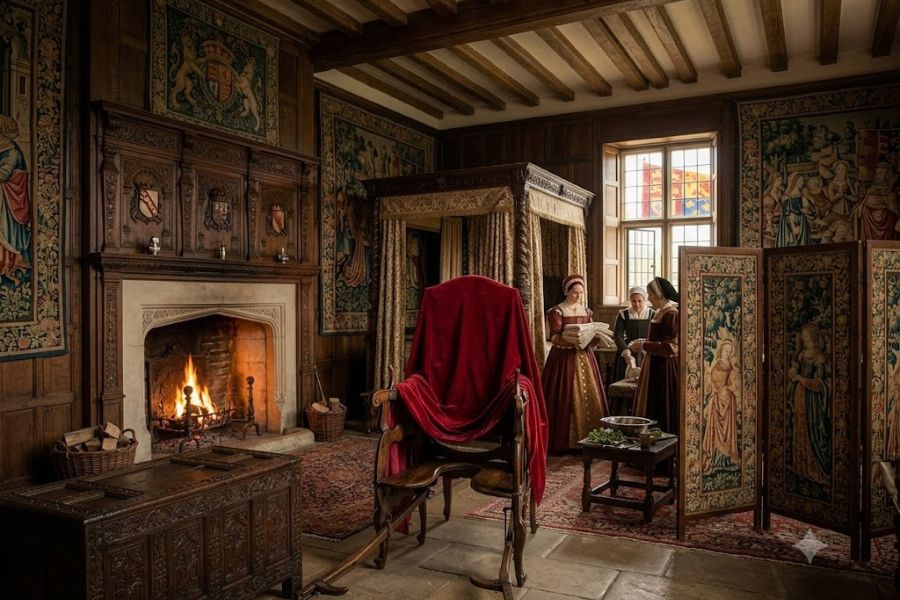
The room was deliberately made dark, warm, and quiet, hung floor to ceiling with tapestries. The whole idea was to recreate the womb, a soft, enclosed, dim little world for mother and baby both. If you want the fuller picture of the rituals, how women actually gave birth in this period is a story of sealed windows and stopped keyholes.
Usually, a single window was left partly open, and no more than that, because too much light was thought to damage the mother’s eyes. Crucifixes and holy objects were kept close by for spiritual protection.
Then there was the furniture. Pallet beds with canopies, a birthing chair known as the “groaning chair,” and, sitting off in the corner, a gilded bowl for the afterbirth. Even the ugliest, most human parts of the day were given a golden dish.
Hooked on the Middle Ages? Get more stories like this one in your inbox.
Who Delivered a Tudor Queen’s Baby
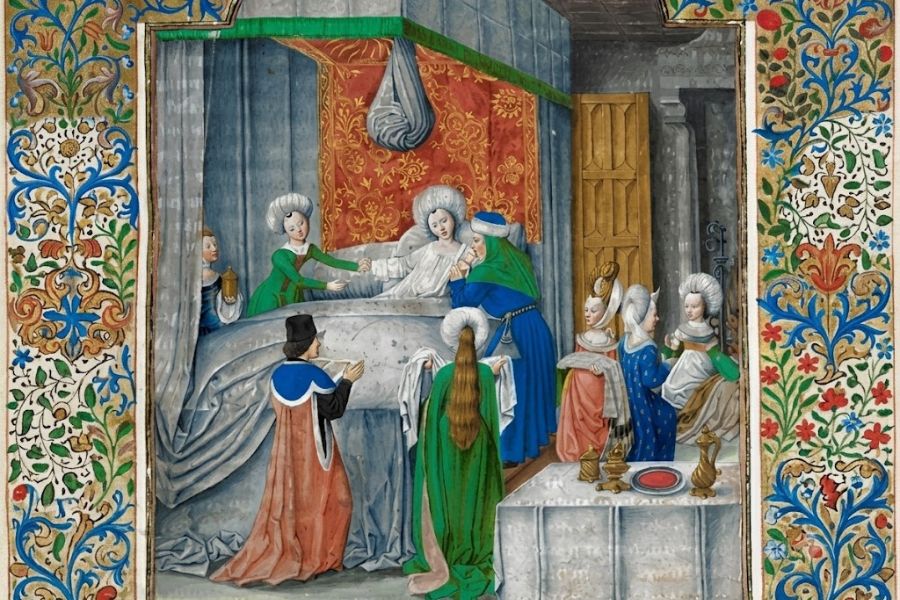
Skilled female midwives ran the room. The best midwives in the kingdom were summoned for a queen, with royal physicians available in the background, and it was the midwife who called the shots on the day.
In the one space in England where men were barred, a woman held real authority, and I rather love that.
That began to shift, though. By the time Jane Seymour came to give birth, male doctors were being allowed in to supervise, and the balance of power in that room started to tilt away from the midwife. What any of them could actually do was limited.
They could turn a badly positioned baby if they were skilled and lucky, offer herbs and warm caudle for strength, and pray. Beyond that, they were largely at the mercy of how the labor chose to go.
How Did Tudor Queens Cope with the Pain and Fear
There was very little in the way of pain relief, so women leaned hard on religion, ritual, and relics, for protection and for comfort both. When you can’t dull the pain, you reach for meaning instead.
The most famous example is the girdle of Our Lady, a holy relic brought from Westminster Abbey for some of Elizabeth of York’s pregnancies to protect her and ease her pains. It was laid on the laboring queen like a blessing made solid. Elizabeth of York herself went through this over and over, and it would eventually be a childbed that killed her, too.
Prayer, burned herbs, and drawn curtains built a kind of protective fog around the bed. Under all of it sat the thing nobody said out loud: the very real awareness that they might not walk out of that room. These women knew the odds. They wrote wills before their confinement. That tells you everything.
How Dangerous Was Childbirth for Tudor Queens Really
Dangerous, yes, but not as apocalyptic as the popular “one in three women died” claim would have you believe. That figure gets repeated everywhere, and it simply isn’t right. The evidence from elite women, even back into the medieval period, puts maternal mortality no higher than about 1.2 percent per birth.
Set against the wider picture, pre-industrial England ran at roughly 10 deaths per 1,000 births, around 1 percent, and about 50 times higher than the modern rate. So a single birth was survivable for most. The catch was that queens didn’t have a single birth. They had pregnancy after pregnancy, and the risk stacked up over a lifetime until the odds turned against you.
The real killers were infection, hemorrhage, and the complications nobody could treat. No antibiotics, no blood transfusion, no way to stop a bleed that wouldn’t stop on its own. My own labor would have been one of those.
What Happened to Jane Seymour
Jane Seymour gave birth to the future Edward VI at Hampton Court Palace on 12 October 1537 after a long, brutal labor, and died 12 days later on 24 October. She’d done the one thing every one of Henry’s wives was asked to do, and it cost her her life.
Her labor lasted around 2 days and 3 nights, most likely because the baby was poorly positioned, the very thing a modern hospital sorts out in an afternoon. The likeliest cause of her death was a postpartum infection, or puerperal fever.
The historian Alison Weir has questioned the fever story, noting that the sources never mention one. Something went wrong after the birth. Exactly what, we’ll never be certain.
Henry, for all his faults, seems to have truly grieved her. He gave her a queen’s funeral, wore black for months, and when his own time came, he asked to be buried beside her. Of all his wives, she was the one who gave him what he wanted and the one he chose to lie next to for eternity.
What Was “Churching” After the Birth
If a queen survived, there was one more ritual to come. Churching was a ceremony of thanksgiving and purification that formally let her resume public life. It drew a line under the confinement and welcomed her back into the world.
Before it, she received the court’s congratulations, still half within that private female realm. Then she was churched, and only then did she step fully back into her public duties as queen. It marked the true end of the whole long, closed-off process.
The ceremony says a lot about the medieval and Tudor mindset around birth and the body. Childbirth was seen as something that needed spiritual protection going in and spiritual cleansing coming out.
Frequently Asked Questions
How Long Did Tudor Queens Stay in Confinement Before Giving Birth?
Tudor Queens stayed in confinement before giving birth for up to 6 weeks, though often around a month before the due date. The queen withdrew from public life into a darkened, sealed chamber and didn’t reappear until after the birth. Men were excluded entirely, so only female attendants and midwives were with her. Preparations for the whole thing started early, sometimes weeks in advance.
Why Were Tudor Birthing Rooms Kept Dark?
Tudor birthing rooms were kept dark to recreate the womb: warm, dark, and quiet. Usually, just one window was left partly open for a little air and light, because too much light was thought to damage the mother’s eyes. The room was hung with tapestries, kept warm, and given over entirely to women. Crucifixes and religious items sat close by for spiritual protection.
How Did Tudor Queens Manage the Pain of Childbirth?
Tudor Queens couldn’t really manage the pain of childbirth. Painkillers were limited, and medical treatment wasn’t very effective, so queens leaned heavily on religion and relics. The girdle of Our Lady, brought from Westminster Abbey, was called for in some of Elizabeth of York’s pregnancies to protect her and ease her pains. Prayers, burned herbs, and holy objects filled the room. Faith did a lot of the work medicine couldn’t.
How Did Jane Seymour Die?
Jane Seymour died 12 days after giving birth to the future Edward VI at Hampton Court Palace on 12 October 1537, after a hard labor lasting roughly 2 days and 3 nights, on 24 October. The likely cause was a postpartum infection or puerperal fever, though the historian Alison Weir has noted the sources never actually mention a fever. Henry mourned her deeply.
Was Childbirth Really Deadly for Tudor Women?
Childbirth could be deadly for Tudor Women. It was risky, but not as apocalyptic as the popular one-in-three claim suggests. For elite women, even back to the medieval period, maternal mortality was no higher than about 1.2 percent per birth. In pre-industrial England, it averaged roughly 10 deaths per 1,000 births, around 1 percent. The danger built up over a lifetime of repeated pregnancies.
What Was Churching After a Royal Birth?
Churching was a ceremony of purification and thanksgiving that a queen went through after giving birth, marking the end of her confinement. Once she’d received the court’s congratulations, she could be churched and then return to her public duties. It grew out of the medieval and Tudor belief that childbirth needed both spiritual protection and, afterward, spiritual cleansing.

Love a good medieval story?
Join our readers and get tales of kings, queens, castles and ordinary medieval lives straight to your inbox.

Kylie Lang is a nationally syndicated travel journalist with bylines on the Associated Press Wire & more, a medieval history writer, and the founder and lead author of Tales of the Middle Ages (talesofthemiddleages.com). She holds a BA (Honours) in History from the University of Kent and is a member of the British Guild of Travel Writers.
Related posts:
 For Jane Seymour the Most Dangerous Place in England Was Henry VIII’s Bedchamber
 How Lady Worsley Turned Her Husband’s Humiliation into High Society Infamy
How Lady Worsley Turned Her Husband’s Humiliation into High Society Infamy
How Lady Worsley Turned Her Husband’s Humiliation into High Society Infamy
 The Execution of Lady Jane Grey: The Teenager Crowned Queen and the Nine Days That Sealed Her Fate