England’s medieval kings spent most of their adult lives doing one thing above all others: trying to produce a son who would outlive them. Everything else, the wars, the marriages, the marriages annulled, the marriages quickly arranged after a wife died in childbirth, was downstream of that single requirement.
When they failed, the kingdom tore itself open. Barons picked sides, foreign powers smelled opportunity, and the people who farmed the land and paid the taxes simply had to stand by and watch the disaster unfold.
Table of Contents
This is the recurring catastrophe of medieval England. Five times between 1100 and 1603, the line broke or bent badly enough to drag the country into crisis. Here’s what happened each time, and what it cost.
William Rufus and the Arrow in the New Forest
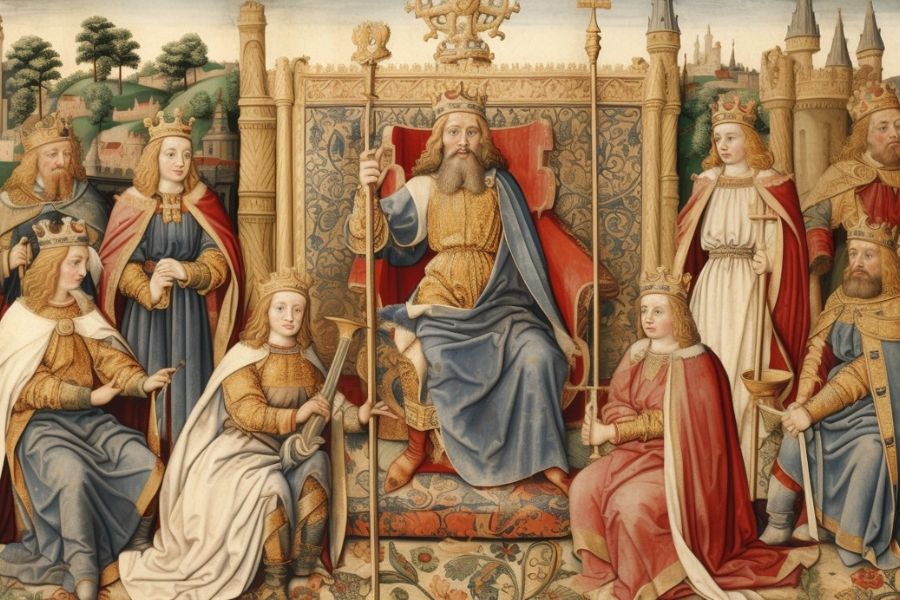
On 2 August 1100, William II went hunting in the New Forest and didn’t come home alive. An arrow loosed by Walter Tirel, or so the chroniclers decided afterward, struck him in the chest. He died on the spot. The hunting party scattered, and Tirel rode for the coast and spent the rest of his life on the Continent.
William Rufus had no legitimate children. He had two surviving brothers: Robert Curthose, the eldest, off crusading and on his way back from Jerusalem, and Henry, the youngest, who happened to be in the hunting party that day.
Henry didn’t wait. He rode straight to Winchester, seized the royal treasury, and had himself crowned at Westminster on 5 August. Three days from arrow to coronation.
Robert returned to Normandy a month later to find his younger brother wearing the crown. What followed was six years of brittle peace and then open war. Henry invaded Normandy in 1106, captured Robert at the Battle of Tinchebray, and kept him locked up for the next 28 years until he died in Cardiff Castle.
When a king died without a son, the closest man to the treasury won. Bloodline mattered, but speed mattered more.

The Anarchy: When a Woman’s Claim Wasn’t Enough
Henry I had the opposite problem from his brother. He had children, dozens of them, but most were illegitimate. His one legitimate son, William Adelheid, drowned in the wreck of the White Ship in November 1120, along with around 300 others, when the vessel hit a rock in the dark off Barfleur.
Henry had one legitimate daughter left: Matilda, widow of the Holy Roman Emperor. He made his barons swear oaths to accept her as queen. They swore. Twice. Then Henry died in December 1135 from what the chroniclers blamed on a meal of lampreys, and the barons immediately broke their oaths.
Stephen of Blois, Henry’s nephew, made the same dash for the treasury that his great-uncle Henry I had made in 1100. He was crowned within weeks.
Matilda didn’t accept it. What followed was nineteen years of civil war that the chroniclers called the Anarchy, and the phrase from the Peterborough Chronicle has stuck for nine centuries: men said openly that Christ and his saints slept.
Castles went up everywhere without royal license, mercenaries roamed the countryside, villages were torched for refusing tribute, then torched again by the other side for paying it. Matilda came within a hair of being crowned in 1141 after capturing Stephen at the Battle of Lincoln, then lost her chance by alienating the Londoners and fleeing Westminster before the ceremony.
The war ended only when both sides were exhausted, and Stephen’s own son Eustace died in 1153. The Treaty of Wallingford handed the succession to Matilda’s son, who became Henry II. Matilda herself never wore the English crown. She’d been promised it, sworn to, and then watched the kingdom bleed for two decades because a daughter, however legitimate, wasn’t a son.

Hooked on the Middle Ages? Get more stories like this one in your inbox.
Richard the Lionheart and the Mess He Left Behind
Richard I spent about six months of his ten-year reign in England. He was crowned in 1189, left on crusade in 1190, was captured and ransomed on the way home, fought a long war in France, and was killed by a crossbow bolt at the siege of Châlus in April 1199. He left no legitimate children.
The rules of succession in 1199 were not what they would later become. There were two candidates with serious claims: John, Richard’s youngest brother, and Arthur of Brittany, the twelve-year-old son of Geoffrey, the brother between Richard and John in birth order.
By the rule of primogeniture as it would harden in the next century, Arthur had the better claim, but by the rule of who was an adult man with an army nearby, John did.
John took England and Normandy. Arthur took Anjou and Maine with the backing of Philip Augustus of France. In 1202, John captured Arthur at the siege of Mirebeau, and he was held at Falaise, then moved to Rouen, and then he vanished.
The most credible account, from the chronicler William de Braose’s family, has John killing Arthur himself in a drunken rage in April 1203 and dumping the body in the Seine. There’s no proof, only the silence afterward and the speed with which John’s French barons defected to Philip.
Within two years, John had lost Normandy, Anjou, Maine, and most of Aquitaine. The Angevin empire built by Henry II collapsed in a single campaigning season. A succession that should have produced one of two legitimate kings instead produced a murdered boy, a hated brother on the throne, and the loss of half the lands the English crown had held for fifty years.

1483: Edward V and the Boys in the Tower
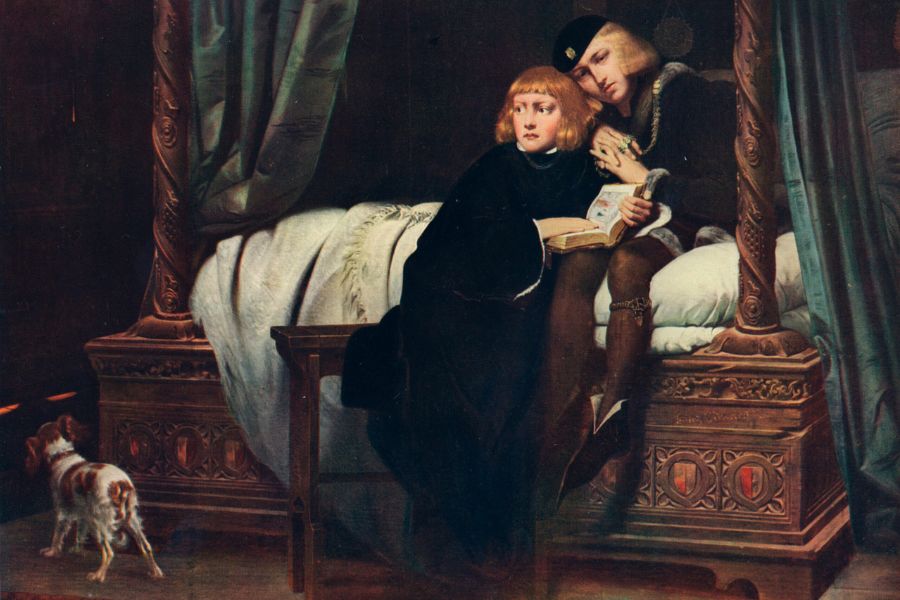
Edward IV died unexpectedly on 9 April 1483, probably of pneumonia or possibly a stroke, at 40. He left two sons. The elder, Edward V, was twelve. The younger, Richard of Shrewsbury, was nine. Edward IV’s will named his brother Richard, Duke of Gloucester, as Protector of the Realm during his nephew’s minority.
Within three months, Edward V and his brother had been declared illegitimate by Parliament on the grounds of an alleged pre-contract between Edward IV and Eleanor Butler, locked in the Tower of London, and removed from public view.
Their uncle was crowned Richard III on 6 July. The boys were last seen alive by anyone who recorded it that summer. After August 1483, nothing.
I’ve read perhaps a dozen books on the subject, and I still can’t tell you with certainty who killed them, or even whether Richard III gave the order. The most likely answer, on the balance of what survives, is that they were killed at Richard’s direction in the late summer of 1483.
The least likely answer, though some still argue it, is that they survived. What’s certain is that by October, men who’d been Edward IV’s loyalists were in open rebellion under the Duke of Buckingham, and within two years, Henry Tudor had landed at Milford Haven with 2,000 mercenaries and ended the Yorkist dynasty at Bosworth.
The failure of 1483 wasn’t a king failing to leave an heir. He left two. The failure was that a twelve-year-old wasn’t a defensible king in a country still trembling from the Wars of the Roses, and an adult brother with an army was. The same logic that put Henry I on the throne in 1100 put Richard III on it in 1483. The boys paid for it.
The Tudor Line: Three Heirs, No Future
Henry VIII spent his reign doing what every medieval king before him had done: trying to secure the succession. He just did it more loudly. Six wives, two annulments, two executions, a break with Rome, the dissolution of the monasteries, and at the end of it all, he died in January 1547, leaving three legitimate children by three different mothers and a kingdom that didn’t agree on which of them was actually legitimate.
Edward VI was nine when he inherited. He was a clever boy, raised on hard Protestant theology, and he died at fifteen in July 1553, probably of tuberculosis. On his deathbed, he tried to redirect the succession away from his half-sisters and toward his cousin Lady Jane Grey, partly from Protestant conviction and partly because his councilors, particularly the Duke of Northumberland, had everything to lose under a Catholic queen. Jane was queen for nine days.
Mary I marched on London with the support of the gentry of East Anglia, took the throne, and had Jane beheaded the following February.

Mary married Philip of Spain, tried for years to produce an heir, suffered what may have been two phantom pregnancies, and died childless in November 1558. Elizabeth I, who’d spent her sister’s reign one wrong letter away from the scaffold, took the throne at 25.
She reigned for 44 years and never married. By the 1590s, the question of who would follow her had become the loudest unspoken question in English politics. To name an heir was to invite a coup, but to name no heir was to invite civil war.
When she died on 24 March 1603, the council had already been corresponding secretly with James VI of Scotland for years. A rider left London within hours, carrying a sapphire ring as proof, and reached Edinburgh in under three days.
James came south, was crowned, and the Tudor line ended without the bloodshed that had followed every other failed succession. That ending wasn’t the natural state of English succession. It was the result of decades of careful, frightened work by men who’d watched what happened the other times, and were determined that this time would be different.
I’ve stood in the Lady Chapel at Westminster Abbey, where Elizabeth and Mary lie buried together under one monument, half-sisters who spent their lives hating each other, and the inscription that Robert Cecil chose for them is worth reading slowly: partners both in throne and grave, here rest we two sisters, Elizabeth and Mary, in the hope of the resurrection.
Love a good medieval story?
Join our readers and get tales of kings, queens, castles and ordinary medieval lives straight to your inbox.

Kylie Lang is a nationally syndicated travel journalist with bylines on the Associated Press Wire & more, a medieval history writer, and the founder and lead author of Tales of the Middle Ages (talesofthemiddleages.com). She holds a BA (Honours) in History from the University of Kent and is a member of the British Guild of Travel Writers.
Related posts:
 September 4, 925: The Day England’s First King, Æthelstan, Was Crowned, But Was He?
 Empress Matilda: Lady of the English and Queen of Ice and Snow. But Should She Have Been England’s First Queen?
 Sweyn Forkbeard: The First Viking King of England
 Empress Matilda: The Crown, the Betrayal, and the Fight of Her Life