
I’ve always felt sorry for Catherine of Aragon. She married Arthur, who didn’t seem to want to be intimate with her, and died before having the chance. She then marries his brother, and he pushes her aside. It’s hard not to get an inferiority complex when something like that happens.
I mean, based on Henry VII’s other wives, she should count herself lucky. At least she kept her head intact, which is more than can be said for Anne Boleyn and Catherine Howard.
Table of Contents
But what was her life like before, during, and after Henry? Did she lead a fulfilled life, or was she full of regret? Was her religion enough to keep her going when she was banished from court?
These are just some of the questions I had about Catherine of Aragon, so I did what I always do, and started researching to see what I could find on Henry VIII’s first wife.

Catherine’s World Before England
Catherine of Aragon was born into a position of power. Her parents were Ferdinand of Aragon and Isabella of Castile, the Catholic Monarchs who spent most of their reign uniting Spain under one crown and one religion. By the time Catherine was old enough to walk, she was trailing behind her mother’s warhorse during the final push to drive out the Moors. Granada fell when she was just six, and the victory parade through the Alhambra was the closing act of a brutal, decades-long campaign.
Catherine grew up between royal courts and military encampments. She learned Latin before she turned ten and could recite prayers, play chess, manage a household, and quote saints by name. Her mother ensured that her daughters were educated like future rulers, not mere ornaments. That meant serious study, philosophy, theology, and even some law. Her religious devotion was part of her job description.
While Catherine was busy learning to run a kingdom, her marriage was being planned across the sea. England had a new royal family on the throne after the Wars of the Roses. Henry VII needed strong alliances, and Spain was at the top of the list. In 1489, when Catherine was just a toddler, a treaty was signed to arrange her marriage to Prince Arthur, the future King of England.
Negotiations dragged on for years, and the wedding was repeatedly postponed. But both courts stayed committed. Spain needed a foothold in England. England needed Spanish gold. Catherine was the glue.
By the time she was fifteen, it was finally time to go. She left Spain in 1501 with a fleet of ships, a stack of Spanish chests, and a household full of attendants. The journey was a disaster. Her first attempt to cross the Bay of Biscay was hit by a storm so fierce that they had to turn back.
When she tried again a month later, the weather was only slightly better. The sea tossed the ships around like toys, and the sailors thought they might not make it. After weeks at sea, her ship finally made it to Plymouth on the second of October, 1501.
And this was only the beginning.

Catherine and Arthur: A Short-Lived Marriage
Catherine hadn’t even had time to settle in when the wedding planning kicked into high gear. The Tudors weren’t wasting a moment. Their first meeting was on 4 November 1501, and they were married ten days later at St Paul’s Cathedral in London. They were both just fifteen years old.
It was grand, no doubt about it. Henry VII pulled out all the stops. The cathedral was draped in Tudor red, the guest list was enormous, and the entire event was designed to showcase England’s growing power. Catherine wore a Spanish gown woven with gold and lined with ermine. Arthur wore white satin. The ceremony was conducted in Latin, and the space was packed with so many people that the crowd could barely move.
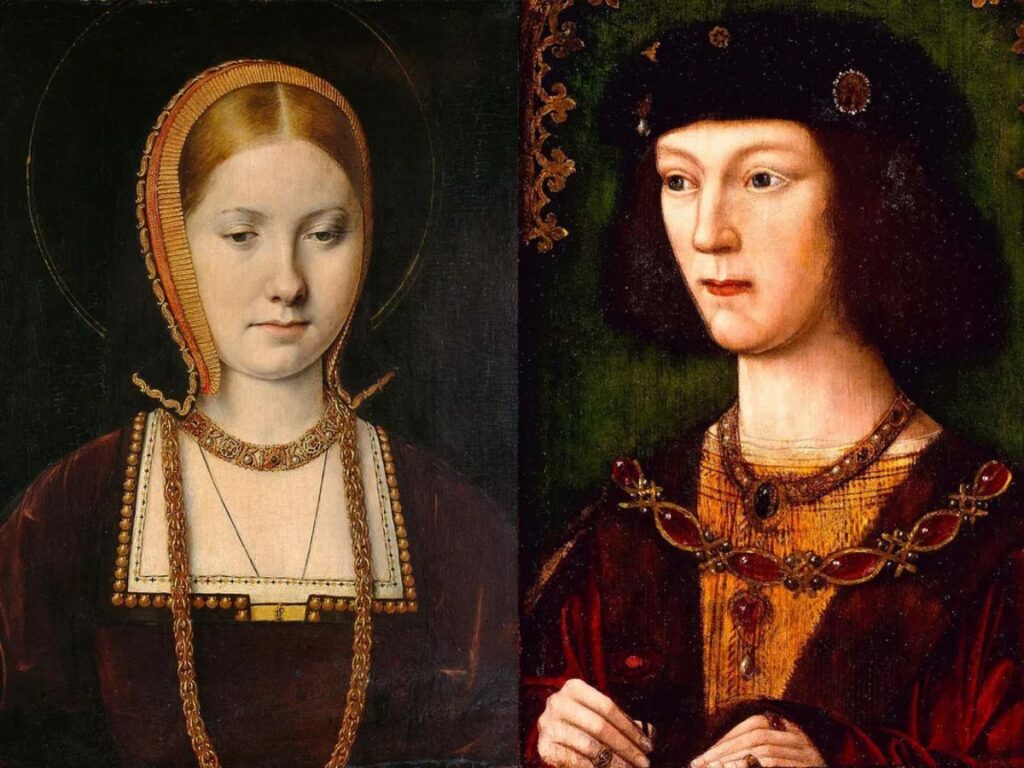
Afterward, there was the usual round of feasting, dancing, and pageantry. But what everyone really wanted to know was whether the marriage had been consummated. That question would come back to haunt Catherine for the rest of her life.
Soon after the celebrations, Arthur and Catherine were sent to Ludlow Castle in the Welsh Marches. It was cold, remote, and a long way from the courtly glamour of London. But it was Arthur’s post as Prince of Wales, and the couple were expected to set up a household and start preparing for their future roles as king and queen.
They weren’t there long. A few months after arriving, both Arthur and Catherine fell seriously ill with sweating sickness. By April 1502, Arthur was dead. He was just fifteen. Catherine recovered, but the grief hit hard. She was alone in a foreign country, widowed before she’d even unpacked properly, and everything about her future was suddenly uncertain.
The court moved fast to protect the alliance. Henry VII didn’t want to lose the Spanish dowry, and Spain didn’t want their princess sent back like unwanted goods. So Catherine stayed in England, technically still a member of the royal family, but caught in a strange kind of limbo. Her official title was Dowager Princess of Wales, but behind the scenes, plans were already shifting.
The idea of marrying her to Arthur’s younger brother, Henry, was quietly floated. It was rumored to be the brainchild of Henry’s formidable grandmother, Margaret Beaufort. She had pushed hard for the match, seeing the political value of keeping Spain on side. Henry was reportedly her favorite, though she didn’t live to see him take the throne or marry the Spanish princess she helped keep in place.


Catherine and Her Tudor In-Laws
Catherine’s relationship with Henry VII was complicated, to say the least. Politically, he wanted to keep her in England after Arthur’s death because sending her home meant giving back half of her 200,000 ducat dowry, which he had no intention of doing. For several years, he kept her in a state of financial and personal limbo, stringing her along.
She had little money, and at one point, her household staff weren’t being paid. Some reports even say she couldn’t afford basic necessities. There are letters where Catherine wrote that she felt “abandoned,” and she reportedly appealed to her father, Ferdinand, about the unfair treatment she was receiving from the English king. So while Henry VII saw her as a valuable diplomatic asset, he didn’t treat her with much warmth or generosity. He was more focused on control than compassion.
With Elizabeth of York, we know less. Elizabeth died in 1503, just two years after Catherine arrived. If they did have a relationship, it was brief and likely built around shared duty rather than personal closeness. But Elizabeth had been married young, too, and she knew what it meant to be a queen consort in a court driven by politics.
Hooked on the Middle Ages? Get more stories like this one in your inbox.
A Second Wedding, a New King, and the Hope of an Heir
When Henry VII died in 1509, his eighteen-year-old son took center stage. Henry VIII was everything his father hadn’t been: young, energetic, popular, and ready to break away from the old guard. One of his first moves as king was to marry Catherine of Aragon. After years of delays, petitions, and political limbo, he wasted no time.
They married in a private ceremony in the church of the Observant Friars just outside Greenwich Palace. Catherine was 23. Henry was still a teenager, just a few days shy of his eighteenth birthday. It was a quiet start for what would become one of the most dramatic marriages in English history.

However, the wedding didn’t take place without controversy. Under canon law, a man wasn’t supposed to marry his brother’s widow. That made Catherine’s earlier marriage to Prince Arthur a legal problem. The solution came in the form of a special papal dispensation from Pope Julius II, which permitted the match to proceed. But only because Catherine swore that her first marriage had never been consummated. She maintained that claim for the rest of her life. Without it, she and Henry wouldn’t have been allowed to marry at all.
Initially, things appeared promising. Henry called her his “beloved wife,” and Catherine finally had the crown she’d waited nearly a decade to wear. She settled into her role quickly. People admired her for her poise, her education, and her faith. She spoke Latin with the scholars, prayed with the priests, and carried herself like she’d always been meant to rule.
Less than a year later, in January 1511, Catherine gave birth to a son, Prince Henry, Duke of Cornwall. It was exactly what England had been hoping for. Church bells rang, bonfires were lit, and the streets filled with celebration. Henry was thrilled. He had a son. The Tudor dynasty finally had its future.
But the joy didn’t last. The baby died just seven weeks later.
Loyalty, Loss, and Leading the Kingdom
Catherine’s early years as Henry’s queen were anything but quiet. Beyond the royal dinners and court appearances, she was dealing with constant pregnancies, diplomatic expectations, and a king who was always looking for ways to prove himself on the battlefield. Life wasn’t all pearls and pageantry.
Back in 1507, before she even married Henry, Catherine had already made history. While still in England and waiting for her future to be decided, she served as an ambassador for the Spanish Crown. That made her the first female ambassador in European history.
She negotiated directly with Henry VII’s court on behalf of her father, Ferdinand of Aragon. It wasn’t a ceremonial title either; she actually handled correspondence, political issues, and kept the Spanish-English alliance on track. She was young, sharp, and completely outnumbered in a world dominated by men, but she held her ground.
A Queen, a Wife, and a Mother
Catherine became pregnant six times during their marriage. Two of those pregnancies resulted in sons, but neither lived longer than a few months. One died after just 52 days. The others were stillborn or died shortly after birth. Only one child survived: their daughter Mary, born in February 1516. She would later become Mary I of England, half-sister to Elizabeth I.
Each loss took a toll. Catherine remained devoted, keeping her pain private, but there’s no question the endless cycle of hope and heartbreak shaped her life. Still, she stayed focused on her role as queen and as Henry’s partner. For a time, their marriage was strong. He admired her intelligence and trusted her judgment. She was more than just a consort; she was his political equal.
The Battle of Flodden and a Queen in Command
In 1513, Henry went off to fight in France, and Catherine was left in charge of the kingdom. As Regent, or Governor of England, she was responsible for making real decisions. And she didn’t hesitate.
When King James IV of Scotland declared war and marched south, Catherine responded immediately. She ordered Thomas Lovell to raise troops in the Midlands, and then rode north to address the soldiers. She was heavily pregnant at the time. It didn’t stop her. Although naturally, she didn’t fight in the battle.

The English army crushed the Scots at the Battle of Flodden. James IV was killed, the last British monarch to die in battle, and Catherine sent a piece of his bloodied coat to Henry as a souvenir. It was her way of showing him she had handled it. No panic, no chaos. Just victory.
This was the version of Catherine that history sometimes forgets. Not the heartbroken wife of later years, but a queen who led from the front, managed her duties with sharp focus, and held the kingdom together while her husband chased glory abroad. For a while, it looked like nothing could shake her place beside him. But Henry was only just getting started.
Affairs, Ambition, and Anne Boleyn
For all Catherine’s loyalty, Henry wasn’t exactly a faithful husband. His wandering eye became common knowledge at court. There were mistresses before Anne Boleyn ever entered the picture, and Catherine was expected to look the other way. That was just how things worked.
The most well-known of his early affairs was with Bessie Blount, one of Catherine’s ladies-in-waiting. It lasted several years and wasn’t just gossip. Bessie gave birth to a son in 1519. He was named Henry FitzRoy and openly acknowledged by the king. That detail mattered. Henry had proved he could father a healthy son. So if no living heir came from his marriage, it couldn’t be his fault. That idea would come back in full force later.

Catherine didn’t make a scene. She never confronted Henry publicly or caused a scandal. Instead, she kept to her duties, leaned on her faith, and protected her daughter Mary’s place in court. However, the strain was evident, and it was intensifying. With every failed pregnancy and every mistress he took, the gap between them widened.
Enter Anne Boleyn
By the mid-1520s, Anne Boleyn was making waves at court. She wasn’t the typical royal mistress. Anne was clever, ambitious, and refused to play by the usual rules. Unlike her sister Mary, who had already been one of Henry’s lovers, Anne wouldn’t sleep with the king. Not unless she had a crown in exchange.
That’s what made her different and dangerous.
Henry became obsessed. Letters from him to Anne survive, and they’re filled with longing, jealousy, and promises. He wrote that he would wait years to be with her. And he did. What started as a flirtation turned into a full-blown plan to replace his queen.
Henry began pushing for an annulment and dispensation from the Pope, Julius II. His argument was built around canon law, that it had been wrong to marry his brother’s widow in the first place. Even though Catherine had sworn under oath that her marriage to Arthur had never been consummated, Henry now claimed it had. The same church he’d leaned on for permission to marry Catherine was now the obstacle in his way.
Catherine refused to step aside. She saw her marriage as valid in the eyes of God, and she wasn’t going to give it up quietly. The more she resisted, the more determined Henry became to be rid of her.
What followed was a slow-motion campaign to remove Catherine from court, erase her influence, and clear the path for Anne. And Catherine, who had once been at the center of everything, was about to find herself pushed further and further to the edges of Henry’s kingdom.

Holding Her Ground
As Henry’s obsession with Anne Boleyn grew, his campaign to get rid of Catherine kicked into full gear. But Catherine didn’t back down. For years, she stood firm and refused to accept that her marriage was over. She kept her own court, continued to call herself queen, and made it clear that she would never recognize Anne as Henry’s wife. For Catherine, it was her marriage, her faith, and her daughter’s legitimacy on the line.
The Legatine Court and That Famous Walkout
In 1529, after years of back-and-forth, Henry finally brought the matter to a public hearing. A special court was held at Blackfriars, with Cardinal Wolsey and Cardinal Campeggio presiding. The goal was simple: declare the marriage invalid and clear the way for Henry to marry Anne.
Catherine showed up, dressed in black, and delivered one of the most powerful speeches of her life. She stood before the court and reminded everyone, including Henry, that she had been his lawful wife for over twenty years. She said she had come to England as a virgin, and that she had always been faithful. Then, without waiting for a reply, she walked out of the room and refused to return.
It was a mic-drop moment. The court didn’t rule in Henry’s favor. Instead, the decision was kicked back to Rome, where it stalled. Henry was furious. Catherine had bought herself time, but the pressure was only getting worse.
Life in Limbo
Even after the court failed to give Henry what he wanted, Catherine’s position kept slipping. In 1531, she was formally banished from court and separated from Mary. She was sent away to smaller, more isolated estates; first The More, then Buckden Palace, and finally Kimbolton Castle. Her household was slashed. Her resources were cut. Henry even controlled who could visit her.
Still, she refused to give in. Catherine continued to sign her letters “Katharine the Queen” and insisted on being addressed properly. She prayed daily, kept in touch with her supporters in England and Spain, and wrote often to her nephew, Charles V, the Holy Roman Emperor. She begged him to pressure the Pope to defend her cause, and he did, though nothing moved fast enough to help.
One of the most telling moments came in a letter she wrote to Henry. “Mine eyes desire you above all things,” she said. It was both tender and heart-wrenching, but even in that letter, she refused to step aside. She was Henry’s wife in the eyes of God, and that would never change.
Catherine’s Final Chapter
By late 1535, Catherine’s health was failing. She was living at Kimbolton Castle, a damp and drafty old place in Cambridgeshire, far from the court she once ruled and the daughter she was no longer allowed to see. Her household had been stripped down to a handful of loyal servants. She was ill, isolated, and still refusing to accept anything less than her title as queen.
In January 1536, she knew the end was near. She asked to be buried in a Franciscan habit, a final gesture of humility and faith. She wrote one last letter to Henry, still calling him “my most dear lord and husband,” forgiving him and asking him to care for their daughter. It was a quiet, dignified goodbye from a woman who had spent her life doing everything in her power to hold her place, even when the world shifted around her.
Catherine of Aragon died on January 7, 1536. She was 50 years old.

Henry didn’t attend the funeral. Neither did Mary. Catherine was buried at Peterborough Abbey, now Peterborough Cathedral, far from Westminster or Windsor, the usual resting places of English queens. She was given a ceremony fit for a princess, not a queen. For years, her grave was modest and overlooked. But people never forgot her. Visitors still leave pomegranates, her personal emblem, on her tomb.
Today, above her grave, a simple inscription reads:
“Katharine Queen of England.”
Because, no matter how the politics played out, that’s exactly what she was.

Love a good medieval story?
Join our readers and get tales of kings, queens, castles and ordinary medieval lives straight to your inbox.

Kylie Lang is a nationally syndicated travel journalist with bylines on the Associated Press Wire & more, a medieval history writer, and the founder and lead author of Tales of the Middle Ages (talesofthemiddleages.com). She holds a BA (Honours) in History from the University of Kent and is a member of the British Guild of Travel Writers.
Related posts:
 Did They or Didn’t They? Was Catherine of Aragon Still a Virgin When She Wed Henry VIII?
 King Arthur’s Dark Side: 7 Shocking Decisions That Almost Destroyed His Kingdom
 The Story of Anne of Cleves Henry VIII’s Reject Queen: Too Plain for a King, Too Clever for Court
 What History Got Wrong About Mary Boleyn: The Forgotten Sister of Anne, Mistress, Mother, Survivor