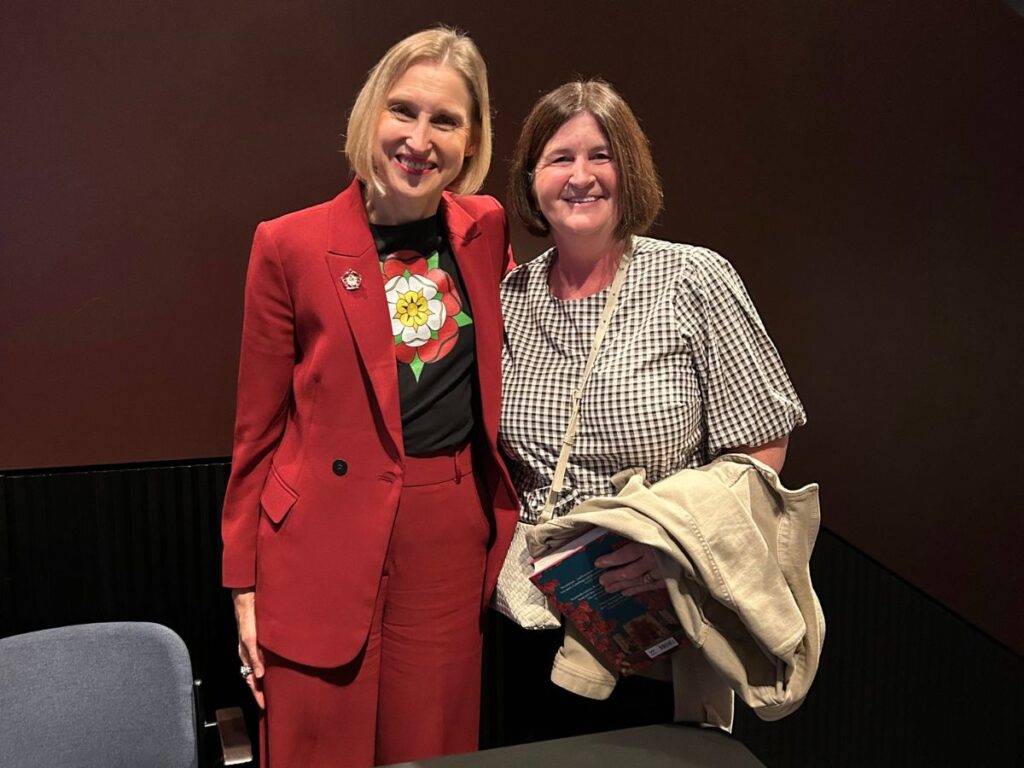
I just got home from an evening with Tracy Borman, and it was fabulous. Her show, Tudors on Tour, is part history talk and part stand-up comedy, and a packed theater in Hertford hung on her every word.
Tracy Borman, Chief Historian at Historic Royal Palaces, spent a part of the show busting the most repeated Tudor myths about some of our favorite Tudors, from villains to virgin Queens.
Table of Contents
She’s worked at Hampton Court Palace for almost 19 years, and has a gift for turning dull facts into exciting pieces of history you can’t help but lap up.

10 Busted Myths from Tracy Borman’s Show, Tudors on Tour
These are the ten myths Tracy busted for us on Tudors on Tour, and I’ve kept her stories as close to how she told them as I can.
Was Henry VII Really a Miser?

Ask most people what they know about Henry VII, and you’ll get one word: stingy. He’s the Ebenezer Scrooge of the Tudor family, the king who checked the royal accounts himself.
He went through his account books with a fine-tooth comb and initialed every single line, so he knew where every penny went. But knowing where your money goes isn’t the same as being afraid to spend it.
When Tracy researched Henry VII, she found that in the first two years of his reign he spent the equivalent of £3 million on his wardrobe alone. That’s a fair whack for a man who supposedly pinched every penny.
He spent money when he judged it would pay off, and for a king who’d won his crown on a battlefield, looking the part was worth every coin.
Was Henry VIII Really a Fearless Tyrant?
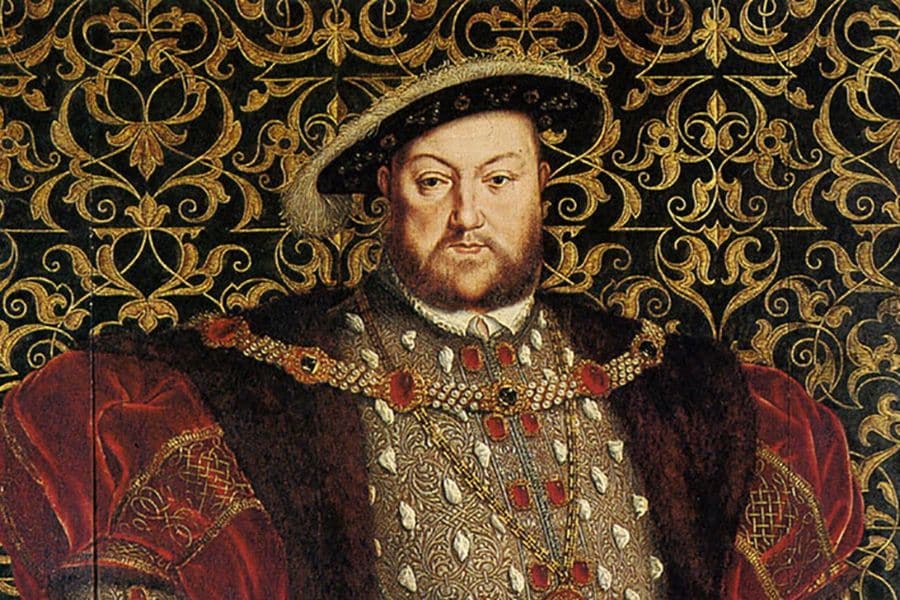
Henry VIII was a tyrant; there’s no arguing with that. In public he was the picture of kingly confidence, legs planted wide and hands on hips, just as Hans Holbein painted him. In private, Tracy says, he was a very different man.
One visitor to his privy chamber described him as the most timid man you could hope to meet. You don’t often hear the word timid and Henry VIII in the same sentence. But what the visitor was referring to was the king’s hypochondria.
Henry had good reason to fear illness. His elder brother Arthur, Catherine of Aragon‘s first husband, died suddenly in 1502 at just 15.
Their mother, Elizabeth of York, died the following year. Henry grew up knowing life could be short, and he was determined that his wouldn’t be.
Every morning a team of royal physicians examined him. He even kept his own medicine cabinet, and the inventory of his privy chamber lists one potion without saying which part of the royal body it was for. The mind boggles.
The Jousting Accident That Changed Everything
Until 1536, Henry was an elite sportsman. He hunted, jousted, and played tennis, and Tracy says he was a world-class tennis player. Then a serious jousting accident in January 1536 left him with leg wounds that turned into ulcers, and he lived with the pain for the rest of his life.
He couldn’t exercise anymore, but he kept eating the way he always had. Tracy puts it at around 5,000 calories a day, roughly twice what’s recommended for a man today.
The weight piled on, it pressed on his ulcerated legs, and the whole thing became a vicious circle. A diet heavy in red meat and red wine had another side effect too, and that’s where the evening got a little earthy.
The Groom of the Stool and the Royal Enema
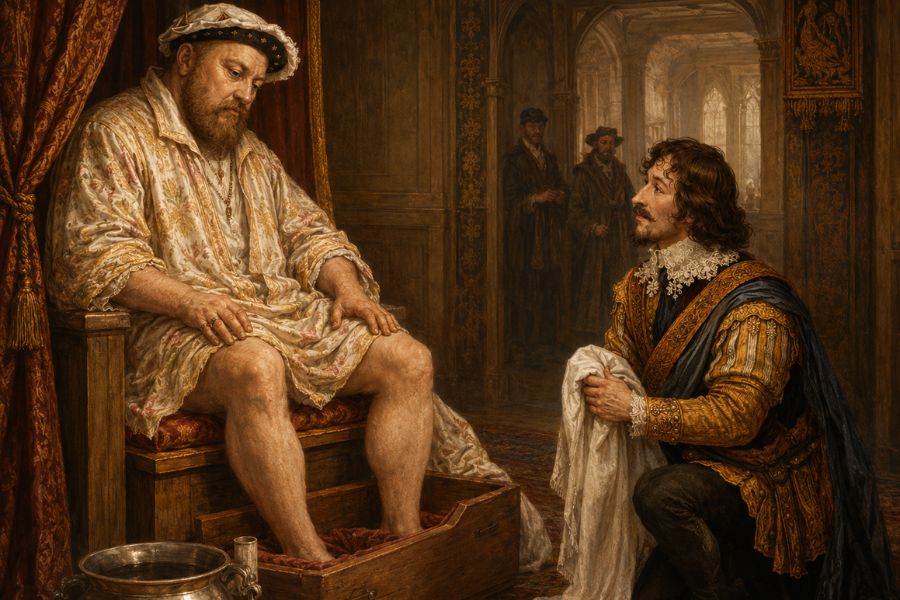
By 1539, Henry was badly constipated and in a foul temper, and he took it out on the man closest to the problem, his Groom of the Stool. This courtier attended the king on his close stool, stood beside him while he did his business, and wiped him clean afterward.
It sounds like the worst job at court, but, believe it or not, it was one of the most sought-after. To get ahead at the Tudor court you needed access to the king, and nobody had more of it than the Groom of the Stool. As Tracy put it, he had a captive audience, so to speak.
In 1539, the job belonged to one Thomas Heneage, and boy did he have to earn his position. After several days of constipation, Henry blamed poor Thomas. Desperate to save his own backside, Thomas came up with an idea for relieving the king.
His answer was an enema, which, after seeing it when Tracy brought a replica on stage, did look like a sort of exhaust with an extremely long tube
Thomas filled the canister with two pints of salted water, inserted it in the royal bottom, and kept it in place for two hours.
Afterward, he reported that the king had enjoyed a “fair siege,” but admitted His Majesty had felt some soreness ever since. We know this because Heneage wrote down the whole procedure.
Was Jane Seymour Really Henry VIII’s Favorite Wife?
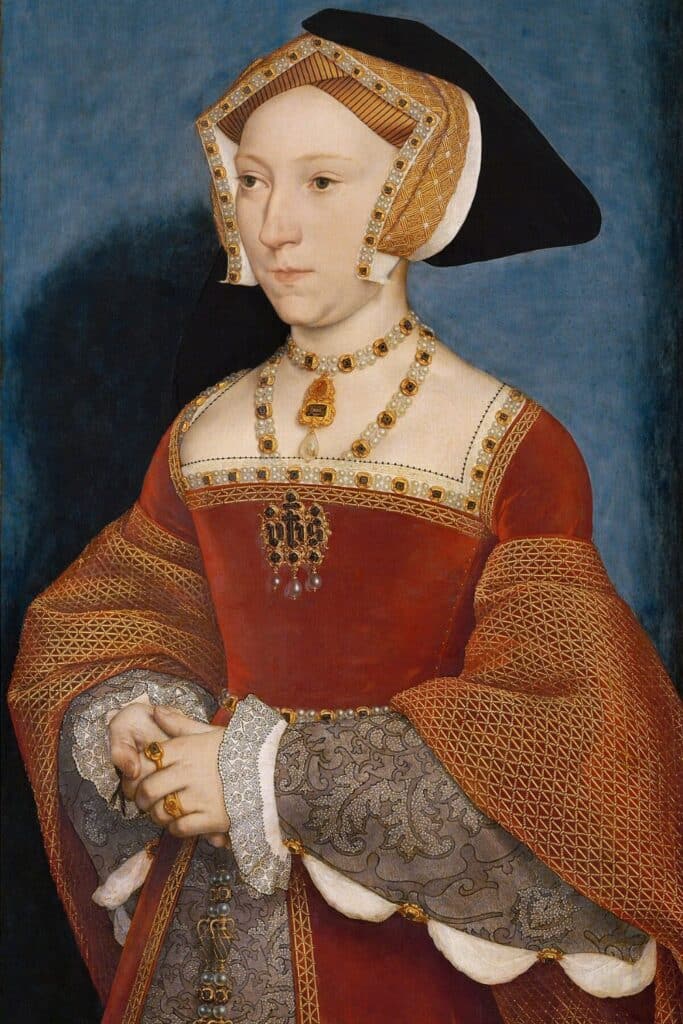
You hear it all the time. Jane was the one Henry loved most. He had her painted into family portraits long after she died, and he chose to be buried beside her at Windsor Castle.
Tracy doesn’t buy it. Jane Seymour gave Henry the son he’d waited so long for, so he wanted history to remember her as his favorite.
Just weeks after the wedding, he was heard complaining that he hadn’t chosen someone better looking. A week after Jane died following Edward’s birth in October 1537, he was said to be in the best of spirits.
And that isn’t the only thing. She wasn’t the meek, mild “plain Jane” of legend either. Tracy says new research shows a very different woman, and that Jane wanted cold, hard cash most of all.
Jane was one of ten children, so she grew up well down the family pecking order. When the chance to become queen came along, she grabbed it and set out to make the most of it. Her plan was simple. She wanted to get rich.
Courtiers did what courtiers always did with a new queen and showered her with gifts. Silver-gilt bowls, embroidered gowns, all the lovely things you’d expect. Jane would thank them politely, but Tracy says she made it clear she’d rather have the money.
The proof is in the New Year’s gift rolls. The Tudors swapped presents at New Year, not Christmas, and Jane only lived to see one New Year as queen. The list shows Henry receiving all sorts of weird and wonderful treasures. Next to Jane’s name, it’s money, money, money.
Next to her feisty predecessor Anne Boleyn, Jane has been badly underrated. She wasn’t a quiet mouse at all. She knew exactly what she wanted.
Hooked on the Middle Ages? Get more stories like this one in your inbox.
Was Anne of Cleves Really Ugly?

No evidence from the time, apart from Henry’s own disgust, suggests Anne was anything but pleasant-looking.
Holbein painted her, and Holbein was famous for not flattering anyone. Tracy describes his portraits as more like photographs than paintings. If he’d made Anne prettier than she was, it would have been completely out of character.
So what went wrong? Henry did. On New Year’s Day 1540, he rode to Rochester in disguise to surprise his bride. In the chivalric tales he loved, a true love would always see through a disguise. He burst into her chamber, marched up to her and kissed her on the lips.
Anne had no idea who this stranger was, and slapped him. When he revealed who he was, Anne couldn’t hide her shock. Henry never got over the humiliation and blamed Anne for it.
You also have to remember that by this time, Henry had gained 17 inches around his waist in about five years. If anyone in that marriage was unattractive, it wasn’t Anne.
The match that Thomas Cromwell had pushed for was annulled after six months, and Anne of Cleves walked away rich, respected, and free of him.
Was Anne of Cleves Pregnant Before She Came to England?
Henry claimed he couldn’t consummate the marriage because Anne’s body didn’t look like a maiden’s. Tracy calls it pure propaganda, a way to blame Anne and blacken her name.
There’s no evidence for any of it, and certainly none for a secret love child.
Was Edward VI Always Weak and Sickly?
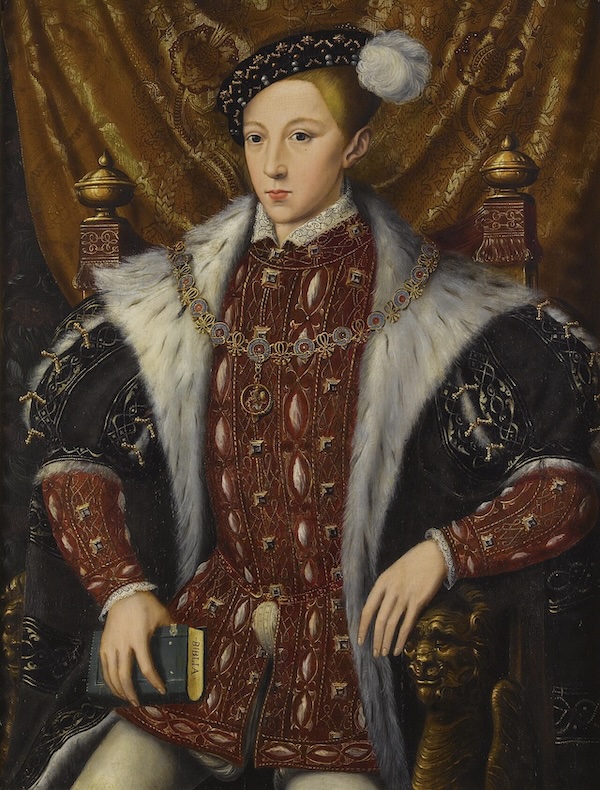
Edward VI died at 15, so we picture a pale, sickly boy, but that wasn’t the case, certainly not before he fell ill. As a baby, he was described as well fed, which more than likely was code for chubby.
He grew into a strapping, sporty young man like his father, and he only fell seriously ill near the end of his short life.
Was Lady Jane Grey Really the Nine Days Queen?

Tracy joked that she’s terrible at math; we have that in common, but even she can tell this one doesn’t add up.
Edward VI died on July 6, 1553, and a new reign always begins the moment the old monarch dies. Edward had named his Protestant cousin Jane as his heir, so she became queen that day. Mary didn’t unseat her until July 19.
That’s 14 days, not nine. The nine-day count starts from Jane’s public proclamation on July 10. Tracy introduced Jane as the Liz Truss of the Tudors, an excellent comparison.
She also thinks we should call her Queen Jane. Edward VI named Jane as his heir in his “Device for the Succession,” and she was proclaimed queen, so for those few days she was the lawful Queen of England.
Once Mary took the throne, her supporters had every reason to play that down. Reducing Jane to plain Lady Jane Grey made her look like a usurper rather than a queen, and the name has stuck for nearly 500 years.
Jane was executed at the Tower of London in February 1554, aged just 16 or 17.
Was “Bloody Mary” the Bloodiest Tudor?
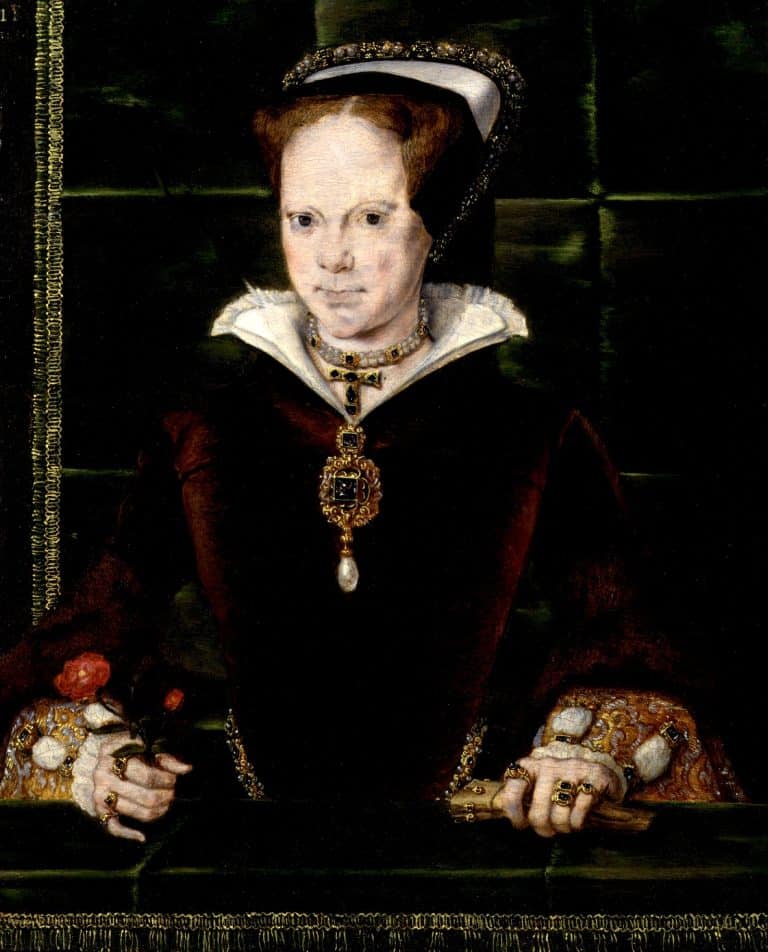
No. Count the deaths each monarch ordered, and Henry VIII comes out far ahead of his daughter.
Mary earned it because of how her victims died. She came to the throne in 1553 determined to return England to the Roman Catholic faith after the upheaval of her father’s and brother’s reigns.
Anyone who refused to conform faced being burned at the stake. Around 280 Protestants died this way during her five-year reign, and the horror of it shocked even her Catholic subjects.
Then she did something her people found even harder to forgive. She married a Spaniard. Mary’s subjects deeply distrusted foreigners, and the idea of Philip II of Spain as their king was beyond the pale.
They feared England would become little more than a satellite of the Spanish Empire, and in early 1554 Thomas Wyatt the Younger led a rebellion against the match.
Mary married Philip anyway, and it wasn’t a match made in heaven. He never warmed to his English wife and spent most of their short marriage abroad. Mary longed for a child to carry on her work, but none came.
When she died in November 1558, childless and heartbroken, she named her heir the one person she’d hoped would never undo her work: her Protestant half-sister Elizabeth.
Was Mary I Really a Bore?
Pious, joyless Mary isn’t the whole story either. Thanks to her burning of Protestants and her intense devotion, she hasn’t gone down in history as the most fun-loving Tudor. But just as with her father, Tracy says the private Mary looks very different from the public one.
Mary enjoyed a tipple. One scandalized ambassador who attended an evening gathering at her court reported that the queen and her courtiers drank more that night than would fill a great river. It seems Mary was quite the party girl.
She had other pleasures too. Mary loved music and played the virginals and the lute, and she adored fine clothes and jewels. Her household accounts show she liked a game of cards and wasn’t shy about losing money on it. None of that fits the grim, black-clad figure we’ve all been taught to picture.
Was Elizabeth I Secretly a Man?
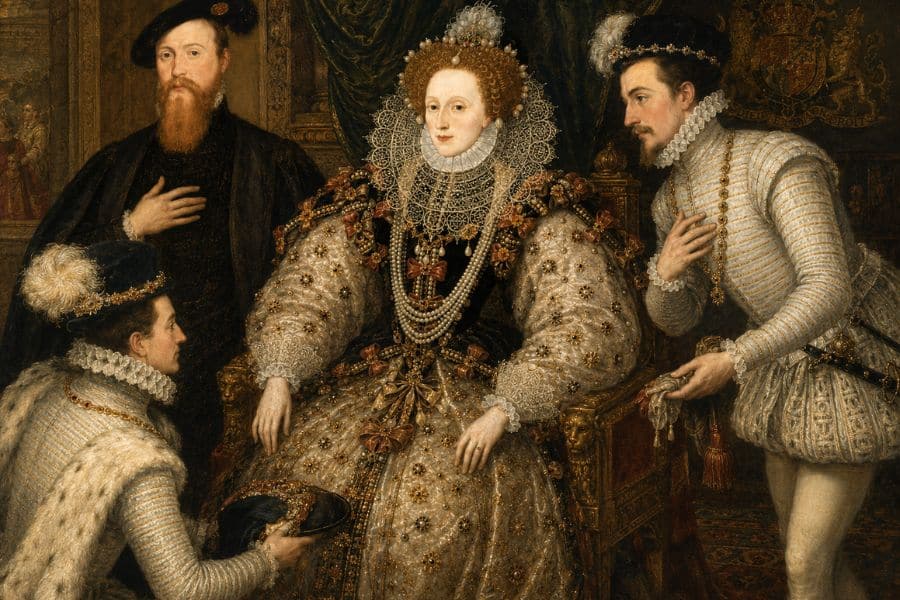
This is the Bisley Boy legend that did the rounds, and you can’t help but smile. When Elizabeth was nine, the story goes, she was sent to the village of Bisley in the Cotswolds to escape the plague in London. According to this story, she caught it anyway and died.
Her terrified attendants were completely panic-stricken. How could they tell Henry VIII his daughter had died? Well, they couldn’t, so they had to come up with something fast. So they searched the village for a red-haired child they could use as a replacement.
The only red-headed child they could find was a boy, so they did what any self-respecting attendant, in fear for their life, would do: they put him in a dress. That, the legend says, is why Elizabeth never married, never had children, and, more importantly, why she was so successful. Because she wasn’t a she, she was a man!
The tale became widely known after Bram Stoker, the author of Dracula, included it in his 1910 book Famous Impostors, and there’s no evidence for any of it.
Did the Tudors Smell?
I think we all get the impression that anyone from another century stinks to high heaven because they didn’t wash. Granted, the Tudors didn’t bathe often, because they believed hot water opened the pores and let infection in. But they didn’t stink.
They handled it differently. Instead, they changed their linen underwear, sometimes up to three times a day. Linen draws sweat and dirt away from the skin, so changing it often kept them surprisingly fresh.
Tracy told us about a fellow historian who tried it for three months and swore she still didn’t smell.
Elizabeth I was considered to be dangerously keen on bathing by the standards of her day. She’s often credited with saying she took a bath once a month “whether she needed it or not,” though nobody has found proof she ever said it. Her teeth, sadly, were another matter.
Did Elizabeth I Name James VI as Her Heir?
For 400 years we’ve been told that Elizabeth named James VI of Scotland as her heir on her deathbed, almost with her last breath. It turns out that scene may never have happened.
Elizabeth never married and never had a child, and for 44 years she refused to name a successor. Parliament begged her, and her people worried, but she wouldn’t budge.
During her sister Mary’s reign, Elizabeth had been the obvious heir. That made her a figurehead for everyone who opposed Mary, and it put her in real danger. She knew exactly what an heir could become. Tracy says Elizabeth was clear that the minute she named one, she would create a rival, and she had no intention of putting herself where Mary had been.
The famous version of Elizabeth’s death comes from William Camden, her earliest biographer. He was writing a history of her reign while she was still alive. His published account describes her dying at Richmond Palace in March 1603.
Her councilors gathered around her bed and asked who should succeed her, and with almost her last breath she declared that it should be the King of Scots.
James was the son of her old rival, Mary, Queen of Scots. In Camden’s version, Elizabeth hands him the crown herself, and the Stuarts take over from the Tudors exactly as she wished.
That’s the story painters loved too. Tracy showed us Paul Delaroche’s painting of Elizabeth’s death, which shows James kneeling at her bedside. He was 400 miles away in Edinburgh at the time, but why would we let a little detail like that get in the way of a good painting.
Camden’s handwritten drafts of his history survive at the British Library, and in 2023 they gave up their secret. A team led by Oxford researcher Helena Rutkowska used transmitted-light imaging to read text pasted over and hidden for 400 years. The paper had been glued down so firmly that nobody could lift it without destroying the page.
Underneath were Camden’s original words. In his first version, Elizabeth died without naming anyone. The deathbed scene wasn’t there. They added it later, after James became king, to put words in Elizabeth’s mouth and make his succession seem like her choice.
The British Library’s experts added that Elizabeth was probably too ill to speak in her final hours, and no other evidence supports the famous scene.
The hidden pages had more surprises. Camden had first recorded the confession of a man named Valentine Thomas, who claimed James had sent him to murder Elizabeth. In the version that went to print, that became a vague accusation that James bore the queen “ill affection.”
Tracy believes James was behind the changes. He had good reason to want them. Henry VIII’s will had cut the descendants of his sister Margaret Tudor, James’s great-grandmother, out of the succession, so James’s claim was shaky in law.
He was simply the quickest off the mark to take the throne. A story of Elizabeth choosing him on her deathbed was exactly the backing he needed.
Tracy’s book The Stolen Crown uncovers more.
FAQs
Was Lady Jane Grey Queen for Nine Days?
No, Lady Jane Grey was queen for 14 days, not nine. A new reign starts when the previous monarch dies, and Edward VI died on July 6, 1553. Mary I unseated Jane on July 19. The famous nine days count only from Jane’s public proclamation on July 10, which is why Tracy Borman argues we should call her Queen Jane.
Was Anne of Cleves Ugly?
No, there’s no evidence Anne of Cleves was ugly. The only complaint from the time came from Henry VIII after their disastrous first meeting at Rochester on New Year’s Day 1540, when she failed to recognize him in disguise. Hans Holbein, who painted her, was known for not flattering his sitters, and his portrait shows a pleasant-looking young woman.
Who Was the Bloodiest Tudor Monarch?
The bloodiest Tudor monarch by number of deaths was Henry VIII, not Mary I. Mary earned the name Bloody Mary because around 280 Protestants were burned at the stake during her reign from 1553 to 1558. The method shocked people, but Henry ordered far more executions over his much longer reign.
Did Elizabeth I Name Her Successor?
Elizabeth I may never have named her successor. The famous deathbed scene in which she names James VI of Scotland comes from William Camden’s history of her reign. According to Tracy Borman, Camden’s original manuscript at the British Library shows Elizabeth dying without naming an heir, and the scene was rewritten after James became king.
Did the Tudors Smell Bad?
No, the Tudors probably didn’t smell as bad as we imagine. They rarely bathed because they feared hot water let disease into the body, but they changed their linen underwear often, sometimes three times a day. Linen draws sweat and dirt away from the skin, which kept the body fresher than you might expect.
Love a good medieval story?
Join our readers and get tales of kings, queens, castles and ordinary medieval lives straight to your inbox.

Kylie Lang is a nationally syndicated travel journalist with bylines on the Associated Press Wire & more, a medieval history writer, and the founder and lead author of Tales of the Middle Ages (talesofthemiddleages.com). She holds a BA (Honours) in History from the University of Kent and is a member of the British Guild of Travel Writers.
Related posts:
 The Execution of Lady Jane Grey: The Teenager Crowned Queen and the Nine Days That Sealed Her Fate
 For Jane Seymour the Most Dangerous Place in England Was Henry VIII’s Bedchamber
 What History Got Wrong About Mary Boleyn: The Other Boleyn Sister Who Outlived Them All
 The Rise and Fall of Anne Boleyn: Power, Passion, and Politics