Given who King Henry VIII was and how he bulldozed his way through English history, you’d expect a tomb with the pomp befitting the man buried there. But no, Henry VIII was buried in St George’s Chapel at Windsor, under a black marble slab you could easily miss.
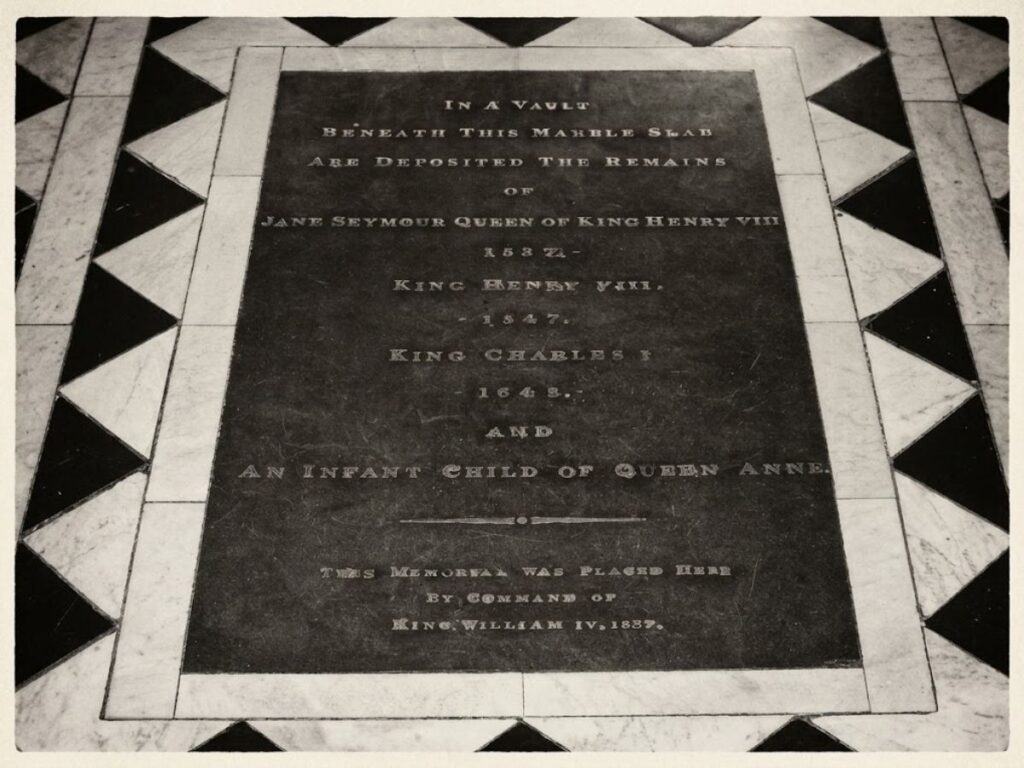
Henry VIII lies in a vault beneath that stone, sharing it with his third wife, Jane Seymour; the executed King Charles I; and an infant child of Queen Anne. There’s no effigy, no canopy, no life-size bronze king on horseback. A plain ledger, laid in 1837 by order of William IV, is the whole memorial.
Table of Contents
So how did a king like that end up with so little and nothing like the splendid tomb Henry had planned?
Where Is Henry VIII Actually Buried?
Henry VIII was interred beneath the quire of St George’s Chapel at Windsor Castle on February 16, 1547, about 19 days after he died at Whitehall Palace on January 28. He lies alongside Jane Seymour, the only one of his six wives to give him a surviving legitimate son, and the one he asked in his will to be buried beside.
The vault itself is sealed under the floor and invisible to visitors. At the center of the quire, you see a black marble ledger stone naming the four people below: Jane Seymour, King Henry VIII, King Charles I, and an infant child of Queen Anne.
William IV is credited at the bottom because they didn’t lay the slab until his reign, almost 300 years after Henry’s funeral.
Henry isn’t at Westminster Abbey. His parents, Henry VII and Elizabeth of York, lie there in the Lady Chapel under one of Europe’s finest tombs. Henry chose Windsor.
Westminster Abbey confirms his burial date at St George’s on February 16, 1547, with his coffin carried from Whitehall to Windsor on February 14 after lying in state. The procession stretched four miles and took two days to cover the 20-odd miles to the castle.
Why Does Henry VIII Have No Tomb?
Henry VIII has no tomb because the one he commissioned was never finished, and the pieces that did exist were stripped and sold off generations after his death. The vault under the quire was meant only as a holding place while the real monument was built.
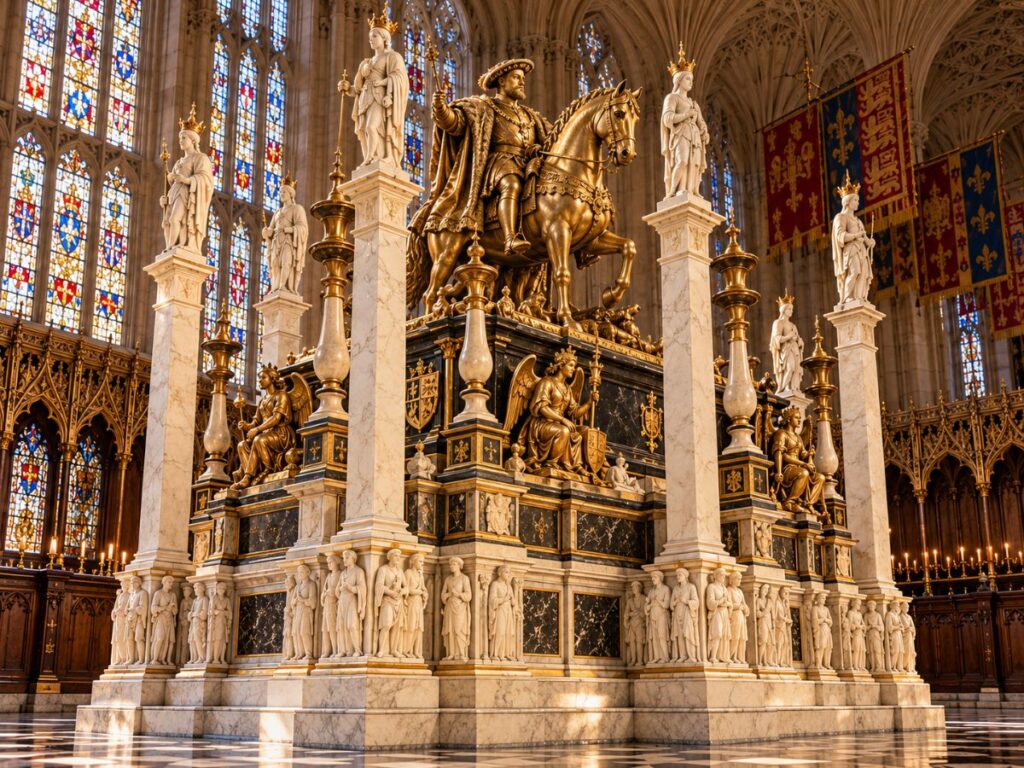
Plans drawn up during his reign called for a vast memorial with a bronze effigy of the king on horseback under a triumphal arch, and 134 statues of prophets, angels and apostles ranked around the structure.
It would have dwarfed anything in England. It was designed to put his parents’ tomb at Westminster in the shade.
Three of his children inherited the problem of finishing it. Edward VI came to the throne as a nine-year-old, with a treasury wrecked by his father’s wars and the Dissolution’s one-off windfall already spent.
Mary I had other priorities and a short reign. Elizabeth I moved some of the pieces to Windsor in 1565 and seems to have intended to complete the project, but she never did.
By the time the Tudors were gone, so was any political will to spend money on a Catholic-looking Renaissance monument to a king whose religious legacy was still being argued over.
Jennifer Loach’s study of Henry’s funeral ceremonial in Past and Present shows how carefully the burial itself was choreographed, with the lying-in-state, the procession and the requiem Mass all staged on a scale fit for a king who still thought of himself as Catholic in his personal piety. The ceremonial was finished. The tomb was not.
Hooked on the Middle Ages? Get more stories like this one in your inbox.
The Tomb Henry VIII Stole From Cardinal Wolsey
The centerpiece of Henry’s planned tomb was Cardinal Thomas Wolsey’s, seized after Wolsey’s fall from favor in 1529.
Wolsey had been building himself a Renaissance tomb worthy of a prince of the church. Around 1524, he hired the Florentine sculptor Benedetto da Rovezzano, one of the best Italian craftsmen working in England, to design a monument in black touchstone and white marble, with four bronze angels standing at the corners.
Work on the sarcophagus had already started when everything went wrong for Wolsey. He couldn’t get Henry the annulment from Katherine of Aragon he wanted so badly, and in 1529 he lost his offices. A year later, he was arrested for treason and sent south to London. He never got there. He fell ill on the way and died at Leicester Abbey in November 1530.
Henry simply took the lot. The sarcophagus, the base, the bronze angels, Benedetto himself, all absorbed into a royal project to produce something grander than any cardinal would have dared commission.
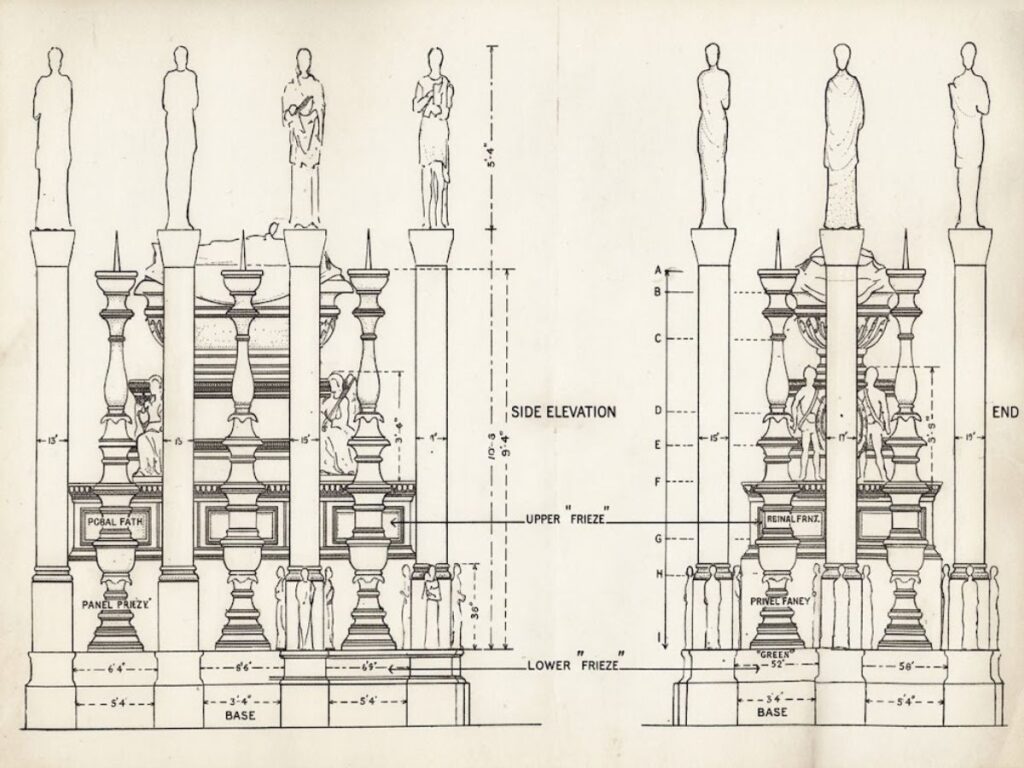
The king added four bronze candlesticks nearly 9 feet tall, among other elements, and the design kept inflating. The last recorded payment to Benedetto was in 1536. After that, the work seems to have stalled.
By 1547 Henry was dead, with a half-finished tomb in storage and a vault under the quire that was supposed to be temporary.
As the College of St George’s own account of the tomb puts it, Henry’s vision was never built; what did exist was already a hybrid: a cardinal’s sarcophagus with a king’s additions, assembled from Italian stone and English ambition, and unfinished by either.
What Happened to Henry VIII’s Tomb Pieces?
The pieces were scattered, melted down, sold, misplaced, and in a few cases rediscovered centuries later in places nobody would have predicted.
Elizabeth I had the components moved to Windsor in 1565, where they sat waiting for a completion that never came. During the Commonwealth period after Charles I’s execution, Parliament needed money, and the valuable metalwork was an obvious target.
The bronze was sold off, and much of it was melted. The great black touchstone sarcophagus, however, survived. It stood in a chapel at Windsor for the better part of three centuries, intact but orphaned, with no royal body ever placed inside it.
Then Admiral Lord Nelson was killed at the Battle of Trafalgar in 1805, and the country wanted a hero’s burial for him. George III handed over the very sarcophagus Wolsey had ordered, and Henry had taken for himself, and it went to St Paul’s Cathedral. I’d love to have seen Henry’s face.
According to the College of St George, it was moved around 1808 to hold Nelson’s remains, which is where it still stands today in the crypt.
The four bronze candelabra ended up in St Bavo’s Cathedral in Ghent, acquired by the Bishop of Ghent in the 17th century. Copies were made for St George’s. The four bronze angels designed for the corners of the tomb vanished entirely for centuries, until two surfaced at auction in 1994 and the other two turned up at a country house in 2008.
The Victoria and Albert Museum now holds all four, as recorded in Katherine Laidler-Yardley’s research on the tomb pieces.
So the man has no tomb at Windsor, but you can see most of what should have been his tomb if you’re willing to visit St Paul’s, the V&A and a cathedral in Belgium.
Why Is Charles I Buried With Henry VIII?
Parliament buried Charles I in Henry’s vault on February 9, 1649, a few days after his execution outside the Banqueting House at Whitehall. The reasons were entirely practical, and almost entirely political.
Parliament had just beheaded a king. Nobody involved wanted a long funeral procession through London, a public lying-in-state or a conspicuous new tomb that might turn into a shrine for Royalist sympathizers.
Windsor made sense. Parliament still held the castle, and it was far enough from London to keep the crowds away. There was also a vault there already, so nobody had to build anything new or put up a monument that royalists could gather around.
So they brought Charles I’s body to St George’s Chapel in a storm of snow, placed it in a coffin covered with a black velvet pall, and lowered it into the vault that already contained Henry VIII and Jane Seymour. A small coffin holding an infant child of Queen Anne was added later.
Four royals, from two dynasties and a century apart, lay together in one chamber because of a hurried burial after a civil war.
Henry VIII, who executed two of his wives and never built himself a tomb, ended up sharing a vault with another king his own grandchildren’s grandchildren’s generation had executed. Four mismatched royals under one slab isn’t what Henry had in mind in the 1530s.
How Henry VIII’s Grave Was Lost and Then Rediscovered
By the early 1800s, Windsor had managed to lose Henry VIII. Everyone knew his vault was somewhere under the quire floor, and the records even listed who was buried in it, but nobody could say exactly where it was. You’d think a king would be hard to misplace.
They found it by accident in 1813. Workmen were cutting a passage from the quire into a new royal vault being prepared for the Hanoverians, and they broke straight through into the old chamber.
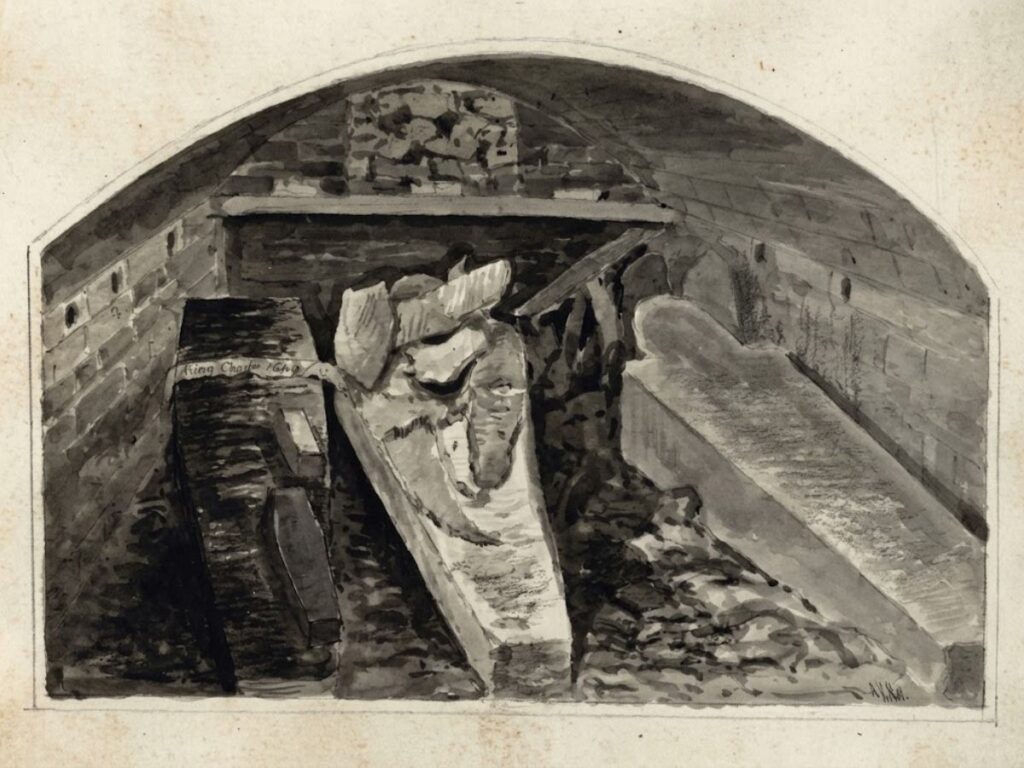
The Prince Regent, the future George IV, was summoned, and he opened the vault in his presence. Inside were four coffins. Henry’s was badly damaged: the lid was broken, and the lead casing split open.
Jane Seymour’s lay intact beside him. They identified Charles I’s coffin and removed several relics for identification, including a piece of neck bone bearing the mark of the executioner’s axe, part of the king’s beard, and a tooth.
The relics of Charles I were replaced in the vault in 1888, and the Surveyor to the Dean and Canons, A.Y. Nutt, painted a watercolor of the interior at that time. It’s one of the few images we have of what the chamber actually looks like, and it shows exactly what the workmen had found 75 years earlier: Henry’s coffin wrecked, Jane’s whole, Charles’s identifiable by its inscribed lead band.
The Prince Regent asked for a marble slab to mark the grave. It took another 24 years. The black ledger stone finally went down in 1837, during the reign of William IV, with the four occupants’ names cut into it. That’s still the only marker.
Can You Visit Henry VIII’s Grave at Windsor Castle?
Yes, you can visit the grave, which sits in the Lower Ward of Windsor Castle and is included on a standard Windsor Castle ticket. The chapel is closed to visitors on Sundays (it’s a working church, with services) and on certain ceremonial days, so check the opening schedule before you go.
When you reach the quire, look at the floor in the center. The black marble ledger stone is set into the pavement, flush with the surrounding stones, naming Jane Seymour, King Henry VIII, King Charles I, and an infant child of Queen Anne, with the credit to William IV at the foot.
People do walk straight over it without noticing. No barriers, no velvet rope, no spotlight. For a man who commissioned 134 statues to stand around his memorial, it’s an astonishingly plain end.
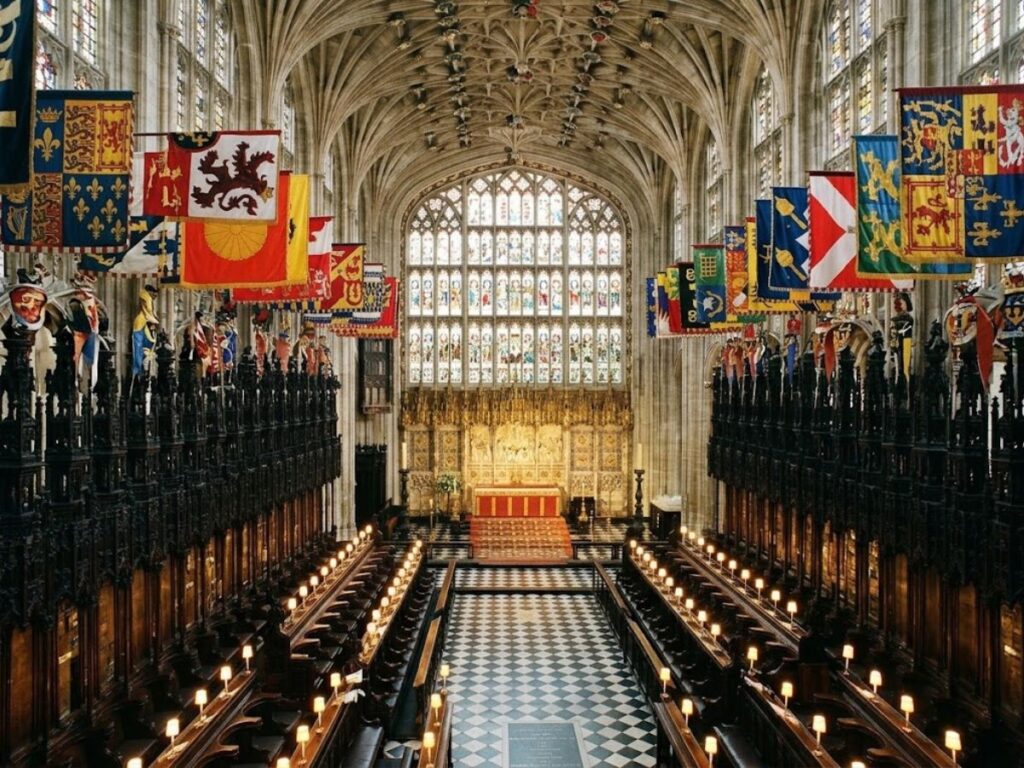
Above you, the quire itself is one of the great sights of English medieval architecture: the fan vaulting, the carved stalls of the Knights of the Garter, the banners and crests of the current knights hanging above their seats.
Ten sovereigns are interred within the chapel, from Henry VI and Edward IV through Henry VIII and Charles I to Edward VII, George V, George VI and, since 2022, Elizabeth II, who lies in the King George VI Memorial Chapel just off the north quire aisle with her husband and her parents.
St George’s holds more English and British monarchs than any other site except Westminster Abbey.
FAQs
Where is Henry VIII buried?
Henry VIII is buried beneath the quire floor of St George’s Chapel at Windsor Castle, in a vault he shares with his third wife, Jane Seymour. He was interred on 16 February 1547, as his will had asked, beside Jane. A black marble slab in the center of the chapel floor marks the spot. The same vault also holds Charles I and an infant child of Queen Anne.
Why does Henry VIII have no tomb?
Henry VIII has no tomb because his planned monument was never finished. The design called for marble pillars, 134 statues, and a bronze effigy of Henry on horseback, and it stood incomplete at his death in 1547.
Is Henry VIII buried with Anne Boleyn?
Henry VIII is not buried with Anne Boleyn. He lies at Windsor beside Jane Seymour, his third wife. Anne, his second wife, was executed in 1536 and buried in the Chapel of St Peter ad Vincula at the Tower of London, where those executed for treason were laid.
Why is Charles I buried with Henry VIII?
Charles I is buried with Henry VIII because, when he was executed in 1649, Henry’s vault at Windsor was already there and Parliament didn’t want to build him a new tomb. Henry and Jane Seymour had been buried in it for over a century. Burying Charles quietly at Windsor, a castle Parliament controlled, meant there would be no grand funeral in London to stir up trouble.
Can you visit Henry VIII’s grave at Windsor Castle?
You can visit Henry VIII’s grave at Windsor Castle on a ticket that includes St George’s Chapel, which opens on selected days, so check the current opening days before you go. The vault itself is sealed beneath the floor and cannot be viewed, but you can stand over the black marble slab in the quire.

Love a good medieval story?
Join our readers and get tales of kings, queens, castles and ordinary medieval lives straight to your inbox.

Kylie Lang is a nationally syndicated travel journalist with bylines on the Associated Press Wire & more, a medieval history writer, and the founder and lead author of Tales of the Middle Ages (talesofthemiddleages.com). She holds a BA (Honours) in History from the University of Kent and is a member of the British Guild of Travel Writers.
Related posts:
 The Execution of Lady Jane Grey: The Teenager Crowned Queen and the Nine Days That Sealed Her Fate
 For Jane Seymour the Most Dangerous Place in England Was Henry VIII’s Bedchamber
 Busting Tudor Myths With Tracy Borman: The Stories We’ve All Been Getting Wrong
 The Rise and Fall of Anne Boleyn: Power, Passion, and Politics