
When people think of King Henry VIII, the spotlight usually lands on his six wives, the drama of Anne Boleyn, or the heartbreak of Catherine of Aragon. But tucked into the pages of Tudor history is a woman who deserves her own chapter, Bessie Blount. She wasn’t a queen and didn’t lose her head, but she did something no one else had managed at the time. She gave Henry something he desperately wanted: a healthy baby boy.
Bessie doesn’t appear in every documentary or school textbook, but don’t let that fool you. Her story is full of royal romance, courtly secrets, and just enough scandal to keep things interesting.
Table of Contents
So, if you’ve watched all the Tudor TV dramas, read the novels, or just fancy stepping behind the curtain of Henry’s court without getting bogged down in dry timelines and dusty dates, you’re in the right place. We’re about to get to know Bessie Blount. Who was she really? What can history tell us about her, and how much of what we see on screen is accurate?
Two Great Books on Bessie Blount
Despite her significant role in Tudor history, dedicated works on Bessie Blount are scarce. However, two notable books offer in-depth perspectives on her life and influence:


Who Was Bessie Blount? Early Life and Court Beginnings
Bessie Blount didn’t start out with royal ambitions. She was born around 1500 in Shropshire, England, into a respectable, well-connected family. They weren’t quite at the top of the social ladder, but close enough to catch the king’s attention a few years later. Her parents were part of the Tudor gentry, and thanks to the right family ties and a bit of courtly maneuvering, young Bessie ended up as a lady-in-waiting to Queen Catherine of Aragon.
This is where things get interesting. The records say she was particularly good at dancing and singing, which, at the time, was basically like being the girl who could walk into a room and instantly charm everyone. Including, as it turned out, King Henry VIII.
By the time Bessie was in her mid-teens, she was already taking part in court masques and pageants. These were no low-key affairs. From the gorgeous velvet costumes to the theatrical performances, there were plenty of opportunities for flirtation under the watchful eyes of the court. One event, a New Year’s celebration in 1515, saw Bessie dancing in the same pageant as the king. That kind of moment didn’t just happen by accident.

There’s no exact record of when things between Henry and Bessie crossed the line from polite court flirtation to full-blown affair, but by the late 1510s, she’d become more than just another face in the queen’s household.
But what makes Bessie stand out from the usual cast of royal mistresses is that she didn’t push for power. She wasn’t trying to unseat the queen or elbow her way to the throne. She seems to have stayed in her lane, albeit one that led her straight into Tudor history books for a very specific reason.
Becoming the King’s Mistress. Was it Tudor Romance or Royal Duty?
By the late 1510s, things had shifted between Bessie and King Henry. She was part of the king’s inner circle in a very different way. We don’t have the exact date the affair began, but it’s safe to say it wasn’t a one-night thing. Their relationship lasted a few years, which, in Tudor terms, is practically a long-term commitment.
Now, was it love or was it strategy? Or was it just one of those courtly things that happened when you were young, charming, and in the king’s line of sight? That’s hard to pin down. We know Bessie didn’t come from a power-hungry family like the Boleyns. There’s no sign she was coached to seduce the king or that she tried to use her position to climb any higher. She didn’t make demands or expect marriage. She was just… there. In the right place, at the right time, with all the right talents.

Of course, Henry had his reasons, too. By then, Queen Catherine had been through several pregnancies, most ending in tragedy. Henry was growing increasingly desperate for a male heir. So when Bessie came along, young, healthy, and full of life, it’s not hard to imagine the appeal. She was everything Catherine, in her late 30s, sadly no longer was in Henry’s eyes. And if he could prove he could father a son? All the better.
Still, there was no big public romance. Mistresses weren’t openly acknowledged, and Bessie didn’t wear a badge that said “the king’s favorite.” Court life meant keeping things quiet, at least officially, though you can bet the courtiers were whispering behind their sleeves.
Bessie didn’t seem to want more from Henry. She wasn’t pushing for a crown or a place at the head of the table. She stayed in the background, kept out of politics, and did what was expected of her. More importantly, she didn’t crash and burn like some of the others. She played her part, then moved on.
Of course, everything changed when Bessie became pregnant. That’s when this courtly affair turned into a very big deal.
Hooked on the Middle Ages? Get more stories like this one in your inbox.
A Royal Secret: Bessie Bears Henry’s Son
At some point in 1518, Bessie found out she was pregnant. And not just by any man, but by the king of England. In any other court, this might have meant instant disgrace. But Henry VIII? He saw it as an opportunity.
This was a huge moment for Henry. Queen Catherine had given birth to a daughter, Mary, but no sons had survived. Now, suddenly, there was a chance to prove that he wasn’t the problem. That he could father a healthy baby boy. The fact that it was with his teenage mistress didn’t seem to bother him one bit.
Naturally, Bessie couldn’t exactly stay at court with a growing baby bump. So, in proper Tudor fashion, everything was done in secret. Cardinal Wolsey stepped in and quietly sent her to a priory in the Essex countryside, St. Laurence at Blackmore. The place even had a nickname: “Jericho.” Far from the royal spotlight, Bessie waited out the pregnancy, away from gossip and curious eyes.
Then came the big moment. In June 1519, Bessie gave birth to a boy. He was healthy, he survived, and he was undeniably the king’s child. Henry was so delighted that he gave the baby a very telling name: Henry FitzRoy. “FitzRoy” literally means “son of the king.” This was Henry saying, “Yes, he’s mine, and I’m proud of it.”
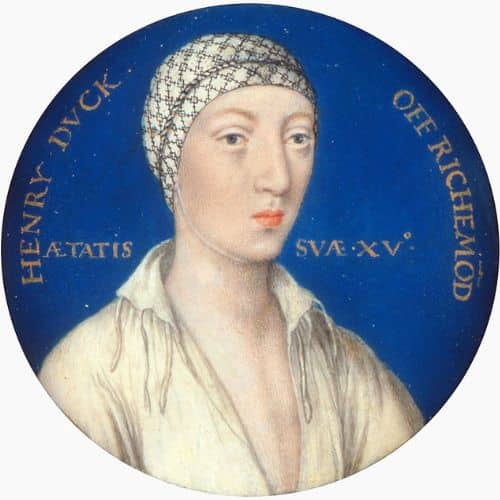
Now, you have to remember that kings had mistresses all the time, but they didn’t usually publicly acknowledge their illegitimate children, let alone shower them with titles. Henry gave FitzRoy not one but two dukedoms, Richmond and Somerset. He was raised with royal tutors, given royal clothes, and lived a royal lifestyle, even though he wasn’t in the official line of succession.
What did Queen Catherine think of all this? That’s the big mystery. The truth is, we don’t know when or how Catherine found out. The birth was kept quiet, and she likely only learned about it after Henry formally acknowledged the boy.
One thing we do know? The public had a field day. There was even a popular saying: “Bless ’ee, Bessie Blount.” People were quick to point out that the king’s mistress had done what the queen couldn’t. It’s not hard to imagine the gossip in the taverns. Henry had a son, and that son wasn’t Mary. The implications weren’t lost on anyone.
For Bessie, giving birth to a royal son changed everything. But rather than cling to her moment in the spotlight, she slipped out of court life just as quietly as she had entered it. The affair ended not long after, but Bessie had already secured her place in Tudor history.
After the Affair: Bessie’s Life Beyond Henry
Once Bessie had given birth to Henry FitzRoy and the king had made it known that the boy was his, the royal romance ended. There was no scandal, no dramatic fallout, and no public disgrace. It was simply over. Henry had gotten what he needed, and Bessie stepped away from court life without fuss.
In 1522, Bessie married a nobleman named Sir Gilbert Tailboys. It was probably arranged or at least encouraged by Henry himself. This was a typical royal move. Find a respectable husband for a former mistress and tie up the situation with a neat little bow. Gilbert was from a good family in Lincolnshire and had enough wealth and status to give Bessie a comfortable new life.
They settled into life on his estates, and Bessie became Lady Tailboys. She had several children with Gilbert, and while some people have speculated that one or two of those children might have also been fathered by Henry, there’s no solid evidence. It seems much more likely that these were Gilbert’s children and that Bessie had moved on.
Meanwhile, young Henry FitzRoy grew up in a grand style. The king adored him. He had his own household, tutors, and titles. There’s even a suggestion in one letter that Bessie stayed in touch and had some involvement in her son’s upbringing. That would have made her one of the few women in Tudor England to be both a royal mistress and the acknowledged mother of a royal child with real influence.
But the good years didn’t last forever. Gilbert died in 1530, leaving Bessie a widow in her early thirties. Just a few years later, her son FitzRoy died suddenly, probably from tuberculosis. He was only a teenager. That loss must have hit her hard. By all accounts, she cared deeply for him.
Still, Bessie did what many Tudor women did. She remarried. Her second husband was Edward Clinton, a younger man with land near hers. They had a few daughters together, and Bessie even returned to court for a short time, serving Queen Anne of Cleves and later Queen Catherine Howard.
That must have been quite the experience. Imagine Bessie, now in her thirties and full of court knowledge, quietly advising a new teenage queen on how to survive the same world she once knew so well.
Bessie died around 1540, likely in her early forties. She didn’t end up in the Tower. She wasn’t banished or forgotten. She simply faded into the background, living a peaceful country life. In a world where many women close to Henry ended up dead or disgraced, Bessie’s story took a very different path.
What We Really Know vs. What We Imagine
One of the biggest challenges with telling Bessie Blount’s story is figuring out what’s fact and what’s been embroidered over time. Like many women at Henry’s court, Bessie didn’t leave behind diaries or letters. What we know about her mostly comes from official records, court gossip, and bits and pieces written down by others.
We know she was a lady-in-waiting to Queen Catherine, had an affair with the king, gave birth to his illegitimate son, Henry FitzRoy, and that Henry acknowledged the boy and gave him titles. We also know she married twice, had several other children, and spent much of her later life living quietly on her estate. These details come from solid records, and historians generally agree on them.
But there’s a lot we don’t know. We don’t know how Bessie felt about Henry or the affair. We don’t know if she was heartbroken when it ended or if she was relieved to be out of the royal spotlight. There’s no record of any letters between her and the king, no clues about what she hoped for or feared. Did she want more? Was she scared? Did she love him? We can only guess.
And this is where the myths sneak in. Over the years, some have claimed that Bessie’s other children, born after her marriage, might also have been fathered by Henry. That makes for a juicy story, but there’s no real proof. By the time those children were born, Henry had moved on to other mistresses. Most historians agree that her husband, Gilbert, was the father.
There’s also the temptation to paint Bessie as either a wide-eyed innocent or a cunning social climber. The truth is probably somewhere in the middle. She was a teenager at court, likely flattered by the king’s attention, and aware that refusing him would not have been an easy option. But there’s no evidence that she schemed her way into his bed or tried to turn the affair into power. She didn’t ask to be queen. She didn’t cause trouble. She simply did what many others did at the time: she adapted.

Bessie Blount On Screen
If you’ve watched The Spanish Princess on Starz, you’ve probably seen a version of Bessie that’s emotional, complicated, and caught in a love triangle with Catherine of Aragon and Henry VIII. On screen, she’s a vulnerable girl who seems to form an unlikely bond with Catherine, right up to that unforgettable scene where Catherine helps her through childbirth.
It makes for powerful television. But how much of it happened? Not much.
Let’s start with that dramatic birth scene. In the show, Catherine is by Bessie’s side as she gives birth to Henry FitzRoy. The queen looks pained but supportive, helping Bessie through labor like a saintly rival. The problem is, there’s no evidence this ever took place. Historically, Bessie was sent away from court when her pregnancy became obvious. She gave birth in private at a religious house in Essex, well away from court life and royal eyes.
There’s also no sign that Catherine and Bessie had any sort of personal relationship beyond the usual formalities. Catherine was the queen. Bessie was one of her ladies. If she had suspicions about the affair, she did what Tudor queens were expected to do: keep quiet and carry on. Any friendship or forgiveness between the two is pure invention.
Then there’s how Bessie is portrayed emotionally. In many TV versions, including The Tudors, she’s shown as either heartbroken or manipulated. She’s either madly in love with Henry or completely abandoned when he loses interest. But the truth is, we don’t know how she felt. There are no letters, diary entries, or personal accounts. That gives TV writers a lot of space to fill in the blanks however they want. Sometimes, they go for sympathy. Other times, they go for scandal.
That doesn’t mean these shows aren’t entertaining. They’re fun to watch, and they get a lot of people interested in history. But they do blur the lines between fact and fiction, and Bessie’s story is a prime example of that. The real version doesn’t need extra drama to make it interesting. It already has secrecy, royal tension, and a king’s only acknowledged illegitimate son. That’s more than enough for a good story.
Love a good medieval story?
Join our readers and get tales of kings, queens, castles and ordinary medieval lives straight to your inbox.

Kylie Lang is a nationally syndicated travel journalist with bylines on the Associated Press Wire & more, a medieval history writer, and the founder and lead author of Tales of the Middle Ages (talesofthemiddleages.com). She holds a BA (Honours) in History from the University of Kent and is a member of the British Guild of Travel Writers.
Related posts:
 Did They or Didn’t They? Was Catherine of Aragon Still a Virgin When She Wed Henry VIII?
 What History Got Wrong About Mary Boleyn: The Forgotten Sister of Anne, Mistress, Mother, Survivor
 Catherine de Medici: The Ultimate Renaissance Power Player
 Beyond Wolf Hall: The Dramatic Rise and Fall of Thomas Cromwell