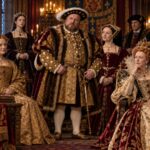
Legs planted apart, fists on hips, shoulders filling the frame, a padded coat so enormous it dares you to look away. That’s the Henry VIII who lives in your head, and it’s the Henry VIII Hans Holbein painted in 1537.
So was Henry VIII really as large as his portraits suggest? Yes and no. His surviving armor tells more than any painting can.
Table of Contents
He was: a 32-inch waist in his athletic 20s that swelled to about 52 inches by 1540, after a jousting accident in 1536 ended his exercise. So was the portrait a true likeness or not?
What His Surviving Armor Actually Measures
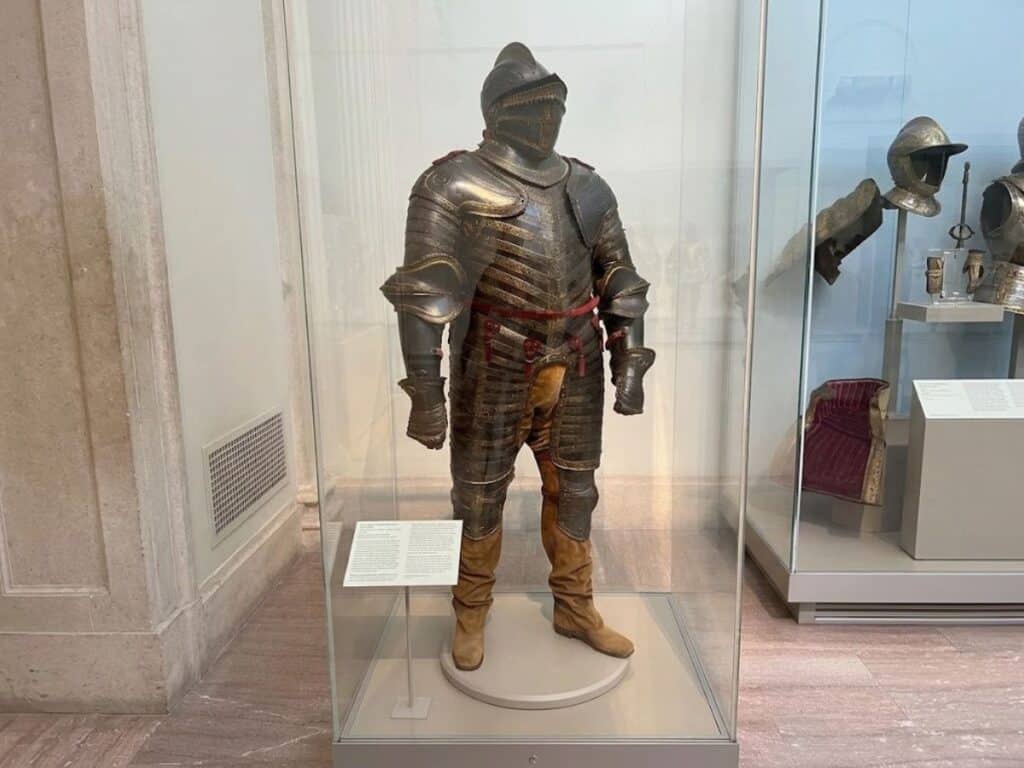
The most honest witness to Henry’s body is the steel he wore. Several of his suits have survived, most of them in the care of the Royal Armouries at Leeds and the Tower of London, and because armor is custom-fitted to the man inside it, each suit is a snapshot of his waist and chest on the day it was finished.
As a young man in his early 20s, Henry’s armor shows a waist of about 32 to 36 inches and a matching chest. His Field of Cloth of Gold armor, made for the great summit with Francis I of France in 1520, when he was 29, measured about 36 inches at the waist.
The last great harness, made around 1540, tells a different story. The Royal Armouries measured that suit at a 52-inch waist and a 53-inch chest, which is severely obese by any modern standard.
Weight is harder to pin down, because nobody put him on a scale, and the figures you see quoted are reverse-engineered from the armor. The early suits suggest a weight of about 180 to 200 pounds.
The last suits suggest 300 to 320 pounds or more. Henry stood between 6 feet 1 and 6 feet 2, so even the heavier figures fit a large frame.
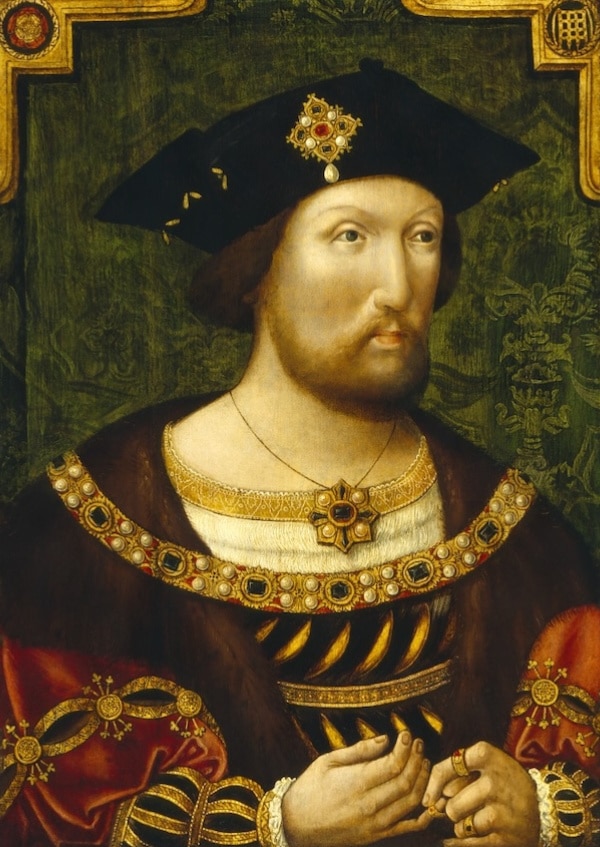
Did Henry VIII Really Weigh 400 Pounds?
Probably not. He may not have been far off 400 pounds at the very end, but the armor evidence points to something closer to 300 to 320 pounds for most of the 1540s. The last suit of armor was made in 1540, when he had seven years left to live, and he almost certainly kept gaining after that.
By 1547, when he could no longer walk and was being carried from room to room in a chair fitted with poles, anything is possible. Nobody weighed him, and nobody recorded his weight anywhere.
The answer is a range. Between about 300 and 400 pounds in his last decade. Anyone who gives you a confident single figure is guessing.
For context, 300 pounds on a 6-foot-1 frame puts a man well into obesity but still mobile. By 400 pounds, especially with a suppurating leg ulcer that never healed, you have a man who can barely function.
Both descriptions match Henry at different points. He wasn’t the same size the day Catherine Howard was executed as he was the day he married Catherine Parr, and he was larger again by the time he died.
How Holbein Made Him Look Even Bigger
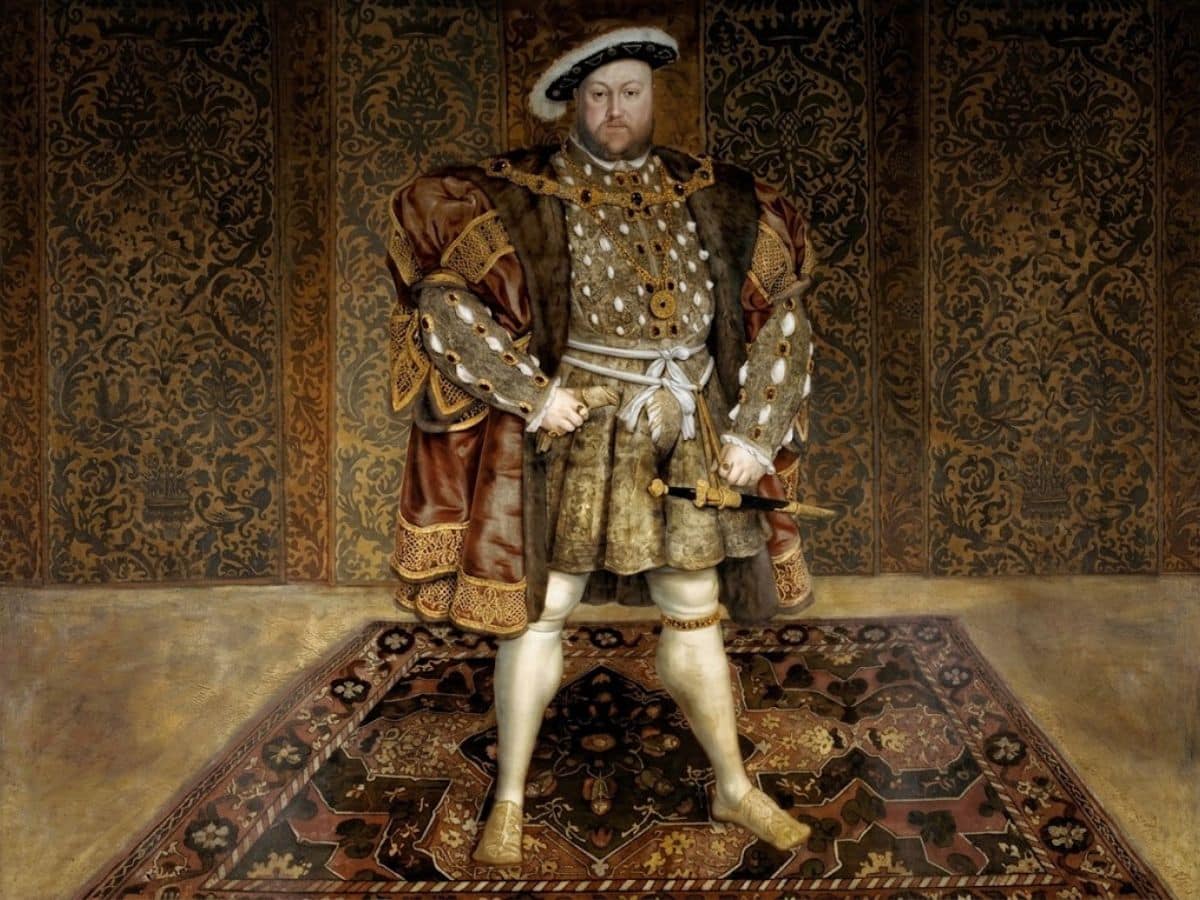
Hans Holbein the Younger painted the Whitehall Mural in 1537, and it’s the single most responsible image for how we picture Henry VIII today.
The original burned in the Whitehall fire of 1698, but the preparatory cartoon survives at the National Portrait Gallery, and a mid-17th-century copy by Remigius van Leemput survives in the Royal Collection.
The mural was dynastic propaganda of the most calculated kind. It was painted on the wall of Henry’s privy chamber at Whitehall Palace, where ambassadors and courtiers waited to see him, and the image was designed to overwhelm them before he arrived.
Henry stands with his legs planted apart, shoulders squared, hands on his hips, looking straight out at the viewer. His father, Henry VII, stands behind him in a more modest pose, deliberately upstaged by his own son.
Compare the figure in the cartoon with the measurements of the surviving armor, and you can see what Holbein did. He gave Henry longer legs than he actually had, broader shoulders, a straighter back. By 1537, the real Henry was already carrying serious weight and nursing an ulcerated leg.
Henry was delighted with it. He had copies made and handed them out as gifts, and before long that broad-shouldered figure was turning up at courts right across Europe. So when artists came to paint him in his later years, when he really was enormous, they didn’t start from scratch. They worked from the image Holbein had already created.
Hooked on the Middle Ages? Get more stories like this one in your inbox.
The 1536 Jousting Accident That Changed His Body
On January 24, 1536, at Greenwich, Henry rode out in a tournament and his horse, in full armor, fell on top of him. He was knocked unconscious and lay senseless for about two hours. The court thought he was dead.
Anne Boleyn, five months pregnant, was told the news and miscarried a male child a few days later, on the day Catherine of Aragon was buried. Anne herself was dead on the scaffold within four months.
Henry recovered, but he never jousted again. He was 44, and the man who had been one of Europe’s most physically active monarchs lost his main form of exercise overnight. The fall also seems to have aggravated an existing leg problem.
A varicose ulcer on his thigh, probably caused by years of wearing tight garters over his hose during athletic exertion, became chronic. It never healed. By the 1540s he had ulcers on both legs; they stank, and they had to be dressed daily.
On bad days the ulcer would close over, trap the infection, and leave him in agony and raging at anyone within earshot until it burst and drained again.
Many historians, including Alison Weir and Robert Hutchinson, point to 1536 as the hinge of Henry’s life. The weight came on because he could no longer burn it off, the pain made him irritable and suspicious, and the ulcer kept him increasingly immobile for the roughly 20 years of life he had left.
Why Did Henry VIII Get So Fat Later in Life?
Henry VIII got fat because the 1536 accident stopped him exercising while his diet carried on exactly as before. The Tudor court ran on meat. Roasted beef, mutton, venison, swan, peacock, capon, pork, washed down with ale and wine from breakfast onwards.
The king himself was served the richest of it in the greatest quantity, as was custom, and no one expected a man of his standing to eat less when he moved less. A lord who could afford meat ate meat.
Stress almost certainly played a part. The late 1530s and the 1540s weren’t peaceful years for Henry personally. Some medical historians have suggested type 2 diabetes, which would fit the weight, the slow-healing ulcers, and the mood swings, though it can’t be proven.
The heavier he got, the harder it was to move. The less he moved, the worse the ulcers got. The worse the ulcers got, the less he could do.
By 1546, he had to be winched onto his horse with a crane, and the mechanical chairs that carried him around his palaces were a serious logistical operation. The man who had hunted all day in 1520 could barely cross a room in 1546.
The Medical Theories: McLeod Syndrome and the Kell Blood Group
The most interesting modern attempt to explain Henry’s physical and mental decline came in 2010, when Catrina Banks Whitley and Kyra Kramer published a paper in The Historical Journal arguing that Henry may have been Kell-positive and suffered from McLeod syndrome.
The Kell blood group is uncommon, and if a Kell-positive man fathers children with Kell-negative women, the first pregnancy usually goes to term, but subsequent pregnancies with the same mother are at high risk of late miscarriage or stillbirth as the mother’s immune system attacks the fetus.
That pattern fits Henry’s wives uncomfortably well. Catherine of Aragon’s one surviving child, Mary, was her first live birth; the pregnancies that followed ended in miscarriage, stillbirth, or infants who died within weeks.
Anne Boleyn gave him Elizabeth and then miscarried. McLeod syndrome itself, carried on the same chromosome, causes physical deterioration and often marked personality change in middle age, usually appearing in a man’s 40s. That’s exactly when Henry’s body and temper went to pieces.
It’s a hypothesis, not a diagnosis, and it can’t be confirmed without genetic testing of Henry’s remains, which won’t happen any time soon. Other historians have pushed back, pointing out that reproductive failure was depressingly common in Tudor marriages for all sorts of reasons and that Henry’s mood may be adequately explained by chronic pain and absolute power.
The older claim that Henry had syphilis has been largely dismissed by medical historians, mainly because there’s no record of him being treated with mercury, which was the standard and unmistakable treatment at the time. The McLeod theory is the best modern guess we have.
Portrait vs Reality: What We Can and Can’t Know
So yes, Henry really was obese by the 1540s, and by the end of his life probably severely so. But the famous Holbein image takes that real decline and blows it up into something much bigger: a deliberate bit of political theater.
The armor at the Royal Armouries is the most reliable source we have, more reliable than any painting and far more reliable than any ambassador’s flattery or any chronicler’s loyalty. Everything else, the exact weight at death, the exact cause of the mood swings, the exact nature of the leg ulcers, is a matter of best guess.
What we can say is this. Henry VIII was a tall, athletic young man who became a very heavy, very ill middle-aged one, and the turning point was a bad fall from a horse in January 1536.
Holbein caught him a year later and painted a monument to the king he wanted the world to see, longer in the leg and broader in the shoulder than he was in life. Henry approved the image, propagated it, and in the end became it in the public imagination.
The portraits weren’t quite true even when they were painted, and the man they described wasn’t quite the man who lived.
Frequently Asked Questions
Was Henry VIII really as large as his portraits suggest?
Henry VIII really was large in his final years, but not quite as large as his portraits suggest. You can see how much his body changed from his armor. In his 20s, he had a 32-inch waist, and by 1540, it had grown to around 52 inches. Holbein’s Whitehall Mural from 1537 gave him broader shoulders and longer legs than he really had, because the point was to make him look powerful, not to paint the man as he was.
How much did Henry VIII weigh when he died?
Henry VIII weighed an estimated 300 to 320 pounds in his final years, though some accounts push it toward 400. Nobody put him on a scale, so these figures are reverse-engineered from his armour, which shows a waist of about 58 to 60 inches at the end.
What was Henry VIII’s waist size?
Henry VIII’s waist was about 32 inches in his early 20s, when he was a famed jouster and athlete. The armor he wore at the 1520 Field of Cloth of Gold shows a waist of around 36 inches. By 1540, the suit held by the Royal Armouries measures roughly 52 inches, and the final suits suggest 58 to 60.
Why did Henry VIII gain so much weight?
Henry VIII gained so much weight after his jousting accident on 24 January 1536 ended his exercise. The fall worsened a leg ulcer that never healed, and he became increasingly immobile for about 20 years. Hunting and jousting stopped; the lavish diet of roasted meats and wine at court did not, and the body changed accordingly.
Did Holbein make Henry VIII look bigger than he was?
Holbein did make Henry VIII look bigger than he was. The 1537 Whitehall Mural was commissioned as propaganda and hung in the king’s privy chamber to overwhelm visitors who were brought before him. Holbein painted the legs planted wide, the shoulders broader, and the stance squared.
What did the 1536 jousting accident do to Henry VIII?
The 1536 jousting accident left Henry VIII unconscious for about two hours after his armored horse fell on him at Greenwich on 24 January. It reopened a leg ulcer that never healed, and ulcers spread to both legs. He never jousted again, lost his main form of exercise, and the resulting immobility and weight gain reshaped the rest of his reign.
Love a good medieval story?
Join our readers and get tales of kings, queens, castles and ordinary medieval lives straight to your inbox.

Kylie Lang is a nationally syndicated travel journalist with bylines on the Associated Press Wire & more, a medieval history writer, and the founder and lead author of Tales of the Middle Ages (talesofthemiddleages.com). She holds a BA (Honours) in History from the University of Kent and is a member of the British Guild of Travel Writers.