Royal marriages in the Middle Ages were almost never about love. It was a treaty with a ring on it. Land, alliances, armies, and heirs, all bartered across a table while the bride and groom sometimes hadn’t even met.
So when a medieval marriage went off the rails, when someone married for love, or lust, or spite, or married the wrong person entirely, the whole of Europe sat up and gossiped.
Table of Contents
The most scandalous marriages of the Middle Ages usually broke one of three rules. Some married far too close in blood, like William the Conqueror and his cousin Matilda. Some stole a bride who was promised to another man, like King John.
And some married wildly beneath their rank for love, like the king who wed a commoner in a wood at dawn, or the widowed queen who secretly married her own servant.
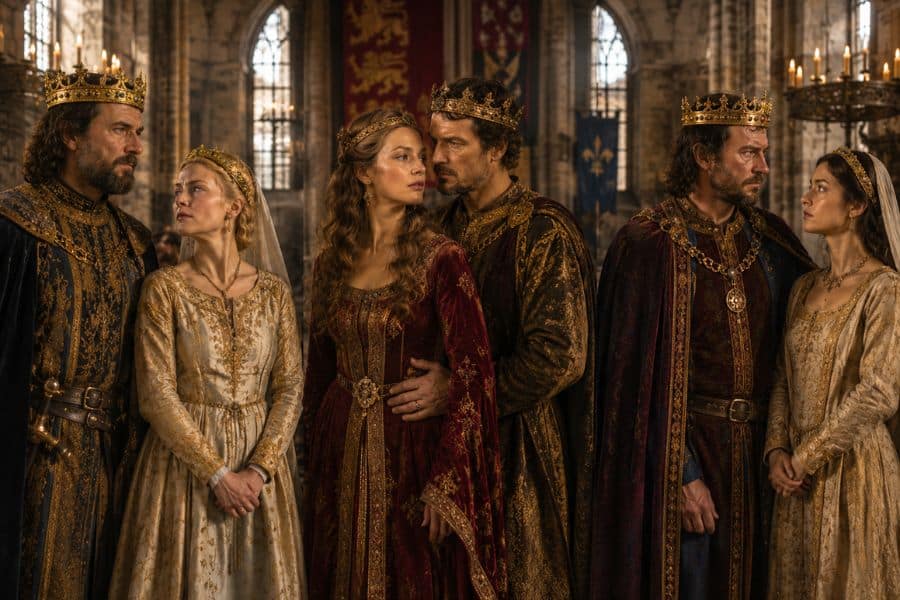
The 8 Most Scandalous Marriages of the Middle Ages
I’ve picked eight of the very best, running in the order they happened. Some are famous, a couple you’ll never have heard of, and one of them involves a crowned corpse.
William the Conqueror and Matilda of Flanders: The Bride Who Called Him a Bastard
We start in Normandy, around 1051, with a marriage the Pope himself tried to stop.
Duke William of Normandy wanted to marry Matilda of Flanders, a well-connected noblewoman with royal blood in her veins.
There was a snag. They were third cousins, and the medieval Church took its rules on marrying relatives extremely seriously, banning unions between people related within seven degrees.
Pope Leo IX flatly forbade the match. William married her anyway, around 1051 or 1052, and simply dared Rome to do something about it. It took until 1059 to get a papal pardon, and as penance, the couple had to build two great abbeys in Caen, which still stand today.
The story goes that Matilda first refused William’s proposal, sniffing that she was far too high-born to marry a bastard, which William technically was.
William, so the tale runs, rode furiously to Bruges, burst into her chambers, and beat her, or dragged her off her horse into the mud, after which she suddenly decided she’d marry him and no one else.
I’d take that with a large pinch of salt. Historians reckon it’s more myth than fact, a story grown up around a marriage that was really a cool political alliance. What’s true is that it worked. Matilda became the first Norman queen of England after 1066, and the two of them were, by the brutal standards of the age, truly devoted for over thirty years.
Eleanor of Aquitaine and Henry II: The Fastest Remarriage in Christendom
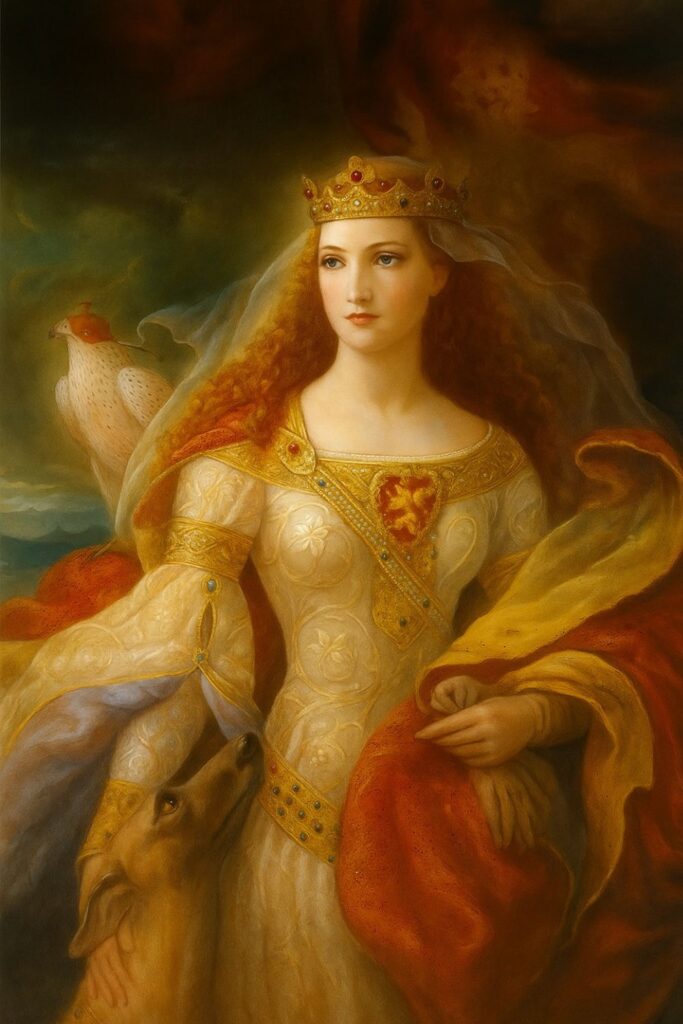

Now to the most famous woman of the age, and a remarriage so quick it made heads spin.
In March 1152, Eleanor of Aquitaine had her fifteen-year marriage to King Louis VII of France annulled, on the convenient grounds that they were, you guessed it, too closely related.
Eleanor was the richest heiress in Europe, ruling vast lands in south-west France in her own right. She was newly single, and every ambitious lord on the continent knew it. She did not keep them waiting.
Just eight weeks later, in May 1152, she married Henry of Anjou, Duke of Normandy, the man who would, two years later, become King Henry II of England.
The speed alone was a scandal. Eleanor had married without the permission of her former husband, the King of France, who was also her feudal overlord and was left spitting with fury. Worse, tongues wagged that Eleanor had known Henry rather well beforehand, and there were even whispers she’d once been involved with Henry’s own father, Geoffrey.
And here’s the best bit. Eleanor and Henry were actually more closely related than Eleanor and Louis had been, the very thing her annulment was based on. She’d swapped one forbidden-degrees marriage for a worse one.
It gave England its most formidable royal couple, and eventually its most spectacular family feud, but it began as a proper scandal.
King John and Isabella of Angoulême: The Bride He Stole from Another Man
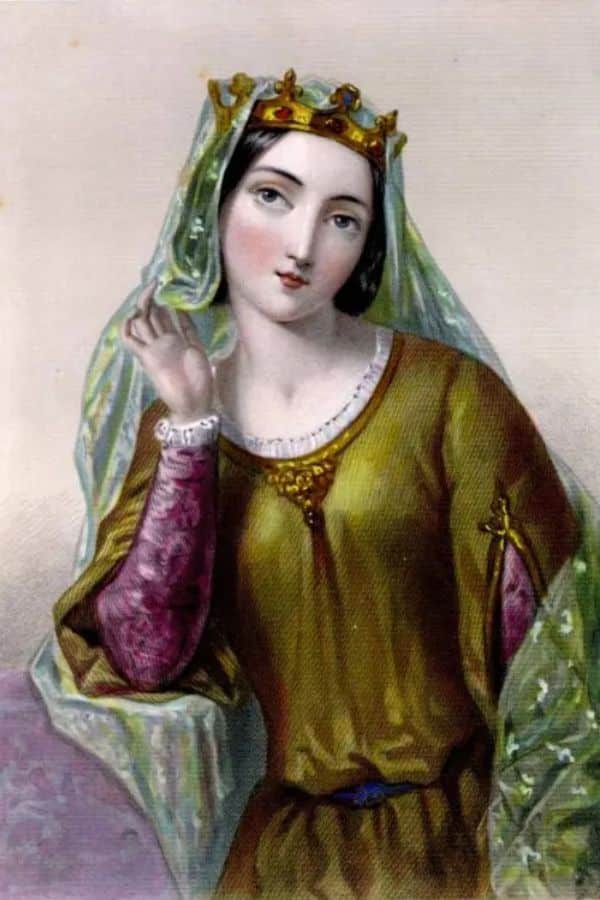

Some kings caused a scandal by marrying for love. King John of England caused a war.
In August 1200, John married Isabella of Angoulême, a French heiress of around twelve years old. She was beautiful, she was rich, and, crucially, she was already betrothed to somebody else.
Isabella had been promised to Hugh de Lusignan, a powerful French nobleman, and John swooped in and married her himself. You can see the appeal; her lands were strategically vital. But snatching another lord’s promised bride was a grave insult, and Hugh was not a man to swallow it.
Hugh appealed over John’s head to the King of France, Philip II, who was John’s feudal overlord for his French territories and was delighted to have an excuse. Philip summoned John to answer for himself, but John refused to show, and Philip declared his French lands forfeit.
The result was a disastrous war in which John lost Normandy and most of the Plantagenet empire in France, a humiliation that helped earn him his nickname, John Lackland, and set England on the road to Magna Carta.
A twelve-year-old bride, and an empire lost. Isabella, for her part, outlived John and then went back to France and married Hugh’s son, which is a whole other tangle. Never a dull moment with that family.
Hooked on the Middle Ages? Get more stories like this one in your inbox.
Pedro of Portugal and Inês de Castro: The King Who Crowned a Corpse
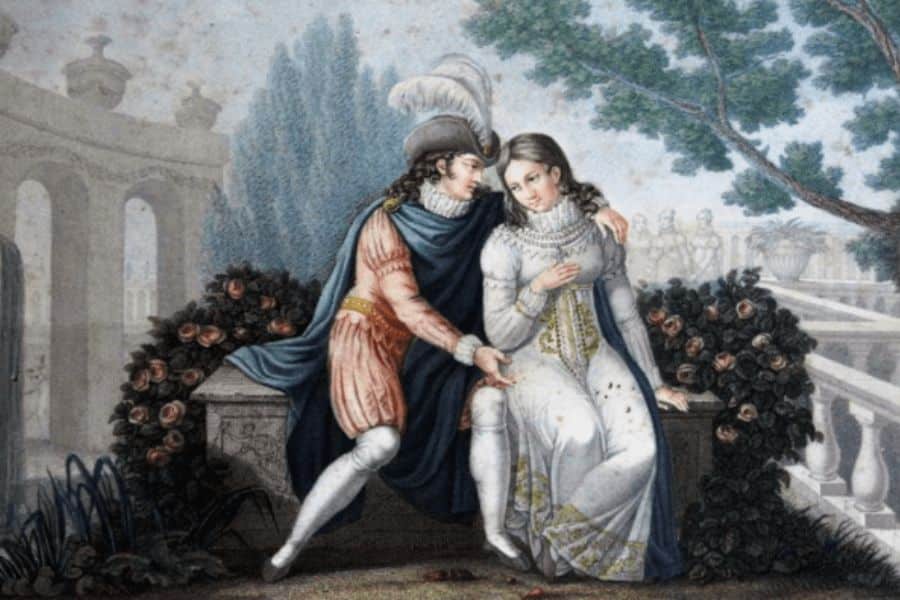
In the 1340s, the Portuguese prince Pedro fell hopelessly in love with Inês de Castro, a Galician noblewoman serving at court as a lady-in-waiting to his wife. When his wife died, Pedro and Inês lived together openly and had four children.
His father, King Afonso IV, was horrified. Inês’s family was foreign and ambitious, and the king feared their grip on his lovestruck son would drag Portugal into Castile’s civil wars. He tried everything to separate them. Nothing worked.
So in 1355, Afonso took the darkest option of all and sent three men to murder Inês. They found her near the monastery at Coimbra and killed her in front of her small children.
Pedro’s grief curdled into vengeance. He rose in revolt against his own father, and when he became king in 1357, he hunted down two of the killers and had them publicly executed by tearing out their hearts, saying they’d destroyed his.
He then announced that he and Inês had been secretly married all along, which would have made her his lawful queen, though his word is the only evidence that it ever happened.
And now the legend, which historians think is a myth that only appeared two centuries later. The story goes that Pedro had Inês’s body dug up, dressed in royal robes, seated on the throne with a crown on her skull, and made the entire court file past and kiss her dead hand in homage.
True or not, it’s one of the most haunting images the Middle Ages ever gave us. Their tombs still face each other at Alcobaça, carved with the words “until the end of the world.”
John of Gaunt and Katherine Swynford: The Mistress Who Became a Duchess


Back to England, and a scandal that quite literally created the Tudor dynasty.
John of Gaunt was the richest and most powerful nobleman in England, a son of Edward III and the power behind the throne. Katherine Swynford was a knight’s wife of modest birth who worked in his household as governess to his daughters.
In the 1370s, the two began a long love affair, while John was married to his second wife and Katherine had been widowed. It was the worst-kept secret at court, and it produced four children, who were given the surname Beaufort.
Carrying on with your children’s governess was scandal enough. But then John did the truly shocking thing. When his wife died, he married Katherine in 1396, making his longtime mistress the Duchess of Lancaster, one of the highest-ranking women in the land.
The great ladies of the court were appalled that a woman of such low birth and such a colorful past had leapfrogged them all. The Pope and the king were persuaded to declare the Beaufort children legitimate, and those legitimized Beauforts became the ancestors of Henry VII, and through him every English monarch since. A governess and her lover founded a royal dynasty.
Owen Tudor and Catherine of Valois: The Queen and the Servant
Speaking of the Tudors, here’s where the name itself comes from: a secret marriage that broke the law.
Catherine of Valois was the widow of King Henry V, the hero of Agincourt. When he died in 1422, she was a young dowager queen, mother of the infant king Henry VI, and far too politically valuable to be left to marry as she pleased.
Parliament was so anxious about who she might wed that it passed a statute forbidding a queen dowager from remarrying without the king’s consent, on pain of the husband losing his lands. And her son was a baby, so consent was years away.
Catherine married anyway, in secret, and to just about the least suitable man imaginable. Owen Tudor was a Welsh squire in her household, a servant, with no wealth, no title, and a Welsh name at a time when the Welsh were treated as second-class subjects. We don’t even know exactly when they married, around 1428, because they kept it so quiet.
They had several children before the truth came out. When it did, Catherine was sent to an abbey, where she died in 1437, and Owen was thrown into prison. Years later, during the Wars of the Roses, he was captured and beheaded, reportedly murmuring as he faced the block that this head would lie on the block that once lay in Queen Catherine’s lap.
Their grandson? He became King Henry VII. A queen and a servant, marrying in secret against the law, started the most famous dynasty in English history.
Margaret Beaufort and Edmund Tudor: A Bride of Twelve
Margaret Beaufort was a Beaufort heiress, a great-granddaughter of John of Gaunt and Katherine Swynford, and one of the richest young women in England. In 1455, at the age of twelve, she was married to Edmund Tudor, Owen’s son, a grown man in his mid-twenties.
Medieval canon law allowed girls to marry at twelve, but it discouraged consummating a marriage until the bride was older, and there was a clear understanding that a child that young should be left to grow up first. Edmund did not wait. He got Margaret pregnant while she was still twelve, apparently to secure his claim to her lands should she die.
She very nearly did die. Edmund was captured and died of plague before his birth, and in January 1457, aged just thirteen, Margaret gave birth in the depths of winter to a son. The labor was so brutal on her small frame that she never had another child, despite later marriages.
That son was Henry Tudor, the future Henry VII. Margaret went on to become one of the most powerful and formidable political operators of the entire age, the woman who built the Tudor throne.
But the marriage that started it all was a scandal even to some of her own contemporaries, and it reads as far worse to us. It’s a stark reminder of what these dynastic matches could cost the girls caught inside them.
Edward IV and Elizabeth Woodville: The Secret Marriage That Doomed a Dynasty
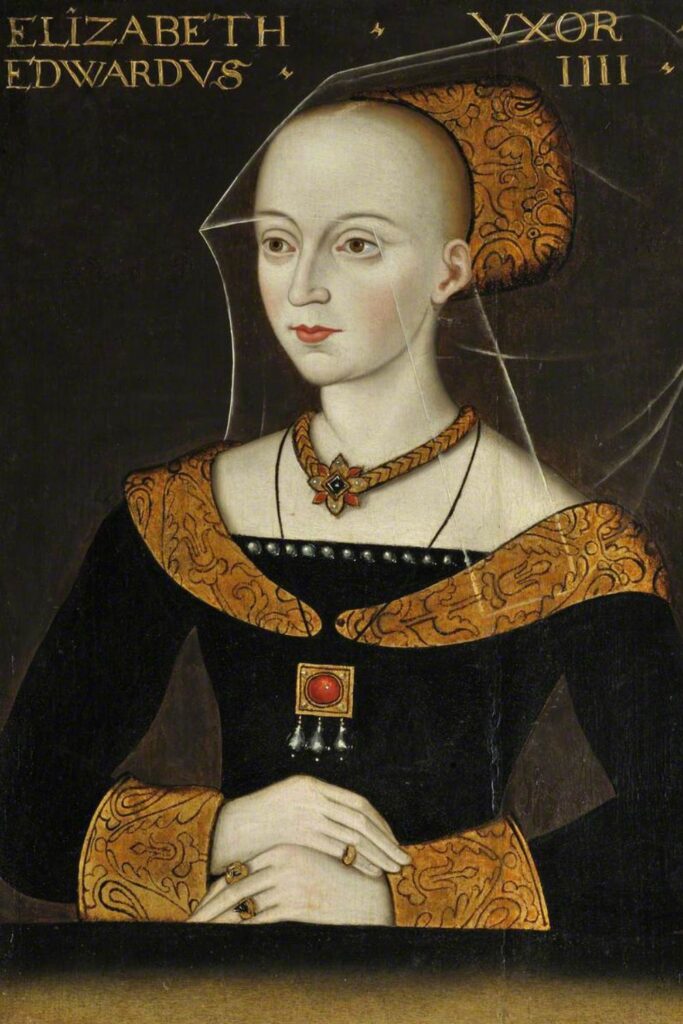

We finish with the secret wedding that arguably lost a king his sons. In 1464, England was in the middle of the Wars of the Roses, and the young Yorkist king Edward IV was expected to marry a foreign princess to seal a useful alliance.
His powerful cousin, the Earl of Warwick, known to history as the Kingmaker, was busy negotiating a French match. And all the while, Edward had a secret. He had already married for love, in private, telling almost no one.
His bride was Elizabeth Woodville, a beautiful widow from a modest Lancastrian family, with two sons already, and no royal blood and no foreign army to bring to the table. They wed in secret in May 1464, reportedly in a quiet ceremony with barely a handful of witnesses.
When Edward finally admitted it months later, the court reeled. Kings simply did not marry commoners, let alone widows from the enemy side. Warwick was humiliated, his French negotiations left in tatters, and the insult helped push him into open rebellion against the very king he’d made.
Elizabeth’s mother, Jacquetta, had herself caused a scandal years earlier by secretly marrying a lowly squire, and she was later accused of witchcraft, with gossips muttering that the Woodville women had bewitched the king into the match.
Years later, this secret wedding came back to haunt the family. The marriage was declared invalid, Edward’s two young sons were branded illegitimate, and those are the very boys who vanished as the Princes in the Tower. A love match in a wood, and a dynasty undone.
Frequently Asked Questions
What Was the Most Scandalous Marriage in Medieval History?
The most scandalous marriage in medieval history is often said to be that of King Edward IV of England and Elizabeth Woodville in 1464, because a reigning king secretly married a commoner widow from the rival side, humiliating his chief ally and helping to trigger fresh civil war. Other strong contenders include Pedro of Portugal and Inês de Castro, and the secret marriage of the widowed queen Catherine of Valois to her servant Owen Tudor.
Did Medieval Royals Really Marry Their Cousins?
Medieval royals did frequently marry their cousins, because royal families were a small, interconnected pool, and matches were made to strengthen alliances. The Church officially banned marriage between people related within seven degrees, but powerful families often married anyway and sought a papal dispensation afterward.
Did King Pedro of Portugal Really Crown a Corpse?
King Pedro of Portugal probably did not crown his lover’s corpse, despite the storyis fame. After Inês de Castro was murdered in 1355, Pedro took savage revenge on her killers and declared they had been secretly married. But the vivid tale of him exhuming her body, enthroning it, and forcing the court to kiss her dead hand first appeared in a play in 1577, more than two centuries later, so most historians regard it as legend rather than fact.
How Old Were Medieval Brides?
Medieval brides could be very young, especially among royalty and the nobility, where marriages sealed political deals. Church law set the minimum age at twelve for girls and fourteen for boys, though it discouraged consummation until the bride was older. In practice, some girls were married and had children very young. Margaret Beaufort was married at twelve and gave birth to the future Henry VII at just thirteen, a birth so hard it left her unable to have more children.
What Was a Secret or Clandestine Marriage in the Middle Ages?
A secret or clandestine marriage in the Middle Ages was one made privately, without the banns being read publicly in church or the usual witnesses and permissions. Under medieval canon law, such marriages were often still valid, as long as both parties freely consented, which is why they caused such chaos.
Could People Marry for Love in the Middle Ages?
People could marry for love in the Middle Ages, but for royalty and nobility, it was rare and often scandalous, because their marriages were treaties between families rather than personal choices. Peasants and ordinary townsfolk had more freedom to choose. When the powerful did marry for love, like John of Gaunt wedding his mistress, it caused an uproar precisely because it put personal desire above duty to the dynasty.
Love a good medieval story?
Join our readers and get tales of kings, queens, castles and ordinary medieval lives straight to your inbox.

Kylie Lang is a nationally syndicated travel journalist with bylines on the Associated Press Wire & more, a medieval history writer, and the founder and lead author of Tales of the Middle Ages (talesofthemiddleages.com). She holds a BA (Honours) in History from the University of Kent and is a member of the British Guild of Travel Writers.