There are numerous contradictory stories about Isabella of Angoulême. Some say she was the Helen of Troy of the Middle Ages, while others say she was more Jezebel than Isabel, but what’s fact and what’s fiction? Was she really as bad as historians and the chroniclers of the day say, or was that just a picture painted to suit leaders and monarchs of the time?
It’s never easy to pick out the truth, as so little from those times has been preserved, so we have no idea what really transpired behind closed doors. As I live only thirty minutes from the city of Angouleme in southwest France, it seemed rude not to dig deeper to see what I could find. This included a trip to the Hôtel de Ville d’Angoulême, where I was given a behind-the-scenes tour of what was once Isabella’s home.
Table of Contents
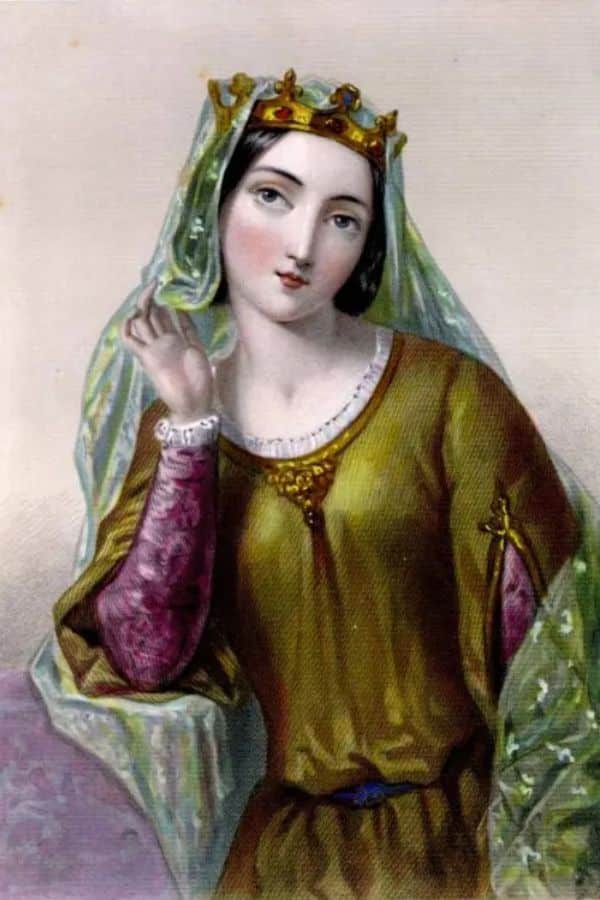
Isabella of Angoulême: The Heiress of a Powerful Line
Before we start, I should just say that Isabella was the daughter-in-law of none other than Eleanor of Aquitaine. Can you imagine what it would have been like to have Eleanor as a mother-in-law? Now, I’m a massive Eleanor fan, but fan or not, that’s enough to make even the bravest woman quake in her boots.
No one can say for sure when Isabella of Angoulême was born. Most agree it was sometime between 1186 and 1188, though the exact year is lost to time.
She came from a family with power on both sides. Her father, Aymer Taillefer, ruled Angoulême, a region that sat within the Duchy of Aquitaine. Her mother, Alice de Courtenay, brought royal blood into the mix. Alice’s father, Peter de Courtenay, was a cousin to King Philip II of France, linking Isabella to some of the most influential royal houses in Europe, including those of Jerusalem, Hungary, Aragon, and Castile.
Chroniclers wrote that Isabella was beautiful, with fair hair and blue eyes that turned heads. Whether those descriptions were accurate or exaggerated to fit her later reputation, we’ll never know. But she made an impression wherever she went.
When her father died in 1202, Isabella inherited his title and lands, becoming Countess of Angoulême. For a young woman of around sixteen, it was an enormous responsibility, and it placed her right in the path of royal ambition and political intrigue.
Power, Politics, and the Price of a Daughter
To really understand Isabella of Angoulême, you have to step back to the late 12th century, a time when daughters weren’t raised for romance but for strategy. Marriage wasn’t about love. It was about land, influence, and family survival.
Young girls were often used as bargaining chips to secure power through alliances. Some were promised away before they could even walk, their futures sealed in ink long before they had a voice. The Church ruled that a girl could marry at twelve, which meant many noble families didn’t wait long to make their move.
That’s exactly how things played out for Isabella of Angoulême. From birth, she was valuable property, an heiress to land and title, and a prize that powerful men wanted to claim.
The Betrothal That Changed the Course of Two Kingdoms
Before she became a queen, Isabella of Angoulême was promised to another man. Her father had arranged a betrothal between her and Hugh IX de Lusignan, the powerful Count of La Marche. It was intended to bring peace between two rival families whose disputes had spanned generations.
The match made perfect sense politically. But politics had a habit of crumbling the moment a king took an interest.
When King John of England caught sight of Isabella, everything shifted. At the time, she was still too young to marry and officially engaged to Hugh IX. What happened next is tangled in half-truths and speculation, the kind of stories that medieval chroniclers loved to twist. But one thing is certain, John wanted her, and kings rarely took no for an answer.

A Marriage of Strategy, Not Passion
Some medieval writers claimed King John was overcome by desire when he met Isabella of Angoulême, so taken by her youth and beauty that he was willing to defy all custom to make her his queen. Others painted a very different picture, one rooted in politics rather than passion.
John had good reason to act fast. If Isabella went through with her marriage to Hugh IX de Lusignan, the union would link two powerful families whose combined territories could threaten John’s control over Poitou and Gascony. For a king already struggling to maintain his grip on his French lands, that was a risk he couldn’t afford to take.
By marrying Isabella himself, John brought Angoulême under his own rule through her inheritance. Her father, Aymer Taillefer, didn’t seem to object. In his eyes, the chance to see his daughter crowned Queen of England outweighed any promise made to the Lusignans.
It was a decision that would set off a chain of resentment, rebellion, and war.

Hooked on the Middle Ages? Get more stories like this one in your inbox.
A Child Bride and a Furious Count
No one can say with certainty how old Isabella was when she married King John. Most accounts place her at twelve, though she may have still been eleven. That would explain why her earlier betrothal to Hugh IX de Lusignan hadn’t yet turned into a marriage.
At the time, Isabella was living in Hugh’s household, as was customary for noble brides-to-be. Then, in the summer of 1200, her father spirited her away and handed her to King John instead. On August 24 of that year, Isabella and John were married in Angoulême, and within weeks they sailed for England.
Their coronation took place at Westminster Abbey on October 8, followed by a royal tour of the north. Back in France, Hugh IX was furious. His rage quickly turned into violence, and his attacks on John’s holdings in Aquitaine sparked years of unrest that would change the political map of the region.
The Forgotten Wife and an Unusual Arrangement
When King John married Isabella of Angoulême, he wasn’t exactly free to do so. He already had a wife, Isabel of Gloucester. Slight problem. However, why let a little thing like a wife get in the way of marrying someone else? The problem was quickly solved when John had the marriage annulled. No scandal, no delay. Just a royal decree and a convenient end.
Ironically, annulments ran in the family. John’s mother, Eleanor of Aquitaine, had also ended her marriage to King Louis VII of France, citing consanguinity, meaning they were too closely related by blood. Eleanor went on to marry Henry II and reshape the map of Europe. John seemed to take the same bold approach, but for far less noble reasons.
Whether John and Isabella’s marriage was immediately consummated is anyone’s guess. She didn’t have her first child until six years later, suggesting the relationship was slow to start. For the first few years, Isabella lived more like a royal ward than a wife. She had no lands of her own and relied entirely on her husband’s household for support.
One of the strangest details about this period is that Isabella spent part of her early married life under the care of John’s ex-wife, Isabel of Gloucester. The former queen remained on the royal payroll and seems to have played some kind of guardian role. How that worked in practice, no one can say, but it illustrates how tangled royal life can become when politics and pride intersect with personal affairs.
From Young Queen to Widowed Mother
After six years of marriage, Isabella finally gave birth to a son, Henry, named after John’s father. Over the next few years, four more children followed: Richard of Cornwall, Isabella, Joan, and Eleanor. Her position at court grew stronger with each birth, but her husband’s troubles never seemed to end.
It took fourteen years for peace to be restored between John and Hugh de Lusignan, yet even that didn’t last long. England soon turned against its own king. The barons were fed up with John’s heavy taxes and failed leadership, and by 1215, their frustration erupted into open revolt.
At Runnymede, John was forced to agree to a document that limited his power, the Magna Carta. He signed it under pressure and had no intention of keeping his word. When he appealed to Pope Innocent III to void the charter, it sparked what became known as the Barons’ War.
By 1216, the fighting had taken its toll. John died at Newark Castle, leaving behind a divided kingdom and a twenty-eight-year-old widow. Her first duty was to secure the throne for her nine-year-old son. Just eight days after John’s death, Henry was crowned King Henry III of England.
The Queen, the Regent, and the Scandal in Angoulême
When King John died in 1216, his son Henry was still a child. Before his death, John made it clear who he trusted to guide his boy, William Marshal, the Earl of Pembroke. Known for his loyalty and military skill, Marshal became regent and ruled in Henry’s name. His leadership brought a sense of order back to England after years of chaos. Under his steady hand, the kingdom began to heal, and Henry’s claim to the throne was secured.
Isabella, however, played no part in any of it. She stayed in England for about a year after her husband’s death but was excluded from politics. Her reputation at court was poor, and few trusted her judgment. Cut off from power and with little connection to her children, who were raised in separate households, Isabella found herself isolated.
Returning to Angoulême seemed the only practical choice. She still held her own lands there and could live independently of the English crown. But her return would create one of the great scandals of her time.
Before leaving England, Isabella’s daughter Joan had been betrothed to Hugh X de Lusignan, the son of Hugh IX, Isabella’s former fiancé. Joan was already living in the Lusignan household in preparation for her marriage when Isabella returned to France.
Instead of ensuring her daughter’s union, Isabella married Hugh herself in 1220. The move shocked both courts. Joan’s future husband became her stepfather, and Isabella refused to send the girl back to England. She kept Joan as leverage, demanding a settlement in exchange for her release and for control over her own lands.
In letters to her son Henry, Isabella claimed she had done what was necessary. Hugh’s advisors, she said, had warned him against marrying someone as young as Joan. With no heir of his own, he needed a wife who could bear children quickly. Isabella, already a proven mother of five, presented herself as the sensible choice. She insisted her marriage had secured their family’s interests, a practical solution, not a betrayal. Talk about “taking one for the team.”
Sorcery, Scandal, and a Queen’s Final Reckoning
Relations between Isabella and her son Henry III remained uneasy. They reconciled briefly in 1226, but trust between them never fully returned. Both England and France viewed Isabella and Hugh X de Lusignan with suspicion, as the pair often played one crown against the other to protect their lands and power.
Her position in France was fragile. She was tied to England by blood and marriage, yet surrounded by French nobles who saw her as an outsider. At court, she clashed openly with Queen Blanche of Castile, mother of King Louis IX, who refused to treat Isabella as her equal. Their rivalry quickly turned bitter.
Life with Hugh offered little comfort either. Though they had nine children together, their marriage was volatile. Chronicles describe fierce arguments and long stretches of hostility. Isabella was accused of arrogance, greed, and witchcraft; accusations that often followed powerful women who refused to stay quiet.
When Hugh supported a French candidate over her son Henry for the county of Poitou, Isabella’s fury boiled over. She expelled him from their castle in Angoulême for three days, a bold move that made headlines across both realms.
But her boldest act was still to come. Isabella was later implicated in a plot to poison King Louis IX and his brother. Two cooks confessed to the attempt and claimed Isabella had paid them. Whether the story was true or a convenient way to silence her, no one can say. But Isabella didn’t wait to find out.
She fled to the sanctuary of Fontevraud Abbey, the resting place of the Plantagenet kings. There, away from the courts that had once feared and condemned her, she lived out her final years. Isabella died in 1246 and was buried in the abbey’s churchyard.
When her son Henry III came to visit, he was appalled to find his mother laid to rest outside, rather than among the royal dead within. He ordered her remains moved inside the church, placing her beside Eleanor of Aquitaine, Henry II, and Richard the Lionheart, the very dynasty that had once defined and destroyed her. I’ve been to Fontevraud and seen her effigy, and compared to the others, it’s tiny.
Isabella never confessed to witchcraft or treason. She met her end as she had lived: unrepentant, defiant, and impossible to ignore.

Isabella of Angoulême: Jezebel or Scapegoat?
So, did Isabella of Angoulême earn her reputation as the Jezebel of her age, or was she a woman misunderstood by history? It’s tempting to think she was simply misjudged, but the few surviving records don’t make her an easy figure to defend. Still, it’s worth remembering that much of what we know about her came from the pens of men who had every reason to twist the truth.
In the Middle Ages, rumor was as powerful as any sword. Stories spread fast, and a well-timed accusation could destroy a reputation overnight. Isabella was accused of everything from bewitching her husband to being the reason he neglected his kingdom. Chroniclers wrote that she kept King John in her bedchamber until midday, distracting him from his royal duties and hastening the loss of Normandy.
And, of course, that wasn’t the only thing she did to add fuel to the fire. Marrying her second husband, the man once betrothed to her daughter Joan, didn’t exactly help matters. It confirmed what many already believed: that Isabella acted for her own advantage and had little regard for scandal.
Whether any of it was true, no one can prove. But Isabella carried the blame for John’s failures and became the convenient villain in a story written by his enemies. History may have portrayed her as a temptress, but behind the whispers and scandal, she was also a survivor —a queen, a mother, and a woman who learned how to wield power in a world that never forgave women who did.
Love a good medieval story?
Join our readers and get tales of kings, queens, castles and ordinary medieval lives straight to your inbox.

Kylie Lang is a nationally syndicated travel journalist with bylines on the Associated Press Wire & more, a medieval history writer, and the founder and lead author of Tales of the Middle Ages (talesofthemiddleages.com). She holds a BA (Honours) in History from the University of Kent and is a member of the British Guild of Travel Writers.