
Growing up in the UK and going to an English school in Essex, it’s hardly surprising that we learned all about William the Conqueror. In fact, our history lessons during our entire first year in high school were dedicated to the Norman Conquest. If someone asked us what date the Battle of Hastings was, we could all answer straight away with 1066.
We learned about the Doomsday Book, William’s conquest of England, and his quelling of rebellions in the North, as well as his construction of castles like the Tower of London. What we didn’t learn about was Matilda of Flanders, beyond the fact that she was William’s wife and mother of his numerous children.
Table of Contents
But without her, things would have been very different. It’s unlikely William would have conquered England at all, as he’d have been busy maintaining control of Normandy. With her by his side, he was able to swan off to England and play war. So who was Matilda of Flanders, and where did she come from?
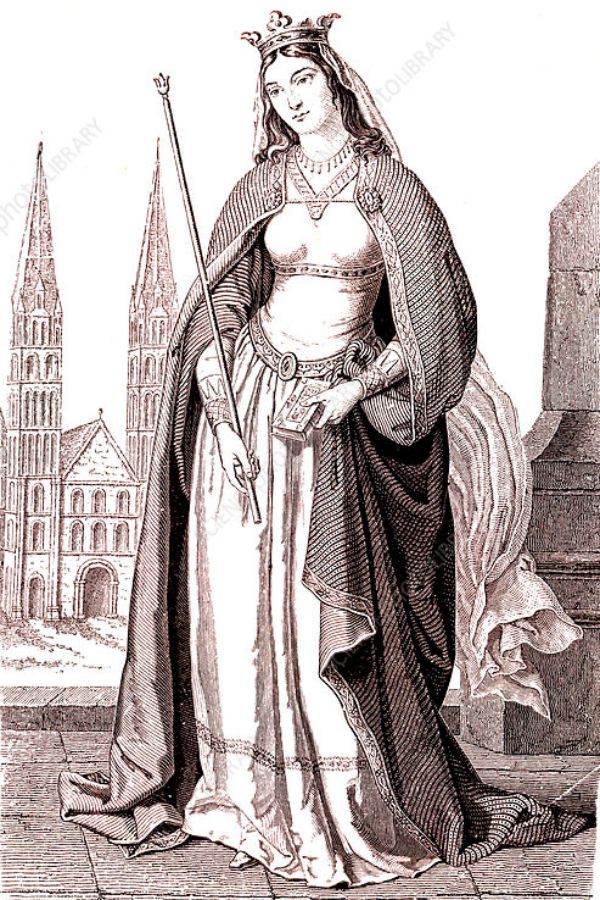
Who Was Matilda of Flanders?
In the Middle Ages, women were rarely seen as equals. Their value was often tied to producing heirs and running a household, with the Church pushing ideals of obedience, purity, humility, and motherhood as the gold standard. Against that backdrop, Matilda’s story stands out. She not only stepped beyond those limits but also held real political power that shaped the course of her husband’s rule.
Matilda was born in 1032 to Count Baldwin V of Flanders and Adele of France. We don’t have any surviving likeness of her, but chronicler Orderic Vitalis described her as a woman of striking looks, noble lineage, intelligence, and strong moral character. That mix made her far more than just a political bride.
Bruges in the 1030s was not a quiet backwater. It was a hub of money and politics, situated between the North Sea and the Frankish kingdoms. That was the world Matilda was born into in 1031 or 1032. Her father was Count Baldwin V of Flanders. Her mother was Adela of France, a Capetian princess and daughter of King Robert II. This gave Matilda royal blood on one side and a power broker for a father on the other.
Baldwin’s court dealt with kings, emperors, and English exiles. It ran on trade, tolls, and alliances. Girls of her rank were expected to read, manage estates, and pray hard. Contemporary writers later praised her education and quick mind.
By her late teens, Matilda was a marriage prize with serious value. Talks for a match with William of Normandy began, then hit a wall in 1049. The Church said they were too closely related under strict kinship rules. The ban stalled everything and turned a tidy alliance into a long negotiation. This is the backdrop to all the colorful stories that get told later.

Hooked on the Middle Ages? Get more stories like this one in your inbox.
Marrying William of Normandy
The story goes that sometime around 1049, William, Duke of Normandy, set his sights on marrying Matilda. She was not impressed. According to legend, she dismissed him outright because of his illegitimate birth. The tale then takes a violent turn. While she was attending mass, William is said to have hauled her out and beaten her in public.
A few days later, the story claims, she changed her mind and declared she would marry no one else. It is the kind of account that makes for a dramatic chronicle, but whether it actually happened is another matter entirely.
What we do know is that the match faced serious opposition from the Church. Pope Leo IX declared it invalid under canon law because William and Matilda were related within the prohibited degrees of kinship. That did not stop them. They married in either 1049 or 1050, and nearly a decade later, Pope Nicholas II finally approved the union. By then, they had already started a family, with their first son, Robert, born in 1051. Matilda went on to have at least three more sons and five daughters.

The marriage brought stability and a strong political partnership, but it also attracted rumors. One eighteenth-century account tells of William becoming involved with two women from the abbey of Préaux. Instead of taking them to his bed, he arranged for them to marry elsewhere.
When Matilda supposedly heard about it, she demanded they be brought to her. That never happened, but a year later, both women were dead. William, suspecting her hand in it, allegedly had her tied by the hair to a horse’s tail and dragged through the streets of Caen.
Another story flips the accusation. A knight in William’s service, Grimoult du Plessis, was caught siphoning money from the royal coffers. He claimed he had done so because he was having an affair with Matilda. According to the tale, she was stripped, tied to a horse’s tail, and paraded naked through the streets before being locked away.
She maintained her innocence. William then disguised himself as a monk to hear her confession. When she again denied the affair, he revealed himself, freed her, and had Grimoult executed in a particularly brutal fashion, skinned alive, and then torn apart by four horses.
The Children of Matilda and William
- Robert, born between 1051 and 1054, died 10 February 1134. Duke of Normandy, married Sybil of Conversano, daughter of Geoffrey of Conversano.
- Richard, born c. 1054, died around 1075.
- William Rufus, born between 1056 and 1060, died on 2 August 1100. King of England, killed in the New Forest.
- Henry, born late 1068, died 1 December 1135. King of England, married Edith of Scotland, daughter of Malcolm III of Scotland. His second wife was Adeliza of Louvain.
- Agatha, betrothed to Harold II of England, Alfonso VI of Castile, and possibly Herbert I, Count of Maine, but died unmarried.
- Adeliza (or Adelida, Adelaide), died before 1113, reportedly betrothed to Harold II of England, probably a nun of St Léger at Préaux.
- Cecilia (or Cecily), born c. 1056, died 1127. Abbess of Holy Trinity, Caen.
- Matilda, “daughter of the King”, born around 1061, died perhaps about 1086, or else much later (according to Trevor Foulds’s suggestion that she was identical to Matilda d’Aincourt).
- Constance, who died in 1090, married Alan IV Fergent, Duke of Brittany.
- Adela, who died in 1137, married Stephen, Count of Blois. Mother of King Stephen of England.
Matilda and the Bayeux Tapestry
For centuries, the Bayeux Tapestry has been linked to Matilda’s name. The tradition claims she commissioned it after William’s victory at Hastings and that she and her ladies stitched the whole thing by hand. It is why in France, you will sometimes still hear it called “La Tapisserie de la Reine Mathilde.”
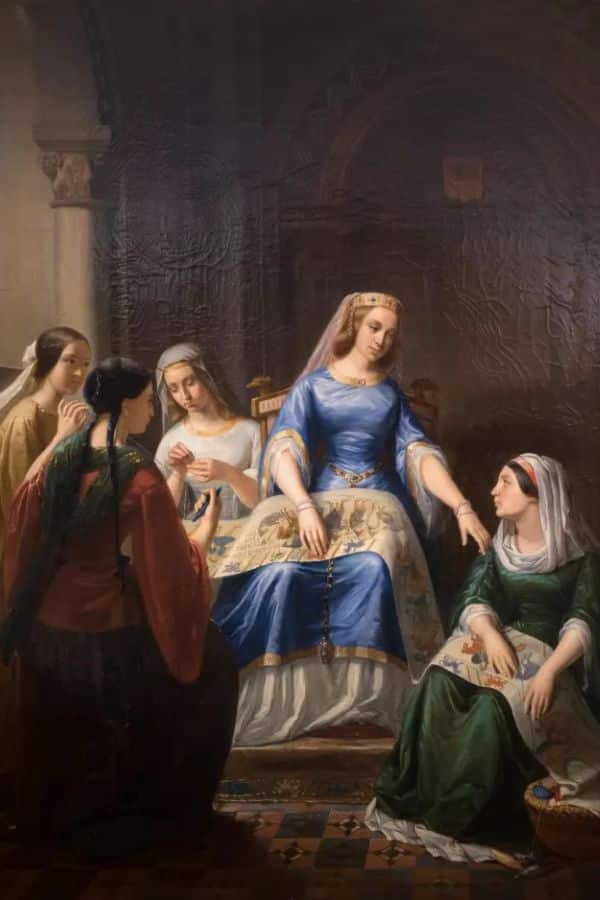
It is a great story, but the evidence does not support it. The tapestry was most likely commissioned by William’s half-brother Odo, Bishop of Bayeux, to decorate his new cathedral in 1077. Odo appears in the embroidery several times, and the workmanship suggests it was produced in England by skilled artisans, not in Normandy by the queen’s household.
So why the royal connection? Later generations liked the idea of a queen preserving her husband’s glory in thread and needle. It gave the conquest a softer, domestic image that fit the romantic view of the Middle Ages. In reality, the Bayeux Tapestry is less a queen’s labor of love and more a political statement stitched for the Church and the nobility who backed William’s rise.
Betrayal, Decline, and Death
In her later years, the cracks began to show. William’s relationship with their eldest son, Robert, had always been uneasy. Robert resented being passed over whenever William left Normandy and wanted a share of authority for himself. In 1077, he took matters into his own hands, leading a rebellion that failed and ended with him fleeing to Flanders.
What happened next was unthinkable for a queen who had spent decades holding her husband’s trust. Matilda secretly sent Robert money to fund another campaign against William. When the king found out, he was furious. Chronicler Orderic Vitalis records her saying she acted out of love for her son, declaring she would “bring him to life at the expense of my own blood.” It was open treason, and William had every right to punish her severely. Instead, she was spared prison or worse, but the trust between them never recovered.

Her health began to fail in the years that followed. By 1083, she was gravely ill, and she died at around 51 years old. Despite the rift, William was deeply affected by her death.
Matilda had been a rare force in medieval politics. Few queens before or after her matched her ability to rule alongside a king and hold power in her own right. Those who tried often met with resistance that she, for most of her life, overcame.
Love a good medieval story?
Join our readers and get tales of kings, queens, castles and ordinary medieval lives straight to your inbox.

Kylie Lang is a nationally syndicated travel journalist with bylines on the Associated Press Wire & more, a medieval history writer, and the founder and lead author of Tales of the Middle Ages (talesofthemiddleages.com). She holds a BA (Honours) in History from the University of Kent and is a member of the British Guild of Travel Writers.
Related posts:
 Empress Matilda: Lady of the English and Queen of Ice and Snow. But Should She Have Been England’s First Queen?
 Empress Matilda: The Crown, the Betrayal, and the Fight of Her Life
 Robert Curthose: The Forgotten Son of William the Conqueror Who Never Became King
 William the Conqueror: Separating Fact from Fiction