I remember going on a school field trip to Runnymede, where the Magna Carta was signed, and being thoroughly unimpressed. But then, how many 11-year-olds do you know who would have been fascinated? Now, as an adult, fascination doesn’t even begin to cover it.
It gets better, because William Marshal, the greatest knight who ever lived, and the one I have a not-so-secret medieval crush on, was there. His name sits right there on the charter, though not as one of the rebels. He was the steady hand both sides somehow still trusted, King John’s own man, the one who kept the whole thing from tipping over into all-out war.
Table of Contents
And the story of how the Magna Carta came about is a cracking one. It came from a country in absolute turmoil. Richard the Lionheart had all but bankrupted England, and then his younger brother John took over and made everything ten times worse, adding cruelty to his long list of talents.
Someone had to make John toe the line. That someone turned out to be William Marshal.
A Kingdom Bled Dry By a Hero King
We tend to remember Richard the Lionheart as the golden warrior king, all crusades and courage. The reality is that he was a disaster for England’s coffers. In a ten-year reign, he spent something like six months actually in the country, and most of that was to squeeze money out of it for his foreign wars.
Then came the truly ruinous bit. On his way home from the Third Crusade, Richard was captured and handed to the Holy Roman Emperor, who promptly held him to ransom. And not a small one. The asking price was 150,000 marks, somewhere around two to three times the entire annual income of the English Crown.
It fell to his formidable mother, Eleanor of Aquitaine, to wring that staggering sum out of an already exhausted country, taxing both clergy and nobles to the bone.
England paid up. Richard came home, then almost immediately went off to France to fight some more, and died there in 1199 with a crossbow bolt in his shoulder.
So that’s the inheritance John walked into. A treasury scraped clean and a nobility thoroughly fed up with paying for it all.

And Along Came John Lackland
King John was the youngest of Henry II and Eleanor’s brood, nicknamed Lackland because there was so little of the family’s lands left to give him. He was clever in his way, and a decent administrator, I’ll give him that. But he was also suspicious, vindictive, and cruel, and he had a real talent for making enemies of the very men he needed on his side.
He is widely believed to have had his own nephew, Arthur of Brittany, murdered to remove a rival claim. He starved one noblewoman and her son to death in his dungeons over a grudge. Even by the rough standards of the day, he stood out.
Then he started losing things. By 1204, he had lost Normandy and Anjou to the patient, calculating Philip II of France, a humiliation that severed his barons from their ancestral lands across the Channel.
He tried to win them back and, in 1214, came badly unstuck at the Battle of Bouvines. To fund all this failure, he taxed his barons mercilessly and helped himself to their money, their wards, and sometimes their wives.
By 1215, the barons had had a bellyful.
The Barons Reached Breaking Point
In the spring of 1215, a large group of barons formally renounced their allegiance to John and went to war. On 17 May, they took London, more or less without a fight, which paralyzed John’s government overnight.
Their leader, Robert Fitzwalter, gave himself the grand title Marshal of the Army of God and Holy Church, which tells you they fancied they had right on their side.
The man caught in the middle was Stephen Langton, the Archbishop of Canterbury, who badly wanted to avoid a bloodbath. Some of the early peace talks were even held at the New Temple in London, the headquarters of the Knights Templar, about as neutral and well-guarded a venue as you could find.
When the moment finally came to thrash out terms, Langton chose Runnymede, a damp water-meadow on the Thames between the royal fortress of Windsor and rebel-held London. Neutral ground, open and flat, where neither side could easily spring an ambush. Clever choice.

Enter William Marshal
Now we get to my favorite part.
William Marshal was, by 1215, an old man by medieval standards and the most respected figure in the kingdom. He had started life as a landless 4th son with nothing but his wits and his skill on a horse.
He made his name and his fortune on the tournament circuit, then served four English kings and was trusted by all of them. The Archbishop of Canterbury later called him “the best knight that ever lived.” High praise, and by all accounts deserved.
But Marshal wasn’t one of the rebels twisting John’s arm. He was one of the very few great lords who stayed loyal to John throughout. He didn’t approve of half of what John did, but he believed in the Crown and in holding the kingdom together.
That made him the one man both the king and the furious barons could still bring themselves to trust. So he became the go-between, shuttling terms back and forth, trying to find a peace that everyone could just about stomach.
And against all odds, he did.

What Really Happened at Runnymede
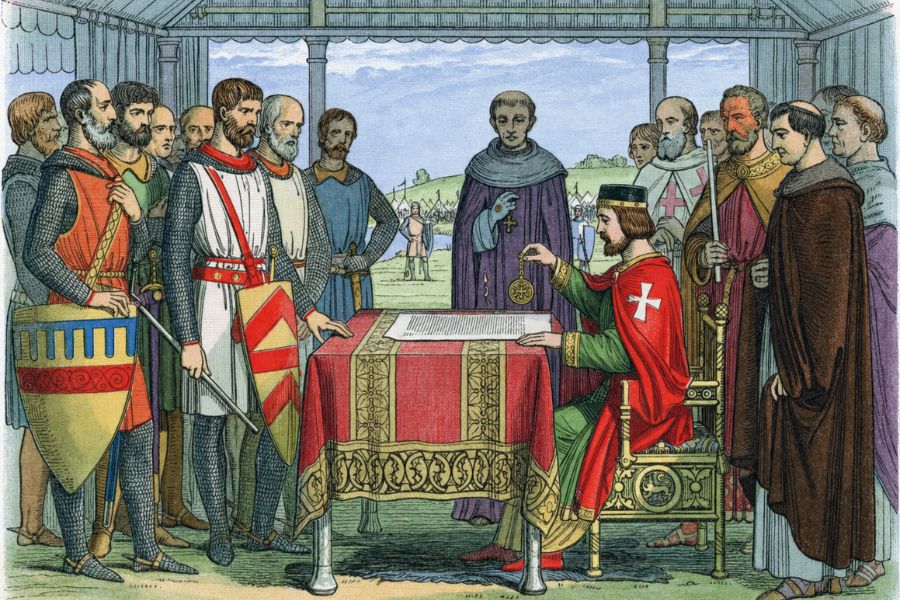
The negotiations weren’t carried out in one afternoon. They stretched over the best part of a fortnight. On 10 June, the two sides agreed on a rough draft known as the Articles of the Barons, and over the next five days, Langton and the others knocked it into a proper charter.
By 15 June, they had a text everyone could live with. On 19 June, the rebels renewed their oaths of loyalty, and copies were sent out around the country.
John didn’t actually sign it. Kings of the period didn’t sign documents; they sealed them. On that day at Runnymede, he pressed his great seal into the wax, and that was that. The charter itself says it was “given by our hand” in the meadow. So every painting you’ve seen of John with a quill in his fist is, strictly speaking, wrong.
It wasn’t even called Magna Carta at the time. That grander name came decades later. In 1215, it was just another charter, one of dozens, forced out of a cornered king. It dealt mostly with feudal grievances, but tucked inside was the radical idea that even the king was bound by the law, and a clause setting up a council of 25 barons to keep him to his word.
Four of those original 1215 copies still survive today, two in the British Library and one each at Lincoln and Salisbury cathedrals.
John Tears Up the Deal
If you think John signed in good faith, think again. Of course, he didn’t. This is John we’re talking about. Within weeks, he had written to the Pope, Innocent III, complaining he’d been bullied into it.
The Pope, who happened to be John’s feudal overlord by this point, obligingly annulled the whole charter that summer, branding it shameful and unlawful.
So much for peace. The First Barons’ War broke out in earnest. The rebels, by now thoroughly done with John, did the unthinkable and invited Prince Louis of France to come and take the English throne instead. Louis landed in 1216 and was soon holding London and half the country.
And then fate stepped in. In October 1216, with his kingdom collapsing around him, John was crossing the treacherous tidal flats of the Wash when his baggage train, royal treasure, and crown jewels and all were swallowed by the incoming tide.
Days later, sick with dysentery and a broken man, he died at Newark Castle. He was only 49 and despised and deserted, almost exactly as he’d lived.

How William Marshal Saved the Realm (and the Magna Carta)
It didn’t. And that is entirely down to William Marshal.
John’s heir, Henry III, was a boy of nine. The French prince held London, and the treasury was empty. The obvious outcome was a French king on the English throne and the charter forgotten as a footnote.
Instead, the nobles turned to the one man with the authority and the reputation to hold things together, and at around seventy years old, William Marshal was made regent, the ruler of England in all but name.
And, of course, the first thing he did was to reissue the Magna Carta in 1216, and again in 1217, stripped of its most awkward clauses but very much alive. In a single move, he pulled the rug from under the rebels, because now the boy king’s own government was offering the reforms they’d gone to war for.
Then he picked up a sword. In 1217, at well past the age most men were dead, he led the royalist army to a decisive victory at the Battle of Lincoln, the French were beaten again at sea, and Louis gave up his claim and went home.
Marshal died in May 1219, his work done, taking his final vows as a Knight Templar and was buried in Temple Church in London, where his stone effigy lies to this day.
So the next time someone tells you King John gave England the Magna Carta, you can gently put them right. John sealed it under duress and tore it up the moment he could. It survived because a loyal old knight refused to let it die, reissued it in a child king’s name, and won the war that made it stick.
If you fancy seeing all this drama played out on screen, by the way, it turns up in a fair few medieval films, though I’d take their version of events with a generous pinch of salt.
Related posts:
 William Marshall, the Greatest Knight Who Ever Lived. But Who Was the Man Behind the Legend?
 What Made William Marshal the Greatest Knight in History?
 Mahelt, First Daughter of William Marshal, the Greatest Knight in History
 How the Young William Marshal Conquered the Tourney Circuit and How He Built a Fortune Before He Was Famous