With the upcoming new series, King and Conqueror, a new drama airing on the BBC, it gives me the perfect excuse to take a deeper look into the legend that is William the Conqueror. Born the illegitimate son of the Duke of Normandy, he fought his way to power long before the Battle of Hastings made him King of England. His life was one of calculated risks, brutal battles, and an unrelenting will to hold onto what he claimed.

But there is more to his story than his battles and achievements. Some say he ripped a woman from her horse by her hair to win her hand. Others claim he took gruesome revenge on a town for mocking his mother. There is even the stomach-turning account of his funeral, where his corpse supposedly burst in front of horrified mourners.
Table of Contents
Separating fact from fiction is never straightforward with a figure like William. The question is, how much of what we think we know is real?

Early Life: From Bastard to Duke Under Siege
William’s story begins in Falaise, Normandy, around 1028. His father, Robert I, Duke of Normandy, had no legitimate heir, and his mother, Herleva, was the daughter of a tanner. That made William a target from the moment he was born. In a world where bloodlines decided your worth, it was a brand that could cost you your life.
When Robert left on pilgrimage to Jerusalem in 1035, he named William, then around seven or eight years old, as his heir. It was a dangerous gamble. Robert died suddenly on the journey home, leaving Normandy in the hands of a child surrounded by rival barons who smelled blood.
The first of William’s appointed guardians, his great-uncle Alan of Brittany, died within a year. Soon after, Gilbert of Brionne, another key protector, was murdered by two men who lured him out with false pretenses and cut him down. Turchetil, another ally, was also killed, as was Osbern, William’s steward, who was murdered in his bed while guarding the boy.
The danger was so constant that William was moved between the castles of loyal vassals under cover of darkness to avoid ambush. Even his closest allies were not safe from shifting loyalties. The unrest boiled over in 1046 when Norman rebels tried to capture or kill him outright.
William fled to the court of his overlord, King Henry I of France, who helped him crush the rebellion at the Battle of Val-ès-Dunes the following year. That victory was a turning point. It showed that the bo, whom some dismissed as a weak claimant, could wield power with the backing of the right allies.
By his late teens, William had already endured a level of treachery and bloodshed that would have destroyed most rulers twice his age. These early years burned into him the lessons that shaped his entire reign: never trust without reason, strike before your enemies can, and hold your position with unrelenting force.
Securing Normandy
By the time William reached his early twenties, Normandy was still a volatile duchy, but he had learned how to turn instability to his advantage. His first major test after Val-ès-Dunes came from his own kin. Guy of Burgundy, William’s cousin, gathered a force of discontented nobles and launched a rebellion.
It ended with Guy cornered in the stronghold of Brionne. William starved him into surrender, letting him walk away alive but stripped of power. It was a calculated choice, the kind of decision that kept his enemies wary without creating unnecessary martyrs.
William also strengthened his position by securing the support of King Henry I of France, though that alliance would not last forever. In these years, he tightened his grip on Normandy’s key castles and replaced disloyal lords with men whose loyalty was to him alone. This was as much about political chess as it was about brute force. Every garrison he secured, every marriage alliance he arranged, made it harder for rivals to unseat him.
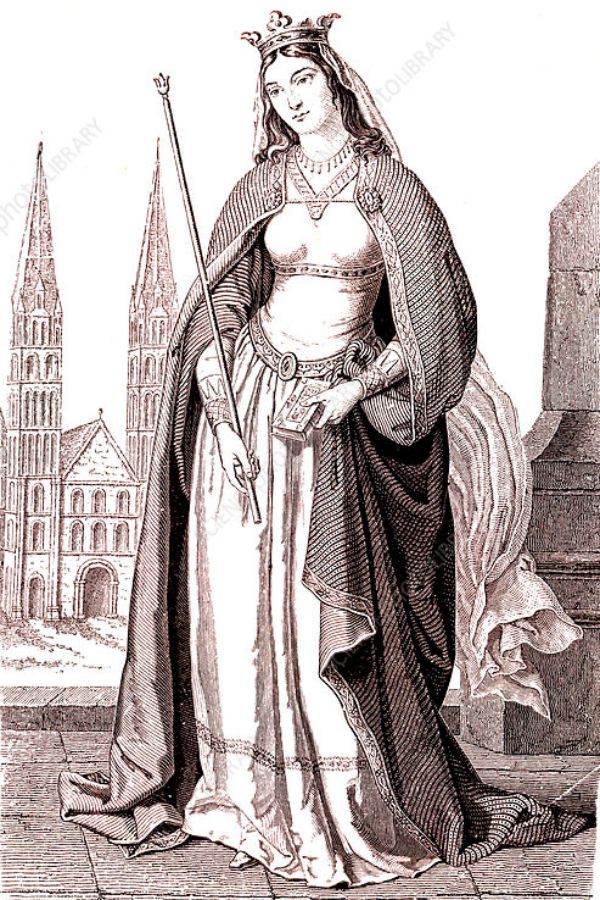
And then there’s the story of how he won his wife, Matilda of Flanders. Chroniclers claimed William rode to Bruges, found Matilda, and pulled her from her horse by her hair after she refused to marry him. The reality is likely far less theatrical. The match was politically valuable because she was the daughter of Baldwin V, Count of Flanders.
Although the Church initially opposed the union for reasons of consanguinity, William and Matilda married around 1051. The marriage was stable and strategic. Matilda managed Normandy while William campaigned, proving herself an effective and trusted partner.
By the mid-1050s, William had turned Normandy into a strong, unified base of power. The same nobles who once plotted his death now had little choice but to follow his lead. His attention began to shift beyond Normandy’s borders, and toward a claim across the Channel that would define the rest of his life.
The Norman Conquest of England
By the early 1060s, William’s ambitions had shifted toward the English crown. His claim rested on two arguments. First, he was a distant cousin of Edward the Confessor through Edward’s Norman mother, Emma. Second, William maintained that Edward had promised him the throne years earlier, during a visit in 1051. Whether that promise was genuine or a diplomatic courtesy that William later framed to his advantage is still debated by historians.
The death of Edward in January 1066 set events in motion. The Witenagemot, England’s council of nobles and clergy, chose Harold Godwinson, Earl of Wessex, as king. William treated this as a betrayal and began preparing for an invasion. He secured papal support, raising his campaign above a personal quarrel and framing it as a holy cause. That backing not only gave him legitimacy but also drew fighters from across Europe to join his fleet.

The Battle of Hastings
William’s fleet landed at Pevensey in late September 1066, building a wooden castle as a base before moving inland. Harold’s army had just marched south from a victory over the Norwegian king Harald Hardrada at Stamford Bridge, covering hundreds of miles in days. Exhausted but determined, Harold positioned his forces on Senlac Hill near Hastings, forming a solid shield wall with his housecarls in the front and less experienced fyrdmen behind.
On 14 October 1066, the two armies met at Hastings. It opened with Norman archers loosing volleys uphill, but the English shields held. William then sent in his infantry, followed by cavalry, but the steep slope and disciplined English line blunted the attack. Several times in the morning, the Normans fell back, and at one point, a rumor spread that William had been killed. He rode forward, lifting his helmet to show his face and rally his troops.
The turning point came with a combination of tactics and luck. Some English troops broke formation to pursue retreating Normans, creating gaps in the shield wall. William exploited this, sending cavalry through the breaches and ordering fresh arrow volleys. One of these arrows may have struck Harold in the eye, as famously depicted in the Bayeux Tapestry, though some historians think he was cut down by Norman knights. With their leader dead, the English resistance collapsed. The battle had lasted most of the day, and the field was left littered with the bodies of England’s defenders.
William’s victory at Hastings was decisive, but not final. He still had to march on London, subdue the remaining opposition, and secure his crown. That would take a mix of force, calculated rewards, and an unrelenting show of authority.
Securing the Crown
After the battle, William paused at Hastings to rest his army and tend to the wounded before beginning a calculated march toward London. Instead of heading straight for the city, he moved in a wide arc through Kent, Sussex, and Surrey, capturing towns, burning property, and intimidating anyone who resisted.
The show of force worked. Several key English leaders, including Edgar Ætheling, the teenage claimant named by some nobles after Harold’s death, submitted before William reached the capital.
London itself was divided. While some factions wanted to resist, the approach of William’s army and the destruction in the surrounding areas pushed the city’s leaders toward negotiation. By early December, William had been offered the crown. On Christmas Day 1066, he was crowned King of England in Westminster Abbey.
The ceremony was tense. When the Norman guards outside heard the cheers for William, they mistook them for a riot and began setting fire to nearby buildings, causing panic inside the abbey. Despite the chaos, the coronation went ahead, marking the beginning of Norman rule in England.
Wearing the English Crown
William’s coronation was only the beginning of a long and often violent effort to hold England. The early years of his reign were marked by rebellions from both English nobles and discontented Normans. In 1067, while William returned to Normandy to secure his continental lands, unrest flared in Kent and the Welsh borders.
He crushed these uprisings on his return, using a mix of brutal punishment and the construction of stone and timber castles to enforce control. The Tower of London began as one of these strongholds, a permanent reminder of his authority. The most serious threat came in the north.
In 1069, an alliance of Northumbrian rebels, Danish forces, and Scottish support rose against Norman rule. William responded with the Harrying of the North, a campaign of scorched earth that destroyed crops, villages, and livestock. Thousands died from famine in its aftermath. It secured the region but left a lasting scar on his reputation, showing his willingness to use fear and devastation to keep order.
William also reshaped the political landscape. He replaced much of the Anglo-Saxon nobility with Norman lords loyal to him and reorganised landholding through the feudal system. Every landholder owed him direct allegiance, a bond he reinforced with the Oath of Salisbury in 1086. That same year, he commissioned the Domesday Book, a vast survey of land, resources, and population across England. It gave him unparalleled knowledge of his realm and tightened his grip on taxation and military service.
William and Matilda had at least nine children who survived to adulthood. Their sons included Robert Curthose, Duke of Normandy; William Rufus, who succeeded his father as William II of England; and Henry, who would later become Henry I. Their daughters, such as Adela of Normandy, were married into powerful European families, extending William’s influence beyond his own borders.
By the end of his reign, William had transformed England into a kingdom firmly tied to Normandy, its nobility reshaped, its defences strengthened, and its political power centralized in the crown. But holding this empire together was a constant balancing act, and it would test him until his final days.

William’s Final Years and Death
The last years of William’s reign were marked by constant movement between England and Normandy. His control over both lands was never entirely secure. In Normandy, he faced raids from France and disputes with his eldest son, Robert Curthose, whose impatience for power led to open conflict. Father and son even fought against each other in battle at Gerberoi in 1079, where Robert wounded William and forced him to retreat. Their relationship never fully recovered.
In England, William’s absence gave ambitious barons room to test their limits. He returned periodically to deal with disputes and collect revenues, but his attention was increasingly focused on continental politics. Normandy’s position between France and the growing Angevin influence meant he could never ignore events across the Channel for long.
In 1087, war broke out with King Philip I of France. William burned the French town of Mantes, but during the campaign, he was thrown forward in the saddle when his horse stumbled. The impact ruptured his abdomen, leaving him in agony. He was carried to Rouen, where his health steadily declined. Chroniclers record that the smell from his injury filled the room as his body began to fail. On 9 September 1087, William died.
Before he died, William still had just enough strength to make the kind of deathbed decision that would keep his family at each other’s throats for generations. His eldest son, Robert Curthose, had long been a source of trouble, so William bypassed him and named his younger son, William Rufus, as King of England.
On paper, this followed Norman custom: Robert would inherit Normandy while Rufus took the English crown. In reality, it was a mistake. Dividing his lands meant dividing his power, and once the words were spoken, Rufus wasted no time. He was on the road to England before his father’s body had even cooled, eager to get the crown on his head before Robert could make a move.
The Funeral from Hell
William the Conqueror’s funeral would go down as one of the most disastrous send-offs of the Middle Ages. His coronation years earlier had been interrupted when guards mistook cheering for a riot and set fire to nearby buildings. That was bad enough. But his funeral rites would be remembered for a level of chaos that chroniclers described in a way modern readers might see as almost Monty Python material.
It began with theft. Almost as soon as William’s body was laid out, the room was stripped bare. Those who had been present at his death scrambled for valuables, leaving the king’s corpse lying naked on the floor. It was not loyal nobles or close family who stepped in, but a passing knight who took pity on the scene. He arranged for an embalming, of sorts, before the body was sent to Caen for burial. By then, the stench was likely already setting in.
When the monks came out to receive the coffin, history repeated itself. Just as at his coronation, a fire broke out in the town, adding smoke and panic to the grim procession. Once things calmed, the body was brought to the Abbaye-aux-Hommes for the service. As the eulogies began, the officiant asked the congregation to forgive William for any wrongs he had committed.

At that moment, a man stepped forward to object. He claimed William had stolen his father’s land, the very ground on which the abbey stood, and that the king had no right to be buried there. Negotiations were held in front of the mourners until a payment was agreed upon.
The worst moment was still to come. The corpse, swollen from heat and poor embalming, would not fit into the stone sarcophagus that had been made for it. The attendants forced it in, and, as chronicler Orderic wrote, “the swollen bowels burst, and an intolerable stench assailed the nostrils of the by-standers and the whole crowd.” Incense was no match for the smell. The service was hurried to its end, with mourners eager to get as far from the abbey as possible.
Fact or Fiction
| Story | What the Legend Says | What the Evidence Suggests |
|---|---|---|
Winning Matilda |
William rode to Bruges, found Matilda of Flanders, and pulled her from her horse by her hair when she refused to marry him. | A medieval soap opera version of events. Most likely the marriage was a carefully arranged political alliance. It strengthened William’s position and proved a lasting partnership, with Matilda running Normandy in his absence. |
Revenge at Alençon |
The townspeople mocked William’s mother’s low birth by banging animal hides on the walls. William captured the ringleaders and had their hands and feet cut off. | This fits his ruthless image, but the story comes from later chroniclers who may have exaggerated it. The core event could be true, yet the details are suspect. |
Harold’s Arrow in the Eye |
At Hastings, Harold Godwinson was killed by an arrow to the eye, as shown in the Bayeux Tapestry. | The tapestry’s stitching is open to interpretation. Some sources say Harold was cut down by Norman knights. The arrow could be a later addition to create a striking ending. |
The Exploding Funeral |
William’s corpse was too big for his stone coffin. When attendants forced it in, his body burst, filling the church with a horrific stench. | Unfortunately for the mourners, this is likely true. Orderic’s account matches what can happen with poor embalming, summer heat, and a coffin built too small. |
Conclusion
William the Conqueror’s life was a blend of hard fact and enduring legend. The records show a man who fought his way from a vulnerable childhood to ruling over two powerful realms. The stories, whether they are fully true or not, reflect how his contemporaries saw him: decisive, feared, and unrelenting.

The upcoming BBC drama King and Conqueror will no doubt bring these moments to life, weaving truth and imagination just as medieval chroniclers did nearly a thousand years ago. Whether the series chooses to focus on the political strategist, the battlefield commander, or the man behind the crown, it is certain to revive the debate over which parts of William’s story are history, and which belong to the realm of legend.

Kylie Lang is a nationally syndicated travel journalist with bylines on the Associated Press Wire & more, a medieval history writer, and the founder and lead author of Tales of the Middle Ages (talesofthemiddleages.com). She holds a BA (Honours) in History from the University of Kent and is a member of the British Guild of Travel Writers.
Related posts:
 10 Shocking Facts About the Battle of Hastings That History Books Don’t Tell You
 Robert Curthose: The Forgotten Son of William the Conqueror Who Never Became King
 Empress Matilda: The Crown, the Betrayal, and the Fight of Her Life
 Empress Matilda: Lady of the English and Queen of Ice and Snow. But Should She Have Been England’s First Queen?