Cecily Neville was born in 1415, the year Henry V cut the French army to pieces at Agincourt. She died in 1495, ten years into the reign of Henry VII, the man who had killed her grandson at Bosworth and married her granddaughter to seal the deal. Between those two dates, she lived through nearly every major event in 15th-century English politics.
She was mother to Edward IV and Richard III, mother-in-law to Elizabeth Woodville, and grandmother to the Princes in the Tower. She watched her husband die at Wakefield, her son George drown in malmsey wine (or so the story goes), and her youngest boy fall at Bosworth in the last meaningful charge of an English king.
Table of Contents
Cecily’s story is the spine of the Wars of the Roses. She was there for all of it, and she outlasted every one of them.
The Rose of Raby
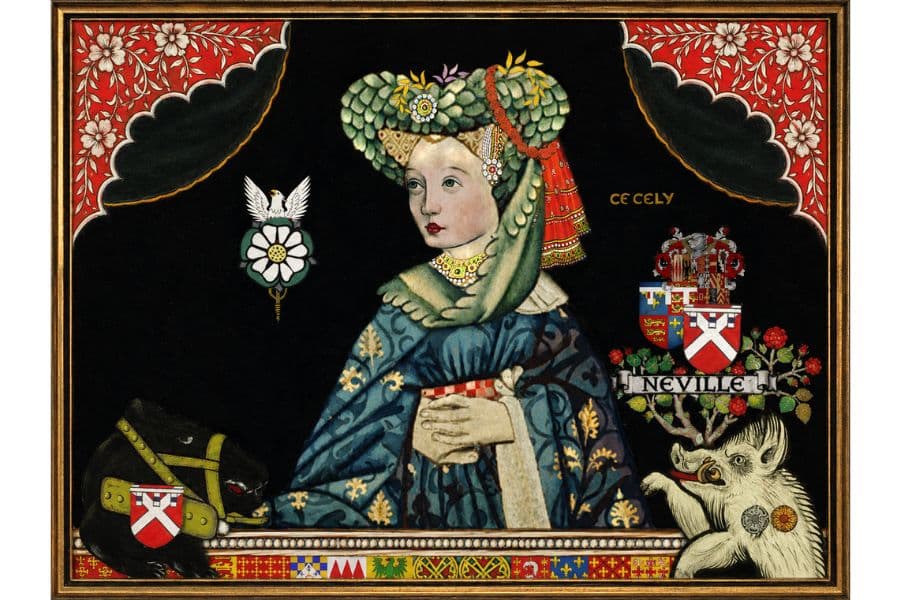
Cecily was the youngest of Ralph Neville’s many children. Ralph, the 1st Earl of Westmorland, had 22 children across two marriages, and Cecily was the baby of the second batch, born at Raby Castle in County Durham. Raby was a serious northern fortress, all battlements and great halls, and the Nevilles were one of the most powerful families in England.
She was considered a beauty, and her family married her well. At nine years old, she was betrothed to Richard, Duke of York, who was 13 and had recently become the ward of her father after his own father’s execution for treason.
They grew up together in the Neville household. By the time they actually married, probably around 1429, they had known each other for years. It’s one of the medieval marriages that seems to have worked. Richard and Cecily had at least 12 children together, which suggests they weren’t avoiding each other’s company, and their letters carry a warmth that protocol didn’t require, which I find quite remarkable.
Duchess of York, and the Slow Slide Toward War
Richard of York was, by blood, one of the closest adult male relatives of Henry VI. He had a strong claim to the throne through both parents and arguably a better one than the king himself.
For years, he served the Lancastrian crown loyally, governing Normandy and then Ireland, with Cecily often at his side. She gave birth to her son George in Dublin in 1449. Her son Edward, the future Edward IV, was born at Rouen in 1442.
This was the high point. The Yorks were wealthy, well-connected, and producing healthy sons at a time when the king and queen weren’t. Henry VI was pious, mentally fragile, and surrounded by advisors the Yorks despised. By the early 1450s, Richard had run out of patience with being kept at arm’s length from the court.
What followed was the long opening act of the Wars of the Roses, and Cecily was already up to her neck in it. In 1459, after the rout at Ludford Bridge, Richard fled to Ireland, and Cecily was left behind with her two youngest sons, George and Richard, to face the Lancastrian army.
She reportedly stood with the boys at the market cross in Ludlow as the town was sacked around her. She was taken into custody and placed under the supervision of her own sister, Anne, who was married to a Lancastrian.
Wakefield, and the Year Everything Changed
December 1460. Richard of York had come back to England, pressed his claim to the throne, and reached a compromise with Henry VI: Henry would remain king for life, but Richard and his heirs would succeed him. Margaret of Anjou wasn’t going to accept that. She raised an army in the north and marched south.
On 30 December, Richard rode out from Sandal Castle in Yorkshire to meet the Lancastrian force at Wakefield. It was a disaster. Richard was killed in the fighting, and his 17-year-old son Edmund, Earl of Rutland, was caught fleeing and killed on Wakefield Bridge by Lord Clifford, supposedly in revenge for Clifford’s own father’s death at St Albans.
Cecily’s brother, the Earl of Salisbury, was captured and beheaded the next day. The three heads, Richard’s, Edmund’s, and Salisbury’s, were stuck on the gates of York, and Richard’s wore a paper crown, in mockery of his claim.
Cecily was 45. She had lost her husband, her second son, and her brother in 48 hours, and the Lancastrian army was now marching toward London. She sent her two youngest, George and Richard, across the Channel to Burgundy for safety. Then she waited.
Three months later, her eldest son Edward won the throne at the bloody field of Towton, said to be the largest battle ever fought on English soil, and Cecily became mother to the king. The paper crown her husband had been mocked with had become real, just not on the head it was meant for.
Hooked on the Middle Ages? Get more stories like this one in your inbox.
Mother of the King, and the Marriage She Hated
Edward IV was 18 when he took the throne. He was tall, handsome, charismatic, and, as it turned out, completely uncontrollable on the subject of women. In 1464, he secretly married Elizabeth Woodville, a Lancastrian widow with two sons and a large, ambitious family. He announced it to his court months after the fact, when it was too late to undo.
Cecily was furious. The Woodvilles were beneath the Yorks by every measure of the time, and a secret marriage to a widow with no political value was a slap in the face to every alliance Edward could have made on the continent.
There’s a story, recorded later and possibly embellished, that Cecily was so angry she offered to declare Edward illegitimate herself, claiming she’d had an affair with an English archer named Blaybourne while Richard was away at war.
That rumor about Edward’s parentage chased him his whole life, and it surfaced again, conveniently, when his brother Richard took the throne in 1483.
Whether Cecily ever said any such thing is doubtful. She was a deeply pious woman who spent hours a day in religious devotion, and the idea that she’d publicly accuse herself of adultery to spite her son strains belief.
What’s not in doubt is that the relationship between Cecily and Elizabeth Woodville was poisonous from the start. The two women shared a court and a son/husband, as far as we can tell, a steady mutual loathing for the next 20 years.

Watching Her Sons Destroy Each Other
Her son George, Duke of Clarence, the middle boy, was the sort of man who couldn’t stop overreaching. He rebelled against Edward, allied with the Earl of Warwick, switched sides, was forgiven, plotted again, and was finally arrested in 1477. In 1478, he was executed in the Tower, possibly by being drowned in a butt of malmsey, which is one of those details too good to be true and yet too well-attested to dismiss.
Edward signed his own brother’s death warrant. Cecily begged for his life and was ignored.
Five years later, Edward IV died suddenly at 40. His 12-year-old son was declared Edward V. Within weeks, Cecily’s youngest, Richard of Gloucester, had taken the boy into custody, declared the marriage to Elizabeth Woodville invalid, had himself crowned Richard III, and put both his nephews in the Tower, where they vanished.
What Cecily thought of any of this, we don’t know. She was at her residence at Berkhamsted by then, living what amounted to a semi-monastic life. Her surviving household ordinances describe a daily schedule of prayer, scripture readings at meals, and very little else.
In August 1485, Richard rode out to meet Henry Tudor at Bosworth. He was killed in the fighting, the last English king to die in battle, stripped naked and slung over a horse. Cecily was 70 years old.
She had now buried a husband, four sons (Henry, who died in infancy, Edmund at Wakefield, George in the Tower, Richard at Bosworth), and watched the dynasty she and her husband had built collapse in a single afternoon on a Leicestershire field. Her grandsons in the Tower were gone. The Yorkist line, in the male line that mattered, was finished.

The Last Decade
Henry VII married Cecily’s granddaughter, Elizabeth of York, in January 1486. That match is what produced the Tudor dynasty, and through it, Cecily is the great-great-grandmother of Elizabeth I. So in a strange way, she did win in the end, just not in the way she would have wanted. Her blood sat on the throne.
The last decade of her life was spent at Berkhamsted Castle in something close to a religious retreat. She rose at seven, attended multiple masses, ate in silence while a chaplain read aloud from devotional texts, and went to bed early.
She had her own copy of Walter Hilton’s Scale of Perfection and the revelations of Bridget of Sweden. The household ordinances that survive give a clear picture of a woman who had decided, after a lifetime of court politics and family slaughter, that she was done with the world.
She died on 31 May 1495, aged 80, and was buried beside Richard of York at Fotheringhay, the castle where their son Richard III had been born 42 years earlier. Her will is a careful, pious document, distributing books of hours and devotional manuscripts to her surviving granddaughters.
She’d outlived her husband by 35 years, her eldest son by 12, her youngest by 10, and had lived through the reigns of five kings of England, four of them her direct relatives, and watched her family go from the wealthiest in the north to the throne and then to nothing.
Love a good medieval story?
Join our readers and get tales of kings, queens, castles and ordinary medieval lives straight to your inbox.
Kylie Lang is a nationally syndicated travel journalist with bylines on the Associated Press Wire & more, a medieval history writer, and the founder and lead author of Tales of the Middle Ages (talesofthemiddleages.com). She holds a BA (Honours) in History from the University of Kent and is a member of the British Guild of Travel Writers.
Related posts:
 The Real Story of Cecily Neville, Mother to Edward IV and Richard III
 Cecily of York: The Princess Who Should Have Been Queen of Scotland But Died in Obscurity
 Plantagenet Princess, Cecily of York Should Have Been Queen of Scotland, So What Happened?
 Sweyn Forkbeard: The First Viking King of England