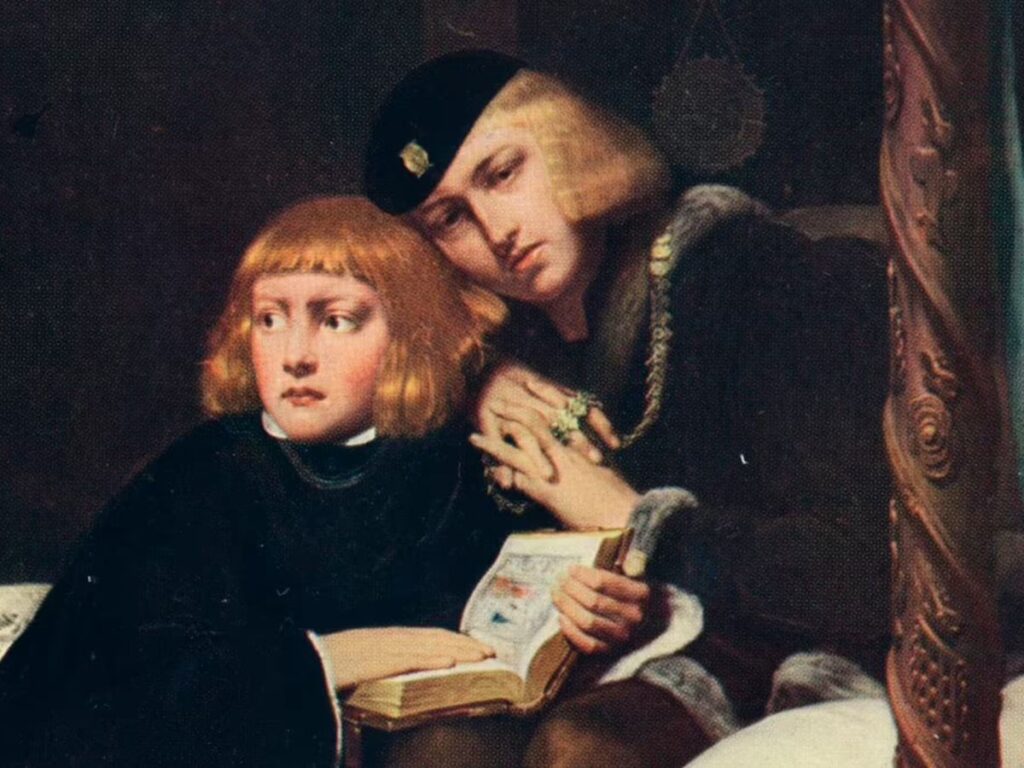
In the summer of 1483, two boys vanished from the Tower of London. Edward V, only twelve years old, and his younger brother Richard of Shrewsbury, were last seen playing in the gardens of the fortress where they had been kept since their uncle seized the crown. After that, silence. No burial recorded. No official word. Just an empty set of rooms and whispers that never stopped.
The disappearance of the princes has remained one of history’s most enduring mysteries. Theories have multiplied for more than five hundred years, each pointing the finger at a different suspect. Some names are obvious, others less so, but politics, ambition, and blood tie all.
Table of Contents
Whoever was responsible knew that the survival of the princes threatened their own hold on England. That left a trail of suspects ranging from kings and queens to loyal allies who may have acted in silence.
Suspect No. 1 Richard III
Richard of Gloucester was the uncle of the princes and the man who placed them in the Tower. On paper, it was supposed to be a safe place while preparations were made for Edward V’s coronation. Instead, the boys’ legitimacy was stripped from them when Richard declared their parents’ marriage invalid. Within weeks, he was crowned Richard III, and the boys slipped further out of sight.

The case for
Richard had the clearest motive of all. So long as the princes lived, they were the rightful heirs. Every rebellion that flared in England during his short reign used their names as a rallying cry. Richard controlled the Tower, which gave him both opportunity and access. A clean removal of the boys would have left him as the sole focus of loyalty, ending doubts about his crown.
The case against
There is no direct evidence that Richard ordered their deaths. No letters, no orders, no witnesses. Some argue he may have preferred to keep the boys alive as hostages, a safeguard against Tudor rivals. Allowing their mother, Elizabeth Woodville, to return to court under his protection also complicates the picture.
If she had suspected Richard killed her sons, would she have risked her daughter’s safety by returning back into his circle? It’s also worth noting that Richard’s reputation was largely written by Tudor historians who stood to gain by painting him as a child-killing tyrant. That leaves the possibility that he was guilty, but equally the chance that he was framed by history.
Suspect No. 2 Henry Stafford, Duke of Buckingham
Henry Stafford was no stranger to shifting loyalties. He was a cousin of both the Yorks and the Tudors, and his family history was soaked in the blood of power struggles. At first, he was Richard III’s ally, helping to secure the throne. Yet within months, he led a rebellion against the very man he had supported. That quick turn has left historians wondering if Buckingham acted on his own to remove the princes, either to please Richard or to clear his own path to the crown.
The case for
Buckingham had ambition. As a descendant of Edward III through both his father and mother, he could trace a thin but legitimate line to the throne. With the princes gone, he may have seen his chance to step forward. He also had opportunity.
Some believe Richard may have entrusted him with the boys, giving him both the means and the chance to act. His sudden rebellion against Richard in the autumn of 1483 is often read as a sign that he had his own agenda from the start.
The case against
Buckingham’s rebellion failed, and he was executed soon after. If he had killed the princes, he never got to claim the benefit. There is also no proof that Richard gave him custody of the boys, only speculation.
His revolt might have been driven less by his own ambition and more by dissatisfaction with Richard’s rule. Some argue that Buckingham simply became the perfect scapegoat, a convenient shadow figure to draw suspicion away from the king.
Suspect No. 3 Henry VII (Henry Tudor)
Henry Tudor was the exiled Lancastrian who would one day defeat Richard III at Bosworth and claim the throne as Henry VII. At the time of the princes’ disappearance, he was across the Channel in Brittany, watching the political chaos in England from afar. His claim to the throne was thin, but if the princes were alive, his cause was even weaker. That has led some to wonder if he had a hand in their fate.

The case for
Once Henry became king in 1485, the survival of the princes would have been disastrous for him. His entire rule rested on marrying Elizabeth of York, the princes’ sister, to unite York and Lancaster. But that claim meant little if her brothers were still living.
By eliminating them, Henry secured his dynasty. His silence on the matter also raises questions. After his victory, he never investigated their disappearance, never tried to find their remains, and never officially cleared Richard of the crime. To some, that silence speaks volumes.
The case against
At the time the boys are thought to have vanished, Henry was in exile with no direct access to the Tower of London. He had no means to touch the princes while Richard was on the throne. If Richard had already removed them, Henry’s later actions make more sense.
His failure to search for the truth may have been less about guilt and more about political convenience. By keeping the mystery unsolved, he allowed suspicion to cling to Richard, which helped justify his own crown.
Suspect No. 4 Margaret Beaufort
Margaret Beaufort was the mother of Henry Tudor and one of the most determined political figures of the fifteenth century. Married off young and widowed as a teenager, she poured her life into advancing her only son’s claim to the throne. Every move she made was calculated, every alliance forged with an eye on power. Some theories cast her as the shadowy hand behind the disappearance of the princes.

The case for
Margaret had a fierce determination to see her son crowned. If the princes were removed, Henry’s path was clearer. She had connections across England and a talent for quiet maneuvering, so arranging such an act from behind the scenes is not impossible.
After Bosworth, she emerged with extraordinary influence, guiding her son’s reign and ensuring the Tudor dynasty took firm root. That later dominance has fueled suspicion that she may have been capable of anything to secure her son’s crown.
The case against
Margaret had no direct access to the Tower, nor the means to carry out such a plot while Richard was in power. The idea that she ordered the murders relies more on imagination than evidence. While she was ambitious, she was also cautious.
Risking such a crime before her son even set foot on English soil would have been dangerous and out of step with her careful strategy. It is more likely that her reputation for relentless scheming led people to project guilt onto her after the fact.
Suspect No. 5 Henry Percy, Earl of Northumberland
Henry Percy was a powerful northern magnate with deep Yorkist roots. His family had long controlled the north of England and often played kingmaker in the shifting wars of the fifteenth century. During Richard III’s reign, Percy held a key role as Constable of the Tower of London, a position that placed him directly in the setting where the princes disappeared. That fact alone has made him a suspect.
The case for
As Constable, Percy technically had authority over what happened inside the Tower. If Richard gave a discreet order, Percy would have been the man to enforce it. Alternatively, Percy may have acted on his own initiative, either to win favor with Richard or to secure his own position in a dangerous political climate. The opportunity was there, and few others held such a direct line to the boys’ confinement.
The case against
Despite his position, Percy’s loyalty was complicated. He was not a natural ally of Richard III, and he is not recorded as one of the king’s closest confidants. If he had committed such a crime, there is no indication he benefited from it.
He remained a prominent noble under both Richard and Henry VII, but nothing in the record suggests he ever leveraged knowledge of the princes for power. Without clear motive, his presence at the Tower looks more like circumstance than conspiracy.
Suspect No. 6 William Stanley
William Stanley came from a family known for playing both sides in the Wars of the Roses. Along with his brother Thomas, he held enormous power in the northwest of England. William’s moment of infamy came at Bosworth in 1485, when he turned against Richard III on the battlefield and helped secure victory for Henry Tudor. His shifting loyalties and reputation for intrigue have led some to wonder whether he played a part in the fate of the princes.
The case for
The Stanleys were masters of survival, changing allegiance when it suited them. William may have seen the princes as valuable bargaining chips. If he removed them, he could have secured favor from Richard or kept their fate hidden until Henry’s return to England.
His later betrayal of Richard at Bosworth shows that he was not above ruthless calculation. That kind of opportunism makes him a plausible suspect.
The case against
There is no evidence linking William Stanley to the Tower or the boys themselves. His power was regional, not centered in London, and he had no official role in their custody. The theory of his involvement rests on his reputation rather than hard fact.
When he was eventually executed under Henry VII for treason years later, no one accused him of the princes’ deaths. That silence makes it unlikely that he was ever directly tied to the crime.
Suspect No. 7 John Howard, Duke of Norfolk
John Howard was one of Richard III’s staunchest allies. Elevated to Duke of Norfolk by Richard, he fought and died at Bosworth defending his king. His loyalty to Richard was unquestioned, but that same loyalty has made him part of the debate about the fate of the princes. Some suggest that he may have acted to remove the boys without Richard’s direct order, believing it would strengthen his master’s hold on the crown.
The case for
Howard was deeply invested in Richard’s reign. He had received lands, titles, and power from the new king, and the survival of the princes remained a threat to everything he had gained. As one of Richard’s closest supporters, he had influence and the reach to arrange such an act.
If he believed killing the princes was in Richard’s best interest, he may have taken it upon himself to carry it out, sparing the king from having blood on his hands.
The case against
There is no sign that Howard had direct access to the Tower or control over the princes’ custody. While he was loyal, he was also pragmatic. Murdering the princes without Richard’s explicit command would have been reckless, even dangerous, given the political consequences.
His death at Bosworth left no confession or rumor tying him to the boys’ disappearance. In the end, suspicion lingers only because he was close enough to Richard to have been involved.

The Case That Still Haunts England
The mystery of the princes in the Tower has endured for more than five centuries because it refuses to give up its secrets. Each suspect had motive and opportunity, yet none can be proven beyond a doubt. Some left trails of ambition, others left only silence, and history has filled the gaps with suspicion.
In 1674, workmen demolishing a staircase in the Tower uncovered two small skeletons. They were placed in Westminster Abbey as the supposed remains of the princes. For centuries, they have rested there, but their identity has never been confirmed. Modern testing could provide answers, yet the church has repeatedly refused to allow the bones to be exhumed.
What we do know is that two boys disappeared in the summer of 1483, and their absence changed the course of England. Richard III’s rule never shook off the shadow of their fate. Henry VII built his dynasty on that silence. Every rebellion, every rumor, and every retelling of the story kept their memory alive while their bodies remained hidden.
Until those remains are examined, the princes remain prisoners of history. Their story is the wound at the heart of the Wars of the Roses, a mystery that binds kings, rebels, and traitors together in a question that still has no answer.