
You’ve probably heard of the commoner who married a king. The widow who caught Edward IV’s eye under an oak tree and ended up wearing a crown. It sounds romantic, doesn’t it? But Elizabeth Woodville’s story is no fairytale. It’s tangled up in war, ambition, family power grabs, and some of the darkest twists in English royal history.

She walked straight into the lion’s den of court politics. Her marriage upended decades of dynastic strategy. Her family’s sudden rise made enemies in all the wrong places. And when the throne was snatched out from under her son, she fought back with everything she had.
Table of Contents
This is the story of a queen who outlived her husband, her enemies, and even her reputation. She made alliances in the shadows. She may have lost everything, but she never gave up control. If you think you know Elizabeth Woodville, think again.

Early Life and First Marriage
Elizabeth Woodville was born around 1437 in the village of Grafton Regis in Northamptonshire. Her father, Sir Richard Woodville, started life as a respectable knight from the landed gentry. Her mother, Jacquetta of Luxembourg, was another story altogether. She had once been the Duchess of Bedford, married to the brother of King Henry V, and she came from one of the most powerful noble families in Europe.
When Jacquetta secretly married Richard Woodville after her first husband died, it caused a royal scandal. They didn’t have permission from the crown and were fined for it. Eventually, they were pardoned, but the message was clear. The marriage was seen as a social step down, and not everyone was quick to forget it.
This complicated mix of high blood and lower rank shaped Elizabeth’s early life. She may have been beautiful, but she didn’t grow up with the full weight of noble privilege behind her. Her family had wealth and influence, but not the kind that opened every door at court.
Around the age of fifteen, she married Sir John Grey of Groby. He was a Lancastrian supporter with land and some status, though nothing spectacular. Together, they had two sons, Thomas and Richard. Then came war. John Grey was killed at the Second Battle of St Albans, fighting for the losing side, and everything changed.
Elizabeth, not yet twenty-five, was left a widow with two young boys. The crown seized her husband’s lands, and with the Yorkists now in power, her family’s Lancastrian ties worked against her. She had to move back in with her parents at Grafton: no influence, money, or real standing in the new regime. From there, her future looked limited. What she did next, though, would change the course of English history.

A Secret Match with King Edward IV
In 1464, Elizabeth Woodville did something few women in her position ever got the chance to do. She stopped the king. Legend says she waited beneath an oak tree with her two young sons, hoping to speak directly to Edward IV as he passed through the area.
The wars had left her vulnerable. Her sons’ inheritance was gone. She had no husband, no protection, and very few options. But she wasn’t meek, and she wasn’t there to beg. She stood firm and asked for justice. That alone caught Edward’s attention.
Edward was known for chasing women. He had a reputation even at a young age, and he was used to getting what he wanted. But Elizabeth didn’t melt at the sight of his crown. According to later accounts, he tried to seduce her, offering her a position as his mistress. She refused. Repeatedly. She made it clear that she would only come to him as a wife or not at all.
This resistance wasn’t just about virtue. Elizabeth understood power. She knew that if she gave in, she’d be discarded as quickly as the others. She made Edward work for her, and in the end, he did. The king, who could have had almost anyone, made a decision that would haunt his reign. He married her in secret.
A Dangerous Match
The wedding likely took place at her family’s home in Grafton. It was small and quiet. No public witnesses, no grand displays. Just a king, a widow, and the start of a scandal. Elizabeth became Queen of England without a drop of royal blood or any of the noble alliances the crown usually demanded. It was a bold move for her, but an even riskier one for Edward.
It was a high-stakes gamble. And when word got out, it caused chaos at court. Edward’s advisors had been setting up a marriage with a French princess. That alliance would have cemented foreign support and strengthened his claim to the throne. Instead, they were handed a queen who came with no dowry, no army, and a family that half the kingdom still viewed with suspicion.
Elizabeth’s elevation triggered a political storm. Warwick, the kingmaker himself, was furious. He had been negotiating the French match personally and saw the secret marriage as a betrayal and an insult. Other nobles were just as angry. Many believed the king had acted out of lust and weakness. Some openly questioned whether Elizabeth had used witchcraft to snare him. Her position was legal, but not accepted. And the fallout was only just beginning.

Queen Consort and the Rise of the Woodvilles
Once Elizabeth became queen, the Woodvilles rose with her. Edward IV was nothing if not loyal to his new wife, and he didn’t hold back when it came to rewarding her family. Elizabeth was the eldest of thirteen siblings, and one by one, her brothers and sisters were elevated. They were married into noble houses, handed prestigious titles, and placed in powerful positions. What looked like generosity from a king in love quickly turned into a power grab in the eyes of the court.
The old nobility saw the Woodvilles as social climbers. They weren’t from the right families. They hadn’t earned their place in battle. And suddenly, they were everywhere. Titles were flying thick and fast. Elizabeth’s eldest son from her first marriage, Thomas Grey, was made Marquess of Dorset and matched with a wealthy heiress. Her father became Earl Rivers, and her brothers secured plum roles that should have gone to men with deeper noble roots.

Scandalous Marriages and Unforgiving Eyes
The marriages arranged for Elizabeth’s sisters did nothing to calm the waters. Three were paired off with heirs of the earls of Kent, Essex, and Pembroke, tightening the Woodville grip on key regions. Catherine Woodville, still only fourteen, was married to the king’s eleven-year-old ward, the Duke of Buckingham. It raised eyebrows and then some.
Another of Elizabeth’s brothers, John, just twenty at the time, married the dowager Duchess of Norfolk. She was in her sixties. The age gap certainly raised a few eyebrows. People saw it for what it was: a financial move to gain her property and title.
These alliances only added fuel to the fire. Rumors flew that Elizabeth was orchestrating the whole thing, using her beauty and charm to influence Edward and fill the court with her own people. Whether or not that was true, the effect was the same. The court had become a battleground, and resentment against the Woodvilles began boiling over.

The Kingmaker’s Revenge
By the mid-1460s, resentment turned to rebellion. Warwick, the powerful noble who had helped Edward win his crown, was being pushed to the margins. He had once been the king’s closest ally. Now he watched a new family take over everything he thought he controlled.
Warwick eventually snapped. He joined forces with Edward’s younger brother, George, the Duke of Clarence, who also had no love for Elizabeth. Together, they launched a rebellion in 1469. Clarence accused Elizabeth and her mother, Jacquetta, of using witchcraft to seduce the king and manipulate the crown.
Jacquetta was even put on trial for sorcery. There was no evidence, and she was acquitted, but the accusation alone showed how far people were willing to go to bring the Woodvilles down.
Blood, Sanctuary, and a Son Born in Hiding
The crisis reached its peak between 1469 and 1471. Warwick’s men captured and executed Elizabeth’s father and one of her brothers. Then came the ultimate blow. Warwick and Clarence managed to drive Edward off the throne entirely. The Lancastrians returned to power, and Henry VI was restored. Elizabeth, pregnant and vulnerable, fled into sanctuary at Westminster Abbey. It wasn’t the first time a royal woman had taken refuge there, but she may have been the only one to give birth behind its walls. Her son, the future Edward V, was born in sanctuary in November 1470.
For months, she was trapped. Her husband was in exile, her enemies were back in control, and her family had been torn apart. It was one of the darkest chapters of her life, and it could easily have ended in ruin. But things changed quickly in the Wars of the Roses, and this time, they turned back in her favor.
Return of the King
Edward returned in the spring of 1471 with an army at his back. He defeated and killed Warwick at the Battle of Barnet. Then came another Yorkist victory at Tewkesbury. The Lancastrians were crushed again, and their last real hope, Henry VI, died shortly afterward in the Tower of London. Edward was restored to the throne, and Elizabeth stepped out of sanctuary with her newborn son to reclaim her place as queen.
With their enemies gone or dead, the Yorkists settled into what seemed like stability. Elizabeth had ten children with Edward, seven of whom survived, including her two sons, Prince Edward and Prince Richard. For the next twelve years, she played her role at court carefully. She supported religious institutions, gave to charities, and showed herself beside the king at all the right moments. But not all was peaceful beneath the surface.
Enemies Close to Home
Not everyone at court had moved on. George, Duke of Clarence, continued to stir up trouble until his execution for treason in 1478. Other nobles, resentful but quieter, waited for their moment. The Woodvilles remained powerful, but they were never fully accepted. Still, as long as Edward IV sat on the throne, Elizabeth’s position was secure.
She was queen, and her sons stood to inherit everything. It looked like the family had weathered the worst. But that security would vanish overnight when the king died, and the crown passed into the hands of a child.
Edward IV’s Death and the Princes in the Tower
Edward IV died suddenly on April 9, 1483, at just 40 years old. There had been no long illness, no warning. One day, he was king; the next, he was gone, and everything Elizabeth had built was hanging by a thread. Their eldest son was only twelve. He was declared Edward V, but he was still a child.
Elizabeth, now Queen Dowager, naturally expected to help guide the new king. She had influence, experience, and every intention of protecting her son’s inheritance. But her brother-in-law had other ideas.
Richard, Duke of Gloucester, Edward IV’s youngest brother, moved fast. He declared himself Lord Protector, took control of the government, and made it clear the Woodvilles were no longer welcome. When young Edward V began traveling to London for his coronation, he never made it to the crown.
Richard intercepted him, arrested his escort, Elizabeth’s brother Anthony Woodville, and her son from her first marriage, Richard Grey, and had them thrown in prison. They were both executed without trial, not long after. Now entirely in Richard’s hands, Edward V was taken to the Tower of London. Officially, it was for his safety. In reality, he had just been removed from the game.
A Second Sanctuary
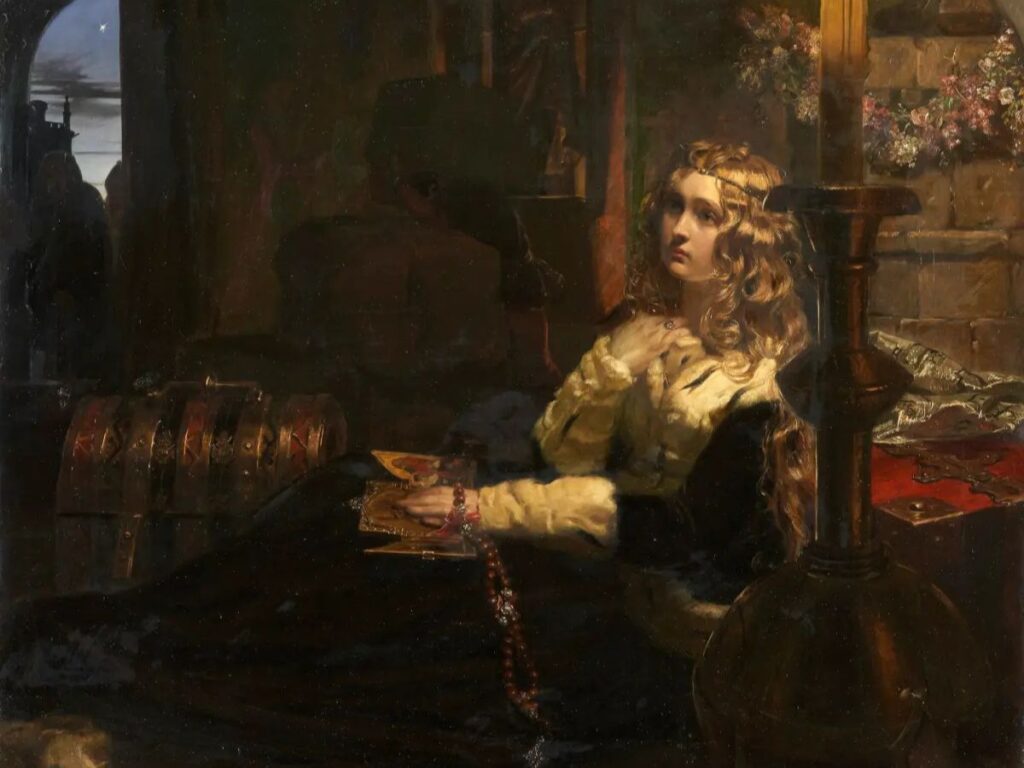
Elizabeth had seen this kind of power grab before, and she didn’t wait around to see how far Richard would take it. She gathered her daughters and her youngest son, Richard Duke of York, and rushed to Westminster Abbey. She had been there before, in her darkest days, and now she returned again.
Surrounded by men loyal to her brother-in-law, she reinforced the Abbey with furniture and supplies, turning the royal sanctuary into a fortress. For weeks, she stayed hidden, cut off from the court and the outside world, watching Richard tighten his grip.
Then, in June 1483, Richard claimed that Edward IV’s marriage to Elizabeth had never been valid. A priest appeared saying Edward had been pre-contracted to marry another woman before he wed Elizabeth. If true, the entire royal family was illegitimate. Parliament didn’t hesitate. They passed an act known as Titulus Regius that labeled all of Elizabeth’s children as bastards with no right to the crown.
It even accused her of using witchcraft to lure Edward into marriage, though that part was so ridiculous it wasn’t pursued seriously. On June 26, Richard had himself crowned King Richard III. Elizabeth, once queen of England, was stripped of everything. She was called “Dame Elizabeth Grey” again, as if her time on the throne had never happened.
The Princes Disappear
The cruelest blow was still to come. Her sons vanished. Edward V and his younger brother Richard, both now locked away in the Tower, were never seen again. Richard III had promised they would be safe. Elizabeth believed him enough to let her younger son join his brother. After that, nothing. No sightings, no messages, no bodies.
Most people believed the boys were murdered. Then and now, suspicion falls squarely on Richard III. Killing them would have removed the last threat to his rule. Contemporary sources referred to the princes as already dead within months of Richard taking the throne. Elizabeth, locked away in sanctuary, was left to mourn children she could no longer even hope to save. Her Yorkist line, through the boys at least, was gone.

A Mother in Mourning—and on the Move
With her sons gone, the next viable Yorkist heir was her daughter, Elizabeth of York. And the dowager queen wasn’t done fighting. From the shadows of the Abbey, she started to look for new allies. She had no armies or titles, but she still had her name, network, and will. And she was about to forge one of the most surprising and game-changing partnerships in the entire Wars of the Roses.
An Unlikely Alliance and the Rise of the Tudors
Elizabeth knew she couldn’t beat Richard on her own. She didn’t have the support at court, and her sons, who should have secured her place in the future, were gone. But she still had one powerful card to play, her daughter, Elizabeth of York. And she found an unlikely partner to help her use it.
Lady Margaret Beaufort had just as much at stake. Her son, Henry Tudor, lived in exile across the Channel, clinging to a distant Lancastrian claim to the throne. Margaret was no stranger to court politics. She survived under Lancastrian and Yorkist rule, always playing the long game.
Together, these two women, one Yorkist and one Lancastrian, set their sights on Richard III. Their idea was bold: They would marry Elizabeth of York to Henry Tudor. That single act could unite the warring houses, end the bloodshed, and give Henry the legitimacy he badly needed.
By the end of 1483, the deal was set. The women arranged everything through messengers. Henry Tudor stood in Rennes Cathedral in France and swore that, if he won the crown, he would marry Elizabeth of York. The plan was clear. Henry would return with an army, take the throne by force, and marry into the Yorkist line. The match would unite the red rose and the white rose and reshape English history.
Out of Sanctuary, but Not Out of the Game
Richard III wasn’t blind to the danger. Rebellions were already breaking out, including one led by his former ally, the Duke of Buckingham. It failed, but it showed Richard how unstable things had become. In a move that seemed generous but was likely strategic, he reached out to Elizabeth Woodville. In March 1484, he allowed her and her daughters to leave sanctuary. He promised their safety and even offered to arrange marriages for the princesses and provide for them financially.
Elizabeth accepted. She left the Abbey and reentered court life, though her power was a shadow of what it had once been. She was given a pension and treated with courtesy. Whether she truly reconciled with Richard or simply played the part while waiting for her moment is still debated. But either way, she stayed close enough to watch the pieces move.

The Battle That Changed Everything
In 1485, Henry Tudor made his move. He crossed the Channel from France with his army and met Richard III on the field at Bosworth. Elizabeth wasn’t there, but the outcome would shape the rest of her life. Richard was killed in battle, and Henry claimed the crown as King Henry VII. Just as he had promised, he married Elizabeth of York in early 1486. Their union brought an end to the Wars of the Roses and gave rise to the Tudor dynasty.
It was the moment Elizabeth Woodville and Margaret Beaufort had worked for. Their children would rule. For Elizabeth, it was vindication. Her daughter restored the Yorkist bloodline and helped heal a divided kingdom. She had outlasted her enemies.

A Crown Reclaimed, But a Voice Diminished
Despite the victory, life under Henry VII wasn’t all celebration. Elizabeth’s titles were restored. Her marriage to Edward IV was officially declared valid again, and her children were recognized as legitimate. She was given back some of her lands and treated with respect as the king’s mother-in-law. But she no longer held real power.
Henry trusted his own mother far more. Margaret Beaufort was made the senior dowager queen and took precedence at court. Elizabeth didn’t challenge this. There were no open feuds between the two women, but it was clear which of them Henry relied on. Elizabeth faded into the background. She had done her part. Her daughter was queen. The Tudors had taken the throne. And after decades of turmoil, she finally stepped away from the stage.
Dowager Queen: Elizabeth’s Final Years
By 1487, Elizabeth Woodville had seen more than most queens ever would. Her husband was gone, her sons were lost, her daughter was now queen of England, and the throne had passed to a new dynasty she had helped bring about. That same year, she quietly withdrew from court and moved to Bermondsey Abbey, just outside London.
Why she left has never been fully settled. Some suspected Henry VII wanted her out of the way, worried she might still be tied to Yorkist plots like the one surrounding Lambert Simnel. Others believe she chose it herself, after decades of political scheming and personal loss. Maybe she was simply tired.
She was around fifty, and she had lived through constant turmoil. Whatever the reason, Henry granted her a generous pension and saw that she was treated with the dignity of a dowager queen. But she was no longer a player in court politics.
A Quiet Life on the Edges
Elizabeth wasn’t completely cut off from her family. Her daughters visited her, and she did attend court briefly for key events, including the birth of her grandson, Prince Henry, in 1491. The boy would go on to become Henry VIII, but at the time, he was just another royal baby in a long line of Tudor heirs. Elizabeth must have known, though, that her bloodline was now at the heart of the crown.
There was even a strange plan floated to marry her off again. After the death of James III of Scotland’s wife, Henry VII reportedly considered offering Elizabeth as a bride to the Scottish king. Nothing came of it; James died before it could go anywhere, but the idea shows that even in her final years, Elizabeth was still seen as a valuable pawn in diplomatic circles. The court might not have needed her voice anymore, but her name still held weight.
A Modest Farewell
Elizabeth Woodville died at Bermondsey Abbey on June 8, 1492, at around 55 years old. Some believe the plague may have played a part in her death, which would explain the quiet, rushed nature of her funeral. She had asked for a simple burial in her will, and that’s exactly what she got. No state spectacle, no elaborate procession. Just a modest ceremony and a final resting place beside Edward IV at St. George’s Chapel, Windsor Castle.
It’s a quiet end for someone who once stood at the center of England’s most brutal power struggle. She had risen from the gentry, fought through scandal and rebellion, and lived long enough to see her daughter crowned queen. She had lost her father, her brothers, and her sons. She had struck secret deals with enemies and outlasted kings. And in the end, she helped give rise to a dynasty that would shape England for the next hundred years.

The White Queen on Screen
The White Queen, the 2013 BBC drama based on Philippa Gregory’s novels, brought Elizabeth’s story to life with plenty of drama, romance, and a heavy dose of mysticism. Rebecca Ferguson’s portrayal gave viewers a glimpse into a queen who was ambitious, emotional, and deeply devoted to her family.
The series sticks quite well to the sweeping events of Elizabeth’s life, her sudden marriage to Edward IV, her rise to power, the fury of the old nobility, and the disappearance of her sons. It captures the high stakes and the personal grief, and it doesn’t shy away from the court intrigue surrounding her.
But like most dramatizations, it also leans into elements that make for good television, including magic and prophecy. These were themes picked up from the novels, not the historical record.

Kylie Lang is a nationally syndicated travel journalist with bylines on the Associated Press Wire & more, a medieval history writer, and the founder and lead author of Tales of the Middle Ages (talesofthemiddleages.com). She holds a BA (Honours) in History from the University of Kent and is a member of the British Guild of Travel Writers.
Related posts:
 Margaret Beaufort vs Elizabeth Woodville: Who Was More Powerful?
 The Real Elizabeth Woodville: How a Widow from the Wrong Family Became Queen of England
 The Untold Story of Jacquetta of Luxembourg, the Woman Behind the Woodville Rise
 The Daughters of Elizabeth Woodville: Marriage, Power, and Survival in Tudor England