On the morning of August 22, 1485, the king of England put on his crown and rode into battle wearing it. By the end of the day, he was dead in the mud, stripped naked, and slung over a horse like a sack of grain.
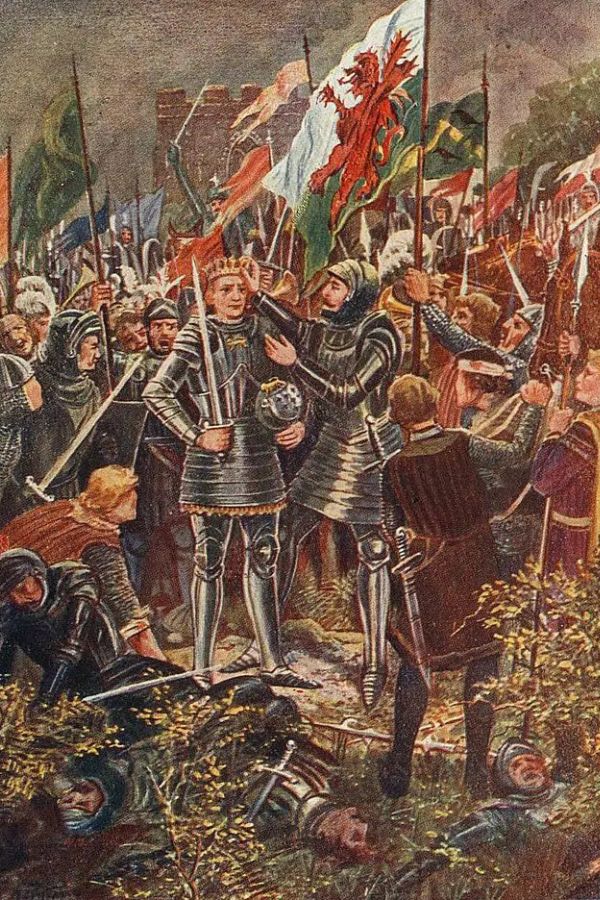
The crown had rolled off his head and, according to legend, was fished out of a thornbush and placed on the head of the man who had killed him. That man was Henry Tudor, a 28-year-old exile with a thin claim to the throne and an army made up of French mercenaries, Welsh recruits, and English defectors.
Table of Contents
He’d spent half his life on the run, and not set foot in England in fourteen years. The Battle of Bosworth lasted maybe two hours and ended the Plantagenet dynasty that had ruled England since 1154, starting the Tudor dynasty that would give us Henry VIII, Bloody Mary, and Elizabeth I.
The Road to Bosworth
Henry Tudor’s claim to the English throne was, on paper, almost laughable. His mother, Margaret Beaufort, was descended from John of Gaunt through a line that had been declared legitimate but explicitly barred from inheriting the crown.
His father, Edmund Tudor, was the son of a Welsh courtier and the widow of Henry V. Henry himself was born at Pembroke Castle in 1457, three months after his father died of plague, when his mother was just 13 years old.
He spent his teens and twenties in exile in Brittany, kept alive partly by the protection of Duke Francis II and partly by the fact that he wasn’t quite important enough to assassinate. That changed in 1483.
Richard III had taken the throne that summer after declaring the children of his brother Edward IV illegitimate, locking those children, the boys we now call the Princes in the Tower, inside the Tower of London, and watching them disappear from the historical record.
With Edward IV’s sons gone, Henry Tudor suddenly became the most credible Lancastrian candidate left standing. His mother, Margaret Beaufort, had spent years building support within England, including a careful alliance with Elizabeth Woodville, the mother of the vanished princes. The two women cooked up a plan: Henry would invade, take the throne, and marry Elizabeth of York, joining the two warring houses. It was an audacious bet on a young man most English people had never seen.

Richard III’s Position
By the summer of 1485, Richard III had been king for just over two years. Those two years hadn’t been easy ones. His only legitimate son, Edward of Middleham, had died in April 1484, aged ten.
His wife Anne Neville had died in March 1485, almost certainly of tuberculosis, though the rumor mill insisted Richard had poisoned her to marry his own niece. He spent Easter that year publicly denying it in front of the Lord Mayor of London, which gives you some sense of how loud the gossip had become.
He also had a credibility problem with his own nobility. The Duke of Buckingham, the man who had helped put him on the throne, had turned on him within months and been executed in 1483. Whispers about the missing princes wouldn’t die. And the lords whose support he needed most, the ones with private armies of their own, were starting to hedge their bets.
The most important of these was Thomas Stanley, Lord Stanley. Stanley happened to be married to Margaret Beaufort, which made him Henry Tudor’s stepfather. Richard couldn’t trust his own rival’s stepfather, so he held Stanley’s son, Lord Strange, hostage to guarantee loyalty. Whether that would actually hold a man like Stanley in place was an open question, and Richard must have known it.

Hooked on the Middle Ages? Get more stories like this one in your inbox.
The Invasion
Henry landed at Mill Bay in Pembrokeshire on August 7, 1485, with perhaps 2,000 men, most of them French troops loaned by the regent of France, Anne of Beaujeu. She wanted Henry to win because a friendly England meant one less problem on her northern flank. And it worked in Henry’s favor.
He marched through Wales gathering support, leaning hard on his Welsh heritage and his descent from the ancient British kings. The Welsh poets had been calling him the mab darogan, the son of prophecy, for years. Rhys ap Thomas, the most powerful man in South Wales, eventually threw in with him after some negotiation. By the time Henry crossed into England near Shrewsbury, his army had roughly doubled.
Richard was at Nottingham when he heard the news. He moved south to Leicester, gathering his forces as he went. The two armies converged near the town of Market Bosworth in Leicestershire.
Richard’s army was the larger of the two, probably around 10,000 to 12,000 men. Henry had perhaps 5,000. And then there were the Stanleys, Thomas and his brother William, who arrived with another 6,000 between them and parked their forces between the two armies without committing to either side.
Richard could see them, and so could Henry, but nobody knew which way they would jump. Possibly the Stanleys didn’t know either.
The Battle Itself
On the morning of August 22, Richard drew up his army on Ambion Hill. The exact location of the battlefield was disputed for centuries until archaeological work in 2009 found cannonballs, badges, and a silver-gilt boar in a field about a mile from where everyone had assumed the fighting took place.
The boar was Richard’s personal emblem, and it was likely lost by one of his household knights at the moment of his death.
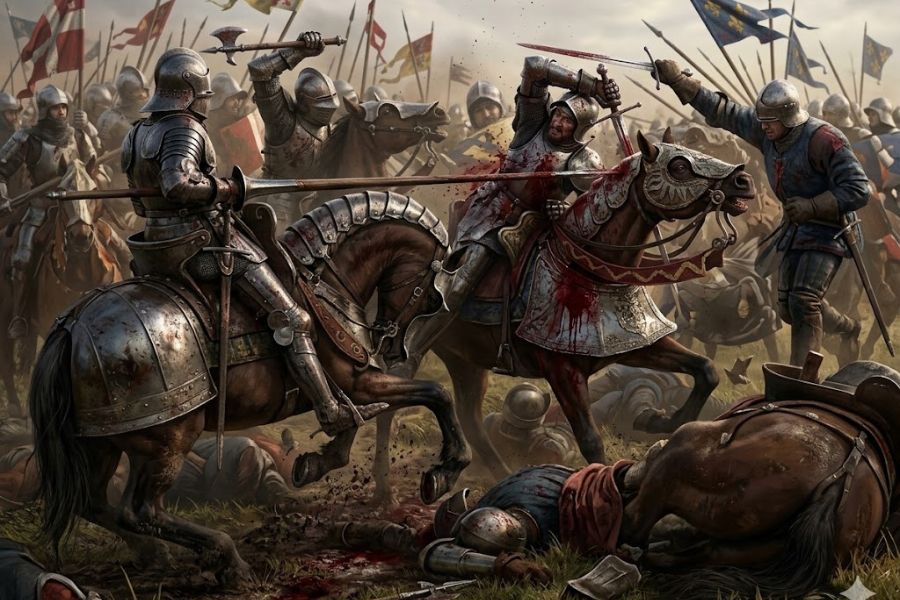
The battle opened with an exchange of artillery and arrows. Richard’s vanguard, led by the Duke of Norfolk, clashed with Henry’s, led by the Earl of Oxford. Oxford was a veteran of the Wars of the Roses and one of the best field commanders of his generation. He kept his men in tight formation, refused to be drawn out, and held his line. Norfolk was killed in the fighting, and that’s when things began to wobble for Richard.
Then Richard did something extraordinary. He spotted Henry Tudor’s standard at the rear of the enemy line, some distance from the main fighting, with only a small bodyguard around him. Richard decided to end the battle himself.
He led a cavalry charge straight at Henry, cutting down Henry’s standard-bearer, William Brandon, and getting within a sword’s length of Henry himself. For a few minutes, the whole future of England came down to whether one man could kill another in single combat.
That was when the Stanleys finally moved. William Stanley brought his men crashing into the side of Richard’s charge. Richard was surrounded, dragged from his horse, and hacked to death.
The skeleton found under a Leicester car park in 2012 showed at least eleven wounds, including two to the back of the skull, severe enough to slice off pieces of bone. He had fought hard. The chroniclers, even hostile ones, agreed on that. Northumberland, commanding Richard’s rear, hadn’t moved at all.

The Aftermath
Richard’s body was stripped naked, slung over a horse, and carried back to Leicester. It was put on public display for two days at the Church of the Annunciation of Our Lady of the Newarke, so that everyone could see the king was actually dead.
Then he was buried without ceremony at the Greyfriars church. The site was lost after the Dissolution of the Monasteries, until that 2012 dig confirmed the skeleton was his through DNA matching with a known descendant of his sister.
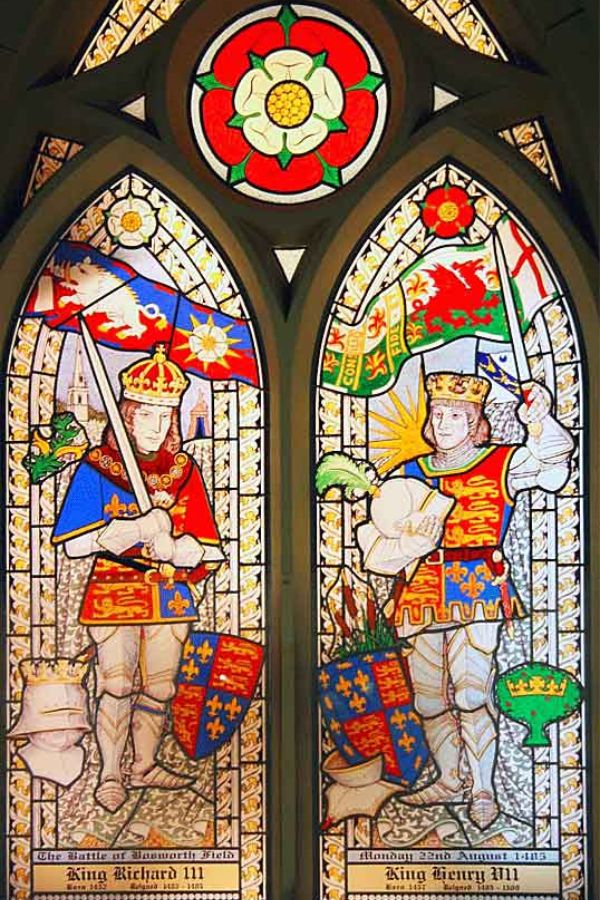
Henry Tudor was crowned on the battlefield, or at least that’s the story, by Thomas Stanley using a circlet retrieved from the field. He dated the start of his reign to August 21, the day before the battle, which conveniently made everyone who had fought against him a traitor. He kept his promise and married Elizabeth of York in January 1486, joining the red rose and the white. Their son would become Henry VIII.
The people who had backed the wrong horse paid for it. The Earl of Surrey, Norfolk’s son, spent years in the Tower before being rehabilitated. Northumberland kept his head for the moment but was murdered by a mob in 1489.
William Stanley, the man whose charge had won the battle, was executed for treason by Henry VII a decade later for getting tangled up in the Perkin Warbeck conspiracy. Loyalty to the Tudors turned out to be a moving target.
The Wars of the Roses weren’t quite over. Henry would face the Lambert Simnel rebellion in 1487 at the Battle of Stoke Field, which some historians argue was the real end of the dynastic wars. But Bosworth was the hinge.
Two hours of fighting, a king killed in a marsh, a dynasty replaced. The cannonballs they pulled out of that field a few years back are smaller than you’d expect. Most of them would fit in your palm.
Love a good medieval story?
Join our readers and get tales of kings, queens, castles and ordinary medieval lives straight to your inbox.

Kylie Lang is a nationally syndicated travel journalist with bylines on the Associated Press Wire & more, a medieval history writer, and the founder and lead author of Tales of the Middle Ages (talesofthemiddleages.com). She holds a BA (Honours) in History from the University of Kent and is a member of the British Guild of Travel Writers.
Related posts:
 The Four Husbands of Margaret Beaufort: The Teenage Bride Who Gave Birth at Just 13 Years Old
 September 4, 925: The Day England’s First King, Æthelstan, Was Crowned, But Was He?
 The Pretender Prince: Perkin Warbeck and the Plot to Overthrow Henry VII
 Sweyn Forkbeard: The First Viking King of England