On a wet August morning in 1485, a king died in a Leicestershire field with a halberd through his skull. He was 32 years old, had reigned for just over two years, and would spend the next five centuries being argued about by people who never met him.
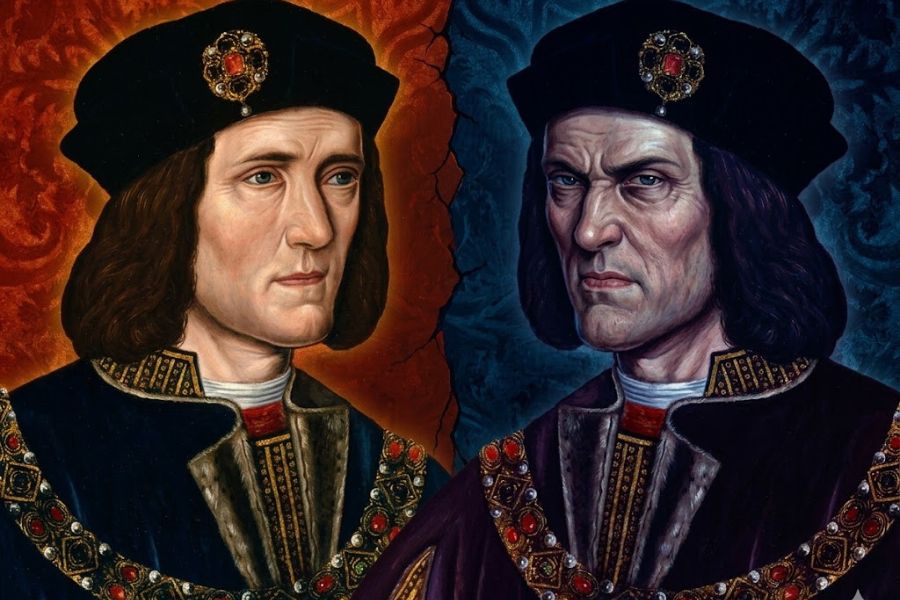
Richard III is the rare medieval figure who manages to be both famous and unknown. Most people can sketch the outline: hunchback, child-killer, the villain Shakespeare gave us, the bones under a Leicester car park.
Table of Contents
Beyond that, things get muddier fast. Was he a usurper or a reluctant protector? A doting brother turned tyrant, or a competent administrator buried under Tudor propaganda?
The truth, as it tends to be with the Wars of the Roses lot, is messier than either side wants to admit. The evidence doesn’t give us a monster or a martyr. It gives us a man who made a series of choices under enormous pressure, lost the gamble, and then lost the story.
The Brother in the Background
Before he was king, Richard was the loyal one. The youngest surviving son of Richard, Duke of York, he was eight when his father and brother Edmund were killed at Wakefield in 1460, and their heads were placed on the gates of York with paper crowns. He grew up in a family that knew exactly what losing felt like.
When his brother Edward IV took the throne in 1461, Richard was sent north to be raised in the household of Richard Neville, Earl of Warwick. He learned soldiering, estate management, and the politics of the northern borders. By the time he was a teenager, he was fighting alongside Edward at Barnet and Tewkesbury, the battles that finally crushed Lancastrian resistance in 1471.
For the next twelve years, Richard ran the north of England on his brother’s behalf. The records are unusually consistent on this point. He was an effective administrator, popular with the northern gentry, and trusted enough that Edward handed him near-autonomous control of a region that had given the crown trouble for generations.
Whatever happened in 1483, it didn’t come from a man with a lifelong reputation for treachery. It came from someone who had spent two decades being the reliable one.

April 1483 and the Decision That Changed Everything
Edward IV died unexpectedly on the 9th of April, 1483. He was 40, probably worn out by years of hard living, and he left behind a twelve-year-old heir, Edward V, and a court packed with people who hated each other.
The queen’s family, the Woodvilles, had spent twenty years accumulating land, titles, and grudges. They wanted to control the young king and rush him to a coronation that would lock in their position. Richard, named Lord Protector in his brother’s will, had different ideas.
He intercepted the prince’s escort at Stony Stratford, arrested the Woodville men leading it, and took custody of his nephew.
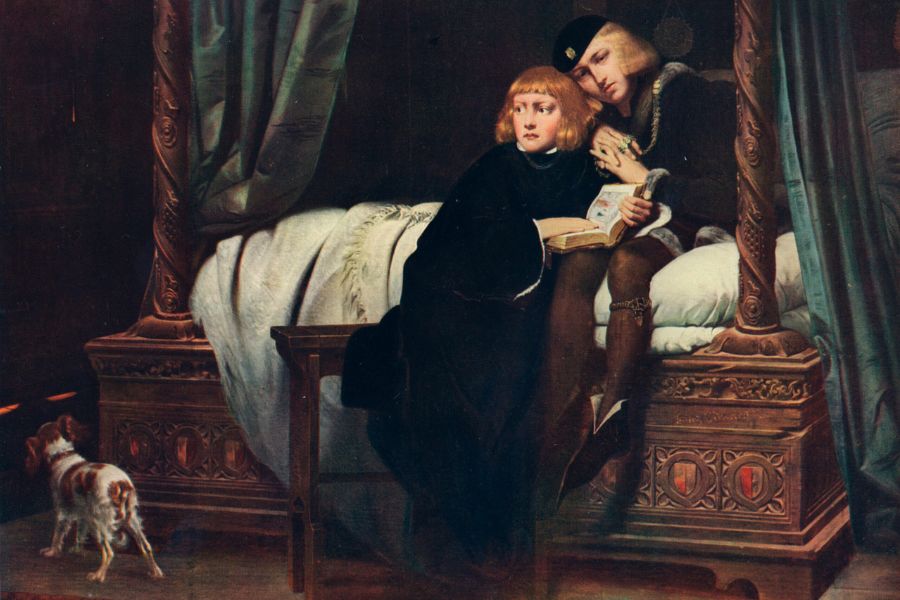
Up to this point, you can read his actions as either a power grab or a defensive move against a faction trying to sideline him. Probably both. What happened next is harder to defend. The young king was placed in the Tower of London, supposedly to await his coronation.
His brother Richard, Duke of York, joined him there in June. Then, on the 22nd of June, a sermon was preached at St Paul’s Cross declaring Edward IV’s marriage to Elizabeth Woodville invalid, the princes illegitimate, and Richard the rightful king. Within two weeks, he was crowned.
The legal grounds for the precontract claim, that Edward had supposedly been betrothed to another woman before his marriage, may or may not have had substance. The timing, though, is hard to mistake. A protectorate had become a coronation in roughly ten weeks.
The Princes and the Question Nobody Can Answer
The two boys were seen playing in the Tower gardens through the summer of 1483. By autumn, they weren’t seen at all. They are never recorded again in any contemporary source.
This is the wound at the center of Richard’s reputation, and no amount of revisionist work has been able to close it. The most likely explanation, the one most historians land on after weighing the evidence, is that they died in the Tower in the summer or autumn of 1483, and that Richard either ordered it or allowed it to happen.
He had the means, the motive, and the custody. He never produced them alive when rumors of their deaths began circulating, which would have instantly silenced his enemies.
That said, the case isn’t airtight. Henry VII, who took the throne in 1485, never accused Richard of the murders by name in any official document, which is strange if he had proof. The bones found under a Tower staircase in 1674 and reinterred in Westminster Abbey have never been properly tested.
Alternative suspects exist, including Henry Stafford, Duke of Buckingham, who had access to the Tower and his own reasons to want the boys gone.
What the evidence actually shows is this: two children disappeared while in their uncle’s care, and he never explained what happened to them. Everything beyond that is inference. Strong inference, in many cases, but inference all the same.
What Richard Actually Did as King
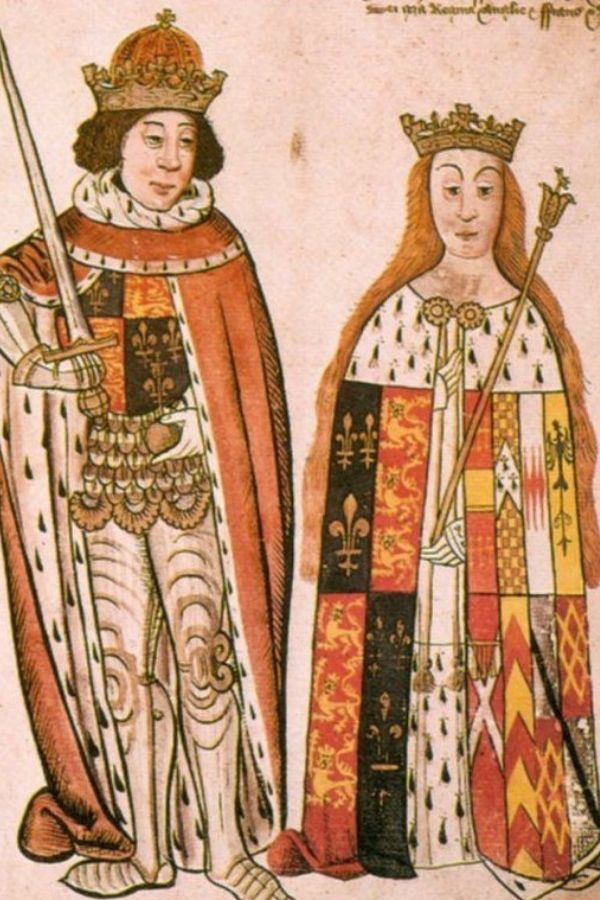
Strip away the question of the princes for a moment, and Richard’s brief reign is more interesting than the villain version allows. In his one full Parliament, in January 1484, he passed legislation that historians have been calling notably progressive ever since.
The laws abolished benevolences, the forced loans Edward IV had used to squeeze money out of his subjects. They reformed the bail system so that accused people couldn’t have their property seized before trial.
They tightened rules around jury selection and land transactions. The statutes were written in English rather than French, the first time that had happened on such a scale, which made them readable by people who weren’t lawyers or clerics.
He also founded the College of Arms, supported the printing trade in its infancy, and continued the patronage of northern religious houses he’d built up as duke. The Council of the North, which he established to handle regional governance, lasted in various forms until 1641.
None of this makes him a saint. Plenty of tyrants have passed good laws. But it complicates the image of a man interested only in power for its own sake. He governed like someone who actually wanted to govern well, even as the foundations of his throne were cracking under him.

Bosworth and the End of the House of York
By the summer of 1485, Richard was running out of allies. The Duke of Buckingham, who had helped put him on the throne, had already rebelled and been executed in 1483. Richard’s wife, Anne Neville, died in March 1485, probably of tuberculosis.
Their only son, Edward of Middleham, had died the year before, leaving Richard without an heir. Rumors that he planned to marry his own niece, Elizabeth of York, damaged him further, whether or not they had any basis.
When Henry Tudor landed in Wales on the 7th of August with a small force of French mercenaries and Welsh supporters, Richard had the larger army and the home advantage. He shouldn’t have lost.
The battle at Bosworth Field on the 22nd of August came down to the moment when Lord Stanley, whose son was being held hostage by Richard precisely to prevent this, threw his forces in on Henry’s side. Richard, seeing his crown slipping, charged directly at Henry’s position in an attempt to kill him personally.
He came close. He cut down Henry’s standard-bearer and got within striking distance of the man himself before being overwhelmed. The wounds on his skeleton, recovered in 2012, tell the story in clinical detail: eleven injuries, eight to the head, including two that would have been instantly fatal. He died fighting, which even his enemies admitted.
The Croyland Chronicle, no friend to Richard, recorded that he fell ‘in the thickest press of his enemies.’
His body was stripped, slung over a horse, and carried back to Leicester, where it was put on display for two days so people could see that the king was dead. Then he was buried in a hastily dug grave at Greyfriars, where he stayed until a parking lot was built over the ruins and an archaeological dig found him again in 2012.

How Shakespeare Buried Him a Second Time
The Richard most people carry around in their heads isn’t the man who died at Bosworth. He’s the creation of Thomas More, who wrote his unfinished history of Richard III around 1513 while working in the household of John Morton, one of Richard’s bitterest enemies.
More’s version, full of vivid invented dialogue and physical deformity, was picked up by the Tudor chroniclers Hall and Holinshed, and from there it went straight to Shakespeare.
Shakespeare’s Richard, written around 1592, more than a century after Bosworth, is one of the great theatrical villains. The withered arm, the limping gait, the gleeful confessions to the audience, the murder of basically everyone who crosses his path.
It’s brilliant drama. It’s also a play written for a queen whose grandfather killed Richard and needed to keep killing him symbolically for the dynasty to feel legitimate.
The skeleton found in 2012 settled some of this. Richard had severe scoliosis, which would have raised one shoulder higher than the other, but he didn’t have a hunchback, a withered arm, or a limp that would have stopped him fighting.
He was slight, around 5’8″, and had been a working soldier for most of his adult life. The body matched a man, not a gargoyle.
What the bones couldn’t tell us, of course, is what he did or didn’t do to his nephews. That argument will keep going as long as people care about the period, which seems to be indefinitely. The Richard III Society has been making the case for the defense since 1924, and they’ve shifted the conversation considerably, even if they haven’t won it.
Conclusion
So where does that leave us? Not with a monster, despite Shakespeare. Not with a martyr, despite the revisionists. With a man who was a competent administrator, a loyal brother, an able soldier, and who in the spring and summer of 1483 made decisions that crossed lines he probably couldn’t have uncrossed even if he’d wanted to.
The princes are the part that won’t go away, and they shouldn’t. Two children went into the Tower and never came out, and the man responsible for their safety took their crown instead. Whether he ordered their deaths, allowed them, or simply failed to protect them from someone else, the responsibility lands on him.
But the rest of the caricature deserves to be set aside. The Richard who reformed bail laws, ran the north for twelve years, and died charging into the thickest part of an enemy line is also part of the record.
He was a medieval king in a violent age, neither better nor worse than most of his contemporaries, who happened to lose the last battle and therefore lose the story. The bones in Leicester Cathedral belong to someone more complicated than either side has ever quite been willing to admit.