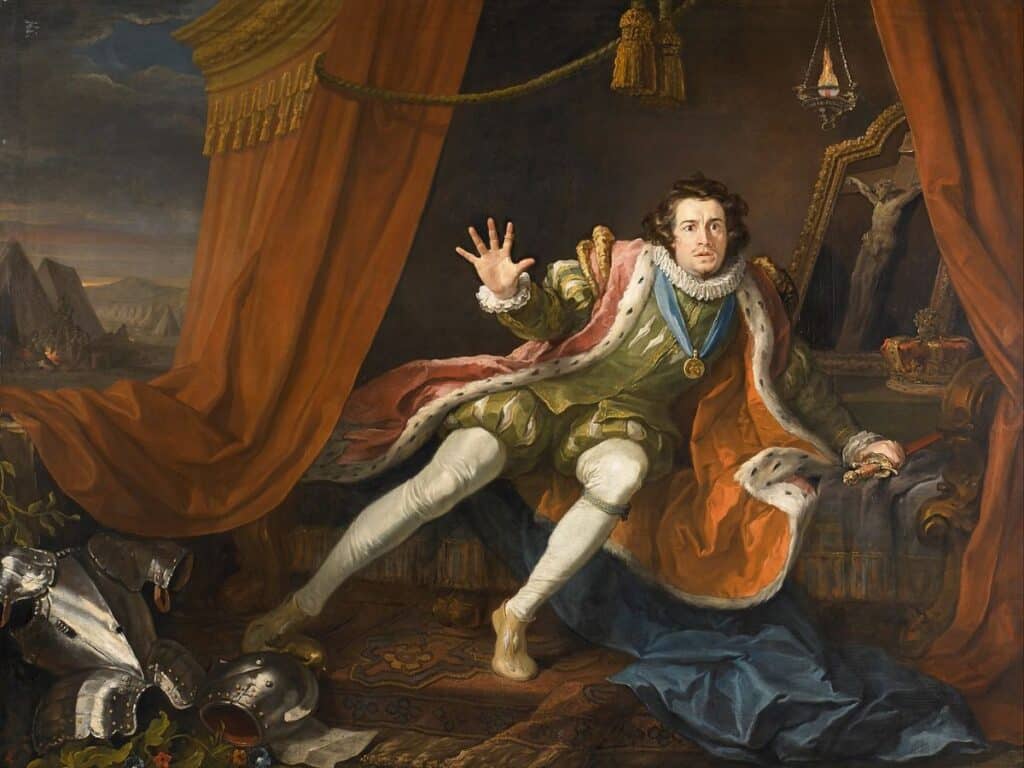
For more than 400 years, Richard III has been remembered as a murderous tyrant with a crooked back and a crooked soul. That image comes less from history than from the stage.

Shakespeare’s Richard III, written under Tudor rule, turned him into one of literature’s greatest villains. But if you peel away the politics and propaganda, a very different picture emerges, one of a capable, reform-minded king cut down before he could fully prove himself.
Table of Contents

Tudor Politics and the Power of a Good Story
Richard III’s reign ended abruptly in August 1485 at the Battle of Bosworth, where he was killed fighting Henry Tudor’s forces. His death brought an end to more than three centuries of Plantagenet rule and marked the beginning of the Tudor dynasty. Henry VII needed to make his victory stick. The quickest way to do that was to destroy Richard’s reputation so completely that no one would mourn his loss or challenge the new king’s legitimacy.
Richard’s real-life story didn’t fit the villain’s mold. He had been fiercely loyal to his brother, King Edward IV, serving him faithfully for years. Edward trusted him with the governance of the North of England, where Richard earned a reputation for fairness, decisive action, and defending the rights of those under his care.
He married Anne Neville, the daughter of the powerful Earl of Warwick, and they had a son, Edward of Middleham. The boy’s death in 1484 was a devastating blow, leaving Richard without an heir and deep personal grief during his short time on the throne.
None of this loyalty, family devotion, or administrative competence suited the story the Tudors wanted told. Instead, Henry VII’s allies promoted accounts that cast Richard as a deformed usurper who murdered his nephews, the Princes in the Tower, to seize the crown. Positive accounts from those who had worked with him were sidelined, and some records simply vanished.
By the time Shakespeare took up his pen more than a century later, the groundwork for the character of Richard III was complete. Writing under a Tudor monarch, Shakespeare transformed him into one of theater’s most compelling villains, a sly, power-hungry schemer with a crooked back and a heart to match.
The image stuck. For hundreds of years, the real Richard has been buried under layers of Tudor spin and dramatic flair. But if you peel back those layers, a very different picture starts to emerge.
The Respected Duke of Gloucester
Long before he wore the crown, Richard was already a trusted figure in his brother’s court. As Duke of Gloucester, he spent much of his career in the North of England, a region often neglected by the crown. Edward IV relied on him to keep peace along the volatile Scottish border and to act as the king’s representative in matters of justice, security, and trade.
Richard built strong relationships with local nobles and merchants, earned a reputation for settling disputes quickly and fairly, and took a genuine interest in the welfare of those under his governance. In Yorkshire, he was so respected that even decades after his death, locals spoke of his time there as one of stability and fair dealing.
By the time Richard became king in 1483, he was no stranger to leadership. He had already proven he could govern effectively, handle military responsibilities, and navigate the complicated politics of the Wars of the Roses. This was not the résumé of an untrustworthy schemer, but the record of a man who had earned his place in the highest office.

The Laws That Made Life Fairer
Richard III’s reign may have lasted only two years, but in that short time, he pushed through reforms that genuinely improved life for his subjects. He believed justice should be accessible to everyone, not just the wealthy and well-connected, and made changes that reflected that view.
One of his most significant moves was making court proceedings available in English instead of Latin or French. This meant ordinary people could finally understand the laws being applied to them without relying on interpreters who might twist the meaning. He also introduced measures to limit corruption in the courts, ensuring cases were heard based on merit rather than influence.
Richard expanded legal aid for those who couldn’t afford it, a rare stance for a medieval monarch. He also took steps to protect small merchants by regulating trade practices and reducing certain taxes and duties, particularly those affecting the cloth trade.
In education, he funded grammar schools and supported charitable works, showing a long-term investment in the kingdom’s future rather than just immediate political gains. These were not the actions of a ruler obsessed only with power. They were the moves of a man who wanted a more balanced system; one that gave ordinary subjects a fairer deal.
The Princes in the Tower and Other Dark Stories
No discussion of Richard III can ignore the disappearance of his nephews, Edward V and Richard of Shrewsbury, the so-called Princes in the Tower. The official story, shaped by Tudor historians, paints Richard as the man who had them killed to secure his own crown. It is the most enduring stain on his reputation.
The truth is far murkier. There is no surviving contemporary evidence proving Richard ordered their deaths. The only direct accounts linking him to the crime were written decades later, under Tudor rule, by men with every reason to blacken his name. Several others, including Henry VII, had both the motive and the opportunity to remove the boys. And while their fate remains one of England’s most famous mysteries, the assumption that Richard alone could have been responsible is not supported by hard proof.
Other accusations, such as the execution of rivals like Lord Hastings, also lose some of their shock when seen in the context of the time. Removing political opponents, sometimes by force, was standard practice in the turbulent Wars of the Roses. Compared to the bloody purges carried out by some monarchs before and after him, Richard’s record is not unusually brutal.
None of this makes him a saint. The 15th century was not an age of gentle politics. But it does make the case that Richard has been judged more harshly than many rulers who committed similar, or worse, acts without the same lasting infamy.
Not Perfect, but No Worse Than His Peers
When judging Richard III, it’s worth remembering the company he kept in history. The late medieval period was a brutal and unstable time. Kings were expected to secure their thrones by any means necessary, often involving executions, confiscations, and swift suppression of rivals. In this world, Richard’s actions were far from exceptional.
Edward IV, his own brother, ordered the killing of Henry VI and his son to end Lancastrian claims. Henry IV deposed Richard II and had him starved in captivity. Not to mention executing his own brother, George, Duke of Clarence.

Even Henry VII, often cast as the noble restorer of order, eliminated political threats with ruthless efficiency, including the execution of Edward “Teddy” Plantagenet, the last legitimate male of the Yorkist line. Teddy was only about twenty-four and had done nothing to warrant such a death beyond his royal bloodline. His fate shows just how far Tudor rulers would go to secure their power.
While most kings focused on rewarding their allies and consolidating personal authority, Richard made tangible changes that benefited a wider portion of the population. His reign was too short to see these reforms reach their full potential, but in those two years, he demonstrated a vision that went beyond survival in a dangerous political game.
In a different set of circumstances, and with more time, Richard might have been remembered alongside England’s most capable rulers instead of its most infamous.
Myth vs. Reality: Richard III Edition
Myth
Richard III was a deformed hunchback.
Reality
Contemporary accounts mention one shoulder higher than the other. His remains show scoliosis, not a grotesque, twisted body.
Myth
He murdered the Princes in the Tower.
Reality
No conclusive contemporary evidence ties Richard directly to their deaths. Others, including Henry VII, had motive and opportunity.
Myth
He seized the throne purely for personal gain.
Reality
He was named Protector for Edward V amid fierce factional infighting. The succession crisis was more complex than simple ambition.
Myth
He was hated by the people.
Reality
In the North he was remembered as fair and effective. Some communities mourned his death at Bosworth.
Myth
He ruled as a tyrant.
Reality
His legal reforms, support for merchants, and backing for grammar schools point to a reform-minded monarch.

Kylie Lang is a nationally syndicated travel journalist with bylines on the Associated Press Wire & more, a medieval history writer, and the founder and lead author of Tales of the Middle Ages (talesofthemiddleages.com). She holds a BA (Honours) in History from the University of Kent and is a member of the British Guild of Travel Writers.