No, medieval people didn’t smell as bad as the myth suggests. They washed their hands and faces every day, bathed in public bathhouses, and even kings like Edward III had baths fitted at Westminster Palace by 1351.
What they lacked was clean streets, proper drains, and any idea that germs existed, so towns could reek even when the people in them were trying hard to stay clean.
Table of Contents
An old stone well sits on our land, left over from the castle that stood here in the 13th century. Every time I lift the cover and peer down, I think about how many buckets were hauled up out of it, and how much of that water went on washing. More than you’d think, as it turns out.
The idea that everyone in the Middle Ages was dirty and smelly mostly comes from later writers who wanted to make their own times look modern. I’ve gone back to the records, from royal accounts to coroners’ rolls, to see what really went on.
So, let’s take a little wander (with our noses firmly covered) through the streets, homes, and bathhouses of medieval Europe.
Did Medieval People Take Baths?
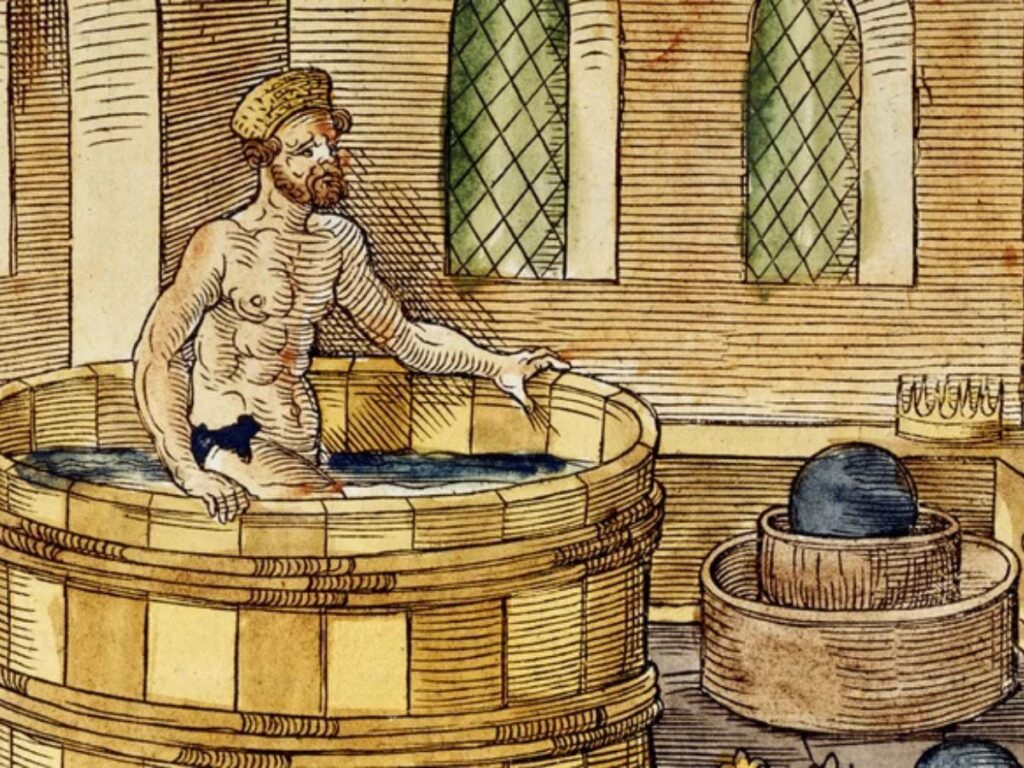
They did, and some took bathing very seriously. King John traveled with his own bathtub and a servant called William, whose job was to look after it.
In 1351, Edward III paid for hot and cold water taps to fill his bath at Westminster Palace. That’s hot and cold running water, nearly 700 years ago.
Lords and ladies without plumbing bathed in wooden tubs lined with cloth so they didn’t get splinters, filled by servants with buckets of hot water. John Russell’s Book of Nurture, written in the late 1400s, tells servants how to prepare a lord’s bath, with sponges, sweet herbs hung around the tub, and a final rinse in warm rosewater. I could get used to that.
Even monks had bath rules. At Westminster Abbey, the monks had to bathe four times a year, at Christmas, Easter, the end of June, and the end of September, and the abbey paid a bath attendant to heat the water. That sounds stingy, but for monks, bathing was a comfort, and comforts were meant to be kept in check.
Public Bathhouses in Medieval Towns

Ordinary townspeople didn’t have their own tubs, so they went to the bathhouse. The English scholar Alexander Neckam, who studied in Paris in the late 1100s, remembered being woken by criers in the street shouting that the baths were hot.
When Philip IV of France taxed Paris in 1292, the tax roll listed 26 people working as bathers, alongside 151 barbers. In Germany, Nuremberg alone had 14 public baths.
These places weren’t always respectable, mind you. In London, bathhouses were called stews, because you sat and stewed in the hot water. By the early 1400s, they’d been pushed out of the City and across the river to Southwark, where many of them were brothels in all but name.
They answered to the Bishop of Winchester, who made a tidy income from them, and the women who worked there were known as Winchester Geese.
Henry VIII finally closed the Southwark stews in 1546.
Washing Every Day
Most people didn’t take a full bath often, but that didn’t mean they didn’t wash. Washing your hands and face first thing in the morning was normal, and so was washing your hands before and after every meal.
People didn’t use forks at the table, so they ate with their fingers from shared dishes. Nobody wanted to share a dish with someone who hadn’t washed.
In grand households, a servant brought a jug and basin to the table so diners could rinse their hands.
At the great abbey of Cluny in Burgundy, the monks washed at a large stone basin before meals, and the abbey had a bathhouse with 12 tubs and 45 toilet cubicles.
People rubbed their teeth clean with a hazel twig or a scrap of woolen cloth, and medical books of the time include recipes for whitening teeth and sweetening breath.
The Tudors carried on much the same way, with a few odd additions of their own.

Hooked on the Middle Ages? Get more stories like this one in your inbox.
Was There Soap in the Middle Ages?
Yes. By the 13th century, Bristol, Coventry, and London made soap, each town with its own type. In northern Europe, people made it by boiling animal fat with ash and lime, which produced a soft, smelly soap.
The best soap came from Castile in Spain and from Marseille, where they made it with olive oil, which was much gentler on the skin.
Most English soap went to the cloth trade, though, where it was used to clean wool before dyeing. Fine soap for washing your body was a luxury. Most people made do with water, a rough cloth, and plenty of elbow grease.
Toilets, Privies, and the Men Who Emptied Them
Medieval people did have toilets. In castles, they were called garderobes: small rooms built into the thickness of the walls, with a stone seat over a chute. Everything dropped into a cesspit or straight into the moat, which is why a medieval castle could be so smelly.

Ordinary townspeople had a backyard privy over a cesspit, often shared with neighbors. Towns also built public toilets, known as houses of easement, but there were never enough. By the late 1300s, London had only about 16 public latrines for the whole city.

Somebody had to empty all those cesspits, and it was one of the worst jobs going. The men who did it, later known as gong farmers, worked at night and carted the waste out of town to be spread on the fields. It could be dangerous, too.
In 1325, a London man called Richard the Raker fell through the rotten floor of a privy and drowned in the pit below. His death is recorded in the London coroners’ rolls, and I can’t think of a worse way to go.
Filthy Streets, and the Kings Who Complained About Them
Here’s where the bad reputation does have some truth to it. Without proper drains or garbage collection, town streets were often foul. Butchers dumped offal, people threw slops out of their doors, and animals wandered everywhere.
The authorities knew it was a problem. On 30 September 1357, Edward III wrote to the mayor and sheriffs of London complaining that “dung, laystalls, and other filth” had piled up in the streets and along the banks of the Thames.
He ordered them to clean it up without delay and to punish anyone who dumped more. In 1388, Parliament passed a law banning people from throwing dung, filth, and animal entrails into ditches, rivers, and other waters near towns. It’s often called England’s first sanitation law.
Was ‘Gardyloo’ Really a Medieval Cry?
‘Gardyloo’ isn’t medieval at all. The cry comes from the French gardez l’eau, meaning ‘watch out for the water’, and it belongs to Edinburgh. The cry comes from the French “gardez l’eau,” meaning “watch out for the water,” and it belongs to Edinburgh.
The earliest record of it in the Dictionary of the Scots Language is from the town records of 1662, and by the 1700s, it was famous. So it’s a Stuart and Georgian habit, not a medieval one.
Why Did Medieval Bathhouses Close?
Medieval bathhouses closed because of syphilis and the doctors who panicked over it. A new disease turned up in Europe in the 1490s and spread through the kind of steamy, crowded bathhouse where half the clientele were there for more than a wash.
Doctors then started telling people that hot water opened the pores and let the plague creep in, so town by town the baths shut their doors, and by the mid-1500s most of them were gone.
I blame the Tudors, or at least their century.
The Dutch scholar Erasmus noticed the change in his own lifetime. Writing in 1526, he said that 25 years earlier, nothing had been more fashionable in Brabant than the public baths. “Today there are none,” he wrote. “The new plague has taught us to avoid them.”
So the truly unwashed centuries were arguably the 1500s and 1600s, not the Middle Ages.
Medicine and Cleanliness
Medieval doctors didn’t know about germs. They believed health depended on balancing the body’s four humors, and that disease could spread through bad smells, or miasma.
That’s why people carried sweet-smelling herbs and pomanders and burned incense when illness was about.
Doctors did write a great deal about bathing, though. The 14th-century Italian physician Maino de Maineri set out dozens of rules for when and how to bathe, and when not to. Their treatments could be grim, and bloodletting was one of the most common.
When the Black Death arrived in 1348, cleanliness couldn’t have saved anyone, because the plague was carried by fleas and spread from person to person.
So, Did Medieval People Smell?
Probably, at least by our standards. Woolen clothes were washed far less often than our cotton ones, houses were smoky, and towns stank of dung and tanneries.
But medieval people noticed bad smells as much as we do, and they didn’t like them any more than we would.
They washed their hands at every meal, bathed when they could, and grumbled to the king about the state of the streets. That doesn’t sound so different from us.
FAQs About Medieval Hygiene
Did medieval people take baths?
Yes, and some took bathing very seriously. King John traveled with his own bathtub and a servant called William, whose job was to look after it, and in 1351 Edward III paid for hot and cold water taps to fill his bath at Westminster Palace.
Was there soap in the Middle Ages?
Yes. By the 13th century Bristol, Coventry, and London all made soap, and the finest came from Castile in Spain and from Marseille, where it was made with olive oil. Most English soap went to the cloth trade, so fine soap for washing the body was a luxury.
Did medieval people have toilets?
Yes, medieval people did have toilets. In castles, they were called garderobes, small rooms built into the thickness of the walls with a stone seat over a chute down to a cesspit or the moat. Ordinary townspeople used a backyard privy, and towns built public latrines known as houses of easement, though London had only a handful of them for the whole city by the late 1300s.
Did people really shout ‘Gardyloo’ when emptying chamber pots?
No, people didn’t really shout ‘Gardyloo’ when emptying chamber pots. Not in the Middle Ages. The cry comes from the French gardez l’eau, and the earliest record of it in the Dictionary of the Scots Language is from Edinburgh town records of 1662. It’s a Stuart and Georgian habit, not a medieval one.
Did medieval people clean their teeth?
Yes, medieval people did clean their teeth. They rubbed their teeth with a hazel twig or a scrap of woolen cloth, and medical books of the time include recipes for whitening teeth and sweetening breath.
Love a good medieval story?
Join our readers and get tales of kings, queens, castles and ordinary medieval lives straight to your inbox.

Kylie Lang is a nationally syndicated travel journalist with bylines on the Associated Press Wire & more, a medieval history writer, and the founder and lead author of Tales of the Middle Ages (talesofthemiddleages.com). She holds a BA (Honours) in History from the University of Kent and is a member of the British Guild of Travel Writers.
Related posts:
 Did Medieval People Really Smell That Bad? What Hygiene Was Really Like In the Middle Ages
 How Did Tudor People Brush Their Teeth and Deal With Hygiene in General?
 How Medieval Women Managed Their Periods: Moss, Rags, and No Knickers
 10 Ancient Phrases We Still Use Today, From the Grossest in the English Language to Those Born From Medieval Scams