Imagine the job interview. You’re a young, well-bred Tudor gentleman with decent prospects, and someone tells you there’s a position opening up at court. Excellent pay, daily access to the king, accommodation, and the chance to whisper in the royal ear before anyone else gets near him.
And then they tell you the duties. You’ll be handing him the linen after he’s finished on the close-stool, monitoring what comes out, and making sure the whole apparatus is clean and discreet. You take the job. Of course you do. Every ambitious man in England wanted it.
Table of Contents
Why? Because the men who held it walked away with titles, fortunes, and influence. But there’s more to it than meets the eye, and once you understand how the job actually worked, you understand how the wheels of medieval and Tudor power really worked.
What the Job Actually Involved
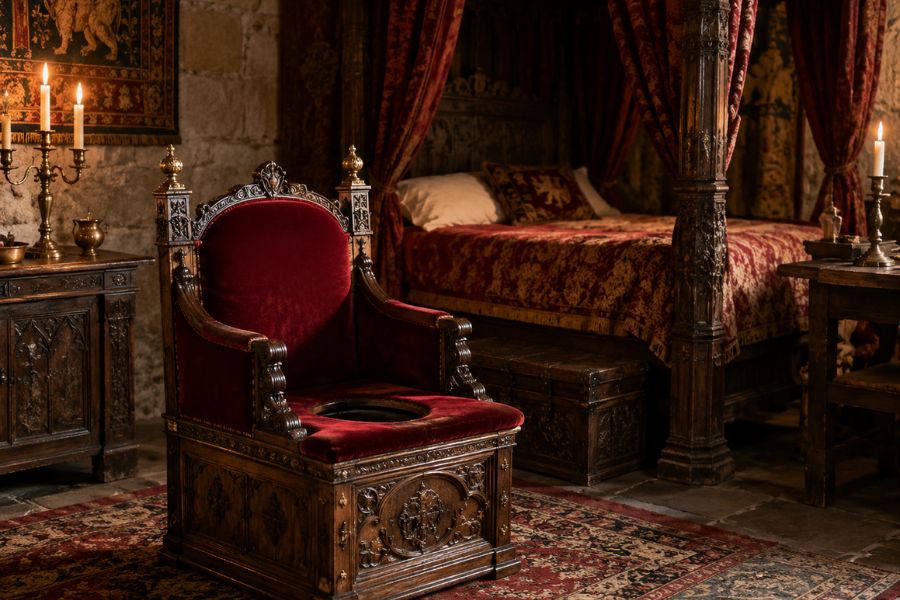
The close-stool was the king’s personal toilet. A padded box, often covered in velvet, with a chamber pot underneath and a hole in the top. It traveled with the monarch from palace to palace, carried by its own dedicated staff and treated as a piece of royal equipment as serious as the bed or the throne.
Henry VIII’s close-stool was upholstered in black velvet, trimmed with ribbon and gilt nails, and had its own cushion. You can read the inventories. They are very specific about the ribbon.
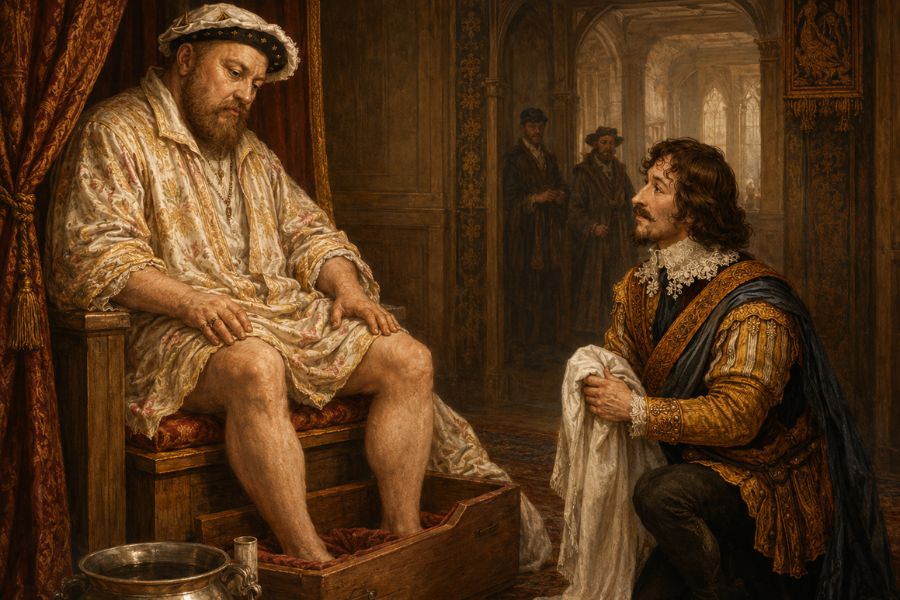
The Groom of the Stool’s job, at its most literal, was to attend the king while he used it. He handed over the linen, the water, and the bowl. He made sure everything was clean before and after. He noted, with the eye of a man who would later report to physicians, what the king’s bowels had produced and in what condition.
In an era when royal health was a matter of national survival, this was useful intelligence. A constipated king was a peevish king. A king with the flux was a king who might be dying. The man closest to the close-stool knew first.
He also slept nearby. He controlled who entered the privy chamber, the small set of rooms where the king actually lived as a private man rather than performed as a public one. He helped him dress, kept his jewels, and held the keys. By the time we get to Henry VII and his son, the Groom of the Stool had effectively become head of the privy chamber staff, with a salary, a household of his own, and the right to be in the room when nobody else was.
Who knew being a toilet attendant could have such power, status, and money?
Why Proximity Was Power
If you wanted Henry VIII to sign something, hear your case, grant your land, or forgive your cousin, you had to get in front of him. Physically. And getting in front of him was harder than it sounds, because the court was built as a series of nested rooms, each one more restricted than the last, with guards at every door.
The presence chamber was open to the well-dressed, the privy chamber was open to the chosen, and the bedchamber was open to almost nobody.
The Groom of the Stool was in all of them, all the time. He could carry a petition from a duke straight to the king’s ear over the breakfast cup. He could mention, while helping with the hose, that so-and-so was looking for a wardship and would be very grateful.
He could also do the opposite. A man who’d offended him could find that his letters somehow never reached the royal hand, that his requests were always lost in the shuffle, that the king had heard a small unflattering thing about him just before the meeting.
The man who held the office could become rich, titled, and feared because of his access. Ancestry mattered less than the simple fact of being in the room. Cardinals and ambassadors waited in antechambers, but the Groom of the Stool walked past them carrying a basin.
Hugh Denys and the Quiet Beginning
The office goes back further than the Tudors. Medieval kings had body servants for centuries, and the role evolved out of older positions in the king’s wardrobe and chamber. But the job we recognize starts taking shape under Henry VII, the first Tudor, who was a careful, suspicious man with a habit of trusting a small handful of people very deeply and everybody else not at all.
His Groom of the Stool was Hugh Denys, a Gloucestershire gentleman who’d attached himself to Henry’s cause and stayed close. Denys ran the privy chamber from about 1495 until the king’s death in 1509. He handled the king’s private money, the secret payments, the bribes to informers, the cash to spies abroad.
Henry VII famously kept meticulous personal accounts, signing each page himself, and it was Denys who brought him the book and the coins. He died of the sweating sickness, leaving a comfortable estate and a reputation as the king’s most discreet man.
Denys set the template. The Groom of the Stool was a private secretary, a treasurer, a gatekeeper, and a confessor of sorts, with the close-stool duties as the daily reminder of just how close he was.
William Compton and the Reign of Henry VIII
When Henry VIII came to the throne in 1509, he was 17, handsome, athletic, and surrounded by his father’s old men. But he didn’t want them, as a young, viral man, he wanted his own friends. The friend he made, Groom of the Stool, was William Compton, who’d grown up alongside him as a royal ward and was about a decade older.
They hunted together, gambled together, jousted together, and Compton took the job and held it for nearly 20 years.
In that time, he became one of the wealthiest commoners in England. He acquired land across the Midlands, built Compton Wynyates in Warwickshire (the house still stands, and it’s a beauty), and accumulated a portfolio of offices that paid him handsomely whether he showed up or not.
He also, by all accounts, ran a side business in introductions: if you wanted Henry’s attention, you went through Compton, and Compton expected a gift. Nobody thought this was corruption because everyone knew this was how the system worked. The Groom of the Stool was where you bought your access.
He died in 1528, of the sweating sickness like Denys before him, and left a fortune that took years to untangle.
Sir Anthony Denny and the King Who Couldn’t Be Crossed
If Compton showed the job’s potential, Sir Anthony Denny showed its peak. Denny took over as Groom of the Stool in 1546, in the last, paranoid year of Henry VIII’s reign, when the king was bloated, ulcerated, and dangerous. The man could barely walk and was hoisted around Whitehall in a wheeled chair.
He was also signing death warrants with a stamp, because his handwriting had gone, and the stamp was kept by Denny.
Think about that for a moment. The instrument that turned the king’s will into law, the actual mechanical thing that ended lives, was in the hands of the man who also helped him on and off the toilet.
Denny didn’t act alone; he was part of a small reformist faction at court, but the physical control of the stamp gave him and his allies real leverage in the final months. Historians have argued for decades about how much the dry stamp was used to push through decisions Henry wouldn’t have made if he’d been fully himself. We can’t know for certain, but we do know that Denny was the man holding it.
It was also Denny who, in January 1547, told Henry he was dying. Nobody else dared. Telling the king he might not survive the night had been treason under the Act for the king’s safety, and courtiers had been hanged for less.
Denny did it anyway, because he was the one in the room, and because by then he was the only one with the standing to speak. Henry died a few hours later, on 28 January 1547, with Denny at the bedside. The office had carried a man from helping with the linen to standing at the deathbed of the most feared king in English history.
What Happened Under Elizabeth and After
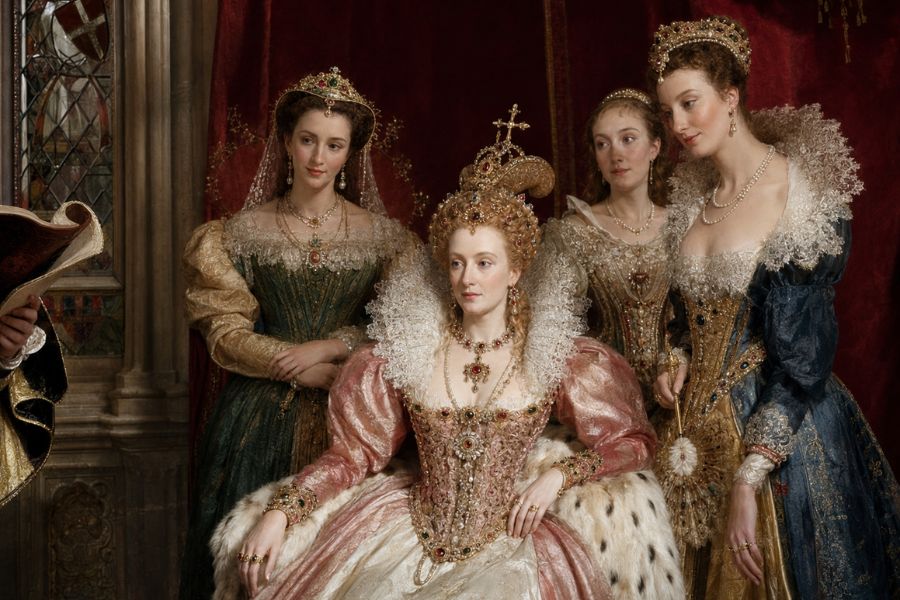
When a queen took the throne, the job had to change, for obvious reasons. Under Mary I and then Elizabeth I, the equivalent position became the First Lady of the Bedchamber, and it was held by women the queen trusted absolutely.
Kat Ashley, Elizabeth’s old governess, was the first. Blanche Parry, who’d known Elizabeth since she was a baby, served for decades. These women controlled access to the queen the way the men had controlled access to the king, and they wielded it with the same skill.
Foreign ambassadors learned quickly that you didn’t get to Elizabeth without going through her ladies first.
Elizabeth’s ladies of the bedchamber knew where her jewels were, which favorites were in or out, when her temper was up, when her courses came, and what she’d actually said about the King of Spain when she thought no one was listening.
They were paid handsomely, given gifts, and trusted with state secrets, and a few of them paid the price when they crossed her. Lettice Knollys was banished for marrying Robert Dudley. Bess Throckmorton was thrown out for secretly marrying Walter Raleigh. The queen’s intimate circle was a small and dangerous place to live.
The Groom of the Stool returned under the Stuarts, maintained its political weight through the 17th century, and gradually faded as the monarchy itself lost its grip on real power. By the time George III appointed his last Groom of the Stool in the 1700s, the job was a ceremonial sinecure with a good salary and not much to do.
The close-stool itself was on its way out, replaced by the early water closet, and the man at the door of the bedchamber no longer decided who governed England. It had been a serious office for the better part of 300 years, and at its height, in the privy chambers of Henry VII and his son, it was one of the most powerful positions in the country.
That’s what power, status, and money looked like in Tudor England.
Related posts:
 9 Medieval Jobs You Won’t Believe Actually Existed
 Just How Filthy Were Medieval Toilets? Were They as Bad as We Think They Were?
 Ladies-in-Waiting of the Tudor Court Who Served Queens, Knew Too Much and Often Paid For It With Their Head
 How Did Women Give Birth in the Middle Ages? The Ceremonies, Rituals, and Strange Goings On