Life in the Middle Ages was brutal compared to today’s standards. After all, we’re talking about a time when people could be hung, drawn, and quartered. The medieval justice system was a patchwork of local customs, royal edicts, and religious laws, leading to various punishments for crimes ranging from theft to treason. Capital punishment was a public spectacle intended to deter others from committing similar offenses, but it was also a form of entertainment, a medieval version of Netflix.

Executions were often carried out in town squares, with large crowds gathering to witness the event. The methods employed were as varied as they were gruesome, reflecting the societal norms and values of the time. Join me as we journey back in time to discover the different forms of capital punishment used across various regions.
Table of Contents
We’ll delve into the crimes that warranted such severe penalties and examine the stories of some of those who suffered these punishments. And maybe, just maybe, the romantic idea we have about knights on horseback and beautiful castles will be replaced with an understanding of the reality of living in this era. Time to remove the rose-tinted medieval glasses.

Origins of Medieval Capital Punishment
Before we get into the gruesome details, it’s worth understanding where it all started. Capital punishment has roots in ancient civilizations, and medieval justice borrowed heavily from what came before, just with a bit more mud, religion, and local flair.
Roman law played a huge part in shaping early medieval punishments. The Romans were big on order and even bigger on public executions. Crucifixions, decapitations, and wild-beast arenas kept the population in check. When the Roman Empire collapsed, its legal systems fractured into a mix of old Roman practices, tribal customs, and Christian doctrine.
That’s where things took a turn.
With the Church rising in power, punishment became not only about justice but also about salvation. Sins and crimes started to blur. Steal a loaf of bread and risk losing a hand. Deny the faith and you might end up on a pyre. And because kings and lords ruled over their own patches of land, what got you killed in one town might only earn a fine in another. Justice was wildly inconsistent.
Executions were never just about the person being punished. They were about setting an example, putting fear in the hearts of the crowd, and reinforcing the idea that authority, whether royal, religious, or both, was absolute. Capital punishment became a kind of social theater.
Hanging: The Gallows Were Always Busy
If you were a peasant in medieval Europe and got on the wrong side of the law, there was a good chance you’d end up at the gallows. Hanging was the go-to punishment for everything from sheep stealing to highway robbery. It didn’t matter if you were hungry or desperate; the rope didn’t care.
Most towns had a gallows just outside the walls, often near a crossroads or the main road. Somewhere highly visible. That wasn’t by accident. They were warnings in wood and rope. A message to everyone passing by that justice was swift, public, and usually final.
The method was brutal. There were no trapdoors or quick drops in most medieval hangings. The condemned was pushed from a ladder or hoisted up slowly. Death came by strangulation, not a snapped neck. It could take several minutes.
Hanging was the most common method of execution because it was used for everyday crimes. Petty theft, begging, breaking curfew, poaching the king’s deer could all see you strung up.
But if the authorities really wanted to make a statement, they took things further. Enter gibbeting.

Gibbeting
This was where the body was chained up in a metal cage and left to rot in public view. Gibbets were placed where people would see them regularly: near markets, bridges, or crossroads. Over time, the sun, birds, and weather did their work. The message was clear. You might be dead, but your punishment wasn’t over.
One of the most famous examples was Robert Aske, the lawyer-turned-rebel who led the Pilgrimage of Grace in 1536. He was educated, well-spoken, and deeply Catholic. When thousands marched north to protest Henry VIII’s religious reforms, Aske became their voice. At first, Henry promised to pardon them. Then he changed his mind.
Aske was arrested, imprisoned in the Tower of London, and eventually hanged in chains in York in 1537. His body was left hanging, a constant reminder of what happened when you dared to challenge the king. Imagine walking to market and seeing the remains of a man who once led a movement.
Beheading: The Nobleman’s Exit
If you had the right bloodline, or at least enough coin and connections, there was a good chance you’d die with your head held high, literally. Beheading was seen as a more honorable way to go. Clean. Quick. Dignified, at least by medieval standards. No kicking, no gasping for air, no swinging in the wind. Just one solid blow and lights out. That was the theory, anyway.
The sword or axe was often reserved for nobles, knights, and political figures. In some cases, the condemned even paid the executioner extra for a sharp blade and a steady hand. You didn’t want to be the poor soul who needed more than one chop.
It was a performance, too. The prisoner would climb the steps, deliver a final speech if allowed, kneel, and hope for a quick end. The condemned would kneel before the block or stand tall for the sword, depending on the region. If the executioner was skilled and the blade sharp, it might be over in one blow. In some places, the severed head was displayed afterward, mounted on a spike at the city gate or outside a castle wall.

One of the most haunting beheadings of the medieval period was that of Edward Plantagenet, Earl of Warwick. He was the last real threat to the Tudor throne after Henry VII took power in 1485. Edward was the son of George, Duke of Clarence, and a legitimate male Plantagenet with royal blood running straight back to Edward III. That made him dangerous.
Henry kept him there for years, unsure what to do with him. Then, in 1499, an alleged plot involving Perkin Warbeck gave the king an excuse. Whether Warwick was truly involved or just used as a scapegoat is still debated, but it didn’t matter in the end. He was led from the Tower to Tower Hill, a site with a long memory for noble blood. There, at just 24 years old, he was beheaded.
And if the executioner missed? Well, it wasn’t unheard of for a head to take several strikes to come off. Margaret Pole, Countess of Salisbury, was 67 years old when she was dragged to the block. She refused to lie still, and the inexperienced executioner reportedly took ten swings to finish the job. The crowd didn’t forget that one.
So yes, beheading was supposed to be the gentleman’s death. But like everything else in the Middle Ages, it depended on who held the blade, and whether they’d been paid enough to do it properly.
Drawing and Quartering: The Ultimate Warning
If hanging was the everyday punishment and beheading the nobleman’s send-off, then drawing and quartering was something else entirely. It was England’s way of saying, “Don’t even think about crossing the crown.” Reserved for men convicted of high treason, it was the full package: humiliation, pain, dismemberment, and public display.
The condemned would first be drawn to the execution site, tied to a hurdle or wooden board, and dragged through the streets by horse. It wasn’t symbolic. It was meant to bounce your body through filth and mud, stripped of dignity before the real horror even started.
Then came the hanging, but only partway. The executioner would hang the prisoner until they were close to death, then cut them down. Still alive. Then the disembowelment, guts pulled out, sometimes set on fire in front of the victim. The heart might be torn out next. And finally, the quartering, the body hacked into four pieces, and the head lopped off.

The parts were sent to different cities and nailed up on gates and bridges as permanent warnings. There’s no better-known example than William Wallace, the Scottish freedom fighter turned national legend. In 1305, after years of leading resistance against English rule, Wallace was captured and handed over to Edward I.
Wallace was dragged through London in chains, jeered at by crowds, then subjected to the full ritual. Hanged until nearly dead, disemboweled, beheaded, and quartered. His head was stuck on a spike on London Bridge, and his limbs sent to Newcastle, Berwick, Stirling, and Perth—the corners of the rebellion, now pinned with parts of its leader.
His execution didn’t have the effect Edward hoped for. Instead of silencing resistance, it made Wallace a martyr. But the method stuck. For the next few centuries, anyone labeled a traitor to the crown could expect the same.
Burning at the Stake: Fire and Faith
Of all the ways to die in the Middle Ages, burning might be the one that stuck hardest in people’s memories. Fire was dramatic. It was final. And it was almost always tangled up with religion.
Burning was the punishment of choice for heresy and witchcraft. If you went against the teachings of the Church or dabbled in things you shouldn’t, you were burned at the stake. The logic was that fire purified. You may have been guilty, but maybe, just maybe, your soul could be saved if your body burned.
It wasn’t a quick death. Victims were tied to a stake, sometimes with chains, sometimes just ropes, and surrounded by wood and straw. If the fire was hot and the wind kind, it might be over in minutes. If not, it could take much longer. Some were mercifully strangled or hanged first, but others weren’t so lucky.
No case captures this better than Joan of Arc.

She was a warrior, a visionary, and a threat. After leading French forces to key victories during the Hundred Years’ War, Joan was captured by the Burgundians and handed over to the English. They didn’t just want her dead; they wanted her discredited.
Her trial was a farce. She was charged with heresy for wearing men’s clothing, claiming to hear saints, and taking up arms. When she refused to back down, they lit the fire. In 1431, she was burned at the stake in Rouen’s market square. She was nineteen. Eyewitnesses said the crowd wept.
Joan’s case wasn’t unique, though. Thousands met the same end across Europe. Some were healers accused of witchcraft. Others were reformers, thinkers, or simply unlucky. In Germany, Switzerland, and parts of France, the flames kept burning well into the early modern period.
The Wheel: Breaking More Than Bones
This one doesn’t get as much attention as the gallows or the axe, but the breaking wheel was infamous in parts of continental Europe. Sometimes called the Catherine Wheel, it delivered a slow, punishing death that crushed your bones.
The wheel was exactly what it sounds like. A large wagon wheel, often fixed to a pole, with the prisoner tied to it. The executioner would take a heavy iron bar or club and bring it down on the limbs, smashing arms and legs across the gaps in the spokes. The blows were calculated. The goal was to break bones without killing the person right away.
After the limbs were shattered, the broken body might be woven through the wheel, threaded between the spokes like meat in a basket. Or the body would be draped over the wheel and hoisted upright for everyone to see. Death could take hours. Sometimes it dragged on for days.

One of the most disturbing cases was Peter Niers, a man accused of black magic and hundreds of murders in the late sixteenth century. His crimes may have been exaggerated, but his execution was anything but. He was tortured for days with hot pincers, beaten, and then broken on the wheel. His death was dragged out to match the fear he inspired.
In France and across the Holy Roman Empire, the wheel was often used to punish robbers and bandits, especially if their crimes were violent. It wasn’t for nobles or traitors. It was the punishment for those who disrupted the peace in the forests and along the roads.
In some cases, the executioner was allowed to give a final blow to the head or chest to end the suffering. But that was optional. Mercy didn’t always come. Afterward, the wheel was left on display with the remains still tangled in it, a grim warning to anyone passing by.
Impalement: When Death Was the Message
If you asked someone in the Middle Ages the worst way to die, impalement would be high on the list. It wasn’t just painful. It was a punishment meant to humiliate and terrify and leave a long-lasting message that power had no limits.
Impalement was most famously used in Eastern Europe, especially in regions like Wallachia and the Ottoman Empire. It was rare in Western Europe but not unknown. Where it was used, it was meant to do more than kill. It was used to silence opposition and to scare the life out of anyone watching.
The method varied, but the result was always slow and brutal. A sharpened wooden stake was driven through the body, often starting from below and exiting through the back or mouth. The person wasn’t always dead immediately. In some cases, they were positioned carefully to avoid major organs. The goal was to keep them alive for hours, sometimes longer, suspended in agony while people looked on.

Vlad III of Wallachia, also known as Vlad the Impaler, was the most notorious figure associated with this method. He ruled in the mid-1400s and is often remembered as the inspiration for Dracula, but the real man was far more terrifying than any vampire story. His kingdom sat between Christian Europe and the Muslim Ottoman Empire, and he was constantly at war.
Vlad used impalement as a weapon of fear. He reportedly ordered thousands of people impaled at once, lining roads with stakes so that enemy armies would think twice before marching any further. One story tells of Ottoman envoys who refused to remove their turbans in his court. Vlad had the turbans nailed to their skulls. Another tells of a field filled with twenty thousand corpses, each one skewered and rotting in the sun.
The historical numbers may be exaggerated, but the fear was real. A warning. A show of force that said, this land belongs to me, and this is what happens when you cross me.
Thrown to the Beasts and Other Spectacles
Not every execution in the Middle Ages followed a set formula. Some punishments were designed with one goal in mind: entertainment. And nothing drew a crowd quite like the idea of watching a human face off against an animal they had no hope of defeating.
The roots of this practice go back to ancient Rome, where criminals and prisoners of war were thrown to lions, leopards, and bears in the arena. It was called damnatio ad bestias, and while the Roman Empire eventually collapsed, the idea of public execution as a performance stuck around.
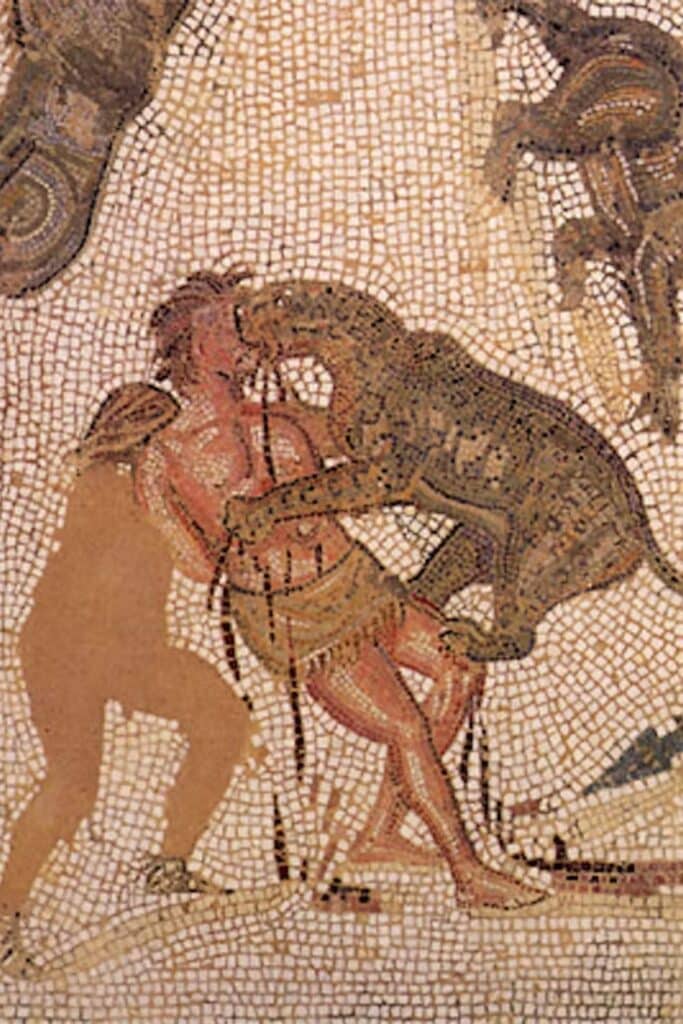
By the medieval period, this kind of punishment had faded in most of Western Europe, replaced by more familiar methods like hanging or burning. But stories of people being thrown to wild dogs or starved animals continued to appear in parts of the Byzantine Empire and the Islamic world. The goal was always the same. The condemned were being turned into a spectacle.
Sometimes it wasn’t about animals at all. It was about making the death creative. There are accounts of people being sewn into animal skins and left outside city walls to be torn apart by wolves. Others were tied to posts and left to be stung by insects, or buried up to their necks to die from exposure, while the public mocked them.
These punishments weren’t common, but they weren’t unheard of either. They were used when someone’s crime stirred deep anger or a ruler wanted to prove a point.
Drowning: Silence as Punishment
For common women, drowning was sometimes the punishment of choice. It was seen as less violent than hanging, more appropriate than burning. If a woman was accused of infanticide, theft, or even just being a bit too troublesome, the local river could become her final judge. The ducking stool was one method. Tied to a chair and dunked in the water until breath ran out or the crowd lost interest.
In parts of Europe, suspected witches were tied to stones and thrown into lakes. If they floated, they were guilty. If they sank, they were innocent, but dead all the same. And in the Holy Roman Empire, men who committed crimes on water, piracy, smuggling, and riverbank murders could be drowned in the very rivers where they sinned.
Then there’s the case of George Plantagenet, Duke of Clarence. Born into the royal family and brother to King Edward IV and Richard III, George had power, influence, and a reputation for switching sides whenever it suited him. During the Wars of the Roses, loyalty was slippery. George backed the wrong faction one too many times and finally paid for it.
In 1478, he was convicted of treason. But his death was never officially described. According to rumor, George wasn’t hanged or beheaded. He was drowned in a vat of Malmsey wine. Whether it’s true or not, the fact that the story stuck says everything. He was royalty. His death had to be memorable. And being lowered into a barrel of sweet white wine is something no one forgets.
Power, Punishment, and the Price of Control
Looking back at these punishments, it’s easy to focus on the horror. And there’s plenty of that. Gallows creaking at the edge of town. Wheels spattered with blood. Flames rising in the market square. But underneath it all was a system trying to keep order in a world where chaos was always just around the corner.
A peasant could be hanged for stealing bread while a noble might walk free for spilling blood in a drunken brawl. The rules were there, but they bent easily depending on who was involved. And when the crown or the Church felt threatened, mercy wasn’t part of the deal.
Executions were public for a reason. They reminded everyone watching who was in charge and the cost of defiance. And yet, not all those voices were silenced. That’s what makes this history worth telling.

Kylie Lang is a nationally syndicated travel journalist with bylines on the Associated Press Wire & more, a medieval history writer, and the founder and lead author of Tales of the Middle Ages (talesofthemiddleages.com). She holds a BA (Honours) in History from the University of Kent and is a member of the British Guild of Travel Writers.
Related posts:
 How Medieval Executioners Got Their Jobs (and Kept Them)
 The Tragic Life of Edward, 17th Earl of Warwick, The Last Plantagenet
 How George Plantagenet, Duke of Clarence, Ended Up Dying in a Wine Barrel
 Genghis Khan had 16 Million Descendants and Counting, But Here’s What They Don’t Teach You About Him