
Have you ever noticed how the villains from history stick in your head far longer than the heroes? I can tell you the name of Vlad the Impaler’s favorite execution method before I can name three saints, and I doubt I’m alone in that.
There’s something about the sheer nerve of a medieval villain, the scale of what they got away with, that keeps them alive in a way the pious rarely manage.
Table of Contents
The Middle Ages produced a particular sort of monster. Not every cruel king made the cut, and not every murderer ended up in a chronicle. To earn a reputation that lasted centuries, you needed access, opportunity, and a chronicler with a grudge or a good ear.
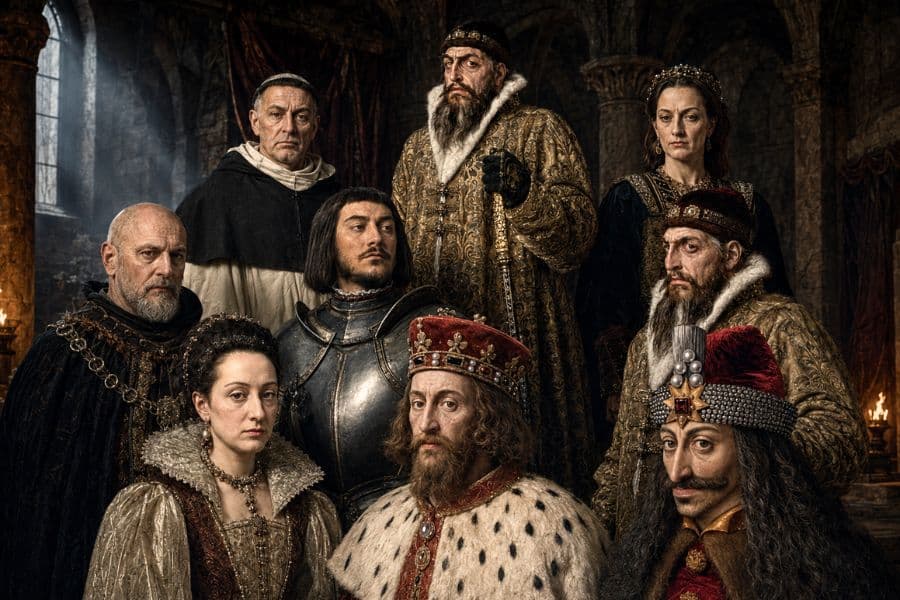
The 10 Most Notorious Villains of the Middle Ages
What follows is a rogues’ gallery of 10 men and women from medieval Europe whose reputations still turn stomachs. Some deserved every word. Others may have been slandered by enemies with better pens. You be the judge.
1. Gilles de Rais, the Marshal Who Became a Monster
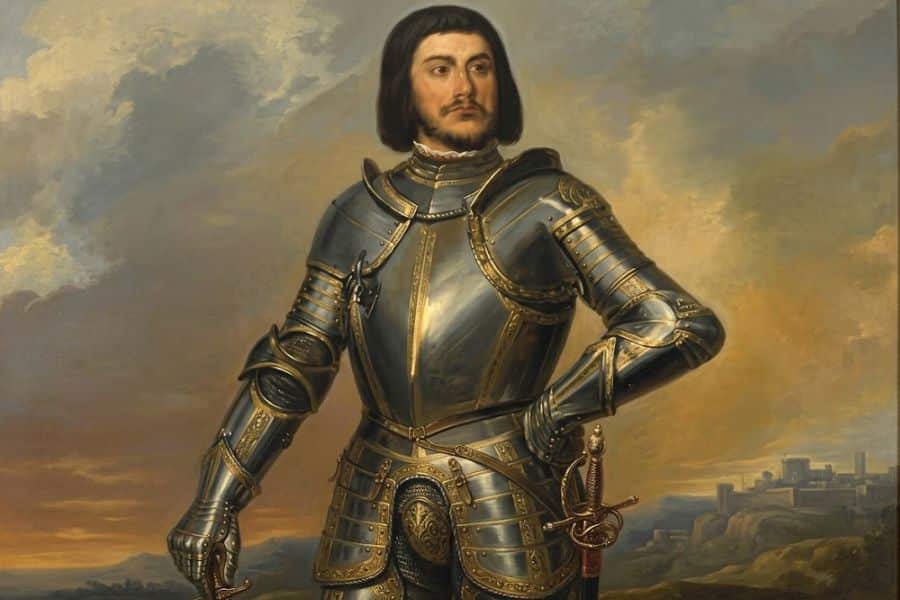
Gilles de Rais fought beside Joan of Arc. He was made Marshal of France at 25, held vast estates across Brittany, and by all accounts cut a fine figure in armor. Then Joan burned, Gilles retreated to his castles, and something in him came apart.
Between roughly 1432 and 1440 he abducted, tortured and murdered children on his own lands, most of them peasant boys lured in by servants. The trial record, held at Nantes in 1440, is one of the most harrowing documents to survive from the 15th century.
Confessions were extracted under threat of torture, which historians such as Matei Cazacu have argued complicates the picture, but the sheer volume of witness testimony from grieving parents is difficult to explain away.
He was hanged and burned in October 1440. The bodies of the children he killed were mostly disposed of in the fires of his own hearths, which is why numbers ranging from 80 to 200 victims are all guesses.
Whatever the true figure, it was a scale of horror that his fellow lords could not stomach even in an age well used to violence.
2. Vlad III of Wallachia, the Impaler

Vlad Dracula ruled Wallachia in short, blood-soaked bursts during the 1450s and 1460s. His preferred method of execution, impalement on tall wooden stakes, was not unheard of in the region, but he industrialized it.
German pamphlets printed in the 1480s and 1490s described forests of impaled bodies outside his capital at Targoviste, and while those pamphlets were partly Saxon propaganda, Ottoman sources including the historian Tursun Beg describe much the same scene when Mehmed II’s army marched into Wallachia in 1462 and turned back at the sight.
He impaled merchants who cheated him, boyars who plotted against him, and Ottoman envoys who refused to remove their turbans. He is credited by Romanian chroniclers with cleaning up crime in Wallachia through pure terror, and he is remembered in Romania today as a national defender rather than a monster.
Bram Stoker borrowed the name and little else. The real Vlad’s cruelty needed no supernatural embroidery.
3. King John of England

John lost Normandy, quarreled with the Pope until England was placed under interdict, and squeezed his barons so hard they forced him to seal Magna Carta at Runnymede in 1215. None of this is why he tops the villain list. That distinction belongs to what he did to the family of William de Braose.
Matilda de Braose, William’s wife, had let slip that she believed John had murdered his own nephew Arthur of Brittany. In 1210 John had Matilda and her eldest son imprisoned at Corfe or Windsor, and starved them to death.
The Anonymous of Béthune, writing not long after, records that Matilda was found gnawing at her son’s cheeks in the final stage of starvation. The chronicler Roger of Wendover tells much the same story.
Both were hostile witnesses, but the disappearance of Matilda and her son from the record after 1210 speaks for itself.
Matthew Paris later called John a tyrant, a bad son, a worse brother, and, worst of all, a bad king. That was the medieval verdict, and modern historians such as W. L. Warren have softened it only slightly.
4. Elizabeth Bathory, the Blood Countess

Elizabeth Bathory sits on the edge of our period, born in 1560 into one of the most powerful families in the Kingdom of Hungary. Her castle at Cachtice in modern-day Slovakia became the setting for one of the era’s ugliest legal investigations.
Between 1602 and 1610, local pastors complained about the disappearance of servant girls from her household. In 1610, the Palatine of Hungary, Gyorgy Thurzo, ordered an investigation.\
More than 300 witnesses were deposed. Their testimony, still held in the Hungarian State Archives, describes beatings, burnings, mutilations and deaths on a horrifying scale.
The famous story of Bathory bathing in the blood of virgins to preserve her youth is a later addition, first appearing in Laszlo Turoczi’s writings in 1729, and there is no contemporary evidence for it.
The murders themselves are another matter. Her accomplices were executed. Bathory was walled into a set of rooms in her own castle and died there in 1614.
Historians including Kimberly Craft, who translated the trial documents, note that the political motive of seizing Bathory lands should not be ignored. Even so, the sheer weight of witness testimony makes complete innocence impossible to argue.
Hooked on the Middle Ages? Get more stories like this one in your inbox.
5. Isabella of France, the She-Wolf
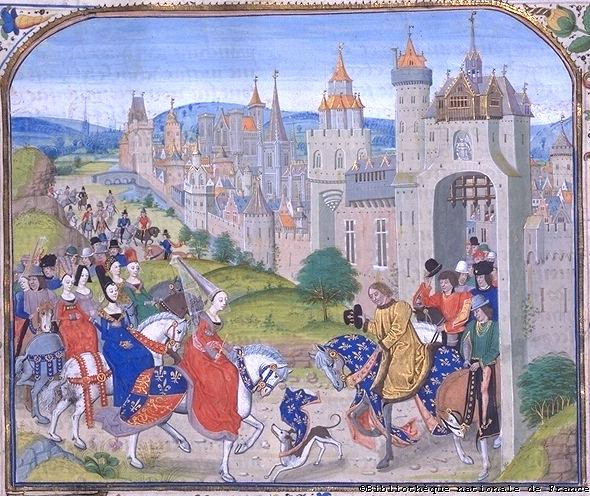
Isabella arrived in England in 1308 as the 12-year-old bride of Edward II. She endured a marriage soured by Edward’s favorites, first Piers Gaveston and then Hugh Despenser the Younger.
In 1325 she sailed to France on a diplomatic mission, took Roger Mortimer as her lover, raised an army, and returned in 1326 to depose her husband.
Edward II was imprisoned at Berkeley Castle and died there in September 1327. The manner of his death, allegedly a red-hot iron thrust into his body, comes from the chronicler Geoffrey le Baker writing decades later, and modern historians including Ian Mortimer have questioned whether Edward died at Berkeley at all.
What is not in doubt is that Isabella and Mortimer ruled England as regents for the young Edward III for three years, executed the Despensers, and enriched themselves so completely that Edward III overthrew them in 1330.
Mortimer was hanged. Isabella was allowed to retire to Castle Rising, where she lived comfortably until 1358. Shakespeare’s tag of she-wolf came later. In her own century she was called worse.
6. Tomas de Torquemada, the Grand Inquisitor

Torquemada, a Dominican friar and confessor to Isabella of Castile, was appointed Grand Inquisitor of Spain in 1483. Under his direction, the Spanish Inquisition became the machinery it is remembered as: torture chambers, mass burnings at the stake, and a system of denunciation that could reach into any household.
Estimates for the number of executions carried out during his 15 years in office vary between 2,000 and 10,000. The historian Henry Kamen, whose work on the Spanish Inquisition is the standard reference, argues for the lower end, but even that figure describes a bureaucratic slaughter of conversos, Jews and Muslims that had no equivalent elsewhere in Europe. Torquemada also drafted the 1492 Alhambra Decree that expelled the Jewish population of Spain, uprooting perhaps 200,000 people.
He died in his bed at the monastery of Avila in 1498. His tomb was opened and his bones scattered in 1832. Revenge is sweet.
7. Ivan IV of Russia, the Terrible

Ivan the Terrible ruled from 1547 to 1584, and the Russian epithet grozny is closer to awe-inspiring than to wicked. Ivan created the Oprichnina, a state within a state that answered only to him, and turned it loose on the boyars he suspected of plotting against him.
In 1570 he descended on the city of Novgorod on suspicion of treason. The massacre that followed lasted five weeks. Contemporary Russian chronicles and the accounts of foreign observers such as Heinrich von Staden, a German who served in the Oprichnina, describe men, women and children tied to sleds and pushed under the ice of the Volkhov river. Modern estimates of the dead range from 2,000 to 15,000.
In 1581, in a rage, Ivan struck his own son and heir with an iron-tipped staff and killed him. Ilya Repin’s painting of the aftermath, produced in 1885, is still one of the most disturbing images in Russian art.
Ivan’s own death three years later left the country in the hands of a feeble second son and set the stage for the Time of Troubles.
8. Fulk III of Anjou, the Black

Fulk Nerra, Count of Anjou from 987 to 1040, built castles the way other men collected relics. He was one of the great castle-builders of the early Middle Ages, a fact that Bernard Bachrach has spent much of his career documenting, and every stone was raised to hold ground he had taken by fire.
He burned his first wife, Elisabeth of Vendome, at the stake in 999, reportedly for adultery. He murdered a nephew at court. When his son Geoffrey Martel rebelled against him, Fulk forced him to crawl on hands and knees wearing a saddle while his father beat him with a stick.
Between atrocities, he made four pilgrimages to Jerusalem, one of them reportedly with the same servants who had helped him carry out his worst crimes, and returned each time absolved to resume the killing.
He died on the road home from his final pilgrimage in 1040. The Angevin dynasty he founded produced Henry II of England and the entire Plantagenet line. Whatever they inherited from him, gentleness was not part of it.
9. Agnes Bernauer’s Killer: Duke Ernest of Bavaria-Munich

Agnes Bernauer was a bathhouse-keeper’s daughter from Augsburg. She caught the eye of Albert, the heir to the Duchy of Bavaria-Munich, and by 1432 or thereabouts he had married her, almost certainly without his father’s knowledge.
Duke Ernest, Albert’s father, considered the match a disaster for the succession.
In October 1435, while Albert was away hunting, Ernest had Agnes seized, tried on a charge of witchcraft, and drowned in the Danube at Straubing. The account survives in the Straubing town chronicles and in the correspondence collected by later Bavarian historians such as Andreas Felix von Oefele in the 18th century.
When she struggled to stay afloat, her executioner reportedly pushed her under with a pole.
Albert raised an army against his father in fury, but the two were reconciled within a year, largely because Ernest arranged a politically useful marriage for his son. Ernest founded a chapel where Agnes was buried and paid for masses to be said for her soul. The gesture did not undo the drowning.
10. Thomas de Marle, the Terror of Picardy
Thomas de Marle, lord of Coucy in the early 12th century, is the medieval villain most people have never heard of, which is a shame because his contemporaries could talk of little else.
Guibert of Nogent, abbot and chronicler, devoted long passages of his autobiography Monodiae to Thomas, and Guibert did not exaggerate for effect when the facts were bad enough on their own.
Thomas hung prisoners by their testicles until they tore free. He kept dungeons at Coucy and Crecy so full that men died standing up for lack of room to fall. He raided pilgrims returning from the First Crusade, in which he himself had fought.
When Louis VI of France finally marched against him in 1114, and again in 1130, it was on the direct petition of the Church, and Thomas was excommunicated more than once.
He died in 1130, wounded in a skirmish and refusing the last rites until the very end, when a priest was smuggled in against his wishes. Guibert’s verdict was simple: no man of his generation had shed more innocent blood. The chronicler had known him personally, which makes the assessment harder to dismiss.
## Sources
Archives départementales de Loire-Atlantique. https://archives.loire-atlantique.fr/44/gilles-de-rais-1404-1440/c_29619
History the Interesting Bits. https://historytheinterestingbits.com/2015/03/20/maud-de-braose-kings-enemy-victim/
Biography.com. https://www.biography.com/crime/elizabeth-bathory
History Hit. https://www.historyhit.com/the-blood-countess-facts-about-elizabeth-bathory/
Biography.com. https://www.biography.com/crime/elizabeth-bathory (accessed 25 August 2026).
Wikipedia: Agnes Bernauer. https://en.wikipedia.org/wiki/Agnes_Bernauer
Love a good medieval story?
Join our readers and get tales of kings, queens, castles and ordinary medieval lives straight to your inbox.

Kylie Lang is a nationally syndicated travel journalist with bylines on the Associated Press Wire & more, a medieval history writer, and the founder and lead author of Tales of the Middle Ages (talesofthemiddleages.com). She holds a BA (Honours) in History from the University of Kent and is a member of the British Guild of Travel Writers.
Related posts:
 Was Isabella of Angoulême the Most Hated Queen of the Middle Ages?
Was Isabella of Angoulême the Most Hated Queen of the Middle Ages?
Was Isabella of Angoulême the Most Hated Queen of the Middle Ages?
 Isabella of France: History Called Her a She-Wolf The Truth Is Far More Interesting
Isabella of France: History Called Her a She-Wolf The Truth Is Far More Interesting
Isabella of France: History Called Her a She-Wolf The Truth Is Far More Interesting