If the history between France and England fascinates you, especially the Hundred Years’ War, we’re about to understand what made these battles legendary.
The Hundred Years’ War wasn’t one long battle; it was a messy, brutal tug-of-war that raged across France for over a century. Kings came and went. Fortunes rose and crumbled. But in the middle of all the drama, three battles stood out like bloodstains on a white tunic: Crécy, Poitiers, and Agincourt.
Table of Contents
Underdog English forces, often outnumbered and half-starved, went toe-to-toe with the armored might of France and walked away with kings in chains and songs sung in their honor. The secret? Not brute strength, but clever planning, clever terrain, and the longbow, the medieval machine gun of its day.
In a conflict that was as much about politics, power, and prestige as it was about battles, alliances, and bloodshed, the Hundred Years’ War shaped the way we think about nations and identities. So, how did this massive conflict unfold, and what were its long-lasting effects?
The Spark: Who Was the Real King of France?
It all started in 1337 when King Edward III of England claimed the French throne. Why? Because the French king, Charles IV, died without a male heir, and Edward, as the grandson of the French king, believed he had a legitimate claim.
The French, however, weren’t having it. They rejected Edward’s claim, and Philip VI was crowned as the new king of France. The dispute over who should rule France ignited a firestorm that would rage for more than a century.
Edward’s refusal to accept Philip’s rule set the stage for an epic conflict between the two countries. And thus began the Hundred Years’ War, though it wasn’t just a single war but a series of battles, truces, and alliances over many decades.
The Key Players: England’s Longbow and France’s Knights
One of the defining features of the Hundred Years’ War was the contrast between England’s army and that of France. On one side, you had the English, whose longbowmen could fire arrows with incredible speed and range, changing the dynamic of battle.
On the other, you had the French knights, heavy-armored cavalrymen who believed in traditional knightly combat. The English archers had a significant advantage, especially in battles like Crécy (1346) and Agincourt (1415).
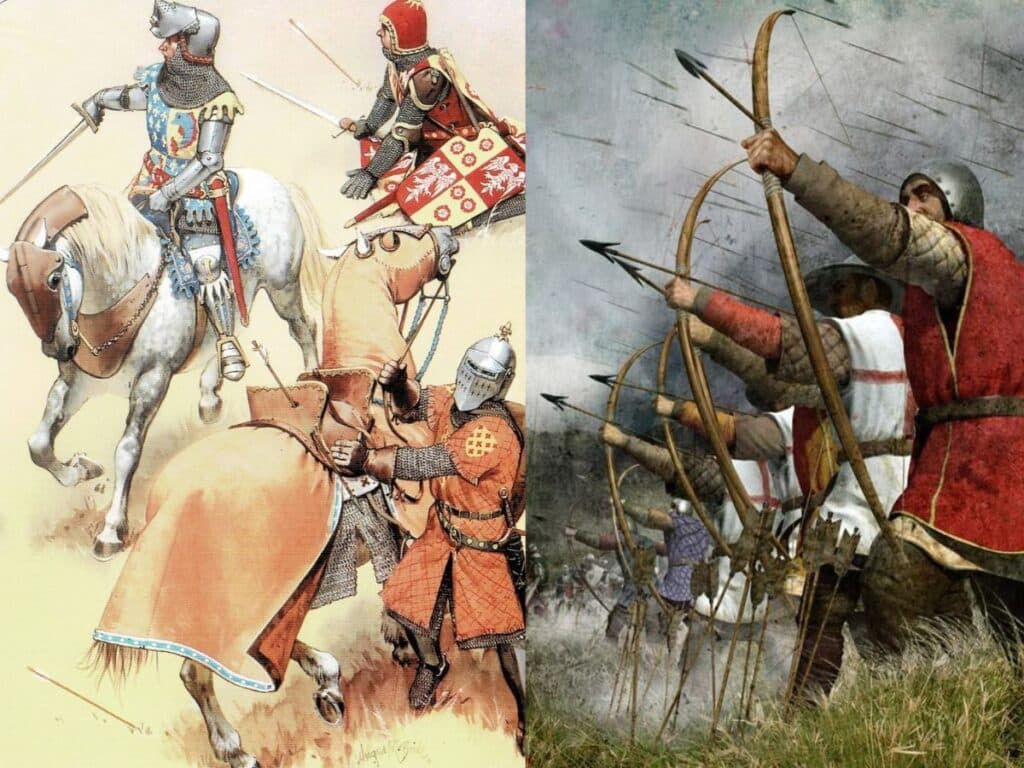
At Crécy, the English longbowmen tore through the French cavalry, decimating their knights before they even had a chance to engage. This was a game-changer for medieval warfare, as it showed that long-range weapons and infantry could defeat heavily armored cavalry.
Meanwhile, the French, stubborn in their reliance on knights and cavalry, had a hard time adapting to this new form of warfare. They often underestimated the effectiveness of English archers, leading to disastrous losses in several key battles.

Hooked on the Middle Ages? Get more stories like this one in your inbox.
Major Battles: From Crécy to Agincourt
The Battle of Crécy (1346)
It’s August 26, 1346. Edward III of England and his teenage son, the Black Prince, are outnumbered by thousands. They’ve marched across France, setting fire to everything in sight, and now the French army under King Philip VI has finally caught up. But instead of running, Edward parks his troops on a hill near Crécy and waits.
The French knights, full of pride and not much patience, charge straight uphill. The English? Calm, quiet, and ready. With thousands of longbowmen behind sharpened stakes, they’re about to put on a deadly performance.
The French open with Genoese crossbowmen who can’t keep up. Their strings are wet, their shields are missing, and they’re running for their lives within minutes. The French knights plow into their own men to get at the English. Bad move. It’s muddy, uphill, and they’re packed in too tight.

The English archers let fly. Arrows fill the sky like rain, and knights start falling like dominoes. Even when the French reach the English line, they’re met with axes and swords. The Black Prince holds firm, and his dad watches from afar, refusing to step in. “Let the boy earn his spurs,” he says. And he does.
Crécy ends in a brutal, one-sided win for the English. Thousands of French died, including King John of Bohemia, who fought blind (literally blind), tied to his knights. The English barely lose anyone. It’s a game-changer. Longbows beat heavy cavalry. Smart tactics beat flashy charges.
And from here on, everyone starts rethinking what medieval warfare really means. Want to bring it to life? Look for battlefield maps, images of longbows vs crossbows, or the famous medieval manuscript that shows arrows raining down like a storm.
The Battle of Poitiers (1356)
Ten years after Crécy, Edward the Black Prince is back. He’s older, more dangerous, and marching around France again, setting things on fire. King John II of France finally says enough is enough and corners him near Poitiers on September 19, 1356.
Edward is badly outnumbered. His troops are tired and low on supplies. But he picks a brilliant spot to fight. He hides behind hedges, a marshy stream, and wagon barriers. Not flashy, but smart.
The French come in waves. First, the cavalry charge. That flops thanks to those longbowmen. Then John’s son, the Dauphin, tries to push through a narrow gap. Doesn’t work. Third wave? Same deal. All while Edward keeps cool and holds his men back.
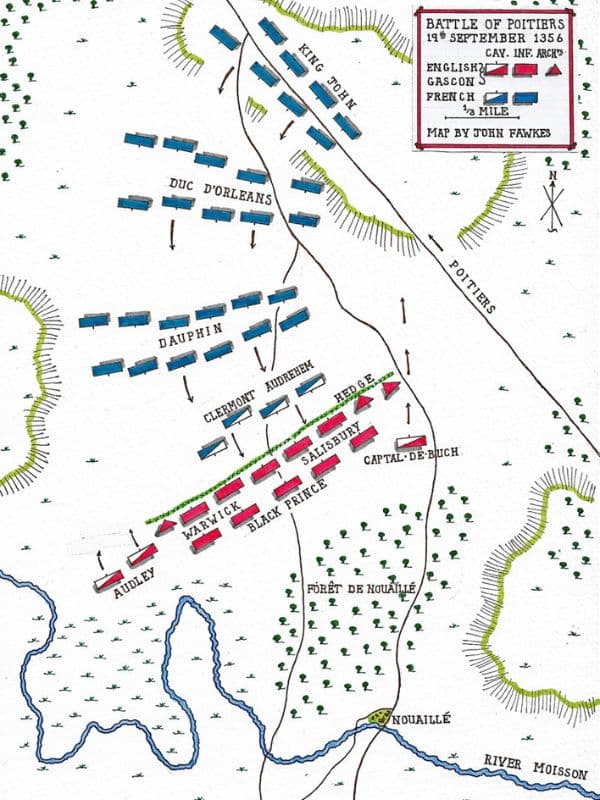
Then comes the twist. He unleashes a hidden force around the side, catching the French from behind. The French army buckles and breaks. King John, swinging a battle-axe like a man possessed, fights until he’s completely surrounded and finally taken prisoner with his teenage son.
The French are crushed. Their king is captured. The ransom is enormous, and the government back home falls into chaos. It’s another English win with smaller numbers, sharper minds, and better terrain. Poitiers proves Crécy wasn’t a fluke.
The Battle of Agincourt (1415)
Now we jump ahead to October 25, 1415. It’s Saint Crispin’s Day. King Henry V is leading a worn-out English army through northern France. They’ve been through a brutal siege at Harfleur, half the men have dysentery, and they’re marching to Calais when they run into a massive French army. It’s three to one. The French think it’ll be a walkover. Henry thinks otherwise.
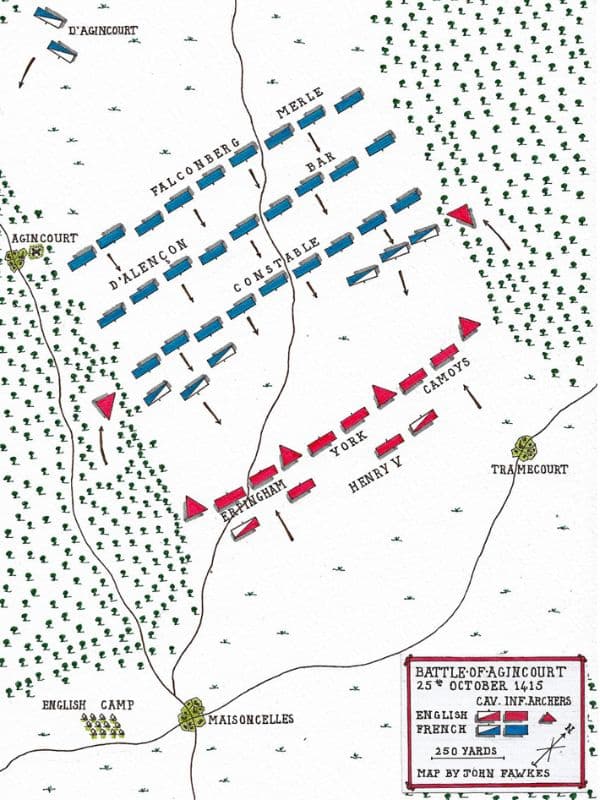
He picks a narrow, muddy field between two woods. Perfect for canceling out the French numbers. His longbowmen plant sharp wooden stakes and dig in. The French wait too long, then finally charge. And it goes horribly wrong. The mud sucks at their armor. The knights bunch up. The arrows start flying.
It’s a slaughter. Henry’s archers fire volley after volley. The French stumble into each other, slip, fall, and die. Henry is right in the middle, swinging a poleaxe. At one point, part of his crown gets knocked off. He keeps swinging.
By the end, thousands of French lie dead. The English barely lose a few hundred. Henry even orders the killing of prisoners, worried they might rise up if the fight reignites. It’s harsh, but it works. Agincourt becomes a legend. Shakespeare turns it into a rallying cry. And for history nerds like us, it’s the ultimate underdog story.
Mud, arrows, leadership, and the stomach flu win the day. Look up reenactment scenes, weapons of the period, or a good map showing the narrow field. And yes, the English archers really did cut their trousers off to deal with dysentery mid-battle.
The Role of Joan of Arc: The Maid Who Lifted French Spirits
Just when it seemed like France was on the brink of collapse, a young peasant girl named Joan of Arc changed everything. In 1429, Joan, claiming to have received divine visions, convinced the French Dauphin (heir to the throne) Charles VII to let her lead the French army.
She played a crucial role in lifting the siege of Orléans, a pivotal moment that turned the tide of the war in France’s favor. Joan’s military victories gave the French people new hope, and her presence revitalized the French army.
Despite being captured by the English and executed in 1431, Joan became a symbol of French resistance, and her legacy would inspire generations to come. The Catholic Church canonized her as a saint in 1920.

The End of the War: A Shifting Balance of Power
By the time the war officially ended in 1453, the political landscape of both England and France had been forever altered. France, under the leadership of Charles VII, was able to drive the English out of most of its territory, including Normandy, marking a victory for the French.
However, the war had also taken a heavy toll on France. It had been ravaged by decades of conflict, and its population and economy were decimated. Meanwhile, England, despite losing the war, had also suffered greatly, facing internal strife and the eventual eruption of the Wars of the Roses, a civil conflict between rival factions of the English nobility.
The Lasting Impact: What the Hundred Years’ War Left Behind
The Hundred Years’ War changed not just the course of history but the very nature of warfare, politics, and national identity.
The Rise of Nationalism
Both England and France saw the rise of a sense of national identity during the war. In England, the war led to a sense of pride in the English crown and its military successes. For France, the war fostered a sense of unity under Charles VII, especially after the victory at Orléans.
The Decline of Feudalism
The war also marked the decline of feudalism in Europe. The need for standing armies, paid soldiers, and modern weaponry led to a shift in how wars were fought and how power was distributed.
Economic Impact
Both nations suffered economically, but in the long run, the war also helped to shape the future of European economies. The focus on professional armies and the changing role of the nobility and monarchs influenced the future of warfare and governance.
The End of an Era: The Hundred Years’ War’s Legacy Lives On
The Hundred Years’ War might have ended in 1453, but its effects were felt for centuries. It was a war over land and a battle over the future of nations, and it reshaped the identities of both England and France.
Two of the most iconic national identities in Europe rose from the ashes of this war, one marked by centuries of rivalry and one shaped by a renewed sense of unity. And the stories of the warriors, like Joan of Arc and Richard the Lionheart, would echo through history, leaving behind legends that would never fade.
The Final Word: Lessons from the Hundred Years’ War
The Hundred Years’ War teaches us about resilience, strategy, and the price of conflict. The war didn’t just change two nations; it shaped the future of Europe. From the role of the longbow in battle to the rise of national identities, the war left lessons that continue to resonate today.
Love a good medieval story?
Join our readers and get tales of kings, queens, castles and ordinary medieval lives straight to your inbox.

Kylie Lang is a nationally syndicated travel journalist with bylines on the Associated Press Wire & more, a medieval history writer, and the founder and lead author of Tales of the Middle Ages (talesofthemiddleages.com). She holds a BA (Honours) in History from the University of Kent and is a member of the British Guild of Travel Writers.
Related posts:
 The Battle of Crécy 1346: How a Teenage Prince and a Wall of Arrows Brought France to Its Knees
 How Did the Hundred Years’ War Actually Start, and Why Did It Last So Long
 Must-Read Books on the Hundred Years War. These Page-Turners Nail It
 The Top 10 Baby Names in the Middle Ages (And Your Medieval Match)