
Would you have been accused of Witchcraft in the Middle Ages? History shows it was men and not just women. What’s the verdict? Innocent or guilty? Let’s find out.
The wind is sharp across the village green. A woman stands alone while a crowd gathers with firewood in hand and judgment in their eyes. She’s quiet, staring ahead, as the priest raises his voice and the whispers turn to jeers. Her crime? Owning a book, tending her herbs, and not knowing her place.
Table of Contents
Welcome to the Middle Ages, when fear and superstition ran hand in hand with justice. The world was harsh and uncertain, and people needed someone to blame when crops failed or babies cried through the night. Witches made the perfect target.
But were there really witches in medieval Europe? Why did people believe so fiercely in their power? There’s more to the history of witches than spells and broomsticks. Some of it is shocking. Some of it is laughably strange. All of it is worth exploring.

Where the Fear of Witches Began
The fear of witches didn’t start in the Middle Ages. It had been simmering for centuries, passed down through cultures that saw magic in both wonder and terror. The ancient Mesopotamians wrote spells to ward off evil sorcerers, the Egyptians had whole rituals to protect against curses, and the Greeks gave us figures like Circe and Medea, powerful women who used potions and charms to bend fate.
In these early civilizations, magic wasn’t always bad. Sometimes, it was just part of life, but the line between healing and harming was thin. The Romans began to formalize the fear. By the time Christianity spread across Europe, pagan traditions and folk practices were branded suspicious.
The Church didn’t immediately launch witch hunts. Magic was seen more as superstition than serious crime for a long time. If anything, early Christian leaders were more worried about heretics and rival beliefs.
That started to shift in the 11th and 12th centuries. Europe was changing. Wars, plagues, and political struggles made people uneasy. Folk healers, women with herbal knowledge, midwives, and anyone who stood out could become a threat. The Church grew stricter about controlling spiritual authority. Magic, once tolerated or ignored, became dangerous.
One of the most famous lines used to justify witch executions came from the Bible: “Thou shalt not suffer a witch to live.” But the original Hebrew word, kashaph, actually referred to poisoners or harmful sorcerers, not the broomstick-flying image we think of today. That mistranslation would go on to justify centuries of bloodshed.
The groundwork was laid. Fear of the unknown, suspicion of outsiders, and growing religious control all helped turn the idea of witchcraft from folklore into a deadly accusation.

Would You Have Been Accused of Witchcraft in the Middle Ages?
Think you’re too ordinary to end up on trial? Think again. From talking to your cat to knowing a bit too much about herbs, it didn’t take much to land you in trouble. Answer seven quick questions to see how likely you would’ve been accused of witchcraft in the Middle Ages.
Answer the questions below to find out you fate!
Timeline of Witchcraft and Fear in the Middle Ages and Beyond
c. 2000 BCE – Ancient Mesopotamia
Clay tablets mention spells to ward off “witches” and sorcerers. Early laws, like the Code of Hammurabi, include punishments for magic.
c. 1000 BCE – Ancient Hebrew Texts
The Hebrew Bible warns against kashaph, often translated as “witch,” though it likely referred to poisoners or malevolent sorcerers.
c. 400 BCE – Classical Greece
Witches appear in mythology as dangerous, often powerful women like Circe and Medea. Magic is both feared and respected.
c. 1st Century CE – Roman Empire
Magic is outlawed if used for harmful purposes. Accusations are sometimes tied to political rivalries. The state begins to regulate supernatural practices.
c. 300–500 CE – Rise of Christianity in Europe
The early Church discourages pagan magic but doesn’t focus heavily on witchcraft. Most magical practices are dismissed as superstition, not satanic.
906 CE – Canon Episcopi (Church Document)
Declares that belief in night-flying witches is false and heretical. The Church at this point does not support hunting witches.
1230s – Papal Inquisition Begins
Launched to root out heresy, not witchcraft specifically. However, it sets the tone for Church-led investigations and punishments.
1300s – The Black Death (1347–1351)
Panic and devastation lead to an uptick in fear-based accusations. Scapegoats include Jews, lepers, and “sorcerers.”
1428 – Valais Witch Trials (Switzerland)
One of the first large-scale witch hunts in Europe. Dozens are executed. Torture is used to extract confessions.
1484 – Pope Innocent VIII issues Summis desiderantes (Papal Bull)
Officially acknowledges witchcraft as a real and dangerous threat. Authorizes inquisitors to pursue and punish it.
1487 – Publication of Malleus Maleficarum
This witch-hunting manual claims women are especially prone to witchcraft. It spreads widely and fuels future persecutions.
1500s–1600s – Witch Hunt Craze Sweeps Europe
Thousands of people, mostly women, are tried and executed for witchcraft. Germany, Switzerland, and Scotland are especially brutal.
1647 – Matthew Hopkins, the “Witchfinder General,” was active in England
Claims to have rooted out hundreds of witches. Uses harsh tactics, including sleep deprivation and torture.
1692 – Salem Witch Trials (Massachusetts)
A series of trials in colonial America led to 20 executions and hundreds of accusations. One of the last major witch hunts.
1700s – Decline of Witch Hunts
Skepticism grows. Courts become more reluctant to accept supernatural evidence. Enlightenment thinking begins to challenge older beliefs.
1782 – Last known execution for witchcraft in Europe (Switzerland)
Anna Göldi was executed. Today, she’s called “Europe’s last witch.” In 2008, the Swiss government formally cleared her name.

What Did They Classify as a Witch in the Middle Ages?
Forget the pointy hats and bubbling cauldrons. That image came much later. In the Middle Ages, a witch didn’t fit one neat mold. Sometimes being a witch didn’t mean doing anything at all.
A witch could be a woman who lived alone, especially if she was older and didn’t have family around. She might have kept a garden filled with herbs or acted as the village midwife. She could have had a sharp tongue, a birthmark in the wrong place, or simply been someone people didn’t like.
In many cases, people who were accused of witchcraft didn’t see themselves as magical at all. They were often folk healers, known for mixing herbs or passing down old rituals. These weren’t secret spells hidden in dusty books. They were practical, everyday traditions that had been part of village life for generations.
However, as Church influence grew, these customs came under suspicion. The idea that someone could curse a neighbor, dry up a cow’s milk, or bring on a storm wasn’t just superstition anymore. It was heresy. And in the eyes of religious leaders, it was a direct threat to the divine order.
Not all witches were women. Men were accused, too, often when politics or property disputes came into play. But the overwhelming majority of accused witches were female. The link between women and witchcraft was no accident. It reflected deep-rooted fears about women’s roles, power, and knowledge.
Hooked on the Middle Ages? Get more stories like this one in your inbox.
Witches, the Church, and Heresy
In the early Middle Ages, the Church wasn’t worried about witches. For the most part, Church leaders believed magic wasn’t real. If someone thought they could curse their neighbor or fly through the night sky on the back of a goat, they were seen as deluded, not dangerous. The Canon Episcopi, written around the 10th century, even mocked the idea of witches flying to secret nighttime meetings, calling it superstition.
But Europe was shifting. By the 12th and 13th centuries, the Church started to take a much harder line on anything that didn’t fall under its control. That included local folk customs, pagan holdovers, and yes, spells and charms passed down from grandmothers.
The turning point came with the rise of heresy. The Church was increasingly obsessed with stamping out any beliefs that challenged its authority. If someone claimed to have special powers outside divine approval, that was considered a spiritual threat.
Witchcraft became linked with heresy. The devil wasn’t just whispering temptations anymore. He was said to be actively recruiting people to worship him, cast evil spells, and attack the faithful. And these weren’t vague fears. The Church insisted that witches had real power and were using it to hurt others.
By the time the Malleus Maleficarum came along in 1487, that link had solidified. Written by two Dominican inquisitors, the book argued that witchcraft was heresy, and that it was mostly women who fell prey to the devil’s tricks. It laid out detailed instructions for spotting, interrogating, and punishing witches, usually in ways that make your stomach turn.
The Church had gone from ignoring witches to becoming the driving force behind their persecution. What had once been dismissed as nonsense was now treated as a deadly threat to Christian society. And that fear would spiral into centuries of accusations, torture, and executions.

The Witch Hunt Craze
By the late 1300s, Europe had been through the wringer. Famine, war, and plague kept knocking at the door. When life felt out of control, people looked for someone to blame. Witches offered the perfect target. You couldn’t always see them. You couldn’t always prove what they did. But if your cow dropped dead, your child got sick, or your neighbor gave you the side-eye, you knew where to point the finger.
One of the first large-scale hunts broke out in 1428 in the Valais region of what’s now Switzerland. Dozens of people were accused of witchcraft, tortured until they confessed, then executed. Confessions were often copied and circulated to nearby towns, like a medieval chain letter of paranoia. Before long, similar trials began cropping up across Europe.
What made these hunts so dangerous wasn’t just the fear. It was the process. Torture was legal. Once someone was accused, it was nearly impossible to defend themselves. Judges were often eager to see more names dragged into the mud. Confessing under pressure didn’t mean saving your life. It usually meant death.
The printing press helped, too. Books like the Malleus Maleficarum spread quickly. They taught readers that witches made pacts with the devil, flew to night-time orgies, and plotted the destruction of Christian society. The line between myth and reality blurred. People started to see evidence of witchcraft in everyday misfortunes.
Whole towns were caught up in waves of accusations. Neighbors turned on neighbors. Entire families were dragged into court. In some areas, the death toll reached into the hundreds. The fear wasn’t just about witches.
Strange but True: The Weirdest Witch Beliefs of the Middle Ages
The list of things people believed witches could do is totally nonsensical, and yet, these ideas were taken seriously by courts, priests, and entire communities.
The one we all know is that witches could fly. Not on brooms at first, that detail came later, but with the help of flying ointment. According to trial records, witches smeared this homemade potion on their bodies to launch themselves through the night sky and travel to secret gatherings.
The recipe? It often included herbs like belladonna and henbane, both known to cause hallucinations. So if someone thought they flew to a devilish sabbat, they might have just been lying in a trance on their bedroom floor.
At these so-called sabbats, witches were said to worship Satan, feast on roasted babies, and dance backward around a goat. These were written into legal documents and cited in confessions.
Then there was the business of weather magic. In some places, witches were blamed for storms, droughts, and floods. Farmers who lost their crops would accuse the local “wise woman” of souring the skies. If your field was dry and hers was thriving, people assumed something dark was going on.
Animals also got wrapped up in the fear. Cats, especially black ones, were thought to be witches’ familiars, demonic helpers in disguise. Owning too many pets or being seen talking to them could get you accused. Some trials even claimed the witches themselves transformed into animals. Pigs, hares, and birds were all reported.
And let’s not forget the “witch’s mark.” This could be a mole, scar, birthmark, or even an oddly shaped freckle. If you had a spot on your body that didn’t bleed when pricked with a needle, it was considered proof that you’d been suckling the devil.
None of it made much sense, but that didn’t matter. Fear is rarely logical. The stranger the story, the more people seemed to believe it.
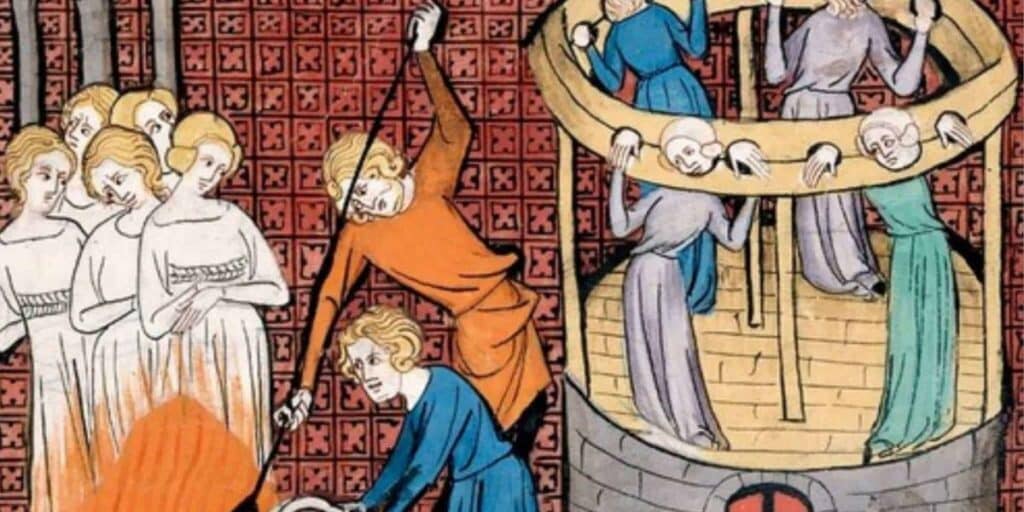
How Witch Hunts Worked: From Accusation to Execution
Once someone was accused of witchcraft in the Middle Ages, the chances of walking away unscathed were slim. The system was rigged from the start, and justice wasn’t the goal. Fear, confession, and control were the driving forces.
Once accused, the person was brought before local authorities. In many cases, these trials were handled by religious courts or inquisitors. The accused was expected to prove their innocence, an impossible task when the charge was invisible and supernatural. They said the devil was helping you lie if you denied the accusation.
Torture was common. Not just allowed, but encouraged. The thinking was that a witch wouldn’t confess unless forced. So they were tied, stretched, burned, starved, or kept awake for days. A confession made under those conditions didn’t have to make sense. It just had to happen.
Confessing didn’t save you. It usually sealed your fate. Many confessed simply to end the pain and gave the names of friends, neighbors, or anyone who crossed them. Each new name triggered a new trial. That’s how small villages quickly ended up with dozens, or even hundreds, of accused witches.
Evidence wasn’t what you’d expect in a real trial. Things like dreams, rumors, or the “testimony” of livestock could be enough. In some places, they performed a water test: tie the accused up and throw them in a river. If they floated, they were guilty. If they sank, they were innocent, but dead or nearly drowned.
Punishments varied by region. In England, hanging was the usual method. In much of continental Europe, burning was preferred. Some were strangled first to spare them the agony. Others weren’t so lucky.
It was a system designed not to uncover the truth, but to feed itself. The more people accused, the more “proof” the authorities had that witchcraft was real. And the more real it seemed, the more people they needed to catch.
Trial by Cake – Yes, Really
It sounds like something out of a twisted baking show, but “trial by cake” was a real method used in witchcraft cases, especially in parts of England.
The recipe? Mix a sample of the accused witch’s urine with flour and ashes, and bake it into a small cake. Then feed the cake to a dog.
If the dog fell ill or behaved strangely, it was taken as proof that the person was guilty of witchcraft. The jury might think twice if the dog stayed healthy, but the accused still wasn’t off the hook.
This bizarre test was based on the idea that witches had a supernatural connection to their bodily fluids, and that harm could be traced through them. In practice, it was just another way superstition found its way into courtrooms and kitchens alike.
How Alewives Became Witches
Before witch hats and cauldrons became costume clichés, they were just part of a day’s work for women who brewed beer.
In medieval Europe, brewing wasn’t a man’s job. It was done almost entirely by women, known as alewives. They brewed small batches of beer at home and sold them to neighbors and passersby. It was honest work and kept households and villages supplied with something far safer than water at the time.
But the image of the alewife slowly soured.
Women brewers wore tall, pointed hats to stand out at the market. They displayed a broomstick outside their door to signal that fresh ale was ready. They brewed in large iron cauldrons, often kept cats to chase off mice from their grain, and sometimes whispered recipes passed down through generations.
As beer production grew more profitable, men began taking over the trade, and the smear campaign began. Alewives were painted as untrustworthy, greedy, or suspiciously skilled. Some were accused of using spells to sell more beer, others of poisoning rivals, and a few, like Agnes de Rochefort, were charged with full-blown witchcraft.
So the next time you see a cartoon witch with a hat, a broom, and a bubbling pot, remember: she might just be brewing a batch of ale.

10 Real Witch Trial Accusations
1. Talking to a cat too often
In 1566 England, Agnes Waterhouse was accused of feeding her cat, named Satan, and having conversations with it.
2. Making butter too quickly
A woman in 17th-century Scotland was accused of using magic to churn butter faster than was humanly possible.
3. Sneezing at the wrong time
During a trial in Germany, a woman’s sneeze was interpreted as a sign she was trying to summon spirits.
4. Giving someone a dirty look
In France, a woman was tried because a child fell ill after she supposedly “glared” at him in church.
5. Having a mole under her left breast
Elspeth Reoch of Orkney was executed in 1616 after examiners found a “witch’s mark” near her ribs.
6. Turning into a rabbit
In 1589, a German woman confessed under torture to changing shape and hopping through fields as a rabbit.
7. Causing a hailstorm
A midwife in Poland was executed in 1630 after a freak storm hit the village the same day she argued with a neighbor.
8. Knowing too much about herbs
Margaret Jones of Massachusetts was hanged in 1648 for using herbal remedies that “worked too well.”
9. Brewing her own beer
Agnes de Rochefort was accused of witchcraft in 14th-century France after brewing beer at home. Her skill in fermentation and her independence as a woman in trade drew suspicion, and locals claimed her ale was enchanted.
10. Laughing at the wrong moment
A woman in Essex was reported for laughing during a church service. It was considered unnatural and suspicious.
Legacy of the Witch Hunts
Historians estimate that between 40,000 and 60,000 people were executed for witchcraft in Europe over several centuries. The real number may be higher. Most of the victims were women, but men and even children were also caught in the dragnet. Many more were tortured, imprisoned, or driven from their homes.
In some towns, entire families were wiped out. Generations of fear and silence followed. Local records show villages where so many people were accused, hardly anyone was left untouched. People learned to stay quiet, keep their heads down, and never draw too much attention.

Witch trials also helped shape legal systems. Some of the worst excesses of torture and forced confession led to later reforms. Courts began to require real evidence. Belief alone wasn’t enough. Slowly, skepticism grew. By the 1700s, Enlightenment thinking started to push back against the idea that witches were hiding in every shadow.
But even as the trials stopped, the fear stuck around. Folklore carried it forward. Superstitions lingered. And the image of the witch, twisted by centuries of fear and fantasy, never really left the stage.
In many parts of Europe today, memorials have been erected to honor the victims. Names once lost in trial records are being remembered. Museums, plaques, and exhibitions are now telling the stories that courts once tried to erase.

Love a good medieval story?
Join our readers and get tales of kings, queens, castles and ordinary medieval lives straight to your inbox.

Kylie Lang is a nationally syndicated travel journalist with bylines on the Associated Press Wire & more, a medieval history writer, and the founder and lead author of Tales of the Middle Ages (talesofthemiddleages.com). She holds a BA (Honours) in History from the University of Kent and is a member of the British Guild of Travel Writers.
Related posts:
 The Terrifying Origins of Europe’s Medieval Witch Trials
 The Night Witches Were Fearless Russian Women Who Terrorized the Nazis from the Sky
 Was Elizabeth Woodville a Witch? Folklore, Fear, and the Making of a Medieval Queen
 How One Colonial Judge Almost Stopped the Salem Witch Trials By Refusing To Continue and Riding Home Without Looking Back