Jacques de Molay was the last Grand Master of the Knights Templar, the most powerful military order the world had ever seen. A man who spent decades trying to hold together an order that was already crumbling, who watched the Holy Land slip away from Christian hands, and who, in the end, was burned alive on a riverbank in Paris for crimes he never committed.
Before the flames had even died down, the men who put him there began to pay for what they’d done. This is the story of Jacques de Molay. And it’s a dark one. It’s a story that sticks with you long after you close the book.
Table of Contents
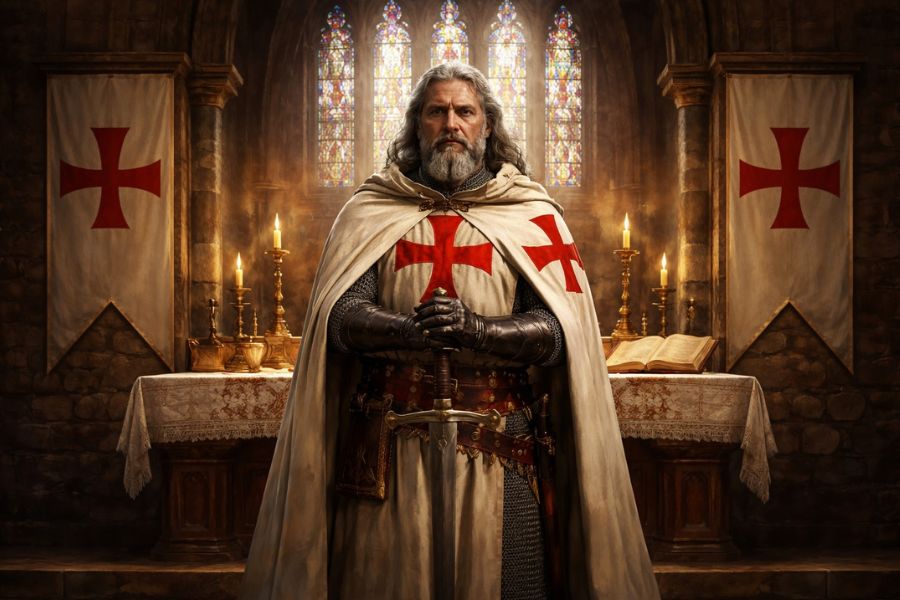
A Boy from Burgundy Who Became a Grand Master
Jacques de Molay was born around 1244 in or near the small village of Molay in the Burgundy region of eastern France, into minor nobility.
Around 1265, he joined the Knights Templar at a chapel in Beaune. He took his vows and disappeared into the Order, spending the next twenty-odd years working his way up through the ranks. Then, in April 1292, he became the 23rd and last Grand Master of the Knights Templar.
The Fall of Acre: The Day Everything Changed
To understand what Jacques de Molay inherited, you need to know what had already been lost.
The Crusader states in the Holy Land had been shrinking for decades. City by city, fortress by fortress, the Muslim forces had been pushing the Christians back toward the sea. By 1291, the last major stronghold was Acre, a port city on the coast of modern-day Israel that had been a Crusader capital for generations. It was where the Templars, the Hospitallers, and the remaining Crusader nobility had dug in. It was their last real foothold.
And in the spring of 1291, the Mamluk Sultan Khalil came to take it.
The Mamluks brought an army that dwarfed anything the defenders could muster. Tens of thousands of cavalry, over a hundred thousand infantry.
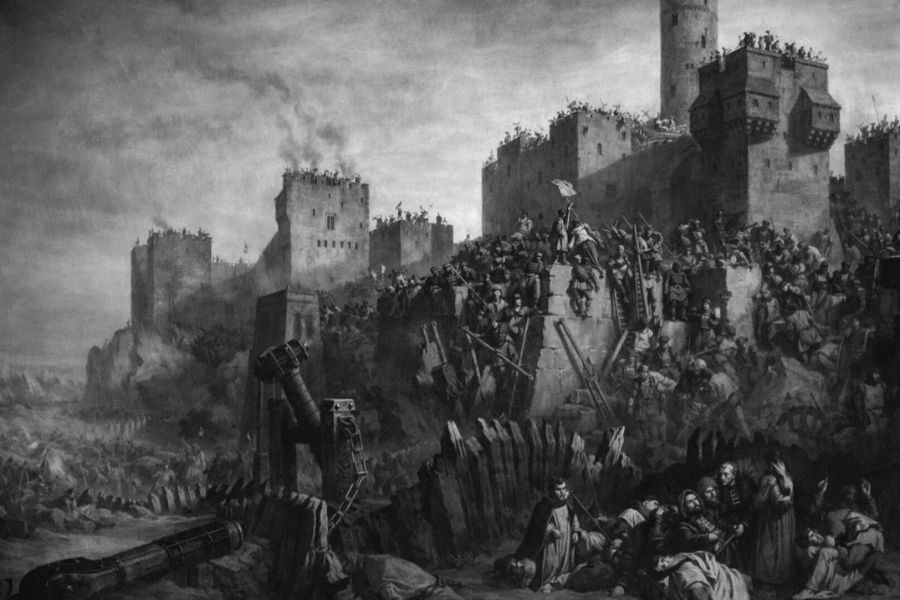
The Templars and Hospitallers fought side by side on the northern walls, defending the Montmusard section of the fortifications. The Grand Master of the Hospitallers, William de Beaujeu, was mortally wounded defending the Gate of St. Anthony and died on the battlefield. The city held for weeks, but the outcome was never really in doubt.
Acre fell on May 18, 1291.
But the Templars didn’t leave with the rest. Their fortress held for ten more days after the city was gone. A knight called Peter de Severy negotiated terms for a safe withdrawal and was betrayed and killed when the Mamluks broke the agreement. The final Templar tower collapsed on May 28, burying both defenders and attackers alike in the rubble.
It was over. The last Christian strongholds along the coast, Sidon, Tortosa, the fortress at Athlit, were evacuated over the following months. By August, it was done. Two hundred years of Crusader presence in the Holy Land, gone.
The Templars retreated to the island of Cyprus. And Jacques de Molay, who had just taken command of the Order, inherited a mission with nowhere left to fight.
A Man With a Plan (That No One Wanted to Hear)
De Molay wasn’t the kind of man to sit quietly and accept defeat. From the moment he became Grand Master, he was pushing hard for a new crusade to reclaim the Holy Land.
He travelled across Europe in the 1290s, meeting popes, kings, and nobles to make his case. He went to Pope Boniface VIII, visited Edward I of England, James I of Aragon, and Charles II of Naples. He laid out the plans, the numbers, the strategy, genuinely believing that the Holy Land could be won back.

But nobody wanted to listen. The appetite for crusading had faded. The political rivalries among European monarchs made it almost impossible to organize a unified campaign. De Molay’s calls for a new war kept hitting the same wall: polite interest followed by nothing.
There was one other thing de Molay pushed back against, and it would matter later. Pope Clement V, a French pope installed with the backing of the French crown, proposed merging the Knights Templar and the Knights Hospitaller into a single order. On paper, it sounded sensible, but in reality, it was a power grab. The merged order would answer to whoever controlled it, and the person most keen to control it was Philip IV of France.
De Molay said no, stating that the Templars were their own order, with their own identity and history. He wasn’t about to hand that over.
It was the right call, historically speaking. It was also a fatal one.
Hooked on the Middle Ages? Get more stories like this one in your inbox.
Friday the 13th: The Day Everything Ended
Philip IV of France badly needed money. His wars against England and Flanders had drained the royal treasury, and he had already gone after everyone else he could squeeze. In 1292, he seized the assets of Lombard bankers. In 1306, he expelled the Jews from France and confiscated their property.
The Templars were next in line, and they were by far the richest target. With the Crusades effectively over, the Order had pivoted from holy warriors to something closer to a medieval banking system, and they had accumulated enormous wealth across Europe.

Philip owed them a significant sum, including a 500,000-livre loan made in 1299. There was also a power problem. The Templars answered only to the Pope, not to any king, and that made it impossible for Philip to control them. He wanted their money, and he wanted them out of his way. The charges of heresy would give him the excuse to take both.
On Friday, October 13, 1307, coordinated dawn raids swept across France.
Every Templar in the country was arrested simultaneously. It was a masterpiece of organisation. Philip IV had been planning this for months, possibly longer. He had the Pope’s support, or at least enough of it to keep the Church from interfering. The charges were ready. The men were in position. And at first light, they moved.
Jacques de Molay was among those taken. So were hundreds of other Templars, including the Order’s senior leadership.
The charges were long and included heresy, blasphemy, sodomy, denying Christ, spitting on the cross, and worshipping an idol called Baphomet. Every accusation was designed to horrify, to turn public opinion against an order that had been, until that morning, one of the most respected institutions in Christendom.
Pope Clement V, rattled by the speed of Philip’s move, initially pushed back. But in the end gave in to Philip and issued the papal bull Pastoralis Praeeminentiae, ordering the arrest of Templars across all of Christendom. The Order was finished.
The Torture, the Confessions, and the Lies
On October 24th and 25th, 1307, de Molay was interrogated and, under torture, he confessed. He admitted to denying Christ and spitting on the cross. But he denied the sodomy charges.
Then he wrote a letter, urging other Templars to confess too. Whether he did this out of genuine belief that cooperation would save them, or because he was trying to protect his men from worse, nobody knows for certain. What’s clear is that the letter was used by the Crown and the Inquisitors to legitimise the whole process.
It was a pattern that repeated across the Templar trials. Confess under torture and retract when papal delegates arrived, and the immediate threat of pain receded. Confess again when the pressure returned. It went back and forth for months, a hideous game where the outcome had already been decided.
In May 1310, fifty-four Templars who had retracted their confessions were burned at the stake. The message was clear: take back your confession, and you die.
The Chinon Parchment: The Secret That Was Hidden for 700 Years
In August 1308, a papal commission was sent to Chinon Castle to interrogate de Molay and the senior Templar leadership directly. The commission was made up of three cardinals, Bérenger Fredoli, Étienne de Suisy, and Landolfo Brancacci, acting on behalf of Pope Clement V.
They interviewed the Templars and heard the confessions. And then, according to the document that records all of this, Pope Clement V absolved Jacques de Molay and the other leaders of heresy. He readmitted them to communion with the Church. He found them, in effect, not guilty of the most serious charges laid against them.
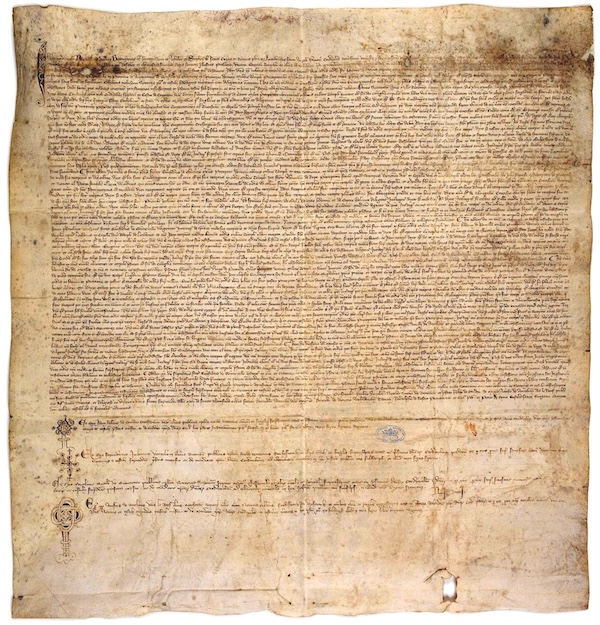
The document, known as the Chinon Parchment, was real and sat in the Vatican archives for centuries. But nobody knew it was there.
In September 2001, an Italian paleographer named Barbara Frale found it. It had been misfiled, catalogued under the wrong reference number, buried in the vast labyrinth of the Vatican’s Secret Archives. The document was dated August 17th to 20th, 1308. It had been there for almost exactly 700 years.
The Vatican published it in 2007, in a limited edition of 800 copies. Pope Benedict XVI acknowledged, publicly, that the Templars had been wrongfully accused. The Church had known, or at least the evidence had been there all along, and the Order had been destroyed anyway.
What the Chinon Parchment tells us is that Clement V tried, in his way, to save them. But Philip IV had soldiers at his gate, and soldiers mattered more than papal bulls.
The Council of Vienne: The Order Dies on Paper
On March 22, 1312, Pope Clement V formally abolished the Knights Templar at the Council of Vienne.
The papal decree was carefully worded, an “apostolic ordinance” to prevent scandal and damage to the Church, not a declaration that the Templars were heretics. Clement knew what the evidence actually showed. But the politics were what they were, and the Order was gone.
The Templars’ properties were officially transferred to the Knights Hospitaller. In practice, Philip IV seized most of the French holdings for himself. The wealth that had made the Templars a target in the first place was absorbed into the French crown.
De Molay watched all of this happen. He had been in custody for five years by now. And through all of it, he had said very little publicly. He had confessed, retracted, and confessed again. But he had not broken.
Not yet.
The Scaffold Before Notre Dame
On March 18, 1314, Jacques de Molay was seventy years old.
He and Geoffroi de Charney, the Preceptor of Normandy, were sentenced to life imprisonment. It was meant to be the end of the story, a quiet conclusion to a messy affair. They would disappear into a cell, and the world would move on.
Instead, something remarkable happened.

De Molay and de Charney were brought out to a scaffold erected in front of Notre Dame Cathedral in Paris. They were meant to read prepared statements accepting their guilt and thanking the King and the Pope for their mercy.
Both men, standing before a crowd that included priests, nobles, and ordinary Parisians, retracted every confession they had ever made. They declared the Order of the Knights Templar innocent and said what they had admitted under torture was false. All of it. And they said it clearly, loudly, and without hesitation.
Philip IV, watching from nearby, didn’t hesitate. He ordered both men seized and burned at the stake that same evening. De Molay and de Charney were taken to a small island in the Seine called the Île des Javiaux.
Jacques de Molay, the last Grand Master of the Knights Templar, was burned alive on March 18, 1314. He was seventy years old and had spent the last seven years in prison for crimes he did not commit. And in the end, he chose death over silence.
The Curse That Haunted a King
Now. Here is where history gets interesting.
The curse of Jacques de Molay is one of the most enduring legends attached to the Templar story. The versions differ, as legends always do. But the most dramatic tells it like this: as the flames consumed him, de Molay raised his voice and cursed both Pope Clement V and King Philip IV. He summoned them, both of them, to face God’s tribunal within one year.
Is it true? Almost certainly not, in those exact words. Eyewitness accounts from the time say that de Molay showed no fear on the pyre. That he spoke, but what he said was recorded differently depending on who was doing the recording. A chronicler called Ferreto of Vicenza wrote a similar curse, but attributed it to a different Templar, a Neapolitan knight executed earlier. It’s likely that the legend grew from multiple accounts, stitched together over time into one dramatic moment.
But the curse “came true.”
Pope Clement V died on April 20, 1314, thirty-three days after de Molay’s execution at the age of sixty-two. The cause was bowel cancer, or possibly dysentery.
King Philip IV died on November 29, 1314, just over seven months later. He suffered a stroke while hunting and was forty-six.
Philip’s three sons, one after another, took the throne and died without male heirs. The House of Capet, which had ruled France for over three hundred years, collapsed within fourteen years of de Molay’s death.
Whether you call it coincidence, poetic justice, or something else entirely is up to you. But the timing is hard to ignore.
The Legacy That Refused to Die
Jacques de Molay left almost nothing behind. No writings, personal letters, or portraits that historians can confirm as his. He was a man of action, not words, and the world he lived in didn’t preserve the inner lives of men like him.
What he left was a story.
The Order of DeMolay, a Masonic youth organisation founded in 1919, was named after him. Freemasonry itself, which emerged roughly four centuries after the Templars were dissolved, has long been linked, rightly or wrongly, to the Knights Templar. De Molay sits at the center of that connection, not because of anything he did in life, but because of what he became after death: a symbol.

A symbol of loyalty. Of resistance. Of a man who could have saved himself by keeping quiet, and chose not to.
Maurice Druon turned the story into fiction with his novels “Les Rois maudits,” The Accursed Kings, a series that ran from 1955 to 1977 and became one of the most popular historical novel sequences in France. It was adapted for French television twice, in 1972 and again in 2005. De Molay’s curse became the engine of the whole series.
The real man is harder to find than the legend. But in the end, what we know about Jacques de Molay comes down to this: he was given every opportunity to betray his Order, to save his own life, to go quietly into a prison cell and be forgotten. He chose, instead, to stand in front of Notre Dame and tell the truth.
It cost him everything, but made him immortal.

Love a good medieval story?
Join our readers and get tales of kings, queens, castles and ordinary medieval lives straight to your inbox.

Kylie Lang is a nationally syndicated travel journalist with bylines on the Associated Press Wire & more, a medieval history writer, and the founder and lead author of Tales of the Middle Ages (talesofthemiddleages.com). She holds a BA (Honours) in History from the University of Kent and is a member of the British Guild of Travel Writers.
Related posts:
 Friday the 13th, Jedi Knights, and a Drug Cartel: The Legacy of the Knights Templar
 Why the Knights Templar Still Haunt History Books. Uncovering the Truth Behind the Legend
From Holy Land to Heresy Trials: The Rise and Fall of the Knights Templar
Why the Knights Templar Still Haunt History Books. Uncovering the Truth Behind the Legend
From Holy Land to Heresy Trials: The Rise and Fall of the Knights Templar
 Betrayed by a King. Erased by a Pope. Were the Knights Templar Heroes, Heretics, or Scapegoats?