Imagine being asked, as a mark of honor, to help carry the coffin of a royal princess through the streets of Paris. You’re the Grand Master of the most feared military order in Christendom, a man who has spent his life in a white mantle with a red cross.
The king walks beside you, and you have no idea that in his sealed dispatches, riding out to every corner of the kingdom, your name already sits at the top of an arrest list. That was the reality for Jacques de Molay on 12 October 1307. The next morning, before the bells rang for prime, Philip IV of France had every Templar he could reach in chains.
Table of Contents
Philip IV destroyed the Knights Templar swiftly and brutally. He ordered the simultaneous arrest of every Templar in France at dawn on Friday 13 October 1307, used torture to extract heresy confessions, seized their wealth, and pressured Pope Clement V into suppressing the order in 1312. De Molay was burned at the stake in 1314.
The Dawn Raid of 13 October 1307
The orders had gone out a month earlier, on 14 September 1307, riding in sealed packets to Philip’s baillis and sénéchaux across France with instructions that they were not to be opened until the evening of 12 October.
Local officials broke the seals by candlelight, read what they were being asked to do, and then had a few hours to organize armed men before the pre-dawn hour named in the writ.
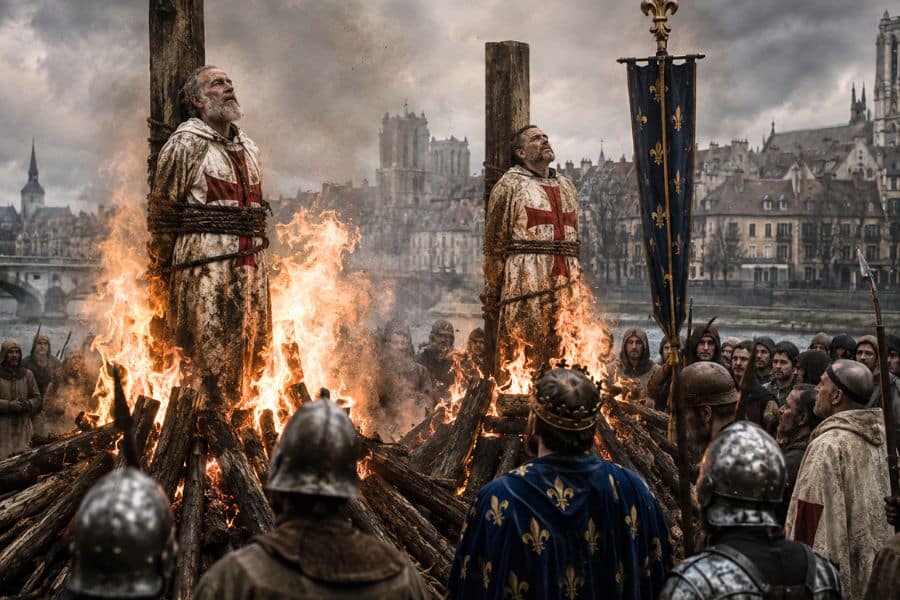
At first light on Friday 13 October, royal officers moved on every Templar house they knew of, from the great fortified enclosure of the Paris Temple down to obscure country preceptories.
Contemporary estimates put the first wave at around 620 arrests, with Jacques de Molay taken at the Paris Temple itself. The prize was the leadership: de Molay, Hugues de Pairaud the Visitor of France, Geoffroi de Charney of Normandy, Geoffroi de Gonneville of Aquitaine.
Rank-and-file brothers, many of them elderly farmers in a habit rather than warriors, were rounded up alongside them.
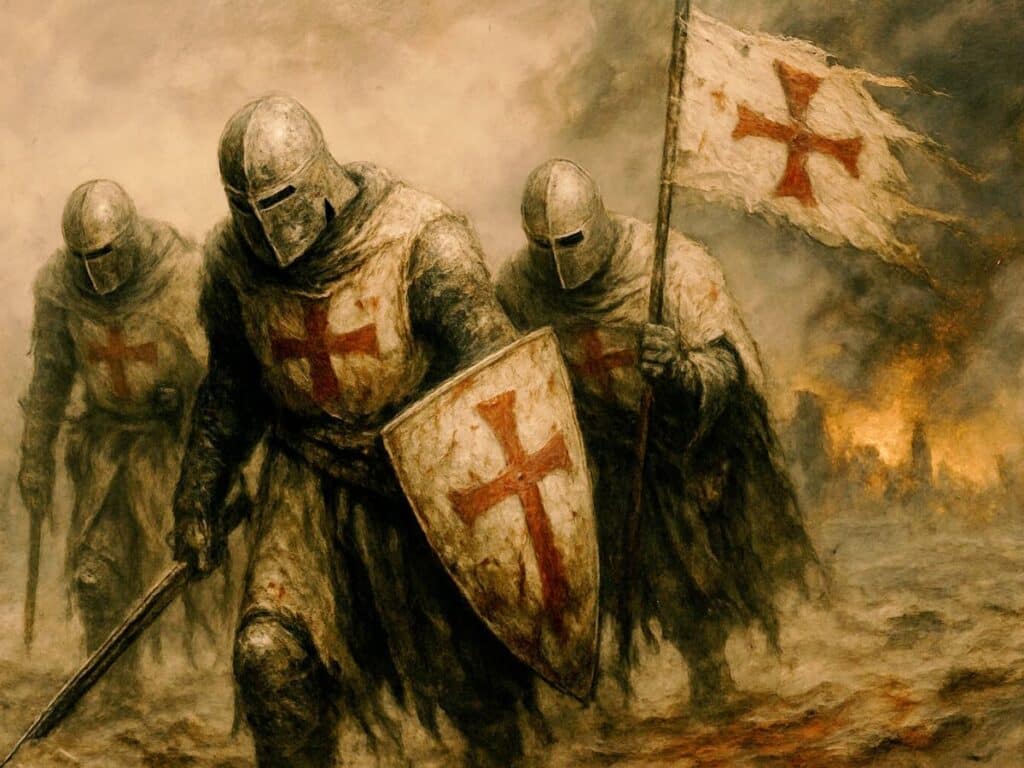
Almost nobody resisted. The Templars in France in 1307 were not the sunburned crusaders of legend but administrators, estate managers, and old men. They had been ordered to obey the king’s officers pending investigation, and most of them, still assuming the pope would sort this out within a week, simply went.
By nightfall on the 13th, Philip’s officers were already inventorying the contents of the Temple treasury in Paris.
Why Did Philip IV Want the Templars Gone?
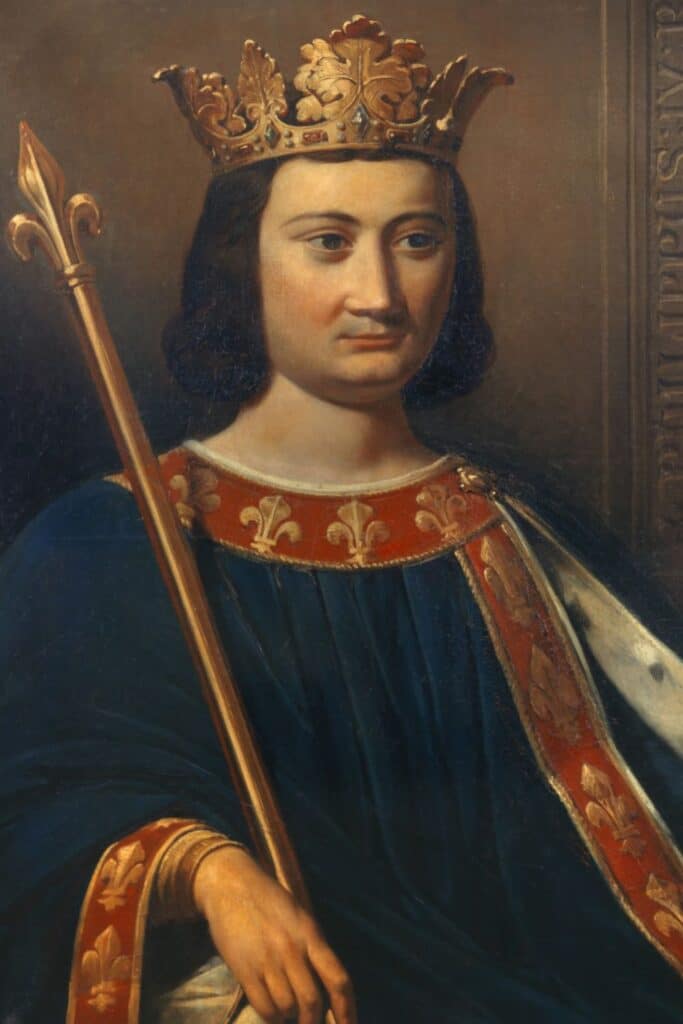
Philip was not a man who did anything for a single reason. He had spent the past decade at war with Edward I of England over Gascony; he had debased the coinage so badly that Parisians rioted in his own capital.
He’d reached for the assets of the two other groups in France with cash on hand: the Jews, whom he expelled and robbed in 1306, and the Lombard bankers, who were arrested and squeezed the year before.
When you run out of Jews and Lombards, and you still owe the Temple a fortune in war loans, the Temple starts to look tempting.
Money was not the only piece of it, though. The Templars answered to the pope alone. They paid no royal tax.
Their Paris headquarters was a fortress inside Philip’s own city, garrisoned by men who owed him nothing. For a king who had already put his hands on Pope Boniface VIII at Anagni in 1303, contributing to Boniface’s death within weeks, an armed international order sitting outside royal authority was a splinter he could not leave in.
Historians disagree on how much Philip actually believed the heresy stories his own ministers were writing down. Malcolm Barber, in The Trial of the Templars, treats the financial and political motive as primary, with the religious language as the tool that made a legal case possible.
Others have argued Philip’s piety was devout and paranoid in equal measure, and that he half-believed his own propaganda by the end. The two are not mutually exclusive. A king can want your gold and also want to believe you deserve to lose it.

The Charges: Heresy, Idols and Spitting on the Cross
The accusations against the Templars had been drafted for months before the raid, largely by Guillaume de Nogaret, Philip’s keeper of the seals and the same man who had led the assault at Anagni.
Nogaret was a lawyer to the bone, and he understood that if you wanted to break a religious order you needed a religious crime. Simple theft would not do, but heresy would work perfectly.
On entering the order, new brothers were said to deny Christ 3 times, spit on the cross, and receive obscene kisses from their receptor on the mouth, the navel, and the base of the spine.
They were said to worship an idol, sometimes described as a bearded head called Baphomet, sometimes as a cat. They were accused of sodomy as a matter of rule.
The Templar ‘kiss of peace’ at reception, an ordinary monastic ritual, was twisted into evidence of the last charge with almost embarrassing crudeness.
None of this had come out of the Temple’s own records. Most of it had come out of the mouths of a handful of expelled or disgraced brothers whom Nogaret’s agents had found and coached in the year before the arrests.
Once the charges were public, they were repeated in every interrogation, and every interrogation was then cited as proof that the charges were true. It was a closed loop, and it had been designed that way.
Hooked on the Middle Ages? Get more stories like this one in your inbox.
How Were the Confessions Extracted?
The confessions came out of torture. The knights arrested on 13 October were not questioned by scholars in a quiet room. They were handed to the same royal officers who had arrested them, isolated from each other, denied food and sleep, and tortured.
The strappado came out early. A man’s hands were tied behind his back, a rope was thrown over a beam, and he was hoisted off the ground by his wrists until his shoulders dislocated.
Weights were sometimes hung from his feet. Foot-roasting was also used: the prisoner’s feet were greased and held over a fire until the flesh cooked off the bone.
Records from the Paris interrogations mention at least one brother who arrived at his hearing carrying the blackened bones of his own toes in a bag, having asked to keep them.
Under that treatment, most knights confessed to whatever was put in front of them. De Molay himself confessed within weeks, admitting to denying Christ and spitting near, though not on, the cross. Hugues de Pairaud confessed to more.
Around 36 brothers died in custody in the first few months, either from the torture itself or from what followed. Philip had his paper trail, notarized and sealed, and he had it fast.
The Chinon Parchment and the Pope Who Absolved Them
Pope Clement V was in an impossible position. He was French, he lived at Avignon under Philip’s shadow, and he had been elected in 1305 partly because Philip wanted him. He also happened to be, by the standards of medieval popes, a lawyer of some conscience.
When de Molay retracted his Paris confession in front of two cardinals and asked for a papal hearing, Clement listened.
In August 1308, Clement sent three cardinals, Berenger Fredol, Étienne de Suisy, and Landolfo Brancacci, to the fortress of Chinon in the Loire Valley, where de Molay and the other four senior Templars were being held.
Over four days, 17 to 20 August 1308, the cardinals heard the leaders’ testimony in private, absolved them of the charges of heresy, and formally restored them to the sacraments and the communion of the Church.
The record of that hearing was written down, sealed, sent back to the papal archives, and there it sat, misfiled, for nearly 700 years.
Barbara Frale, a paleographer working in the Vatican Apostolic Archive, rediscovered the document in 2001. Her scholarly edition, ‘The Chinon chart: Papal absolution to the last Templar, Master Jacques de Molay,’ pieced together what Clement had actually done.
He’d absolved the men, but had not, by the same act, cleared the order itself, which he suspended rather than exonerated. That distinction let Philip keep pressing.
It also left de Molay in the queer position of being, by 1309, a man in good standing with the Church who was still in a French prison, and would still be burned as a relapsed heretic five years later.
Vox in Excelso and the Council of Vienne
Philip’s next move was to force the order’s outright dissolution, and here he had leverage Clement could not ignore. Through 1310 and 1311, Philip’s envoys reminded the pope, again and again, that a heresy case could still be reopened against the dead Boniface VIII, whose bones would then have to be dug up and burned.
It was the sort of thing Philip was entirely capable of arranging. In February 1312, at private meetings between Clement and Philip’s men, a bargain was struck: the Boniface case would be dropped, and the Templars would be dissolved.
On 22 March 1312, at the Council of Vienne, Clement issued the bull Vox in excelso. He did not condemn the order for heresy, which he could not, given Chinon. He suppressed it by administrative fiat, on the grounds that the accusations had made the order impossible to save regardless of guilt.
Two months later, in May 1312, the bull Ad providam handed most Templar property to the Hospitallers, the rival military order, rather than to Philip directly. Philip took what he could in expenses, in unpaid loans, in fees for the years his officers had administered the estates, but the bulk of the wealth slipped past him.
On the ground, the transfer was slow and contested for decades. In some kingdoms the Hospitallers had to sue to get the properties they had been granted. In France, Philip’s officials proved reluctant to hand over houses, mills, and vineyards they had grown used to running.
If Philip did not get the Temple’s gold in the neat pile he’d imagined, he’d at least broken the institution that owned it.
The Burning of Jacques de Molay, 18 March 1314
By March 1314, the four surviving senior Templars, held for nearly seven years, were brought out onto a scaffold in front of Notre-Dame in Paris to hear their final sentences.
A papal commission read out that de Molay, Hugues de Pairaud, Geoffroi de Charney and Geoffroi de Gonneville would spend the rest of their lives in prison, their confessions confirmed, the matter closed.
De Molay refused. Standing on the scaffold in front of the Paris crowd, he retracted everything. He said the Templars were innocent, that his confession had been extracted by torture, and that he would rather die than let the lie stand.
Geoffroi de Charney stood up beside him and said the same. Pairaud and de Gonneville stayed silent and took the life sentence; they died in prison, unrecorded.
Philip, informed within hours, did not wait for the Church. He convened his own council that afternoon, declared the two retractors relapsed heretics, and had them taken that evening to a small island in the Seine, the Île aux Juifs, between the royal palace and the gardens of the Augustinian friars.
Contemporary chroniclers, including the continuator of Guillaume de Nangis, report that the two men were burned slowly over smokeless charcoal so the crowd could hear them speak. Both went to the fire calmly.
The legend, which grew in the decades after, holds that de Molay called Philip and Clement to meet him before God’s court within the year. Clement V died in April 1314, roughly a month later, of a long illness.
Philip IV died in November of the same year, after a hunting accident and a stroke. The curse is almost certainly a later invention. The two deaths, following the burning by a matter of months, were not.
Beyond France, the crackdown had already run a softer course, with Edward II in England refusing to move on the order until January 1308 and using little torture, and with Templars in Aragon, Portugal and Cyprus absorbed into other orders or acquitted outright. France was the exception. The fire on the Île aux Juifs was where the story ended, in Philip’s own city, within sight of his own windows.
Frequently Asked Questions
Why did Philip IV arrest the Knights Templar?
Philip IV arrested the Knights Templar mainly because he was broke and they were rich. Deep in debt from his war with England, he had already squeezed France’s Jewish and Lombard lenders for cash, and the tax-exempt Templars, who answered only to the pope, were the next target. Historians debate whether he also believed the heresy charges, but the money and the reach for royal control came first
What day were the Knights Templar arrested?
The Knights Templar were arrested at dawn on Friday 13 October 1307, in a single coordinated sweep across France. Philip IV’s sealed orders had gone out to his officials on 14 September and could only be opened the night before, so agents kicked in commandery doors everywhere at once, before anyone could flee or warn the others. Jacques de Molay, the Grand Master, was among the first taken.
What were the Knights Templar accused of?
The Knights Templar were accused of heresy, denying Christ, spitting on the cross at their initiation, worshipping idols, and sodomy. Historic Royal Palaces counts 127 separate charges laid against the order. Most of it was manufactured by Philip IV’s ministers, and the innocent-sounding ‘kiss of peace’ exchanged when a knight joined was twisted into an accusation of ritual sodomy to make the case stick.
Did the Pope really absolve the Knights Templar?
The Pope did quietly absolve the Templar leaders, according to the Chinon Parchment, a document Barbara Frale rediscovered in the Vatican archives in 2001. In August 1308, Clement V’s cardinals heard Jacques de Molay and the other chiefs recant, cleared them of heresy, and restored them to the Church. He still suspended the order and, under Philip’s pressure, dissolved it in 1312. The men were executed anyway.
How did Jacques de Molay die?
Jacques de Molay died at the stake on 18 March 1314, burned on a small island in the Seine in Paris. Brought out to hear a sentence of life imprisonment, he stunned the crowd by publicly retracting his forced confession and declaring the order innocent. Philip IV, enraged, abandoned legal procedure and ordered him and Geoffroi de Charney burned that same evening at the hour of Vespers.
How long did it take Philip IV to destroy the Templars?
Philip IV’s destruction of the Templars took roughly seven years, from the arrests on 13 October 1307 to the burning of Jacques de Molay on 18 March 1314. The key turning point came in between, when Pope Clement V formally dissolved the order with the bull Vox in excelso on 22 March 1312. Even then, Philip pushed further, executing the leadership two years after the order legally ceased to exist.
What happened to the Templars’ money and property?
The Templars’ wealth did not go straight into Philip IV’s treasury, at least not on paper. The 1312 bull Ad providam handed most of the order’s property to the rival Knights Hospitaller. In practice, Philip clawed back a great deal through ‘expenses’ and a fee squeezed from the Hospitallers, so the crown that ran the trials still came out ahead
## Sources
Primary sources
“Parchment of Chinon.” Vatican Apostolic Archive. 1308. https://en.wikipedia.org/wiki/Chinon_Parchment.
“Vox in excelso.” Decrees of the Council of Vienne. 1312. https://www.papalencyclicals.net/councils/ecum15.htm .
Secondary sources
Barber, Malcolm. The Trial of the Templars. Cambridge: Cambridge University Press, 2006. https://books.google.com/books/about/TheTrialoftheTemplars.html?id=GEu58-OIT1MC.
Frale, Barbara. “The Chinon chart: Papal absolution to the last Templar, Master Jacques de Molay.” Journal of Medieval History, vol. 30, no. 2. 2004. https://www.academia.edu/8850655/TheChinonParchment.

Love a good medieval story?
Join our readers and get tales of kings, queens, castles and ordinary medieval lives straight to your inbox.

Kylie Lang is a nationally syndicated travel journalist with bylines on the Associated Press Wire & more, a medieval history writer, and the founder and lead author of Tales of the Middle Ages (talesofthemiddleages.com). She holds a BA (Honours) in History from the University of Kent and is a member of the British Guild of Travel Writers.
Related posts:
 The Last Grand Master: How Jacques de Molay Burned for the Truth and Took a King to His Grave
 From Holy Land to Heresy Trials: The Rise and Fall of the Knights Templar
 Why Do the Knights Templar Have Us So Fascinated? Heretics or Heroes
Why the Knights Templar Still Haunt History Books. Uncovering the Truth Behind the Legend
Why Do the Knights Templar Have Us So Fascinated? Heretics or Heroes
Why the Knights Templar Still Haunt History Books. Uncovering the Truth Behind the Legend