
In the summer of 1325, Isabella of France sat in her chamber in Paris and refused point-blank to get on a ship to return to her husband, Edward II, in England.

Her brother was the King of France, her son somewhere on the Channel coast waiting for her, and her lover, an escaped Marcher lord with a price on his head, a few days’ ride away. It was quite the setup, and it was about to change history.
Table of Contents
But how does a wronged queen end up leading an army against her own husband, putting her teenage son on his throne, and then losing everything again to that same son four years later? The story of Isabella of France and Roger Mortimer is one of the strangest political sequences in English medieval history.
A Marriage That Was Broken Before It Started
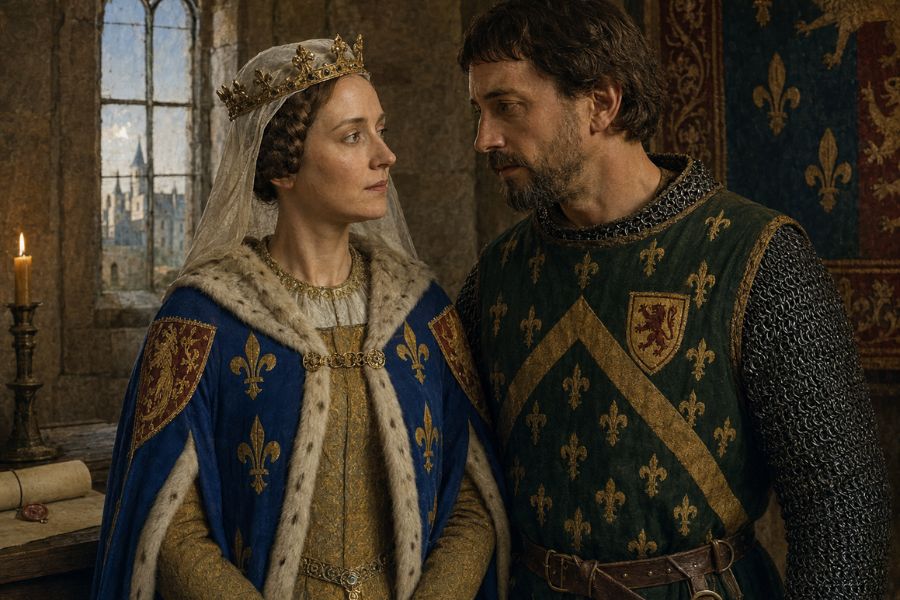
Isabella was 12 years old when she married Edward II at Boulogne in January 1308. She was the only surviving daughter of Philip IV of France, a girl raised in the most powerful court in Christendom, and her dowry alone was meant to make her position at the English court unassailable.
It didn’t. Edward gave the jewels Philip had sent as wedding gifts to his favorite, Piers Gaveston, and spent much of the wedding banquet at Gaveston’s side rather than his bride’s. Isabella’s uncles, the counts of Valois and Évreux, walked out of the celebrations in fury.
Gaveston was murdered in 1312 by a group of English earls led by Thomas of Lancaster, and for a few years the marriage steadied. Isabella bore Edward four children, including the future Edward III in 1312, and she seems to have played the peacemaker in more than one crisis between her husband and his barons.
The chronicler Geoffroi de Paris praised her diplomacy during the Anglo-French tensions of 1313. She was, by every account we have, doing the job of a medieval queen and doing it well.
Then came the Despensers. Hugh Despenser the Younger and his father wormed their way into Edward’s affections and, more damagingly, into control of royal patronage from around 1318 onwards.
Hugh the Younger was greedy on a scale that even hardened medieval barons found startling, and by the early 1320s he had stripped Isabella of her estates, seized her income, and placed her children in the custody of his own relatives.
The Vita Edwardi Secundi, written by an anonymous cleric in Edward’s own household, records Isabella’s humiliation with unusual sympathy. She was, in effect, a prisoner in her husband’s court.

Paris, 1325: The Queen Who Wouldn’t Come Home
In March 1325 Edward sent Isabella to France to negotiate with her brother, Charles IV, over the disputed duchy of Gascony. It was a sensible choice on paper. She was fluent, well-connected at the Capetian court, and had every reason to want a settlement.
She reached Paris, negotiated a treaty by the end of May, and then, when the time came to return, she didn’t.
Her public reason, delivered in an extraordinary speech at the French court, was that she could no longer live with a husband who had allowed a third party to come between them. She named the Despensers directly. She wore widow’s clothes, and told her brother, in front of his court, that she would not return until Hugh Despenser was removed from Edward’s side.
And it worked, because Charles refused to compel her.
Roger Mortimer of Wigmore was already in Paris. A Marcher lord from the Welsh borders, he’d led the baronial revolt against the Despensers in 1321, been captured at Shrewsbury in January 1322, and imprisoned in the Tower of London.
In August 1323 he’d escaped, drugged his guards according to the Anonimalle Chronicle, climbed down from the Tower by rope, crossed the Channel, and made his way to the French court.
By the winter of 1325 he and Isabella were living openly together. Jean le Bel, the Hainault chronicler who’s friendlier to Isabella than most, treats the affair as open by the following year, and Isabella made no serious effort to hide it.
When Edward wrote demanding she send their son home, she refused that too. The boy, Prince Edward, had done homage to Charles IV for Gascony and Ponthieu in September 1325, and he stayed with his mother.
The Invasion of 1326
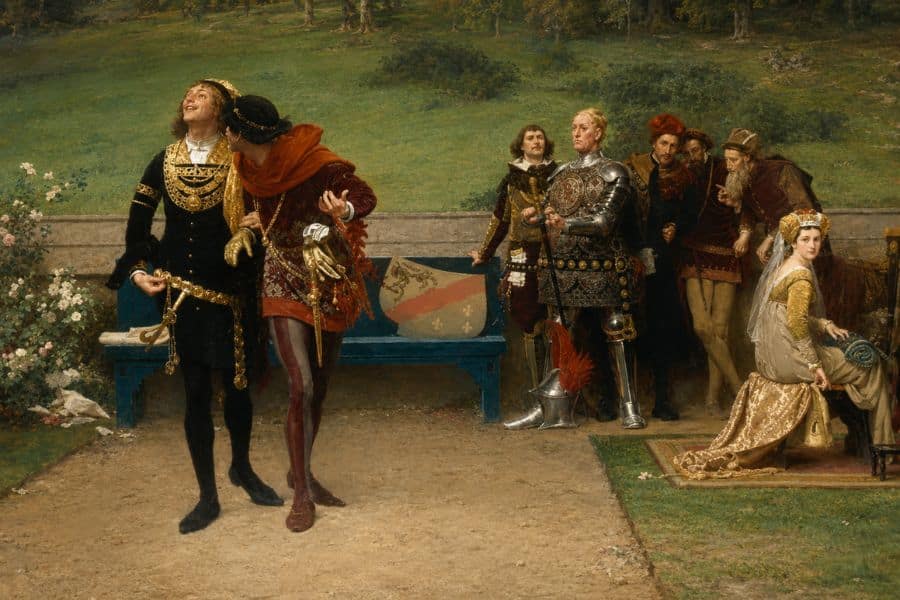
Charles IV eventually asked his sister to leave Paris, embarrassed by the scandal and pressed by Edward’s diplomats. Isabella and Mortimer went north to Hainault, where they arranged the betrothal of Prince Edward to Philippa, the daughter of Count William of Hainault.
Philippa’s dowry paid for ships and mercenaries. On 24 September 1326 the invasion fleet sailed from Dordrecht and landed two days later on the Suffolk coast near Orwell. It wasn’t large, perhaps 1,500 men including Hainault mercenaries under John of Hainault, but it didn’t need to be.
Edward II’s regime collapsed almost on contact. The city of London rose against the king’s officials, dragging Bishop Walter Stapledon from his horse in Cheapside on 15 October and hacking off his head with a bread knife.
Edward fled west with the younger Despenser, hoping to raise troops in Wales. He raised none. Hugh Despenser the Elder was captured at Bristol on 27 October and hanged in his armor, his body cut down and fed to dogs.
The king and the younger Despenser were run to ground in open country near Llantrisant on 16 November.
Hugh Despenser the Younger was taken to Hereford and put on trial before a court that included Mortimer. The sentence, recorded in detail by the chronicler Geoffrey le Baker, was appalling even by the standards of medieval treason executions: he was dragged behind horses through the streets, hanged 50 feet in the air on a specially built gallows, cut down alive, castrated, disemboweled, and finally beheaded.
Isabella and Mortimer watched, and Edward himself was the harder problem, because kings weren’t deposed in England and there was no procedure for what would happen next.
The Deposition and the Death at Berkeley
A parliament, or something calling itself one, met at Westminster in January 1327. The bishops led by Adam Orleton of Hereford argued that Edward had broken his coronation oath, favored evil counselors, lost Scotland, and shown himself incapable of governing.
On 20 January, a delegation went to Edward at Kenilworth, where he was being held, and told him he would be deposed. He wept, fainted, and eventually agreed to abdicate in favor of his 14-year-old son, who was crowned Edward III on 1 February 1327.
The deposed king was moved in April to Berkeley Castle in Gloucestershire, held by Mortimer’s son-in-law, Thomas de Berkeley. On 21 September 1327 he was reported dead.
The official cause was natural, but within a generation the chroniclers were repeating a story that has stuck to English history ever since: that Edward had been murdered by having a red-hot poker or spit thrust into his bowels, so as to leave no external mark.
Ranulf Higden’s Polychronicon carries the story, as does Geoffrey le Baker’s account, written several decades after the event.
Whether it happened is another matter. Ian Mortimer, in his 2003 biography of Roger Mortimer and a series of subsequent articles, has argued that Edward II wasn’t murdered at Berkeley at all, and that the so-called Fieschi Letter, a document sent to Edward III in the 1330s by a Genoese priest, suggests the deposed king escaped and lived out his life on the continent as a hermit.
Seymour Phillips, whose 2010 biography of Edward II is the standard modern account, isn’t persuaded and thinks Edward almost certainly died at Berkeley, though probably by suffocation rather than by the poker.
What’s not in doubt is the political effect. Edward II had been eliminated as a rival, and Isabella and Mortimer held the government of England in the name of a teenage king.
The Regency and Its Collapse
For the next three years, Isabella and Mortimer ran the country. There was no formal regency council, which was itself part of the problem, and Mortimer accumulated titles and lands at a rate that made even the Despensers look modest.
He created himself Earl of March in October 1328, an entirely new dignity, and took control of most of the Welsh Marches. Isabella took an income of £13,333 a year from the crown, an enormous sum, and much of the dowry she had once complained about was restored.
They also made bad decisions. The Treaty of Northampton in 1328 recognized Scottish independence and arranged the marriage of Isabella’s daughter, Joan, to David Bruce, the young son of Robert Bruce. English opinion called it the Shameful Peace.
When Edmund of Woodstock, Earl of Kent and half-brother of Edward II, was drawn into a plot in 1330 based on the belief that Edward II was still alive, Mortimer had him executed at Winchester in March.
The executioner refused to strike, and Kent stood on the scaffold for hours until a convicted latrine cleaner was pulled from prison and offered a pardon in exchange for cutting off the earl’s head.
Edward III was 17 by the autumn of 1330, married, a father, and increasingly angry at being treated as a child. On the night of 19 October, during a great council at Nottingham Castle, the young king and a small group of trusted knights entered the castle through a secret tunnel arranged by the constable, William Montagu.
They surprised Mortimer in a chamber adjoining the queen’s. Isabella is said by the chronicler Geoffrey le Baker to have called out, ‘Fair son, have pity on gentle Mortimer,’ but her son didn’t.
Mortimer was taken to London, tried before Parliament on 26 November on 14 charges including the murder of Edward II, and hanged at Tyburn on 29 November 1330. His body was left on the gallows for two days and nights.

What Happened to Isabella
Isabella wasn’t tried or executed. Her son, whatever he thought of his mother’s part in the last four years, kept the reckoning private. She was moved to Berkhamsted and then to Castle Rising in Norfolk, given a substantial household and a generous income, and lived under a light form of house arrest for the first few years.
The story that she went mad and was locked away in a tower is a Victorian invention, largely traceable to Agnes Strickland. The records show her receiving visitors, including Edward III himself, buying books, hunting, and traveling to other royal residences.
She outlived Mortimer by 28 years. She was at Hertford Castle when the Black Death swept England in 1348 and 1349, and she survived it.
She saw her son become the most successful warrior king England had produced since Edward I, watched him win at Crécy in 1346 and take Calais the year after, and she lived long enough to see her grandson, the Black Prince, capture the French king at Poitiers in 1356. She died at Hertford on 22 August 1358, aged 63.
She was buried in the Franciscan church at Newgate in London, dressed, according to one late tradition, in the wedding cloak she had worn at Boulogne 50 years earlier. Mortimer’s heart was buried with her in a silver casket, at her request.
## Sources
Westminster Abbey. https://www.westminster-abbey.org/abbey-commemorations/commemorations/edmund-1st-earl-of-kent.
Encyclopedia.com (Women in World History) https://www.encyclopedia.com/women/encyclopedias-almanacs-transcripts-and-maps/isabella-france-1296-1358.

Kylie Lang is a nationally syndicated travel journalist with bylines on the Associated Press Wire & more, a medieval history writer, and the founder and lead author of Tales of the Middle Ages (talesofthemiddleages.com). She holds a BA (Honours) in History from the University of Kent and is a member of the British Guild of Travel Writers.
Related posts:
 Isabella of France: History Called Her a She-Wolf The Truth Is Far More Interesting
The She-Wolf Who Invaded England. Isabella of France Would Not Be Tamed
Isabella of France: History Called Her a She-Wolf The Truth Is Far More Interesting
Isabella of France: The She-Wolf Who Would Not Be Tamed & Dared to Take a Throne
Isabella of France: History Called Her a She-Wolf The Truth Is Far More Interesting
The She-Wolf Who Invaded England. Isabella of France Would Not Be Tamed
Isabella of France: History Called Her a She-Wolf The Truth Is Far More Interesting
Isabella of France: The She-Wolf Who Would Not Be Tamed & Dared to Take a Throne