I love a good medieval history movie, and I’ve been rewatching a couple of my favorites recently, trying to escape the intense summer heat we have here in France at the moment.
Hands down, the best movie about medieval queens has to be The Lion in Winter, with Katharine Hepburn as Eleanor of Aquitaine. I might be a bit biased as I do love Eleanor, but for me, Hepburn got her just right, as I’ve always imagined her.
Table of Contents
But it’s not the only movie deserving of a mention, not by a long shot. So if you’re looking for something new to watch about medieval queens, I’ve got a good lineup for you.
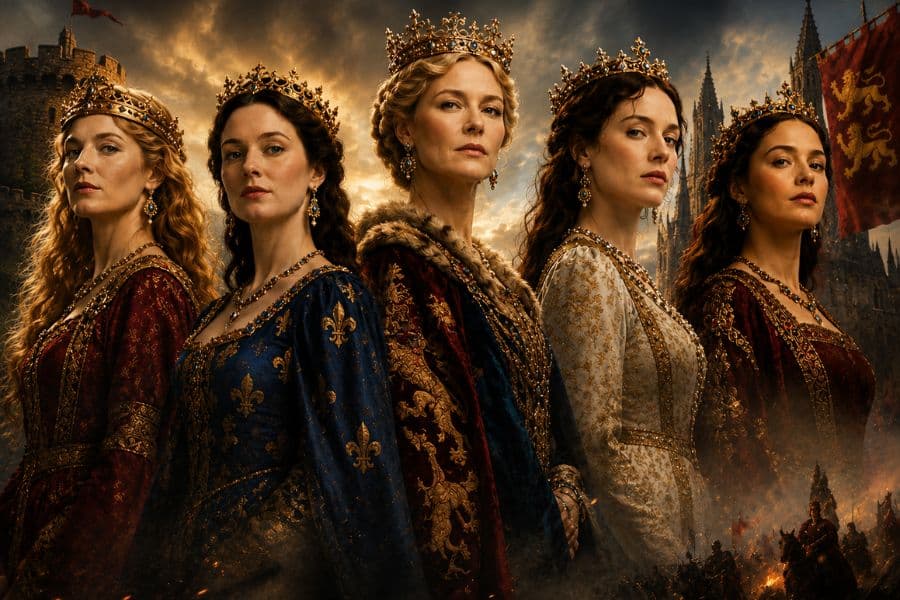
8 Movies About Medieval Queens Worth Watching
A quick word on the ratings. They’re mine, they’re subjective, and they blend how good the film is with how much it’s worth your time as a history lover. Feel free to disagree. And if you want a broader watchlist once you’ve worked through these, my round-up of 15 medieval movies to watch casts the net wider than queens alone.
The Lion in Winter (1968): Eleanor of Aquitaine
Start here. If you watch only one film on this list, make it this one.
It’s Christmas 1183, at the castle of Chinon. Aging King Henry II has let his imprisoned wife out of her tower for the holidays and summoned their three surviving sons, so the family can thrash out who inherits the throne.
Henry wants his youngest, John. His queen, Eleanor of Aquitaine, wants their son Richard. Add the young King of France and Henry’s teenage mistress into the mix, and what follows is two hours of the most gloriously vicious family scheming ever put on screen.
Everyone betrays everyone, everyone is lying, and underneath it all, two people who once loved each other are still, somehow, the only match for one another.
Katharine Hepburn plays Eleanor and won her third Academy Award for it, becoming the first person to win the Best Actress Oscar three times. Peter O’Toole is Henry. Watch out for a very young Anthony Hopkins as Richard the Lionheart and an even younger Timothy Dalton, in his film debut, as the King of France.
The script crackles like a log fire. It’s sharp, funny, cruel, and quotable, and Hepburn’s Eleanor is one of the great queens of cinema, all wit and steel and old wounds.
The specific Christmas gathering never actually happened, not at Chinon. There was one at Caen in 1182, but the movie event was completely fictional. But the people are real, and the tensions were real. Eleanor really did spend around sixteen years as Henry’s prisoner for backing their sons against him.
She also outlived him and came roaring back into power. When it was over, she held her own court at Poitiers, on her own terms. The film only hints at the woman she’d go on to be.
Kylie’s rating: 9.5/10. A near-perfect film and the best Queen on this list.
Kingdom of Heaven (2005): Sibylla of Jerusalem
One rule with this one. Watch the director’s cut, not the version that hit cinemas.
Ridley Scott’s Crusader epic follows a French blacksmith, Balian, who travels to the Holy Land in the 1180s and finds himself caught up in the fragile peace holding Jerusalem together under its dying young king, Baldwin IV, the leper king who rules from behind a silver mask.
At the center of the court is Princess Sibylla, the king’s sister, married to the reckless, war-hungry Guy de Lusignan.
When Baldwin dies, and Guy goads the great Muslim leader Saladin into war, the whole kingdom comes crashing down, and Sibylla is left choosing between the man she loves and the crown she’s tied to.
Eva Green plays Sibylla, opposite Orlando Bloom as Balian, with Edward Norton unforgettable as the masked Baldwin, and Jeremy Irons and Liam Neeson filling out the cast.
The cinema cut got middling reviews and left Sibylla as barely more than a love interest. The director’s cut adds around 45 minutes, most of it giving her a real story of her own, and turns a decent film into a rich one.
In history, the real Sibylla was devoted to Guy and fought to keep him at her side, so the film’s romance with Balian is invention. Jerusalem did fall to Saladin in 1187, and the coda nods to the Third Crusade that followed, when Richard the Lionheart came east and met Saladin’s army in the bloodbath at the Battle of Arsuf.
Kylie’s rating: 8/10 for the director’s cut. Knock off a point and a half for the cinema version.
Braveheart (1995): Isabella of France
Right, brace yourself, because this is the one where I have to be the party pooper.
Mel Gibson’s Best Picture winner tells the story of William Wallace and the Scottish rising against the brutal English king Edward I.
Somewhere in the middle of it, Princess Isabella of France, married off to Edward’s weak son, is sent north to parley with Wallace, and the film has the two of them fall for each other. There’s even a heavy hint that the future English king is really Wallace’s child.
It’s rousing, sweeping stuff, with that famous freedom speech, and Sophie Marceau’s Isabella is one of the best things in it, all quiet intelligence in a court full of brutes.
Mel Gibson directs and stars, with Patrick McGoohan chilling as Edward I and Marceau as Isabella. As a piece of cinema, it’s a cracker, and it earned its Oscars.
As history, though, the Isabella storyline is complete nonsense, and I do mean complete. She was about ten years old and still living in France when Wallace was executed in 1305. She didn’t marry into England until 1308, three years after his death. They never met.
The love affair, the baby, none of it could have happened. And the maddening part is that the truth was better. The real Isabella of France grew up to do what Wallace never managed.
She raised an army, invaded England, deposed her own husband, Edward II, and ruled as regent. History called her the She-Wolf. The film turned a lioness into a love interest.
Kylie’s rating: 8/10 as a film. As history for this particular queen, I’d give it a 1.
Hooked on the Middle Ages? Get more stories like this one in your inbox.
Margrete: Queen of the North (2021): Margaret I of Denmark
Now here’s a hidden gem you’ve very likely never heard of, and one of the few films on this list built entirely around a queen who actually ruled.
It’s 1402. Margaret I has done something extraordinary, uniting Denmark, Norway, and Sweden into a single realm called the Kalmar Union, and holding it together through sheer political nerve. Then a man turns up claiming to be her son, Oluf, long thought dead.
If he’s telling the truth, she has her boy back. If she accepts him and he’s a fraud, the whole union she’s bled for could unravel. What follows is a tense, devastating story about a mother and a monarch being forced to choose between her heart and her life’s work.
Trine Dyrholm plays Margrete. It’s a Danish film, so you’ll be reading subtitles, but do stick with it. The critics loved it, and it looks stunning, all cold stone halls and candlelight.
It’s based on the real episode of the “False Oluf,” an impostor who really did appear and claim her son’s identity, so the bones of it are true even if the film fleshes out the drama. Margaret was one of the shrewdest rulers of her age, and she belongs in the same conversation as the other formidable medieval women who ruled rather than merely married well.
Kylie’s rating: 8/10. The one most people have missed, and the one I’d most like to send you toward.
Henry V (1989): Catherine of Valois
Kenneth Branagh’s blazing take on Shakespeare’s play is, first and foremost, the story of a king. Young Henry V presses his claim to the French crown, crosses the Channel, and wins the impossible victory at Agincourt against a French army many times the size of his own.
But the film ends on a queen in the making. In the final stretch, Henry woos the French princess Catherine of Valois to seal the peace, in a scene that’s tender, funny, and a little awkward, as a soldier who’s brilliant at war fumbles his way through courtship.
Branagh directs and stars in his debut feature, with Emma Thompson as Catherine, and an excellent supporting cast, including Judi Dench, Derek Jacobi, Brian Blessed, and a teenage Christian Bale.
It won the Oscar for Best Costume Design and had Branagh nominated for both directing and acting, and it regularly tops lists of the best Shakespeare on film.
Fair warning, Catherine’s part is small. She’s the promise at the end of the war, not the engine of the plot. But she’s a real medieval queen, and a fascinating one.
After Henry died young, Catherine secretly married a Welsh courtier named Owen Tudor, and through that marriage, she became the grandmother of Henry VII and the entire Tudor line. The English-French rivalry that drives the film spanned over a century, and Agincourt was only one chapter in the brutal battles between England and France.
Kylie’s rating: 8.5/10 as a film. Just know you’re coming for the king and staying for the queen.
Richard III (1995): The Queens of the Wars of the Roses
Ian McKellen and director Richard Loncraine take Shakespeare’s Richard III and drop it into a chilling, invented 1930s England, where Richard is a fascist strongman clawing his way to the throne over the bodies of his own family.
It sounds mad on paper, but on screen it works beautifully.
McKellen is mesmerizing as Richard, relishing every scheme. Around him sit two real queens of the Wars of the Roses. Annette Bening plays Queen Elizabeth, born Elizabeth Woodville, widow of Edward IV and mother of the doomed princes.
Kristin Scott Thomas is heartbreaking as Lady Anne Neville, whom Richard woos over the coffin of the husband he helped kill. Maggie Smith, Jim Broadbent, and a young Robert Downey Jr fill out a superb cast. It won BAFTAs for its design, and Roger Ebert handed it four stars.
Both queens were real, and their true stories are every bit as gripping as the film. Elizabeth Woodville, the commoner who married a king, lost her boys to the Tower and lived to see her daughter crowned.
Anne Neville went from the daughter of a kingmaker to Richard’s queen and died young and worn out. The film does cut one giant of the era, the fierce Lancastrian queen Margaret of Anjou, and whether Richard really did away with the princes in the Tower is an argument that’s still running five centuries on.
Kylie’s rating: 8/10. Give the 1930s setting ten minutes, and it’ll win you over.
1492: Conquest of Paradise (1992): Isabella of Castile
This one’s a flawed film with one great queen and one unforgettable piece of music holding it up.
Ridley Scott’s other epic on this list follows Christopher Columbus as he badgers, pleads, and gambles his way to a westward voyage across the Atlantic. The person who finally says yes is Queen Isabella of Castile, who grants him his ships and his chance.
The film covers the crossing, the arrival in the Caribbean, the ugly business of colonization that followed, and Columbus’s own fall from grace. It’s long, and the critics were lukewarm.
Gérard Depardieu plays Columbus, and Sigourney Weaver is a coolly commanding Isabella. The real star, though, might be the score. Vangelis wrote a theme called “Conquest of Paradise” that outlived the film, and you’ve almost certainly heard it booming at sporting events and political rallies without knowing where it came from.
In history, Isabella really did fund Columbus in 1492, the same extraordinary year she and her husband Ferdinand completed the reconquest of Spain by taking Granada. She was one of the most powerful monarchs in Europe, and the film rather underuses her.
Kylie’s rating: 6/10. Worth it for Weaver, that score, and the spectacle.
Mad Love, or Juana la Loca (2001): Joanna of Castile
We finish on the daughter of the queen above, and the most heartbreaking story on the list.
This lush Spanish drama tells the life of Joanna of Castile, daughter of Isabella and Ferdinand, sent north in 1496 to marry the dashing Philip the Handsome of Flanders.
What begins as real passion curdles into obsession as Philip strays, and Joanna’s jealousy consumes her. Meanwhile, the men around her, her husband, her father, and later her own son, decide that a woman this “unstable” cannot possibly rule, and strip her, bit by bit, of the power that is hers by right.
After Philip’s death, she is shut away in the castle of Tordesillas, where she remains, still technically a queen, for the rest of her long life.
Pilar López de Ayala plays Joanna, and she is extraordinary, sweeping up the Goya and the San Sebastián best actress awards for it. Daniele Liotti is Philip. The costumes and settings are sumptuous, and while it tips into soap opera here and there, López de Ayala’s performance keeps you rooted to the spot.
And here’s the question the film leaves you wondering. Was Joanna of Castile actually mad at all? Plenty of modern historians think she suffered grief and depression rather than insanity, and that “Juana la Loca,” Joanna the Mad, was a convenient label for the men who wanted her crown.
She held her royal title for decades while locked away. One small note for the purists: she reigned from 1504, right on the line where the medieval world tips into the early modern one, so she’s the latest queen I’ve added to this list.
Kylie’s rating: 7/10. Uneven, but that central performance will stay with you.
Frequently Asked Questions
What Are the Best Movies About Real Medieval Queens?
The best movies about real medieval queens are The Lion in Winter (1968), with Katharine Hepburn’s Oscar-winning Eleanor of Aquitaine, Margrete: Queen of the North (2021), starring Trine Dyrholm as Margaret I of Denmark, and the director’s cut of Kingdom of Heaven (2005), with Eva Green as Sibylla of Jerusalem.
Was Isabella of France Really in Love with William Wallace in Braveheart?
Isabella of France was not in love with William Wallace, and the Braveheart romance is impossible. She was around ten years old and still living in France when Wallace was executed in 1305, and she did not marry into the English royal family until 1308. The two never met.
Was Joanna of Castile Really Mad?
Whether Joanna of Castile was really mad is still debated by historians. “Juana la Loca,” Joanna the Mad, most likely suffered grief and depression rather than true insanity, and the “madness” label was useful to the men around her. Her father, Ferdinand, and later her son Charles used it to seize her power. She kept her royal title while confined at Tordesillas castle for nearly 46 years.
Which Medieval Queen Movie Is the Most Historically Accurate?
The most historically accurate medieval queen movie is arguably Margrete: Queen of the North, which follows the real “False Oluf” crisis and Margaret I’s rule of the Kalmar Union fairly closely. The Lion in Winter invents its Christmas gathering but gets the real people and their rivalries right. Braveheart sits at the opposite end, as its portrayal of Isabella of France is almost entirely fiction.
Are There Any Movies About Eleanor of Aquitaine?
Yes, there are movies about Eleanor of Aquitaine. The best known is The Lion in Winter (1968), where Katharine Hepburn’s Eleanor won an Academy Award, with a 2003 television remake starring Glenn Close in the same role. Eleanor also appears in Becket (1964). She was one of the most powerful women of the Middle Ages, serving as queen of France and then queen of England.
Was Joan of Arc a Queen?
No, Joan of Arc was not a queen. She was a teenage peasant girl from the village of Domrémy who led French armies during the Hundred Years’ War and helped crown King Charles VII, before being captured and burned at the stake in 1431. She was a soldier and later a saint, not royalty, which is why she does not feature on this list of films about medieval queens.
Love a good medieval story?
Join our readers and get tales of kings, queens, castles and ordinary medieval lives straight to your inbox.

Kylie Lang is a nationally syndicated travel journalist with bylines on the Associated Press Wire & more, a medieval history writer, and the founder and lead author of Tales of the Middle Ages (talesofthemiddleages.com). She holds a BA (Honours) in History from the University of Kent and is a member of the British Guild of Travel Writers.
Related posts:
 Joanna of Castile: the Mad Queen of Spain
 The Forgotten Daughter of Eleanor of Aquitaine: Joanna Plantagenet Survived Betrayal, Crusades, and Imprisonment
 15 Medieval Movies to Watch if You Love History, the Middle Ages and Being Transported to Another Era
 The Legend of Joanna of Flanders, Jeanne la Flamme, Warrior Duchess of Brittany