
I’ve always been fascinated by Eleanor of Aquitaine. I live in the Charente, on land that was once part of her duchy, so she never feels very far away. Her sons get most of the attention, Richard the Lionheart and John especially, but Eleanor had 5 daughters as well, and I’ve always wanted to know what became of them.
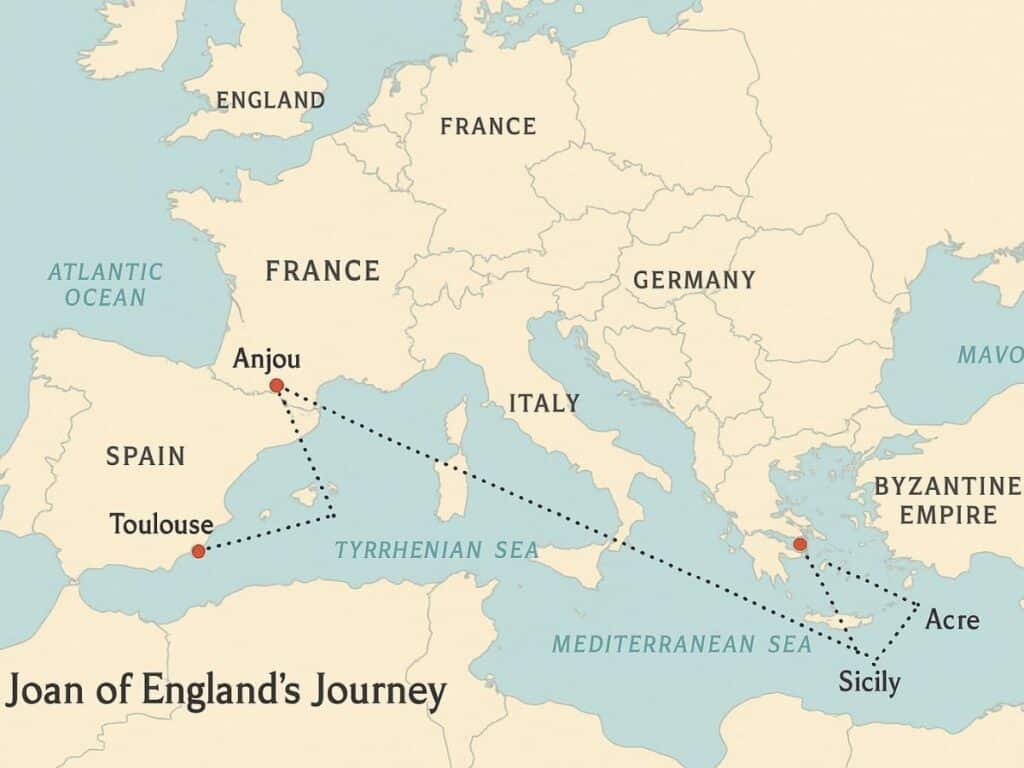
Joanna was the youngest of the 3 daughters she had with Henry II. She was 11 when she was sent to Sicily to marry a king she had never met, and before she turned 30, she was held under guard in Palermo, stranded off Cyprus in a storm, and offered by her own brother as a bride to Saladin’s brother.
Table of Contents
Joanna Plantagenet was Queen of Sicily from 1177 to 1189 and Countess of Toulouse from 1196 until her death in 1199, at the age of 33. She led soldiers in the field, mourned the brother she adored, and was made a nun on her deathbed while she was still married and pregnant.
Who was Joanna?

Joanna was born at Angers in October 1165, the 7th child of Henry II and Eleanor of Aquitaine. Her mother also had 2 daughters, Marie and Alix, from her first marriage to Louis VII of France. Joanna’s full brothers and sisters were:
- William, born 1153, who died as a small child
- Henry the Young King, born 1155
- Matilda, born 1156, later Duchess of Saxony
- Richard, born 1157, later Richard I of England
- Geoffrey, born 1158, later Duke of Brittany
- Eleanor, born 1162, later Queen of Castile
- John, born 1166, later King John of England
She spent much of her early childhood at Fontevraud Abbey with John, the only sibling younger than her. That changed after the great revolt of 1173 to 1174, when Eleanor backed her sons against their father and ended up as Henry’s prisoner.
Unsurprisingly, their marriage never recovered. Henry took Joanna to England in July 1174, and she lived in Winchester when the Sicilian ambassadors came to inspect her.
I first learned about Joanna after reading Lionessheart: The Life and Times of Joanna Plantagenet by historian Catherine Hanley, published in 2025.
Queen of Sicily at Age 12
William II of Sicily, known as William the Good, sent his envoys to England in 1176, and Henry agreed to the match on May 20. According to Norgate, the ambassadors reported that the girl’s beauty pleased them “exceedingly.”
Joanna sailed from Southampton at the end of August with 7 ships, and her eldest brother, Henry the Young King, escorted her through Normandy and Anjou. Richard took over at the edge of Aquitaine and saw her safely to the port of Saint-Gilles, where a Sicilian fleet of 25 ships was waiting for her.
She was so seasick that the fleet put her ashore at Naples. She spent Christmas there and finished the journey by land through Calabria and across the Strait of Messina, reaching Palermo at the end of January 1177. On Sunday, February 13, the Archbishop of Palermo married her to William and crowned her Queen of Sicily on the same day. She was 11, and William was about 23.
In 1181, word reached Normandy that Joanna had given birth to a son called Bohemond. If he existed at all, he died as a baby, and no other child followed. William never tried to set her aside. Instead, he named his aunt, Constance, the daughter of Roger II of Sicily, as his heir.
The Death of William II and a Stolen Throne
William died in November 1189, and Joanna’s position collapsed with him. She was a childless widow in a foreign kingdom, and the throne was meant for Constance. The problem was Constance’s husband. She married Henry VI, the son of the Holy Roman Emperor Frederick Barbarossa, in 1186, and many Sicilian nobles had no wish to see a German emperor’s son ruling them.
They backed Tancred of Lecce instead, Constance’s illegitimate nephew, and he had himself crowned early in 1190. Joanna had supported Constance, and Tancred made her pay. He refused to hand over her dower lands, the estates William had settled on her on their wedding day, and kept her in his custody in Palermo.
Richard the Lionheart Arrives at Messina
Richard the Lionheart, now king, arrived at Messina with his crusading fleet in September 1190 and demanded her release and her dowry. Tancred sent Joanna to Messina straight away, but he held on to the money.
She stayed at the Hospital of St. John, and on September 29, Philip II of France came to visit her. He enjoyed himself so much that people started to say he wanted to marry her.
But Richard wasn’t in a patient mood, and he seized a monastery and the castle of La Bagnara across the strait, moved Joanna there on October 1, and attacked Messina itself.
By November, Tancred gave in and paid a sum of money to settle Joanna’s claims and buy out her dower lands. The money went to Richard, who had a crusade to pay for, and it didn’t come back to her. When Richard died 9 years later, he still owed his sister money.
In March 1191, Eleanor of Aquitaine arrived in Messina with Berengaria of Navarre, the bride she had found for Richard. Eleanor stayed only a few days before setting off for home, leaving Berengaria in Joanna’s care.

Hooked on the Middle Ages? Get more stories like this one in your inbox.
Shipwrecked Off Cyprus
The fleet left Messina on April 10, 1191. A storm scattered it 2 days later, and the ship carrying Joanna and Berengaria was blown off course and ended up off Limassol on the south coast of Cyprus.
The island was ruled by Isaac Komnenos, a Byzantine nobleman who had made himself emperor, and he had every reason to want 2 royal women and their treasure in his hands. They stayed on board and refused to come ashore.
Richard arrived in early May and took Limassol by force. He married Berengaria there on May 12, 1191, and she was crowned Queen of England the same day, with Joanna at her side. Then Richard went after Isaac and took the whole island. When Isaac finally surrendered, he begged not to be put in irons, so instead, being the kind-hearted man that he was, Richard had him bound in chains of silver instead.

Acre and an Offer of Marriage to Saladin’s Brother
The 2 queens reached Acre in the summer of 1191, while Christian armies were still besieging the city. It surrendered on July 12, and when the terms for ransoming the Muslim garrison fell through that August, Richard had the prisoners killed, the most brutal act of the Third Crusade.
Joanna’s own part in the crusade came that September. Richard, stalling in his talks with Saladin, offered her as a wife for Saladin’s brother, al-Adil, known in the West as Saphadin. The two would rule Jerusalem together, and the war could end.
She was a woman of gumption, as you’d expect from Eleanor of Aquitaine’s daughter, and she vowed that nothing on earth would make her marry a Muslim; she would agree only if al-Adil became a Christian, which, surprise, surprise, he refused to do.
Saladin played along anyway and accepted Richard’s terms on condition that the wedding went ahead at once. Richard wriggled out by claiming a widowed queen needed a papal dispensation, which would take 6 months, and then offered his niece, Eleanor of Brittany, in place of Joanna. Saladin ended the talks there.
Joanna and Berengaria sailed for home at the end of 1192, separately from Richard, who was shipwrecked and captured on the way and spent more than a year waiting for his ransom. The 2twowomen seem to have lived together for the next few years.
Countess of Toulouse
In October 1196, Richard married Joanna to Raymond VI, Count of Toulouse, at Rouen. She was his 4th wife. The match ended a long quarrel between the counts of Toulouse and the dukes of Aquitaine, and Joanna brought the lands of Quercy and the Agenais with her as her dowry.
Her son, another Raymond, was born at Beaucaire in July 1197, and a daughter, also called Joan, seems to have followed in 1198.
Raymond had a bad name among churchmen, who suspected him of sympathy for the Cathar heretics, and some of the chroniclers who disliked him say the marriage soon turned sour. The writer who was closest to events in Toulouse, William of Puylaurens, tells a different story.
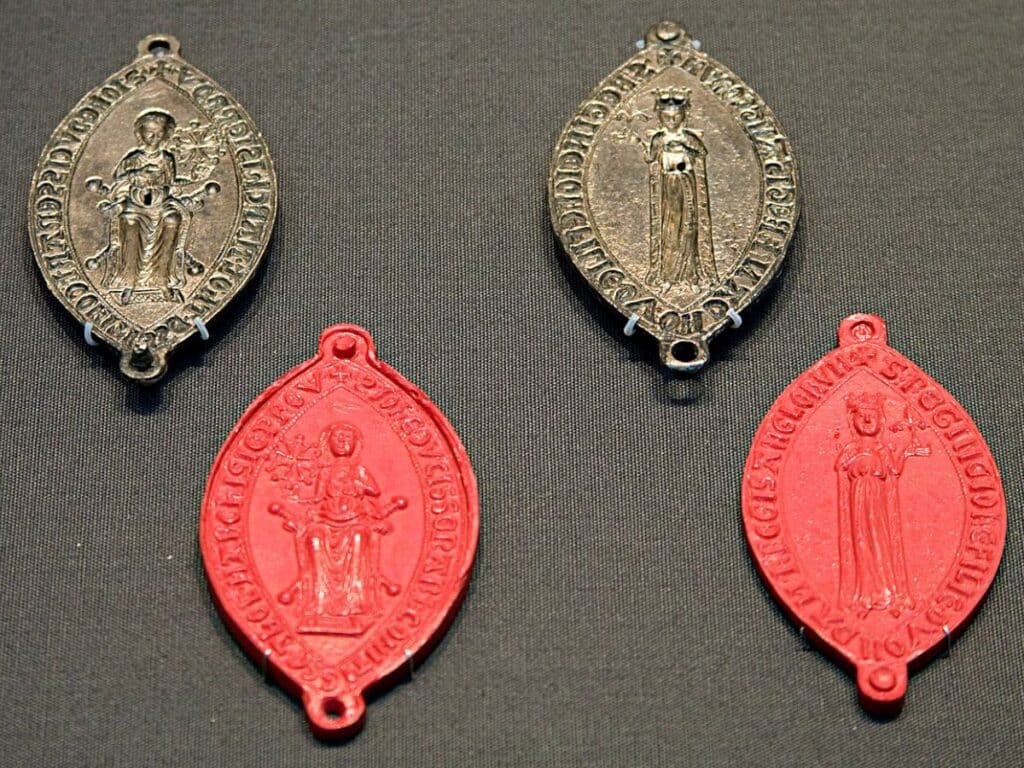
He calls Joanna “an able woman of great spirit,” and says that once she had recovered from giving birth, she took up arms to defend her husband against his rebellious lords.
The Siege of Les Cassés
With Raymond away, Joanna laid siege to Les Cassés, a castle held by the lords of Saint-Félix. Puylaurens says some of her own people secretly passed arms and food to the men inside, then set fire to her camp, and she only just got out.
Sources disagree on the year, with Norgate placing it in 1197 and other accounts in 1199. Either way, the Winchester annalist was impressed enough to call her a woman whose “masculine spirit overcame the weakness of her sex.”
Joanna set out to see Richard and ask for his help for Raymond, and on the way she heard that he had died at Châlus in April 1199. She spent time at his grave at Fontevraud before going on to Normandy to ask King John for help.
One story in the Winchester annals says she had the man who killed Richard blinded and flayed alive, but the chronicler Roger of Howden blames Richard’s mercenary captain, Mercadier, so treat it with a pinch of salt.
John promised her 100 marks a year to spend for the good of her soul. On August 26, 1199, at Rouen, he also signed a settlement giving her 3,000 silver marks so she could make her will, in return for clearing all the debts Richard had owed her.
The charter names Eleanor and 3 archbishops, including Hubert Walter of Canterbury, as the people who would hand out her bequests.
The original is lost, and the text survives in a copy made by the French antiquary Roger de Gaignières, now in the Bibliothèque nationale de France.
Joanna’s Final Days
By then Joanna was pregnant again, ill and exhausted, and she knew she was dying. She begged to be admitted as a nun of Fontevraud, which was almost unheard of for a married woman who was expecting a baby. Hubert Walter, the Archbishop of Canterbury, agreed, and she was veiled as a nun of Fontevraud before she died.
She died at Rouen in September 1199, giving birth to a son. The baby lived just long enough to be baptized Richard, after the brother she loved most. Joanna was 33.
They buried her at Fontevraud at the feet of her father and beside Richard. When her son Raymond VII of Toulouse died in 1249, he was buried beside her, and their effigies knelt facing each other until both were destroyed in the French Revolution.
Frequently Asked Questions
Who was Joanna Plantagenet?
Joanna Plantagenet was the youngest daughter of Henry II of England and Eleanor of Aquitaine. She was born at Angers in 1165, became Queen of Sicily through her marriage to William II, and later became Countess of Toulouse as the wife of Raymond VI.
How old was Joanna Plantagenet when she married William II of Sicily?
Joanna Plantagenet was 11 when she married William II of Sicily in Palermo on February 13, 1177. She was crowned queen the same day.
Did Joanna Plantagenet have any children?
Joanna Plantagenet had children with her second husband, Raymond VI of Toulouse: Raymond VII, born in 1197, probably a daughter called Joan, and a son called Richard, who died soon after his birth in 1199. A son with William II, called Bohemond, was reported in 1181, but if he existed, he died as a baby.
Why did Joanna refuse to marry Saladin’s brother?
Joanna refused to marry Saladin’s brother, al-Adil, because she would not marry a Muslim. Richard the Lionheart proposed the match in 1191 as a way to end the Third Crusade, but Joanna would only agree if al-Adil converted to Christianity, and he refused.
How did Joanna Plantagenet die?
Joanna Plantagenet died in childbirth at Rouen in September 1199, at the age of 33. She had been admitted as a nun of Fontevraud on her deathbed, and her newborn son lived only long enough to be baptized.
Where is Joanna Plantagenet buried?
Joanna Plantagenet is buried at Fontevraud Abbey in Anjou, at the feet of her father, Henry II, and beside her brother Richard the Lionheart. Her son Raymond VII was later buried beside her.

Love a good medieval story?
Join our readers and get tales of kings, queens, castles and ordinary medieval lives straight to your inbox.
Kylie Lang is a nationally syndicated travel journalist with bylines on the Associated Press Wire & more, a medieval history writer, and the founder and lead author of Tales of the Middle Ages (talesofthemiddleages.com). She holds a BA (Honours) in History from the University of Kent and is a member of the British Guild of Travel Writers.