
Heads rolled, fires roared, and traitors met their end on scaffold and stake. The Tudors ruled in a world where politics, religion, and survival were tied to the axe. To fall out of favor with the crown could mean an ending as public as it was brutal.

These weren’t clean or quick affairs. Sometimes blades missed their mark, sometimes bodies were burned for hours, and sometimes the condemned were pulled apart piece by piece. Executions were meant to terrify the crowd as much as they punished the accused.
Table of Contents
Behind each death was a story of ambition, faith, rebellion, or betrayal. Some names are familiar, others less so, but all left a mark that still makes people shudder today. Let’s step into the shadow of the scaffold and meet those who learned the hard way what it meant to cross a Tudor.
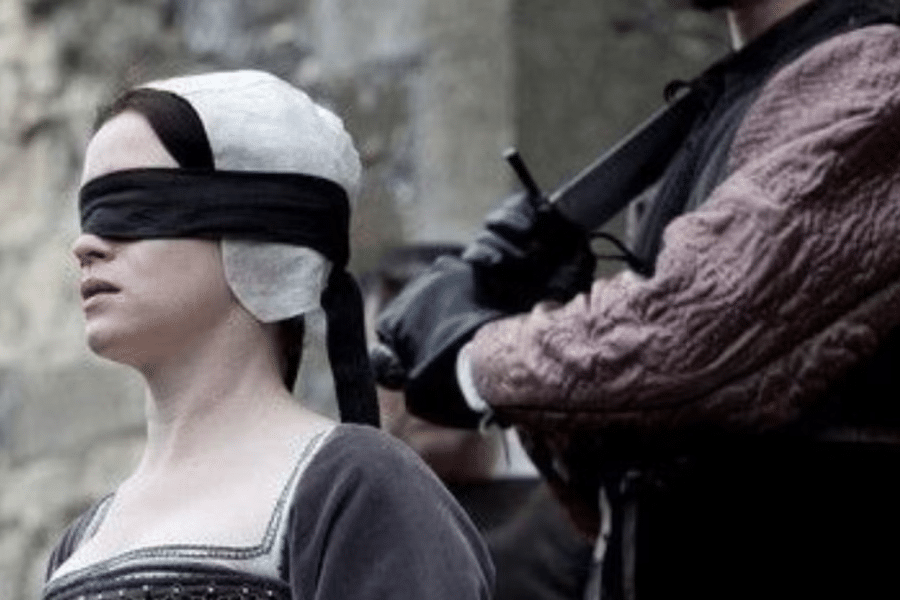
Executions Under Henry VII (1485–1509)
Edward Plantagenet, Earl of Warwick
Edward Plantagenet, Earl of Warwick, was the last legitimate male heir of the House of York. He was the son of George, Duke of Clarence, who had been executed by his brother Edward IV. He was the last direct male Plantagenet, making his claim to the throne strong. That bloodline made him dangerous in the eyes of the Tudors from the moment Henry VII seized the crown in 1485.
Henry kept him locked in the Tower of London from childhood, never giving him a real chance at freedom. His supposed crime came years later when Perkin Warbeck, a pretender claiming to be one of the lost Princes in the Tower, tried to escape and allegedly conspired with Edward. Whether Edward truly plotted or was simply a pawn has never been clear.
A trial was arranged in Westminster. He pleaded guilty, though the circumstances suggest there was little hope of another outcome. On 28 November 1499, Edward was led to Tower Hill. He was publicly beheaded, a cruel ending for a young man who had spent nearly his entire life as a prisoner for the crime of being born into the wrong family.
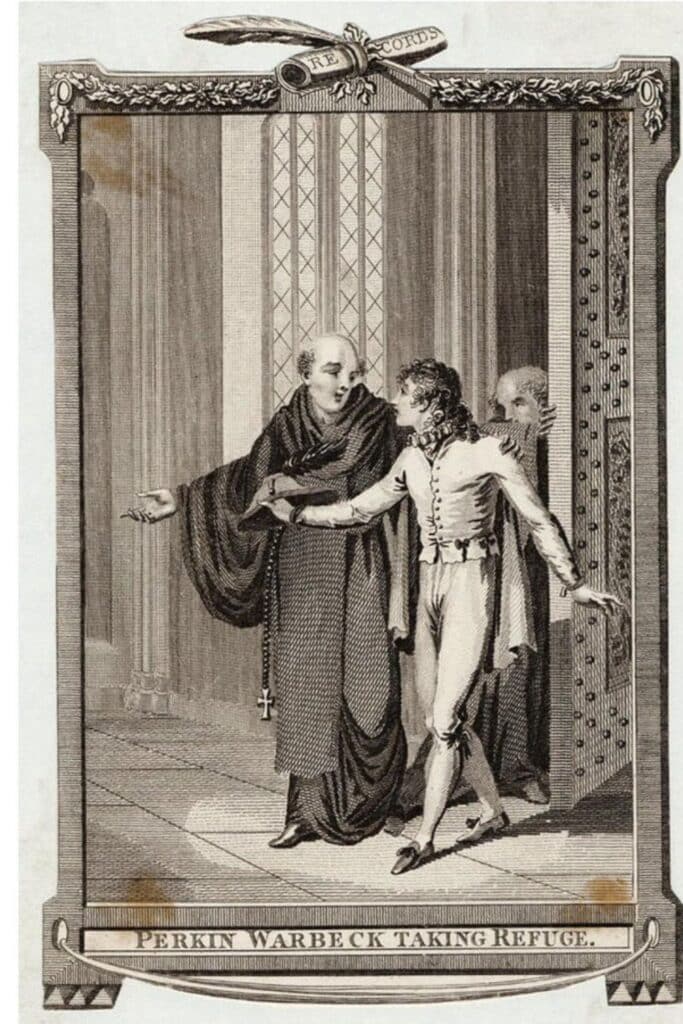
Perkin Warbeck
Perkin Warbeck was a pretender who claimed to be Richard, Duke of York, one of the missing Princes in the Tower. His story took him across Europe, where powerful rulers, such as Margaret of Burgundy and James IV of Scotland, used him as a tool against Henry VII. For more than a decade, he managed to convince courts and followers that he had a legitimate claim to the English crown.
When his attempts to invade England failed, Warbeck surrendered in 1497. Henry VII kept him alive at first, parading him through London as a prisoner to humiliate him. Warbeck was confined in the Tower, but in 1499, he supposedly tried to escape with Edward Plantagenet, the Earl of Warwick. The plot sealed both their fates.
Warbeck was dragged to Tyburn on 23 November 1499. He was forced to read a confession declaring himself an impostor before the crowd. Then he was hanged, his body swinging as proof of what happened to those who threatened the Tudor crown. His death was less about justice than sending a clear warning that the dynasty would not be challenged.
Henry VIII (1509–1547)
George Boleyn, Lord Rochford
George Boleyn, Lord Rochford, was Anne Boleyn’s brother. Alongside him stood Henry Norris, Francis Weston, William Brereton, and Mark Smeaton. All were accused of committing adultery with Queen Anne and plotting the king’s death. In truth, the charges were thin and shaped to remove Anne and secure Henry VIII’s new marriage to Jane Seymour.
The men were tried in May 1536. Smeaton, a court musician, gave a confession under pressure, likely forced. The rest denied everything. It made little difference. The juries delivered guilty verdicts, and the sentences were set. Officially, they should have been hanged, drawn, and quartered, the punishment for treason. Henry commuted their deaths to beheading, a small mercy for men of rank.
On 17 May 1536, they were brought to Tower Hill. One by one, they placed their heads on the block. Smeaton, the commoner, went first. George Boleyn followed, addressing the crowd with a final speech that avoided direct reference to his sister. By the end of the day, five men who had once been at the center of court life lay headless, their deaths clearing the way for Anne’s own execution two days later.
Thomas Cromwell
Thomas Cromwell’s rise was meteoric. Born to a blacksmith and mercenary, he clawed his way into royal service, becoming Henry VIII’s most trusted minister. He orchestrated the king’s divorce from Catherine of Aragon, dismantled monasteries across England, and filled the royal treasury. But power made him enemies, and when his arrangement of Henry’s marriage to Anne of Cleves soured, those enemies moved quickly.
Cromwell was arrested in June 1540 while sitting at the council table. He was charged with treason and heresy, accused of plotting to marry the king’s daughter Mary and of supporting radical religious reform. Parliament condemned him without a fair trial, and his fate was sealed.
On 28 July 1540, he was taken to Tower Hill. Crowds gathered to watch the man who had once decided life and death for others. The executioner botched the job, needing several strokes to sever his head. Cromwell’s brutal death reflected the same ruthless system he had helped to build.
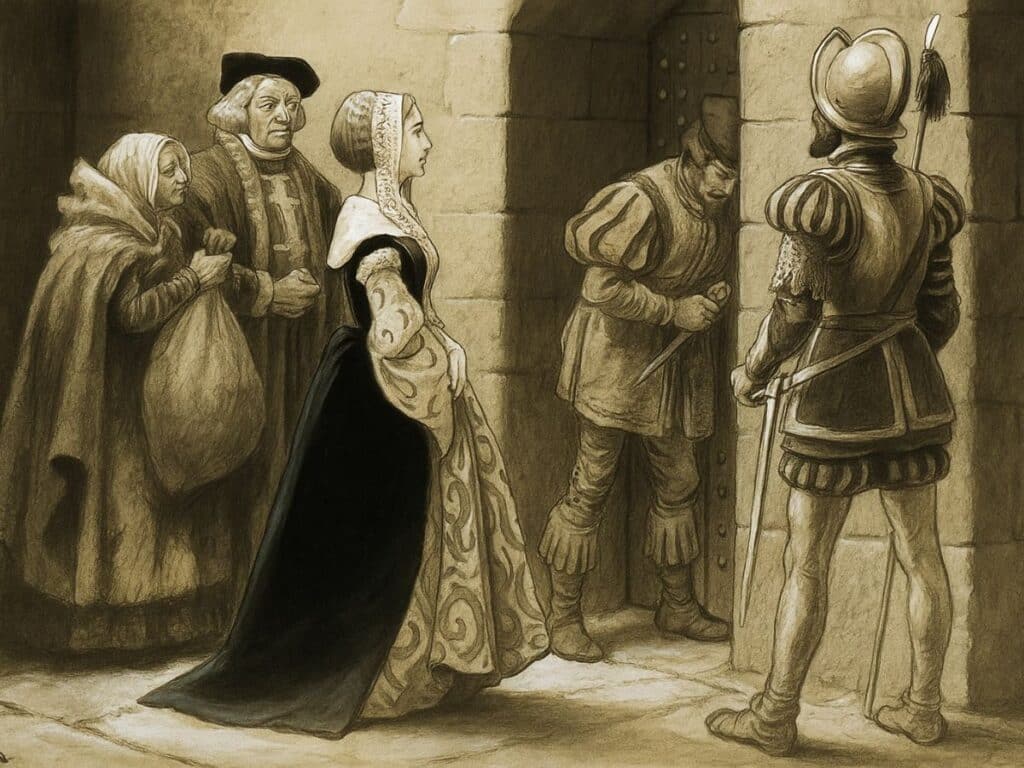
Anne Askew
Anne Askew was a young Protestant from Lincolnshire who refused to follow the teachings of the Catholic Church. She was outspoken about her beliefs, and that outspokenness led to her arrest in 1545. Released once, she was seized again in 1546 and taken to the Tower of London, where officials demanded the names of fellow reformers, possibly even Queen Catherine Parr.
She resisted, and the authorities resorted to torture. Askew was stretched on the rack so violently that her joints dislocated, and she could no longer walk. Carried to trial in a chair, she was convicted of heresy for denying the doctrine of transubstantiation. She was sentenced to burn.
On 16 July 1546, she was chained to a stake at Smithfield alongside three men. Because she could not stand, she was strapped to a chair. Witnesses reported that she prayed as the flames rose. Her death became a rallying point for Protestants, remembered as one of the most shocking examples of Tudor cruelty.
Margaret Pole
Margaret Pole, Countess of Salisbury, was a relic of the old Plantagenet dynasty and one of the last with royal blood that rivaled the Tudors. She was the daughter of George, Duke of Clarence, and niece of Edward IV and Richard III. For decades, she lived a quiet life, raising her family and even serving as governess to Princess Mary. Her fortune turned when her son, Reginald Pole, condemned Henry VIII’s break with Rome from exile in Italy.
In 1539, Margaret was arrested and accused of treason, though little evidence tied her to any plot. She was imprisoned in the Tower of London for two years. No formal trial was held. Her death was a political message aimed at her son and the remaining Plantagenets scattered across Europe.
On 27 May 1541, she was brought to Tower Green. Contemporary accounts say the executioner was inexperienced, striking her multiple times before finally killing her. One report even claimed she ran from the block before being forced down. Her death at more than sixty years old horrified foreign courts, who saw it as needless and savage.

Robert Aske
Robert Aske was a lawyer from Yorkshire who became the figurehead of the Pilgrimage of Grace, the massive rebellion in 1536 that protested the closure of monasteries and Henry VIII’s religious reforms. He led thousands of rebels, securing temporary concessions from the king. For a moment, he believed Henry would listen and restore the monasteries.
The hope was short-lived. Once the rebellion dispersed, the crown moved to crush its leaders. Aske was summoned to London, questioned, and then imprisoned. He was accused of treason, a charge that left no room for defense. The promises Henry had made to him were empty from the start.
In July 1537, Aske was taken back north. At York, he was executed by hanging in chains from the walls of Clifford’s Tower. His body was left exposed, a grim reminder of the fate that awaited those who opposed the crown. For the people of Yorkshire, his death marked the final collapse of their rebellion.
Edward VI (1547–1553)
Thomas Seymour
Thomas Seymour was the brother of Jane Seymour, Henry VIII’s third wife, and therefore the uncle of young Edward VI. After Henry’s death, he married Catherine Parr, the king’s widow, without the council’s permission, which raised suspicion. His ambition for power was no secret. He sought influence over the boy king and even pressed for a marriage between himself and Princess Elizabeth.
In 1549, Seymour was accused of plotting to seize control of Edward VI by abducting him from court. The most damning episode came when he was found entering the royal apartments at night armed with a pistol. Though he denied treason, his reputation for scheming left him with few allies. Parliament condemned him without a formal defense.
On 20 March 1549, Thomas Seymour was led to Tower Hill. Accounts say he asked the headsman to strike swiftly. One clean blow removed his head, ending the career of a man who had aimed too high in a dangerous game of Tudor politics.
Edward Seymour
Edward Seymour, elder brother of Jane Seymour, rose to power as Protector of the Realm after Henry VIII’s death. As guardian of the boy king Edward VI, he held near-royal authority. He pushed through Protestant reforms and campaigned against Scotland, but his arrogance and heavy-handed rule alienated the nobility.
In 1549, he was accused of abusing his position and mishandling rebellions in the west and Norfolk. He was imprisoned and briefly restored, but by 1551, his enemies moved against him again. This time, he faced charges of treason, accused of plotting against John Dudley, Duke of Northumberland. The evidence was weak, but Dudley ensured a conviction.
On 22 January 1552, Seymour was brought to Tower Hill. Large crowds gathered, many sympathetic to him, as he had been popular with the ordinary people. He maintained his innocence on the scaffold before laying his head on the block. With one stroke, his life ended, and Dudley’s faction stood unopposed.
Robert Kett
Robert Kett was a Norfolk landowner who unexpectedly became the leader of a major uprising in 1549. Known as Kett’s Rebellion, it erupted over the enclosure of common land and grievances against landlords. Kett organized a camp of thousands near Norwich, drawing attention to the economic hardships of ordinary people.
The rebellion spiraled into open conflict with government forces. At first, the rebels captured Norwich, but they were defeated when John Dudley led a professional army against them. Kett was captured and taken to London, accused of treason for raising arms against the crown.
On 7 December 1549, he was returned to Norwich. Authorities chose a death meant to humiliate. He was hanged from the walls of Norwich Castle, his body left dangling as a warning. His execution symbolized the state’s brutal answer to rebellion, even one sparked by desperate social conditions.
Mary I (1553–1558)
Lady Jane Grey
Lady Jane Grey was just sixteen when she was proclaimed queen after Edward VI’s death in 1553. She had royal blood through her mother, a niece of Henry VIII, and Protestant leaders used her as a figurehead to block the Catholic Mary Tudor from taking the throne. Jane herself had little say in the matter. Within days, Mary gathered enough support to claim the crown, and Jane was imprisoned in the Tower of London.
She was charged with treason for accepting the crown and put on trial at Guildhall in November 1553. Jane admitted she had allowed herself to be made queen, but insisted she acted without desire for power. The court still condemned her to death. Mary delayed the sentence at first, hoping to spare her, but Jane’s father became involved in a second rebellion. That sealed her fate.
On 12 February 1554, Jane was taken to Tower Green. She delivered a brief prayer, then fumbled to find the block, crying, “Lord, into thy hands I commend my spirit.” The axe fell swiftly. A teenage girl manipulated by others, her young life ended in the Tower, her blood soaking into the ground where she had played as a child prisoner.

Lord Guildford Dudley
Guildford Dudley was Jane Grey’s husband and the son of John Dudley, Duke of Northumberland, who had engineered Jane’s rise to the throne. He was little more than a pawn in his father’s ambitions. When Jane’s reign collapsed, Guildford was arrested with her and locked in the Tower.
He was tried alongside other supporters of the failed coup and found guilty of treason. While Jane’s fate was uncertain for months, Guildford’s was tied to hers. When Wyatt’s Rebellion against Queen Mary broke out, the government decided both Jane and Guildford had to die to end the threat.
On 12 February 1554, the same morning as Jane, Guildford was led from the Tower to Tower Hill. He was executed by beheading before a large crowd, his young wife’s turn following within the hour. Dragged into a plot beyond his control, his head rolled in the dust of Tower Hill, a brutal full stop on a doomed marriage.
Thomas Cranmer
Thomas Cranmer was the Archbishop of Canterbury and the architect of much of England’s Protestant Reformation. Under Henry VIII and Edward VI, he promoted the Book of Common Prayer and reshaped religious life in England. When Mary I came to power in 1553, Cranmer was arrested for heresy, his role in annulling her mother’s marriage to Henry only deepening her hatred of him.
Imprisoned for years, Cranmer was pressured to recant his Protestant faith. He signed several recantations, but when brought to St. Mary’s Church in Oxford in March 1556, he stunned the congregation by rejecting them. Instead, he declared his faith in Protestant doctrine and said the hand that had written his recantations would burn first.
On 21 March 1556, he was led to the stake. True to his word, Cranmer thrust his right hand into the flames before the fire consumed his body.
Elizabeth I (1558–1603)
Mary, Queen of Scots
Mary Stuart, Queen of Scots, spent nearly twenty years as Elizabeth I’s prisoner after fleeing to England in 1568. She was Elizabeth’s cousin and a Catholic with a strong claim to the English throne, which made her a constant focus for plots and conspiracies. By the 1580s, intercepted letters tied her to the Babington Plot, which aimed to assassinate Elizabeth and put Mary on the throne.
She was tried for treason at Fotheringhay Castle in October 1586. The trial was stacked against her, and though she denied the charges, her fate was inevitable. Elizabeth hesitated to sign the death warrant, knowing it would mean killing a fellow queen, but finally approved it under pressure from her council.
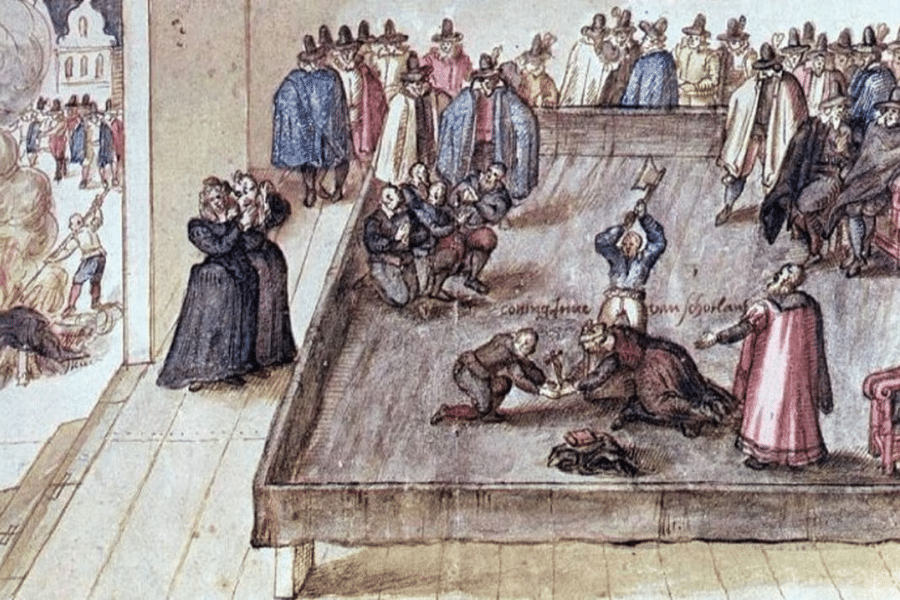
On 8 February 1587, Mary entered the great hall at Fotheringhay dressed in black, the color of mourning. After removing her outer gown, she revealed a crimson petticoat and sleeves, the Catholic color of martyrdom. She lay her head on the block, but the executioner struck twice before severing it, and when he raised the head in triumph, her wig slipped free, leaving the grisly sight of her body slumped on the scaffold.
Margaret Clitherow
Margaret Clitherow was a Catholic convert from York who sheltered priests in her home at a time when it was illegal to do so. She refused to attend Protestant services and openly defied the law. In March 1586, she was arrested when a search of her house uncovered evidence of Catholic worship.
She refused to plead at her trial, knowing that doing so would bring her children into the case as witnesses. By remaining silent, she forced the court to condemn her by “pressing,” a punishment reserved for those who would not enter a plea. It was meant to break both body and will.
On 25 March 1586, she was laid on the ground in York, a door was placed on top of her, and heavy stones were piled until her ribs cracked. Witnesses said she cried out once for Jesus before being crushed to death. Pressed slowly until her body gave way, her execution remains one of the most brutal inflicted on a woman in Tudor England.
Robert Devereux, 2nd Earl of Essex
Robert Devereux was one of Elizabeth I’s favorites, a soldier and courtier who enjoyed her trust for years. Ambitious and reckless, he squandered his position with failed campaigns in Ireland and a disastrous attempt to force his way back into Elizabeth’s favor. In February 1601, he staged a hopeless rebellion in London, trying to rally the people to his cause.
The rebellion collapsed within hours, and Essex was arrested. Tried for treason, he was found guilty and sentenced to death. For Elizabeth, it was a personal betrayal, but she did not spare him.
On 25 February 1601, he was taken to the Tower. He knelt at the block and prayed before the axe fell. It took three strokes to finish him. The queen’s onetime favorite bled out on the scaffold, his mangled death showing how quickly favor at court could turn into a butcher’s scene.
Edmund Campion, SJ
Edmund Campion was a Jesuit priest who returned to England in 1580 to minister secretly to Catholics. His mission was spiritual, but in Elizabeth’s reign, Catholic priests were treated as traitors. After months in hiding, he was captured in 1581, shackled, and dragged through London as a prize for the crown.
He was tortured in the Tower of London, put on the rack, and interrogated about supposed plots against Elizabeth. Despite his suffering, he refused to betray others or deny his faith. Tried for treason, the verdict was a foregone conclusion, and he was condemned to the traitor’s death.
On 1 December 1581, Campion was taken to Tyburn. He was hanged until half-dead, cut down, disemboweled, and quartered before the watching crowd.

Kylie Lang is a nationally syndicated travel journalist with bylines on the Associated Press Wire & more, a medieval history writer, and the founder and lead author of Tales of the Middle Ages (talesofthemiddleages.com). She holds a BA (Honours) in History from the University of Kent and is a member of the British Guild of Travel Writers.
Related posts:
 For Jane Seymour the Most Dangerous Place in England Was Henry VIII’s Bedchamber
 How Lady Worsley Turned Her Husband’s Humiliation into High Society Infamy
How Lady Worsley Turned Her Husband’s Humiliation into High Society Infamy
How Lady Worsley Turned Her Husband’s Humiliation into High Society Infamy
 The Last Wife of Henry VIII: Catherine Parr’s Fight for Faith, Power, and Survival