
Anne Askew was educated, outspoken, and determined to think for herself in a time when that could get a woman killed. She was just 25 when she was tied to a stake and burned alive in front of a crowd in Smithfield. Her crime? Refusing to say the body of Christ was in the bread.
She refused to name names. She refused to recant. And when they tortured her to try to break her, she dictated her beliefs afterward from a chair because she could no longer walk. Her execution was meant to send fear through the Protestant underground, but it ended up putting her name in the history books.
Table of Contents
Her story is of a young woman caught in the storm of Henry VIII’s final years. A time when your belief in God could be used against you by people who claimed to share your faith. Anne’s death was about power, fear, and the brutal cost of defiance.
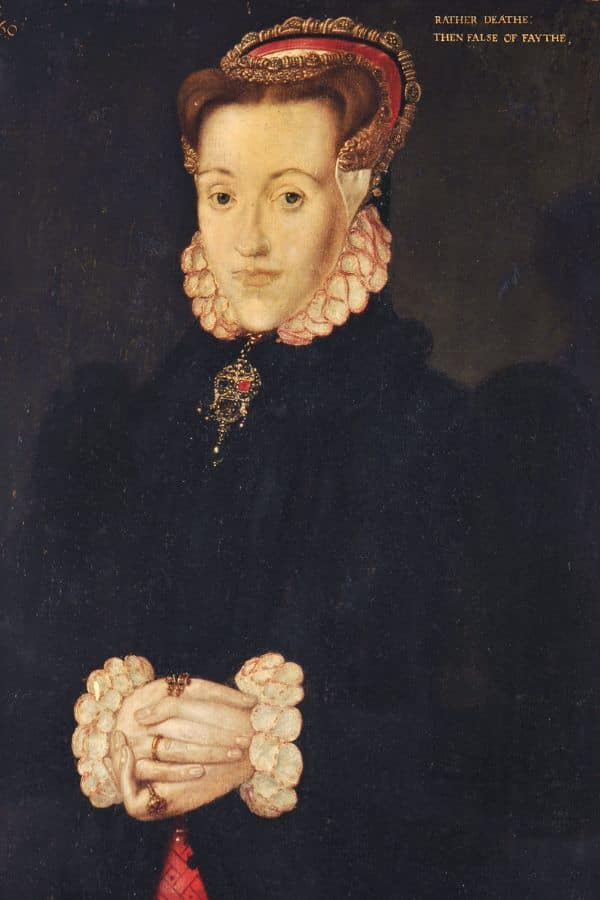
Anne Askew’s Early Years
Born in 1521 in Lincolnshire, Anne Askew was the daughter of Sir William Askew, a wealthy landowner who moved in the same circles as Henry VIII’s court. Her upbringing would have followed the typical expectations of gentry daughters at the time: obedience, modesty, and a good marriage.
But Anne was not typical. From a young age, she showed an intense hunger for learning, especially scripture. She was unusually well educated for a girl of her time and could read and write with confidence. More importantly, she read the Bible in English, something still deeply controversial even after Henry’s break from Rome.
Her path took a sharp turn after the death of her older sister Martha. Martha had been promised in marriage to Thomas Kyme, a local Catholic landowner. After her death, Anne was forced to take her sister’s place. It was not a marriage of love or faith. Kyme was a conservative, traditional Catholic who had no patience for Anne’s outspoken beliefs.
From the moment she entered his household, Anne refused to follow the expected script. She refused to abandon her religious convictions, continued to read banned texts, and openly challenged the idea that a priest could forgive sins.
The marriage broke down quickly. Kyme tried to silence her, but Anne refused to be quiet. When he demanded she stop preaching and conform, she walked out of the house and made her way to London. That alone was an act of rebellion. Respectable women did not leave their husbands. They did not travel alone. And they did not walk straight into the center of religious controversy.
In London, she joined a growing network of evangelical reformers. She attended sermons, held discussions with like-minded thinkers, and became known for her sharp intellect and unwavering resolve. She was not content to be a passive listener. She debated. She questioned. She quoted scripture from memory and interpreted it herself. That placed her in direct conflict with the religious authorities, who had little tolerance for laypeople, especially women, who claimed to understand the Bible better than the priests.
At a time when owning a copy of the English Bible could still lead to imprisonment, she treated it as her right. When women were expected to learn humility and obedience, she chose logic and scripture. She saw salvation as something personal, not handed down by the church. And she believed that the truth was worth dying for.
What made her so dangerous to those in power was not just her beliefs, but that she spoke it clearly and refused to back down.
Interrogated by the Church
Anne Askew registered her presence in London under her maiden name, not her married one, which in itself was a public rejection of her husband’s authority. Almost immediately, she caught the attention of the religious authorities who were tasked with sniffing out heresy. Protestant reformers were gaining ground, and conservative bishops were determined to crush them. Anne was the perfect target. Young, intelligent, outspoken, and female.
She was first arrested in March 1545 and brought before Edmund Bonner, the Bishop of London. Bonner was known for his sharp tongue and even sharper disdain for reformers. He expected Anne to fold quickly. Most did. But she refused to give him the satisfaction.
When questioned about her beliefs, particularly regarding the doctrine of transubstantiation, the idea that the bread and wine of communion become the body and blood of Christ, she did not hesitate. She told them plainly that she believed it was symbolic, not physical. That alone was enough to be branded a heretic.
Bonner tried to trap her in contradiction. He read passages from scripture, expecting her to back down or fall into error. Instead, she responded with her own verses. She had spent years studying the Bible and knew it well enough to challenge even the most experienced theologians. Her answers were calm, clear, and deliberate. She wasn’t flustered. She was focused.
Despite their efforts, the interrogators couldn’t pin her down on charges strong enough for execution. She was sent to the Guildhall and questioned again by a panel of officials. Again, she stood her ground. Eventually, they released her. It looked like she had won. But in reality, she had only bought time.
She returned to her work in London, and they continued to watch. Anne was a woman who had publicly defied one of the most powerful bishops in England and walked out alive. That made her a symbol. And symbols were dangerous. She had embarrassed the Church in front of its own court. The men in power would not forget that.
The second arrest would not be as easy. Next time, they would bring her to the Tower.
Hooked on the Middle Ages? Get more stories like this one in your inbox.
Tortured in the Tower
Anne Askew was arrested for the second and final time in May 1546. This time, the stakes were higher. She had become more than just a theological nuisance. Behind the scenes, a power struggle was boiling over at court. Henry VIII was nearing the end of his reign, and the factions around him were circling like wolves.
The conservative faction, led by Bishop Stephen Gardiner and Lord Chancellor Thomas Wriothesley, wanted to destroy not just Anne, but anyone tied to the Protestant cause. That included Queen Catherine Parr.
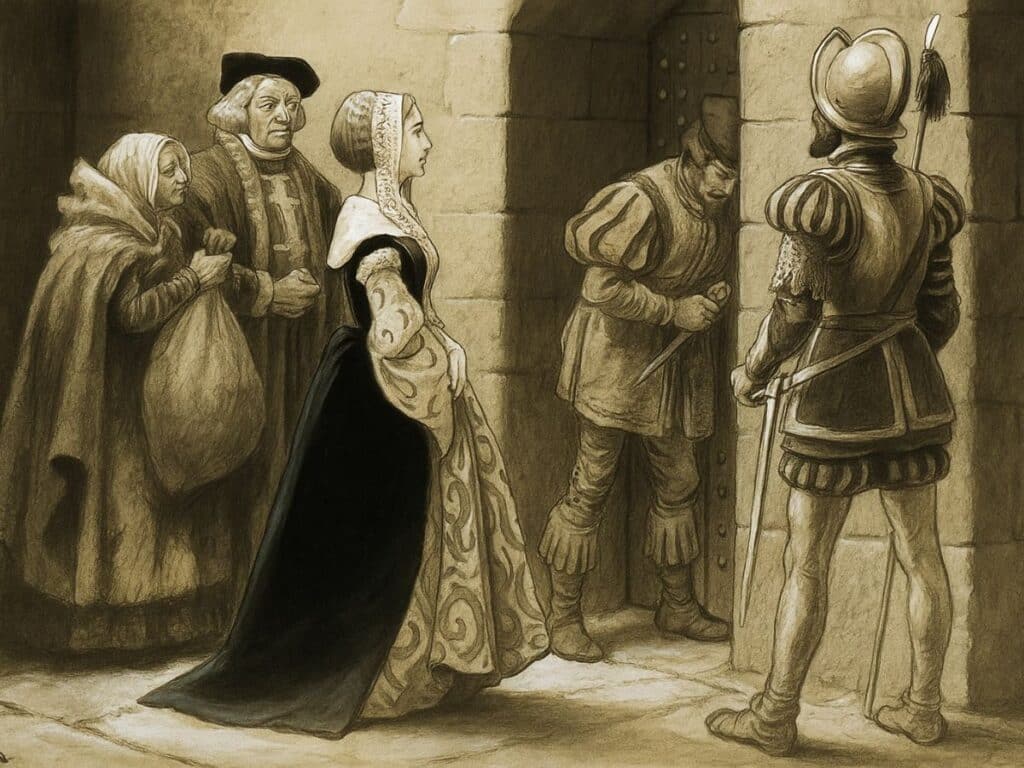
Anne was taken to Newgate and then to the Tower of London. She was questioned relentlessly. They already knew what she believed. This time, they wanted names. They were convinced that she was part of a Protestant conspiracy centered on the Queen. If they could get Anne to implicate Catherine Parr or her ladies, they could strike directly at the royal household. But Anne refused to play along.

She was brought to the rack, a device designed to stretch the body until joints tore and muscles ripped apart. Torture of women was extremely rare in Tudor England, especially women of noble birth. It was technically illegal to rack a woman without the king’s permission. They did it anyway.
Wriothesley and Sir Richard Rich personally supervised the torture. When the Lieutenant of the Tower, Sir Anthony Knyvett, refused to turn the handle, horrified at what was being done to a young woman, they did it themselves. Anne’s body was stretched until her hips and shoulders were dislocated. She could no longer walk. Her body was broken, but her will was not.
Even under that agony, she gave them nothing. No names. No confessions. No compromise. When they dragged her off the rack and laid her in the Tower infirmary, she dictated her final statement by hand, while lying flat, barely able to move.
Anne’s silence may have saved the Queen. Catherine Parr was known to discuss scripture in private, and she walked a delicate line at court, surrounded by enemies. But Anne kept her mouth shut.
When the day of execution came, she had to be carried to the stake in a chair. Her body could no longer support her. The crowd at Smithfield watched as a young, pale woman, broken from the rack, was tied to the post alongside three men. Books tied to their robes, symbolic of their heresy, burned as the flames rose. She never screamed.
Anne Askew became the only woman ever officially tortured in the Tower of London. Not because she plotted or betrayed or led an uprising, but because she would not say that a wafer was the body of God. And because she refused to help the powerful destroy someone else.

Burned but Not Silenced
Anne Askew died on July 16, 1546. She was just twenty-five years old. As the flames took her, those in power likely believed they were stamping out a voice that had grown too loud. But they didn’t silence her. In many ways, they did the opposite.
Before her death, Anne had recorded two written accounts of her experiences. She described her first interrogation, the attempts to trap her, the questions she refused to answer, and the scriptures she used in her defense. After her torture, she dictated her final statement from the infirmary and added it to the rest.
The manuscript was smuggled out and published abroad by John Bale under the title The Examinations of Anne Askew. It was one of the earliest firsthand accounts of religious persecution by a woman in English history.
What makes her voice so powerful is how unshaken it is. She doesn’t ask for pity. She doesn’t portray herself as a victim. She speaks plainly, even when describing her body being torn apart. Her focus is on faith, justice, and truth. That calm, deliberate tone made her writings a weapon. They were printed, copied, and read in secret. In reformist circles, Anne became a symbol of defiance.
Her execution was one of the final acts of religious violence under Henry VIII. Less than a year later, the king was dead. The balance of power shifted again. The men who ordered Anne’s torture lost their influence. And Queen Catherine Parr, the woman they tried to implicate through Anne, survived the fallout.

Love a good medieval story?
Join our readers and get tales of kings, queens, castles and ordinary medieval lives straight to your inbox.

Kylie Lang is a nationally syndicated travel journalist with bylines on the Associated Press Wire & more, a medieval history writer, and the founder and lead author of Tales of the Middle Ages (talesofthemiddleages.com). She holds a BA (Honours) in History from the University of Kent and is a member of the British Guild of Travel Writers.
Related posts:
 The Rise and Fall of Anne Boleyn: Power, Passion, and Politics
 The Story of Anne of Cleves Henry VIII’s Reject Queen: Too Plain for a King, Too Clever for Court
 What History Got Wrong About Mary Boleyn: The Forgotten Sister of Anne, Mistress, Mother, Survivor
 The Queen Who Blew Up the Tudor Court: Catherine Howard’s Rise and Catastrophic Fall