
When you think about the Tudors, mostly the names that come to mind are Henry VIII and his six wives and Elizabeth I. But almost nobody remembers the young French widow and the Welsh servant whose forbidden love affair started it all.
Her name was Catherine of Valois, and hers is one of the strangest and most touching stories of the age. She was a French princess who married the great warrior king Henry V of England, gave him a son, and was left a widow at twenty.
Table of Contents
Forbidden by law from marrying again, she fell in love with a Welsh courtier in her own household named Owen Tudor, wed him in secret, and bore him several more children. Their grandson seized the English throne as Henry VII, founding the Tudor dynasty that would rule for over a hundred years.
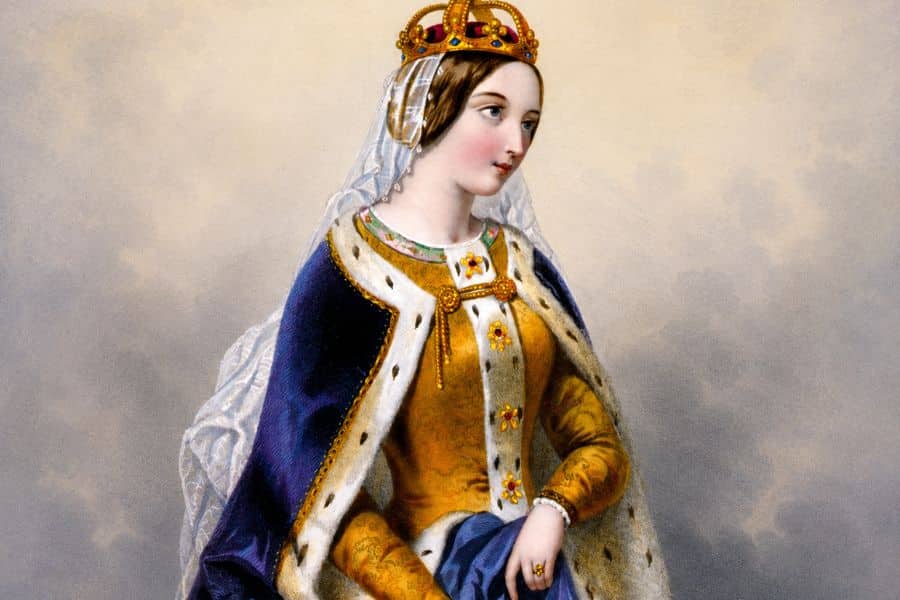
A Princess Raised in the Shadow of a Mad King
Catherine was born in Paris on 27 October 1401, and she drew a difficult hand from the start. Her father was King Charles VI of France, the tragic monarch history remembers as Charles the Mad, the one who suffered years of terrifying breakdowns and, during his worst spells, believed he was made of glass and might shatter if anyone touched him.
Her mother was the much-maligned Isabeau of Bavaria, left to hold a fracturing kingdom together while her husband lost his mind.
It was not a warm or stable childhood. With the king incapacitated for months at a stretch and the French court riven by feuding factions, the royal children were sometimes badly neglected, and stories tell of them left short of food and clean clothes while the grown-ups fought over power.
Catherine was one of twelve children, and she knew early what it was to be a pawn on a very dangerous board. Her elder sister Isabella had already been shipped to England as the child-bride of King Richard II. Catherine would be sent the same way, into the arms of the very king who was busy conquering her homeland.
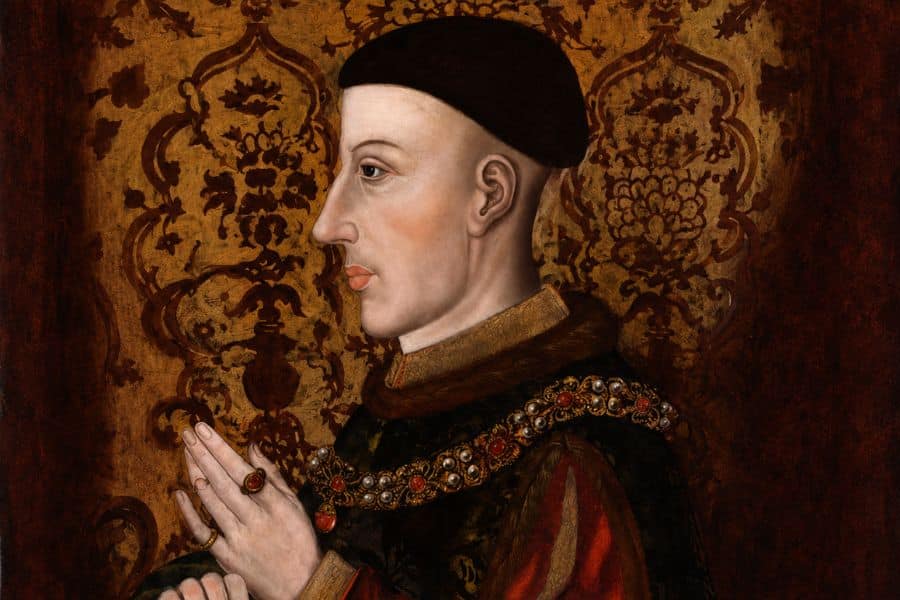
The Bride Who Sealed a Conquest
By the time Catherine reached her late teens, England and France were locked in the long agony of the Hundred Years’ War, and the young English king Henry V was winning it. In 1415, he shattered the French nobility at Agincourt, one of the most famous battles between England and France, and from there he pressed his advantage until France had little choice but to sue for terms.
Those terms were staggering, and Catherine was written into the heart of them. Under the Treaty of Troyes in May 1420, her father agreed to disinherit his own son, the Dauphin, and recognize Henry V of England as heir to the French throne. To seal the bargain, Henry would marry Catherine.
And so on 2 June 1420, in Troyes Cathedral, the French princess married the English conqueror who had just been promised her father’s crown. She was not a bride so much as a clause in a treaty, the human signature on France’s humiliation. She was crowned Queen of England at Westminster Abbey the following February.

Queen, Mother, and Widow at Twenty
For a brief while, it looked like a triumph. Catherine fell pregnant, and on 6 December 1421 she gave birth to a son at Windsor Castle. Henry V had supposedly warned her not to have the baby at Windsor, muttering over an old prophecy, and when he heard the news he was said to be uneasy. That baby was the future Henry VI, and the prophecy, as it turned out, was not kind to him.
Then it all fell apart with brutal speed. In August 1422, campaigning in France, Henry V died of dysentery, just short of his thirty-sixth birthday. Catherine was barely twenty years old, a widow, a foreigner in a country not her own, and the mother of a baby who was now, astonishingly, king of both England and, within weeks, France as well, after her mad father died too.
She had gone from bride to dowager queen to political afterthought in the space of two short years. And a beautiful, young, royal widow was a very inconvenient thing for the men now running England.
The Law Made to Keep Her Single
Catherine was young and marriageable, and whoever married her would gain enormous status as stepfather to the boy king. That terrified the English council, especially when it looked as though she might marry Edmund Beaufort, a powerful and ambitious young nobleman.
So Parliament did something extraordinary. Around 1427 to 1428, it passed a statute laying down that a queen dowager could not remarry without the king’s express permission, and that any man who married her without it would forfeit his lands and possessions for life.
Permission could only be granted once the king came of age, and Henry VI was a small child. In effect, the law told Catherine she must stay single and quiet for years, perhaps a decade or more, while everyone decided what to do with her.
She was a queen, a mother of a king, and she was being warehoused. A lesser woman might have accepted it. Catherine did not.

Hooked on the Middle Ages? Get more stories like this one in your inbox.
The Queen and the Welsh Servant
Somewhere in her household was a man named Owen Tudor. He was Welsh, from a family that had backed the great Welsh revolt against the English crown, and he held a modest position in Catherine’s service, something like keeper of her wardrobe or her household.
He had no title, no fortune, and a Welsh name at a time when the Welsh were treated as second-class subjects under harsh laws. On paper he was just about the least suitable match imaginable for a dowager queen of England.
The stories of how they fell in love are pure romance, and probably later invention, but they’re too good not to share. One version has Owen dancing at a court celebration, losing his footing, and tumbling drunkenly straight into the queen’s lap. Another has Catherine spying him swimming and being rather taken with what she saw.
The truth is lost, because everything about this relationship was hidden. What we do know is that Catherine and Owen became lovers and, at some point around 1430, almost certainly married in secret, in flat defiance of that statute.
No record of the wedding survives, which is exactly what you’d expect from a couple with every reason to keep it quiet. Over the next years she bore him several children, and still they kept the secret, raising a family in the shadows while Catherine’s royal son grew up a short distance away.
When the Secret Came Out
Secrets like that cannot hold forever. When the truth finally emerged, the reaction was everything Catherine had feared. A dowager queen of England had married a Welsh servant, in secret, against an act of Parliament. It was a scandal that struck at the dignity of the crown itself.
Catherine was separated from Owen and was withdrawn to Bermondsey Abbey in London, and it was there, on 3 January 1437, that she died, aged just thirty-five, apparently worn down by illness and possibly the aftermath of yet another childbirth.
She did not live to see what became of her children, which is one of the saddest things about the whole tale. Owen, meanwhile, was hauled in to answer for himself. He was imprisoned in Newgate, escaped, recaptured, and eventually pardoned and even granted a modest pension by his stepson kin. For a while, the storm passed.
Owen Tudor’s Bloody End
The peace did not last, because England was sliding toward the Wars of the Roses, the long dynastic bloodletting between the houses of Lancaster and York. Owen and his sons threw in their lot with the Lancastrian side, the side of Catherine’s royal boy, Henry VI.
In February 1461, at the Battle of Mortimer’s Cross, one of the brutal clashes of that war, the Lancastrians were beaten, and Owen Tudor was captured. He was taken to Hereford and beheaded in the marketplace.
The old man seems not to have believed they’d really do it until the last moment, when, according to the chronicler, he said that “that head shall lie on the stock that was wont to lie on Queen Catherine’s lap,” before laying it down.
A local woman, said to be not quite right in her mind, gathered up his severed head, washed the face, combed the hair, and set a ring of lit candles around it in the market square.
The Dynasty They Never Lived to See
Neither Catherine nor Owen had any idea what they had set in motion. Their eldest surviving son, Edmund Tudor, was raised up by his royal half-brother Henry VI and married to a formidable young heiress named Margaret Beaufort. Edmund died before his son was born, but that son was Henry Tudor.
Their other son, Jasper Tudor, became the boy’s fierce protector, keeping him alive and in exile through the worst of the wars. And in 1485, that grandson of a French princess and a Welsh servant marched into England, killed Richard III at Bosworth, and took the crown as King Henry VII, first monarch of the House of Tudor.
Through him came Henry VIII, Elizabeth I, and a line that runs, in the end, all the way to the royal family of today. A secret marriage that a law had tried to forbid became the root of the most famous dynasty in English history.
Catherine’s son by Henry V, the boy king Henry VI, lost his throne and his life in the wars. Her sons by the humble Welsh servant she wasn’t supposed to marry founded a dynasty of kings. The forbidden love match outlasted the royal one.

The Queen Who Wouldn’t Stay Buried
And now the twist I promised you, because Catherine’s story carries on for centuries after her death in the most macabre way imaginable.
She was buried in Westminster Abbey, but her grandson, Henry VII, tore down the old Lady Chapel to build his own magnificent new one, and Catherine’s coffin was lifted out and never properly reburied.
Some say he was faintly embarrassed by his grandmother’s scandalous second marriage and his own humble Tudor roots, and left her in limbo on purpose. Whatever the reason, her wooden coffin was placed above ground near the tomb of her first husband, Henry V, and there it stayed.
The lid rotted and fell away, exposing her embalmed body, and for the better part of three centuries her corpse lay open to view. Abbey vergers would show her off to visitors, and for a small coin you could even handle the mummified remains of a queen of England.
Which brings us to one of the odder entries in the diary of Samuel Pepys. On his thirty-sixth birthday in 1669, Pepys visited the abbey, lifted Catherine’s dried-out body from its open coffin, and kissed her on the mouth.
He wrote it down with obvious delight, noting that he “did kiss a Queen,” and that it was his birthday, so he reckoned he could say ever after that he had kissed a queen on his birthday.
It was not until 1878, in the reign of Queen Victoria, that Catherine of Valois was finally given a settled, dignified grave beneath the chantry of Henry V, where she rests to this day.
She was a treaty bride, a widowed teenager, a mother of kings, and a woman brave enough to marry for love against the whole weight of the law. She deserved a great deal better than she got, in life and long after it. But she got the last laugh in one way that matters. Her blood, and the blood of the Welsh servant she loved, sits in the veins of royalty still.
Frequently Asked Questions
Who Was Catherine of Valois?
Catherine of Valois was a French princess, born in 1401, who became Queen of England as the wife of King Henry V. She was the daughter of the mentally ill King Charles VI of France, the mother of King Henry VI of England, and, through her later secret marriage to the Welsh courtier Owen Tudor, the grandmother of King Henry VII and the ancestress of the entire Tudor dynasty.
Did Catherine of Valois Really Marry Owen Tudor?
Catherine of Valois almost certainly married Owen Tudor, though no record of the wedding survives, so it cannot be proven beyond doubt. The couple kept the marriage secret because it broke a parliamentary statute forbidding a queen dowager to remarry without the king’s permission. They had several children together, and their union was later accepted as a valid marriage, which is what allowed their Tudor descendants to claim the throne.
Why Was Catherine of Valois Forbidden to Remarry?
Catherine of Valois was effectively forbidden to remarry by a statute of around 1427 to 1428, passed because the English council feared the power any husband would gain as stepfather to the boy king Henry VI. The law said a queen dowager could not remarry without the king’s consent, and that consent could only come once he was an adult. As Henry VI was still a small child, Catherine was expected to stay single for years.
How Are the Tudors Descended From Catherine of Valois?
The Tudors are descended from Catherine of Valois through her secret marriage to Owen Tudor. Their son Edmund Tudor married Margaret Beaufort, and their child became King Henry VII, the first Tudor monarch, after defeating Richard III at Bosworth in 1485. This makes Catherine and Owen the grandparents of Henry VII and the great-great-grandparents of Henry VIII and Elizabeth I.
How Did Owen Tudor Die?
Owen Tudor was executed in 1461 during the Wars of the Roses. Fighting for the Lancastrian side, he was captured after the Battle of Mortimer’s Cross and beheaded in the marketplace at Hereford. He is said to have accepted his fate with the words that his head would now lie on the block that once lay in Queen Catherine’s lap. A local woman reportedly washed his severed head and set candles around it.
What Happened to Catherine of Valois’s Body?
Catherine of Valois’s body had a bizarre afterlife. After her grandson Henry VII rebuilt the Westminster Abbey chapel where she lay, her coffin was left above ground and never properly reburied. Its lid rotted away, exposing her embalmed corpse, which became a tourist curiosity for centuries. The diarist Samuel Pepys even kissed it on his birthday in 1669. She was not given a proper grave until 1878.
Love a good medieval story?
Join our readers and get tales of kings, queens, castles and ordinary medieval lives straight to your inbox.

Kylie Lang is a nationally syndicated travel journalist with bylines on the Associated Press Wire & more, a medieval history writer, and the founder and lead author of Tales of the Middle Ages (talesofthemiddleages.com). She holds a BA (Honours) in History from the University of Kent and is a member of the British Guild of Travel Writers.
Related posts:
 The Queen Who Blew Up the Tudor Court: Catherine Howard’s Rise and Catastrophic Fall
 The Most Scandalous Marriages of the Middle Ages That Shocked All of Europe
 Catherine of Aragon Loved By England Discarded By a King
 Did They or Didn’t They? Was Catherine of Aragon Still a Virgin When She Wed Henry VIII?