How many times have you met someone, been introduced to them, and found that the name was a nickname? For example, one of our friends is always introduced as Two Dog Bob because there are a few Bobs in our friend circle. The two dogs he has help people know which Bob we’re talking about.
And they had the same sort of nicknames for royalty, dating back to the Middle Ages. Names like, Charles the Bald, Charles the Fat, and Louis the Stammerer.
Table of Contents
We tend to imagine kings and queens as grand, untouchable figures. Yet the people around them, the chroniclers and courtiers and later the monks, handed out nicknames as freely as anyone in a village pub.
Some flattered, but a good few were cruel. And once one stuck, there was no shaking it, not in life and certainly not for the next thousand years. Poor old Ethelred is still called the Unready today, and he’s been dead since 1016.
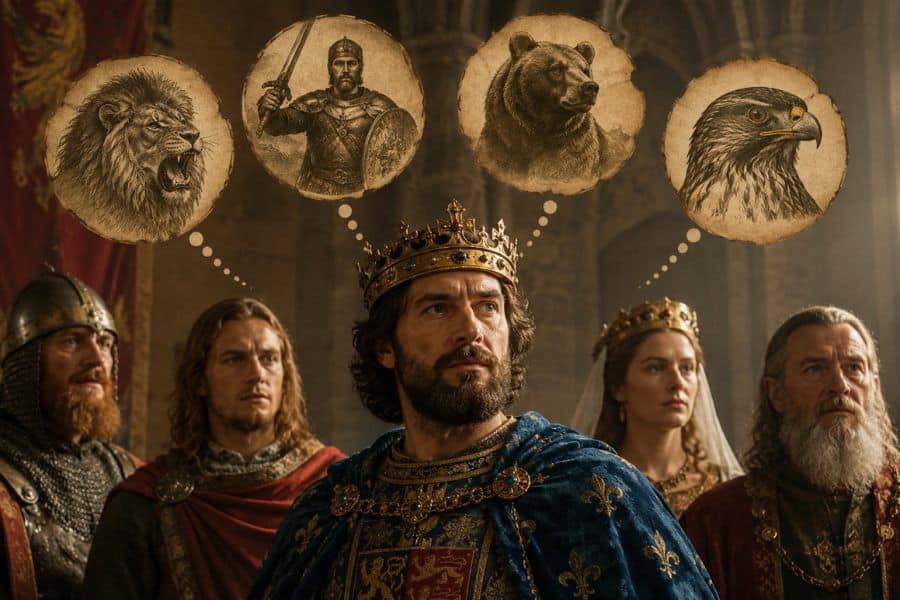
Where Medieval Royal Nicknames Came From
For most of the Middle Ages, surnames as we know them didn’t really exist, or at least weren’t fixed. If your village had four men called John, you had to tell them apart somehow. So John became John the Miller, or John with the Limp, or John of the Marshes. The extra word told you the trade, the place, or the peculiarity.
Half of medieval Europe seemed to be called Charles, Louis, Henry, or Edward. Naming your son after a great ancestor was the done thing, which is great until you have five Edwards in a row and no way to keep them straight in the records.
A king rarely got a say in his own nickname. It might celebrate a triumph, or it might follow him around like a bad smell for the rest of his days. This was an age with a very sharp tongue, and the insults people actually flung at each other were rude and offensive. A royal nickname was often just a polite version of the same instinct.
Longshanks: The King with the Endless Legs
Edward I of England, the fearsome king who hammered the Scots and finished off the Welsh princes, is remembered as Edward Longshanks. It means, quite literally, long legs.
Edward was a giant for his time. When his tomb was opened in 1774, he measured 6 feet 2 inches, which put him a clear head above most of the men around him. “Shanks” is just the old word for shins or legs, so Longshanks is the medieval way of saying the tall one with the endless pins.
The historian Michael Prestwich reckoned all that length was an asset in a fight. Long arms made him a better swordsman, long thighs a better horseman. So this is a rare nickname that was both descriptive and, if you were Edward, quite flattering.
Lackland: The Prince Who Was Given Nothing
Edward’s great-uncle was John, the youngest son of Henry II, and he went down in history as John Lackland. In French, Jean sans Terre. John without land.
The name was his own father’s doing. Henry II had a great sprawl of territory to carve up between his sons, and by the time he got to John, the youngest, there was precious little left.
Richard, John’s glamorous older brother, was set to inherit the lot. So Henry called the boy Lackland, half in jest, the way a dad might tease the runt of the litter. Nobody expected John to amount to much.
Then, one by one, his brothers died, and the landless boy ended up King of England. You’d think that would kill the nickname off. Instead, it curdled into something crueler, because John proceeded to lose nearly all the vast French lands his family had spent generations building. Lackland stopped being a joke about his inheritance and became a verdict on his reign.
This is a man who managed to be so bad at kingship that his own barons forced Magna Carta on him in 1215, and he features, unsurprisingly, near the top of the list of the most ruthless and rotten rulers of the age.
His mother, mind you, was the formidable Eleanor of Aquitaine, a queen who ran two kingdoms and outshone every man in the family.
Hooked on the Middle Ages? Get more stories like this one in your inbox.
The Unready: A Thousand-Year-Old Pun
Æthelred the Unready ruled England on and off from 978, through some of the worst years of the Viking raids. When we hear “unready,” we picture a hapless king caught with his boots off while the Danes come ashore.
Understandable, but wrong. The real nickname was unræd, and it doesn’t mean unprepared at all.
Æthelred’s name meant “noble counsel,” from the Old English æðel for noble and ræd for counsel. Some chronicler tagged him unræd, which means “bad counsel” or “no counsel.” So the joke is that Æthelred, whose very name promised good advice, was the king who took nothing but bad advice.
However, it doesn’t appear in the records until the early 1200s, nearly two hundred years after he died. The man was mocked from beyond the grave.
The old word unræd fell out of use, “unready” sounded close enough, and the mistranslation we all now repeat was born. Given that his reign really did founder on high taxes, mistrust, and a court full of scheming, you can see why the name stuck.
Curthose, Forkbeard, and Bluetooth: When Your Body Named You
Plenty of royal nicknames came straight off a man’s appearance, and they were not always kind.
Take Robert Curthose, the eldest son of William the Conqueror. Curthose comes from his short legs, and his father coined it. Loosely translated, it means something close to “shortypants.”
Imagine being the son of the most powerful man in Europe and having your dad go around calling you Shortypants in front of the whole court. It’s little wonder Robert spent his life fighting for a crown that never came and died a prisoner. A boy named like that has something to prove.
Then there’s Sweyn Forkbeard, the Danish king who briefly conquered England, whose splendid two-pronged beard did all the work. Sweyn Forkbeard became the first Viking king of England, and with a name like that, of course, he did.
My favorite of the lot is Harald Bluetooth, the Danish king who unified Denmark and Norway in the 10th century. The wireless technology is named after him, because it “unites” devices the way Harald united kingdoms, and the little logo is his initials in runes.
As for the tooth itself, the going theory is that he had a dead one that had gone dark, a sort of blue-grey. A king remembered for a manky tooth, and now half the gadgets in your house carry his name. You couldn’t make it up.
And Then We Have the Franks
If the English were blunt, the Frankish kings got it far worse, mostly because so many of them were called Charles or Louis that the chroniclers had to get inventive.
Charlemagne’s own son was Louis the Pious, for his devoutness, which is a nickname you’d happily accept. His grandsons fared less well. One was Charles the Bald, and nobody is quite sure whether he actually was bald, since some think the name was sarcastic and he had a full head of hair.
Either way, imagine ruling an empire and being remembered chiefly for your hairline. Down the generations came Charles the Fat, though there’s no contemporary record of him being especially large. That one was pinned on him by a Saxon annalist writing two centuries later, which is a bit rich.
Charlemagne’s own father was Pepin the Short. And my favorite piece of French nuance, Charles the Simple, whose name did not mean stupid at all. “Simple” here meant straightforward and honest, a man without guile. There was even a Louis the Stammerer, named for his speech.
Bloodaxe and the Boneless: The Vikings Named It as They Meant It
The Norse, as you’d expect, went for names with a bit more menace. Eric Bloodaxe earned his the hard way. One chronicle says he got it for murdering five of his own brothers to clear his path to the throne.
Another says it was simply his reputation as a raider. In either version, you would not want to meet him. It’s a nickname that tells you everything before the man even opens his mouth.
And then there’s Ivar the Boneless, leader of the Great Heathen Army that tore through Anglo-Saxon England in the 860s. His name is a proper mystery. Some historians think he had a condition like osteogenesis imperfecta, brittle bones, which would fit “boneless” rather literally.
Others point out that the Old Norse word could mean “legless,” which has led to all manner of speculation. Whatever the truth, Ivar and his Great Heathen Army were the stuff of Anglo-Saxon nightmares, and the name only added to the legend. A leader who couldn’t be broken, or so his enemies feared.
The Lucky Few: The Great, the Lionheart, and the Conqueror
For balance, let’s give the flattered ones their moment, because a well-earned nickname could burnish a reputation forever.
Alfred the Great is the only English king ever to carry that title, and he earned it, holding Wessex together when the Vikings had overrun almost everything else.
Richard the Lionheart got his for sheer battlefield nerve, though it’s worth remembering he barely spent any time in England during his short reign as King.
And William the Conqueror rebranded himself beautifully. Before 1066, he was known as William the Bastard, on account of his illegitimate birth. Win one decisive battle, and suddenly you’re the Conqueror.
Love a good medieval story?
Join our readers and get tales of kings, queens, castles and ordinary medieval lives straight to your inbox.
Kylie Lang is a nationally syndicated travel journalist with bylines on the Associated Press Wire & more, a medieval history writer, and the founder and lead author of Tales of the Middle Ages (talesofthemiddleages.com). She holds a BA (Honours) in History from the University of Kent and is a member of the British Guild of Travel Writers.


