I’ll never forget a trip I took to the Tower of London with my Dad when I was a kid. My brother had measles, so my mom packed me off with my Dad for the day for a trip to the Tower. We saw everything, including the dungeons and the rack, a medieval torture instrument that stretched the victim’s body to the point of breaking to get them to confess their sins.
It made my eight-year-old knees go weak.
Table of Contents
I’d be useless, because I’d spill my guts with just one look at a torture instrument. I’m the biggest wimp going, so how these poor souls were able to keep their secrets, because some of them did, is completely beyond me. Barbaric doesn’t even begin to cover it.
But the rack is just one of many instruments they used. So, if your stomach can handle it, and I’m not sure mine can, we’re going to enter the horrific world of medieval torture and just what was in store for you if you got on the wrong side of the law.

First, a Word Before We Begin
The Middle Ages were not the non-stop chamber of horrors we’ve all been raised to picture. Plenty of what we imagine is real and grim enough to keep you up at night. But a fair chunk of it was dreamed up centuries later by people who wanted the past to look as savage as possible.
England, it turns out, was rather squeamish about torture compared to its neighbors.
It was never a routine part of the law here. To put someone to the rack, you generally needed the king’s personal say-so, a special warrant signed at the very top. It was the exception, not the everyday.

The Rack, and Why It Wasn’t Quite as Medieval as I Thought
Let’s start with the one that turned my knees to jelly all those years ago.
The rack was real, no question. The victim was laid on a wooden frame, wrists and ankles bound to rollers at either end, and the rollers were slowly turned.
The body stretched until joints popped from their sockets. Horrible, and exactly as bad as it sounds.
But here’s what I never knew as a wide-eyed eight-year-old. The rack only arrived at the Tower of London around the 1420s, brought in by John Holland, Duke of Exeter, who was Constable of the Tower at the time. His connection to it earned it the nickname of the Duke of Exeter’s daughter.
And its busiest years weren’t medieval at all. They were Tudor. The most famous victims of the Tower Rack came long after the Middle Ages had ended. Anne Askew, the Protestant martyr, was racked there in 1546 in the reign of Henry VIII, the only woman we know who was tortured in the Tower. Guy Fawkes was hanged on it in 1605, after the Gunpowder Plot.
Mind you, the Tower had been wringing confessions out of prisoners long before the rack ever turned up. The Knights Templar, locked away, were interrogated under torture during 1311, and most of them duly confessed to heresy, almost certainly to make the pain stop.

Hooked on the Middle Ages? Get more stories like this one in your inbox.
The Ones That Were Horribly Real
Plenty of the rest, though, was every bit as nasty as the legends claim.
Burning at the stake was the punishment reserved for heresy, and it was used in earnest. So was hanging, drawing, and quartering, the gruesome fate handed to traitors in England.
The Scottish leader William Wallace suffered it in 1305, and the details are too grim to dwell on over your morning cuppa.
Then there was the breaking wheel, where a person was lashed to a great cartwheel, and their limbs were shattered with an iron bar. There was the strappado, an Italian favorite, where the victim was hauled into the air by their wrists tied behind their back, wrenching the shoulders from their sockets.
England had its own peculiar horror called peine forte et dure, which means hard and forceful punishment. If an accused person refused to enter a plea in court, they could be pressed beneath ever-heavier weights until they either spoke or died.
A woman named Margaret Clitherow, known as the Pearl of York, was pressed to death in 1586, all because she wouldn’t admit to harboring Catholic priests. It was one of the most brutal punishments ever handed to a woman in Tudor England.
Earlier still, there was trial by ordeal, which is a whole grim subject of its own. The accused might be made to carry a red-hot iron bar or be plunged into cold water, on the belief that God would protect the innocent.
The Church withdrew its support for ordeals at the Fourth Lateran Council in 1215, and England dropped the practice soon after.
And for lesser crimes, there were the stocks and the pillory, where you’d be locked up in the village square for everyone to jeer at and pelt with rotten food. More humiliation than torture, but I imagine it stung the pride something rotten.
And the Ones Somebody Made Up Later
Now for the pile that disappointed and fascinated me in equal measure. Because some of the most famous “medieval” torture devices going were never medieval at all.
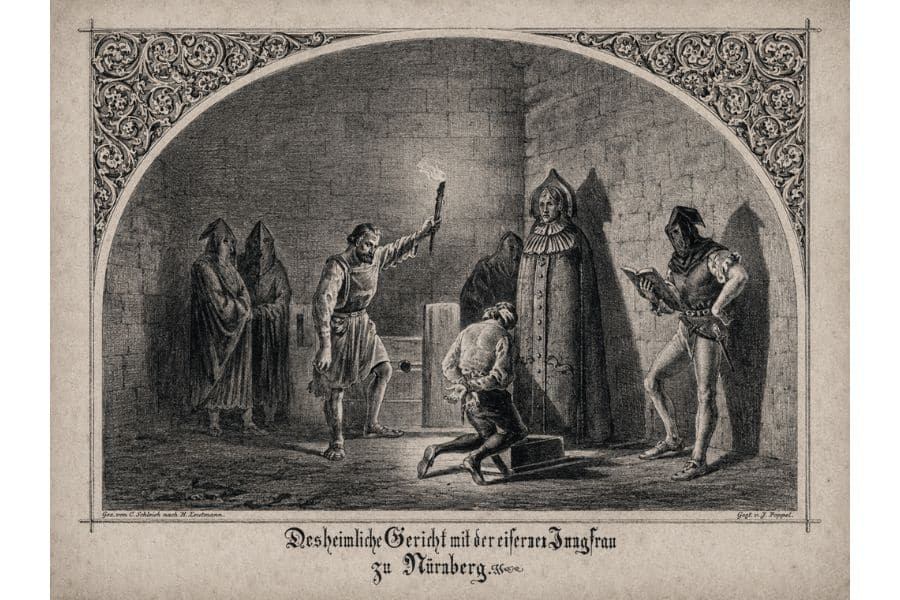
Take the Iron Maiden, that upright coffin lined with spikes that supposedly skewered its victim when the door swung shut. It’s the very picture of medieval cruelty, and it’s almost entirely a fake.
There’s no record of any such thing before the late 1700s. The famous example, the so-called Iron Maiden of Nuremberg, was a showpiece, and the lurid origin story was popularized by a German writer called Johann Philipp Siebenkees in 1793. The cabinet itself was destroyed in a bombing raid in 1944.
The Brazen Bull is another one. A hollow bronze bull in which a victim was roasted alive, their screams turned into the bellowing of the beast. Ghastly, certainly, but it belongs to ancient Greece, not the Middle Ages. It’s credited to the tyrant Phalaris of Akragas in Sicily in the sixth century BC, the better part of two thousand years too early.
Then there’s the Pear of Anguish, a screw-operated metal device said to expand inside the body. The surviving examples seem to date from the 1500s or 1600s at the earliest, and a number of historians doubt the thing could even work the way the legend claims.
Many now reckon it was some completely innocent tool, perhaps for shaping gloves or measuring, that later got a dark and dramatic backstory bolted on.
The Judas Cradle, a horrid pyramid-shaped seat, has almost no real evidence to back it up at all. And the swinging pendulum blade, descending inch by inch toward a bound prisoner, comes straight from Edgar Allan Poe’s short story of 1842. Pure fiction, and brilliant fiction, but fiction all the same.
So, Why Do We Picture It All Wrong?
A great deal of our gruesome mental image comes not from the Middle Ages but from the centuries that followed. The Georgians and the Victorians had a real appetite for the macabre.
Gothic novels were all the rage, and enterprising showmen and collectors put together “medieval” torture collections to thrill paying visitors, often cobbled together from odds and ends with a good story attached. It’s the same Victorian imagination that turned real, once colorful castles into the bare candlelit ruins we picture today.
There was something in it for them, too. Painting the Middle Ages as a uniquely savage time, a so-called Dark Age of ignorance and cruelty, made everyone feel terribly modern and enlightened by comparison. It’s a flattering story to tell about yourself. It just isn’t a very accurate one.
Medieval justice could be brutal beyond words, but it was also bound up in rules, rituals, warrants, and paperwork, carried out by ordinary men who believed they were upholding the law.
Someone, after all, had to swing the axe, and the job of the medieval executioner was a grim and lonely one that nobody much wanted.

Love a good medieval story?
Join our readers and get tales of kings, queens, castles and ordinary medieval lives straight to your inbox.

Kylie Lang is a nationally syndicated travel journalist with bylines on the Associated Press Wire & more, a medieval history writer, and the founder and lead author of Tales of the Middle Ages (talesofthemiddleages.com). She holds a BA (Honours) in History from the University of Kent and is a member of the British Guild of Travel Writers.
Related posts:
 Anne Askew: Tortured and Burned for Her Faith in Tudor England
 Lady Jane Grey Was Not the Innocent Victim History Made Her: What the Evidence Actually Shows
 15 Medieval Movies to Watch if You Love History, the Middle Ages and Being Transported to Another Era
 17 Gruesome Tudor Executions and the Horrific Stories Behind Them