
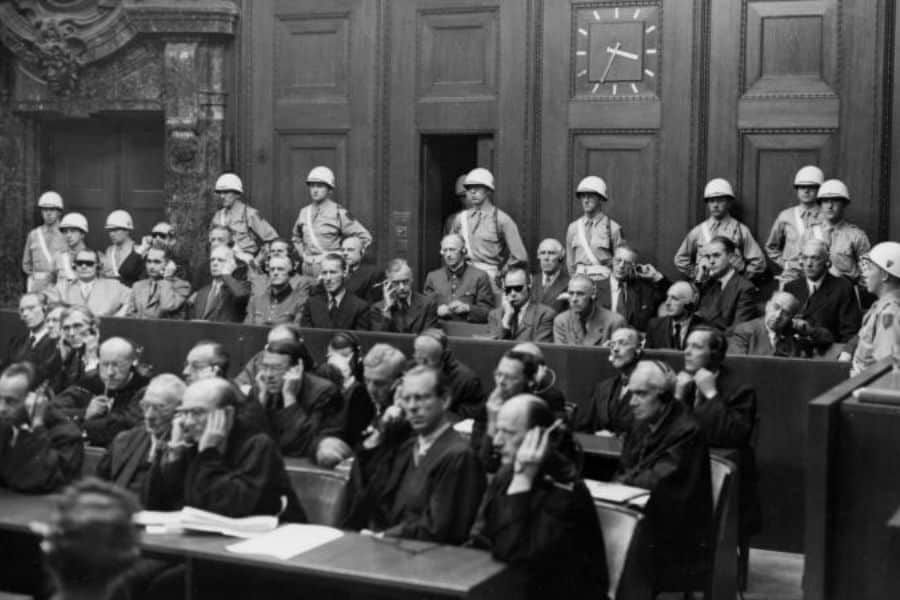
On the morning of November 20, 1945, twenty-one men filed into a wood-paneled courtroom in a half-ruined German city and sat down to face the consequences of what they had done. Hermann Göring went first, in a faded Luftwaffe uniform with the insignia torn off. He looked, by most accounts, in the room, almost cheerful.
The building was Courtroom 600 in the Palace of Justice at Nuremberg. The city had been chosen partly for symbolism; this was where the Nazi Party had held its torchlit rallies, and partly because the courthouse was one of the few large legal buildings in Germany still standing. Outside, rubble. Inside, a polished oak dock, four flags, and the world’s first attempt to put an entire regime on trial.
Table of Contents
What followed over the next ten months was messy, sometimes farcical, occasionally electrifying, and shot through with arguments that legal scholars are still having eighty years on. This is what actually happened in that room, and why a trial that nearly didn’t happen at all became the blueprint for how the world deals with atrocity.
The Trial That Almost Wasn’t
Winston Churchill’s preferred option, well into 1945, was simply to shoot the senior Nazis on sight. Draw up a list, identify the men, and execute them once captured. He believed a trial would give the defendants a platform, drag on for years, and end in legal arguments that would muddy what everyone already knew.
Stalin, of all people, disagreed. He wanted a trial, though the kind of trial he had in mind looked a lot like the show trials of the 1930s, with verdicts decided in advance.
It was the Americans, led by Justice Robert H. Jackson of the US Supreme Court, who pushed for something closer to a genuine legal proceeding. Jackson took leave from the Court to serve as chief prosecutor and spent the summer of 1945 negotiating the London Charter with British, Soviet, and French representatives.
The Charter created the International Military Tribunal and defined three categories of crimes: crimes against peace, war crimes, and crimes against humanity. That last category was brand new. There had never been a law, anywhere, that allowed a state to be prosecuted for what it did to its own citizens.
The defendants’ lawyers seized on this immediately. You can’t try a man, they argued, for breaking a law that didn’t exist when he committed the act. It is the oldest principle in criminal law: no crime without law.
The tribunal’s answer was essentially that some acts are so monstrous they don’t require a prior statute to be recognized as criminal. I find that argument morally satisfying and legally uncomfortable, which I suspect is exactly how the judges felt drafting it.
The Men in the Dock
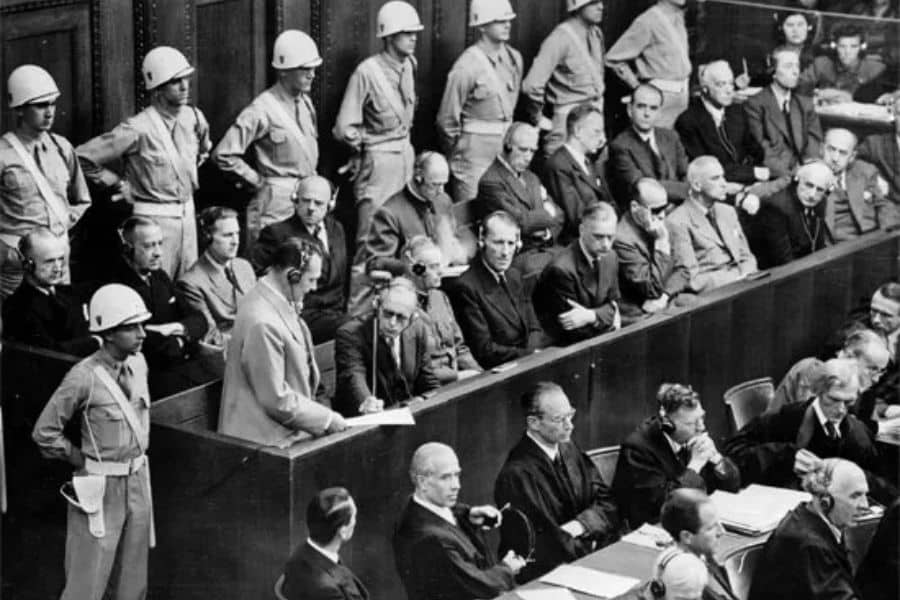
Twenty-four defendants were originally indicted. Robert Ley hanged himself in his cell before proceedings began, using a towel and the pipe in his toilet. Gustav Krupp was deemed too ill to stand trial. Martin Bormann was tried in absentia, his body still missing in the ruins of Berlin.
That left twenty-one men in the dock, and they were not the cartoon villains posters had made them out to be. They were tired, middle-aged, and often physically diminished. Several had lost considerable weight in captivity, and a few wept openly during the screening of concentration camp footage. Others noticeably did not.
Göring dominated the front row and the proceedings themselves. He had lost around sixty pounds, weaned himself off the paracodeine he had been taking by the dozen, and arrived sharp, articulate, and entirely unrepentant.
Across the months of the trial, he became the de facto leader of the defendants, glaring at any of his co-accused who showed signs of breaking ranks. When Albert Speer, the architect and armaments minister, began to admit collective responsibility, Göring reportedly hissed at him during lunch recess.
Then there was Rudolf Hess, who had flown solo to Scotland in 1941 on some half-mad peace mission and spent the war in British custody. He arrived at Nuremberg claiming amnesia, refused his lawyer’s advice, read novels through much of the proceedings, and was widely suspected of malingering.
Julius Streicher, publisher of the pornographically antisemitic Der Stürmer, was so loathed that the other defendants asked to be seated apart from him.
Hans Frank, the former governor-general of occupied Poland, had converted to Catholicism in prison and seemed almost to welcome his own punishment.
Joachim von Ribbentrop, the foreign minister, looked permanently bewildered, as if he had wandered into the wrong building.
Hooked on the Middle Ages? Get more stories like this one in your inbox.
The Films, the Documents, the Silence
Jackson’s opening statement, delivered on November 21, is still one of the most quoted pieces of legal oratory of the twentieth century. “The wrongs which we seek to condemn and punish have been so calculated, so malignant, and so devastating, that civilization cannot tolerate their being ignored, because it cannot survive their being repeated.”
He spoke for most of the day, and when he sat down, the prosecution’s case began, and the strategy he and his team had chosen turned out to be the decision that shaped everything.
Jackson decided to convict the Nazis with their own paperwork. The Third Reich had been a bureaucratic regime, obsessively documented, and Allied forces had seized literal tonnes of files: ministry memos, SS reports, transport schedules, eyewitness orders signed in ink by men sitting twenty feet from the prosecutor.
The trial became, in large part, a long and brutal reading aloud of what the defendants had themselves written down. It was effective and, frankly, slow. Reporters complained that the prosecution was burying the horror in paperwork.
That changed on November 29, when the prosecution screened a film compiled from footage shot by Allied troops liberating the camps. Bergen-Belsen, Dachau, Buchenwald. The bulldozed pits, the survivors who looked barely human, the warehouses of hair and shoes and gold teeth.
The courtroom lights were dimmed, but spotlights stayed on the defendants so observers could watch their reactions. Funk wept, Schacht turned his face away, but Göring, it was noted by several journalists, looked annoyed, as though the film were an unfair tactic rather than an account of what had been done in his name.
I have watched footage of that screening more than once, and the thing that strikes me every time is how quiet Courtroom 600 became at that point. No coughing or foot shuffling, just the projector.
Cross-Examination and the Göring Problem
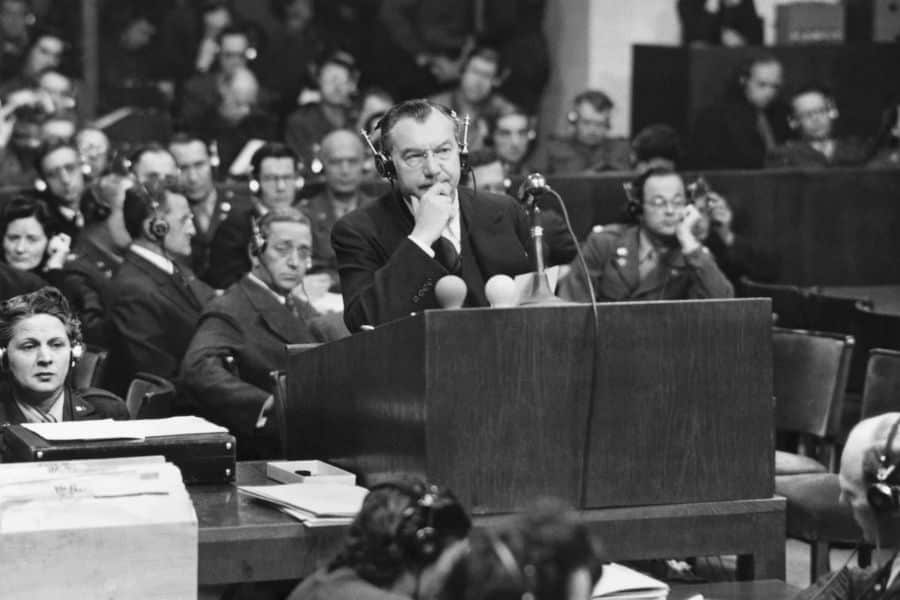
When Göring took the stand in his own defense in March 1946, he ran rings around the British prosecutor Sir David Maxwell Fyfe’s initial colleague, the American Jackson. Jackson was a fine orator but had handled few criminal trials, and Göring was a politician of considerable skill.
For three days, the Reichsmarschall lectured the courtroom on German history, the Treaty of Versailles, and the legitimacy of Nazi foreign policy. He treated Jackson’s questions as openings for speeches.
The American press, which had arrived expecting a swift demolition, began writing pieces suggesting the prosecution had lost its footing.
Maxwell Fyfe took over the cross-examination, and the room shifted. Where Jackson asked open questions, Maxwell Fyfe asked closed ones, pinning Göring to specific documents and specific signatures.
He produced a memo about the murder of fifty escaped RAF airmen from Stalag Luft III, the so-called Great Escape, and asked Göring to explain it. Göring tried to deflect, but Maxwell Fyfe pressed.
Within an afternoon, the Reichsmarschall was reduced to evasions and small, irritable concessions. It is one of the great cross-examinations in legal history, and you can read the transcripts now and feel the temperature of the room change.
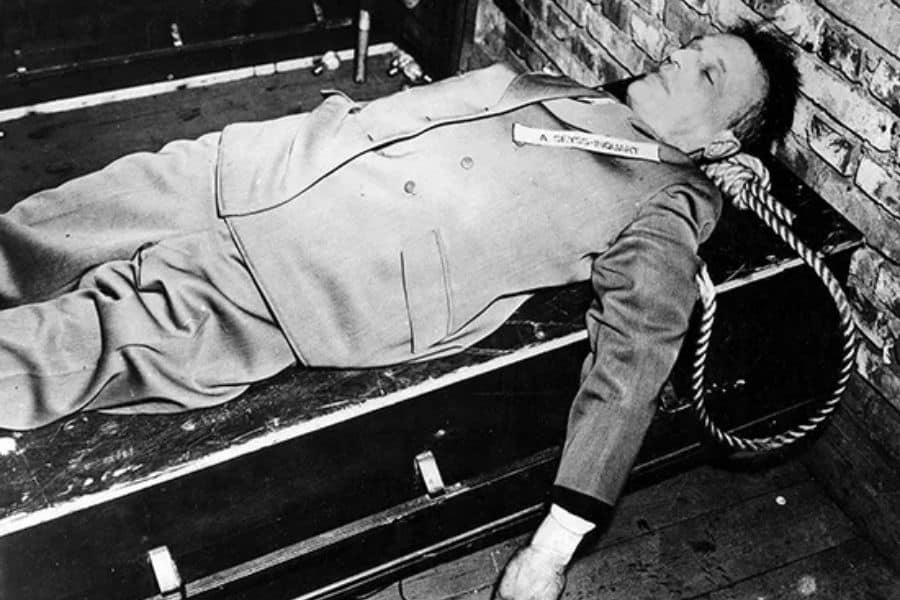
Göring never lost his composure entirely, though. On the morning of the verdicts, October 1, 1946, he stood and received his sentence of death by hanging with a stiff nod. Two weeks later, hours before he was due to be executed, he took cyanide in his cell. How he got the capsule has been debated ever since.
The most credible account, given decades later by an American guard named Herbert Lee Stivers, was that Stivers had been chatted up by a German woman who asked him to pass messages and small items to Göring.
Whether that is true or whether Göring had kept a capsule concealed since his capture, the result was the same. He cheated the rope by about ninety minutes.
The Verdicts and What They Set in Motion
Of the twenty-one men tried in person, eleven were sentenced to death, three were acquitted, and the rest received prison sentences ranging from ten years to life.
Franz von Papen, Hjalmar Schacht, and Hans Fritzsche walked out of Nuremberg as free men, a fact the Soviet judges bitterly objected to. It was, in its odd way, evidence that the trial had been something more than a foregone conclusion. A purely vengeful court does not acquit anyone.
The hangings took place in the gymnasium of the Palace of Justice on the night of October 16, 1946. The American hangman, Master Sergeant John C. Woods, was later criticized for botching several of them. The trapdoors were reportedly too small, and at least some of the condemned struck the sides as they fell, dying slowly of strangulation rather than a broken neck.
Ribbentrop went first. Streicher, by every account, screamed Nazi slogans on the scaffold and had to be wrestled into position. Frank, the convert, was the calmest of them.
The bodies were photographed, cremated, and the ashes scattered into a tributary of the Isar so no grave could become a shrine.
What Nuremberg produced legally was the framework that runs through every war crimes tribunal since: the former Yugoslavia, Rwanda, Sierra Leone, and the permanent International Criminal Court at The Hague.
The idea that individuals, not just states, can be held criminally responsible for what governments do. The idea that “I was following orders” is not a defense. The idea that there is such a thing, in law, as a crime against humanity.
None of those propositions existed in any enforceable form before November 1945. All of them exist now because twenty-one men sat in a dock in Nuremberg and a Supreme Court justice from upstate New York refused to let them be quietly shot.
Whether the trial achieved justice in any deeper sense is harder to say. The Soviets, who hanged people without trial by the thousand in their own zone, sat on the bench. Major industrialists who had used slave labor mostly escaped prosecution.
The thousands of mid-level functionaries who actually ran the camps were dealt with in later, smaller proceedings, many of them lightly. I think about that sometimes when people talk about Nuremberg as a triumph.
It was a triumph of a kind, but it was also a beginning, and a partial one. In Courtroom 600 today, which is still a working courtroom, you can stand in the dock and look across at where the judges sat.
It’s a smaller room than the photographs suggest. The dock is a few feet from the prosecution table. The whole thing happened, in the end, between men close enough to hear each other breathe.

Love a good medieval story?
Join our readers and get tales of kings, queens, castles and ordinary medieval lives straight to your inbox.

Kylie Lang is a nationally syndicated travel journalist with bylines on the Associated Press Wire & more, a medieval history writer, and the founder and lead author of Tales of the Middle Ages (talesofthemiddleages.com). She holds a BA (Honours) in History from the University of Kent and is a member of the British Guild of Travel Writers.


