Being a king in medieval times was not a ticket to the good life. Far from it. In between actually ruling a country, dealing with enemies, court gossip, backstabbing, battles, and money, there was the very real issue of death.
To say you needed eyes everywhere would be an understatement. Brother turned on brother, cousin on cousin, and there was always someone waiting in the wings to take your place and see you take a spectacular tumble.
Table of Contents
I know I’d have had to sleep with one eye open, always worried that someone would try to do away with me in my sleep. And there were some pretty gruesome ways to die in the Middle Ages, which begs the question: which medieval English King had the most brutal death?
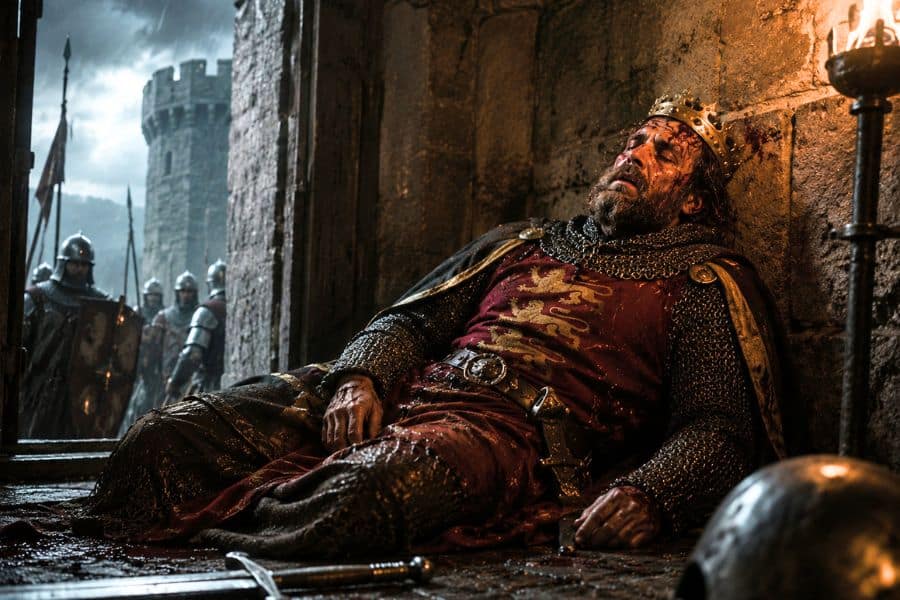
The prize for most brutal death goes to Edward II, murdered at Berkeley Castle in September 1327, with chroniclers claiming a red-hot iron was pushed into his body through a horn. Whether it really happened that way is where things get interesting, but he wasn’t the only one to suffer a rather grim end.
Medieval Kings Who Suffered Brutal Deaths
Edward II is the name most people reach for, thanks to the red-hot poker legend at Berkeley Castle in 1327. He isn’t the only contender, though. Edmund Ironside, Richard III and Harold Godwinson all have a strong claim, and each died in a way that makes you wince.
Did Edward II Really Die by Red-Hot Poker?
This is how the story goes. Edward, deposed and imprisoned, is held face down while his killers push a heated iron up into his body through a drenching-horn, the idea being to leave no mark on the outside.
That version comes from Geoffrey le Baker, writing decades after the event, and le Baker had a purpose. He wanted Edward remembered as a suffering martyr, a king who died in agony for his sins.
The earliest chronicles say something much plainer. They say Edward died, and they reach for ordinary causes, illness, sorrow, suffocation. No poker at all.
The historian Ian Mortimer has argued that Edward may not have died at Berkeley Castle in 1327 at all, and that the deposed king lived on in obscurity on the Continent for years afterward.
So why did the poker tale stick? Because by the time he died, Edward had lost everything. His throne was stripped from him by his own queen, Isabella of France, and her lover Roger Mortimer.
Edward’s rumored relationships with men made him a target, and the manner of the murder was invented to sneer at him.
Edmund Ironside and the Death on the Privy
If Edward II wins for cruelty, Edmund Ironside wins for sheer indignity. The story, told by Henry of Huntingdon more than a century later, has the king stabbed twice from below while he sat on the toilet in 1016.
The assassin, said to be the son of the treacherous ealdorman Eadric Streona, is hiding down in the cesspit, and he leaves the dagger jammed in the king’s bowels.
Later writers couldn’t resist improving it. The single hidden killer became a crossbow booby-trap in some versions, a spring-bow in others, even a mechanical stabbing device rigged under the seat. The gorier it got, the further it drifted from anything believable.
But many chroniclers mention no murder at all. Edmund had fought a savage war against the Danish warlord Cnut, and the likeliest explanation is that he died of wounds taken at the Battle of Assandun, or of disease, worn out at around twenty-five.
Richard III: Nine Blows to the Head at Bosworth
Now for the death we can actually prove. Richard III was killed at Bosworth Field on 22 August 1485, the last English king to fall in battle. For centuries his end was a matter of Tudor propaganda and Shakespeare.
Then, in 2012, they found his skeleton under a Leicester car park, and the bones told the story his enemies never could.
The forensic reading is horrifying in its clarity. His skeleton carries eleven separate wounds inflicted at or around the time of death, nine of them to the skull. The killing blows landed at the base of the skull, from a halberd or a heavy blade, and for that to happen his helmet must have been gone, knocked off or torn away in the press of the fight.
There is more, and it’s ugly. Some of the injuries were inflicted after he was already dead, the so-called humiliation wounds, consistent with his body being stripped, slung over a horse and paraded through the streets.
Whatever you make of Richard III, villain or victim of a smear campaign, his last minutes were savage. Bosworth was the final bloodletting of the Wars of the Roses, and it did not end gently.
Harold Godwinson and Edward the Martyr
Three more kings deserve a place in the lineup, even if none quite topples Edward II.
Harold Godwinson took an arrow to the eye at Hastings in 1066, or so the tapestry tells us.
Then, by some accounts, Norman knights fell on his body and hacked it apart so thoroughly it could barely be identified afterward. An arrow, then a butchering. That is a hard way to lose a kingdom.
Edward the Martyr had the shortest and most treacherous end of all. He was sixteen, stabbed in the back while someone handed him a drink at Corfe in 978, killed on the orders of his own family so his younger half-brother could take the throne.
The Anglo-Saxon Chronicle called it the worst deed done in England since the Saxons first came to these shores.
George, Duke of Clarence and a Barrel of Wine
One more death is too extraordinary to leave out, even though the man never wore the crown. George, Duke of Clarence, was the brother of two kings, Edward IV and the future Richard III, and one of the most disloyal men of his age.
He rebelled, he schemed, he switched sides more than once, and in 1478 his brother the king finally ran out of patience and had him condemned for treason.
What came next is one of the strangest ends in English history. Clarence was put to death privately inside the Tower of London on 18 February 1478, and the story that raced around Europe was that he had been drowned in a barrel of malmsey, a sweet, strong wine he was said to love a little too well.
Whether it happened quite so literally has been argued over for centuries. But unlike the red-hot poker, this tale was told by people alive at the time, which makes it one of the very few gruesome royal legends that might genuinely have happened. Shakespeare thought it too good to waste. Neither will we.
The Runners-Up: Two Williams and a Lionheart
Push a little further back, and the Norman kings offer their own catalog of nasty ends.
William the Conqueror did not die violently, but his funeral was a horror show. His body had swollen so badly by the time it reached the church at Caen that when the monks forced it into a stone coffin slightly too small, it burst, and the stench emptied the building.
A man who conquered England, undone at the last by his own corpse.
His son William Rufus went out with an arrow through the chest while hunting in the New Forest in 1100. It was called an accident.
Plenty of people at the time, and ever since, have wondered whether it was murder, because his younger brother Henry happened to be conveniently on the spot and had seized the throne and the royal treasury within days.
Then there is Richard the Lionheart, the great crusader king, brought down not in a grand battle but at a piddling little siege in the Limousin, not far from where I sit writing this.
A crossbow bolt caught him in the shoulder in 1199, the wound turned gangrenous, and it killed him within a couple of weeks. He spent his life chasing glory and died over a squabble about buried treasure.
Hooked on the Middle Ages? Get more stories like this one in your inbox.
How Historians Weigh “Brutal” When the Sources Disagree
The goriest story is almost always the least trustworthy one.
Chroniclers wrote decades or centuries after the fact, with agendas, church disapproval, family loyalties, and the odd pun they couldn’t resist.
A king they disliked got a shameful, symbolic death on the page whether or not that is how it happened. The red-hot poker and the dagger in the privy are punishments as much as they are reports.
That is why Richard III sits slightly apart from the rest. We are not taking a monk’s word for his end. We have the bones, eleven wounds deep, and they cannot be edited to make a point. The plain account is usually the true one, and the lurid one usually tells you more about the writer than the victim.
If you want to see how often medieval reputations were built on exactly this kind of storytelling, the most ruthless kings and queens of the age are a masterclass in it.
So who wins? Edward II keeps the crown in the popular imagination, on the strength of a story that probably isn’t true. Richard III wins on the evidence, wound for wound. And Edmund Ironside takes the prize nobody wants, for the most undignified exit a king ever made.
Take your pick. Every one of them had a worse day than you’re having.
Frequently Asked Questions
Which medieval English king had the most brutal death?
The medieval English king most often named as having the most brutal death is Edward II. He was said to have been murdered at Berkeley Castle in September 1327 by having a red-hot iron pushed into his body through a horn, meant to leave no outward mark.
Is the Edward II red-hot poker story actually true?
The Edward II red-hot poker story is probably not true. It comes from Geoffrey le Baker, writing decades later to portray Edward as a martyr, while the earliest chronicles say only that he died, variously of illness, sorrow, or suffocation. The historian Ian Mortimer has gone further, arguing that Edward may not have been murdered at Berkeley Castle in 1327 at all, and lived on into the 1330s.
How did Edmund Ironside die?
Edmund Ironside is said to have died in 1016 by being stabbed twice from below while sitting on the privy, the assassin hiding in the cesspit and leaving the dagger in his bowels. That grim version comes from Henry of Huntingdon, writing over a century later. Many chroniclers mention no murder at all, and Edmund more likely died of wounds from the Battle of Assandun or of disease.
How did Richard III die at the Battle of Bosworth?
Richard III died at the Battle of Bosworth on 22 August 1485, the last English king to die in battle. Forensic analysis of his skeleton, found under a Leicester car park in 2012, revealed eleven wounds inflicted at or near death, nine of them to the skull. The fatal blows struck the base of the skull, likely from a halberd or sword, meaning his helmet was gone.
Love a good medieval story?
Join our readers and get tales of kings, queens, castles and ordinary medieval lives straight to your inbox.

Kylie Lang is a nationally syndicated travel journalist with bylines on the Associated Press Wire & more, a medieval history writer, and the founder and lead author of Tales of the Middle Ages (talesofthemiddleages.com). She holds a BA (Honours) in History from the University of Kent and is a member of the British Guild of Travel Writers.
Related posts:
 The Four Husbands of Margaret Beaufort: The Teenage Bride Who Gave Birth at Just 13 Years Old
 The 7 Most Brutal Battles of the Wars of the Roses: How England’s Crown Was Won in Blood
 The Battle of Crécy 1346: How a Teenage Prince and a Wall of Arrows Brought France to Its Knees
 Isabella of France: History Called Her a She-Wolf The Truth Is Far More Interesting