Most people only know one story about King Cnut, the one with the tide rolling in at his feet. But his real life was far more ruthless and fascinating than any parable. He rose from a young Danish prince to one of the most powerful rulers in Europe, carving out a kingdom that stretched across the sea.
Cnut’s world was violent and unpredictable. Kings fell as quickly as they rose, and loyalty was often bought in silver rather than sworn in faith. To survive, he had to be cunning, decisive, and willing to strike first. This is the story of a Viking king who bent kingdoms to his will and left a mark on medieval Europe that still echoes today.
Table of Contents

Origins and Early Life
Cnut was born in Denmark in the 990s, though the exact year and place remain uncertain. His father was Sweyn Forkbeard, the man who became king of Denmark and briefly England, and his mother may have been from the powerful Piast dynasty in Poland. The sources disagree, and the truth is hazy, but what is clear is that Cnut’s birth tied him into a web of dynastic ambition across northern Europe.
As a boy, he would have been trained for war, learning the skills of command, the weight of weapons, and the rituals that bound men to their leaders. When his father launched a full-scale invasion of England in 1013, Cnut was at his side.
Sweyn’s campaign was swift and brutal. English towns submitted, and King Æthelred fled to Normandy. In the middle of it all, Cnut was left in charge of the fleet at Gainsborough, still young but already trusted to hold power in enemy territory.
That trust came with consequences. When Sweyn died suddenly in February 1014, everything unraveled. The English rallied behind Æthelred, and Cnut was forced to retreat. In a move that burned his name into English memory, he left behind hostages who were mutilated before being executed. It was a lesson in how quickly fortune could turn and how cruel medieval politics could be.

The Road to the English Crown, 1015–1016
When Sweyn Forkbeard died, Cnut’s first attempt at kingship collapsed. But he did not give up. In 1015, only a year after retreating from England, he gathered a fresh army and sailed back across the North Sea. It was a full invasion, backed by seasoned warriors who saw profit and power in following him.
England was weak and divided. King Æthelred was ill, and his kingdom had been bled dry by years of Viking attacks. The English nobility were split, some siding with the crown, others ready to deal with whoever looked strongest. In that chaos, Cnut pushed inland. His army stormed through Wessex, Mercia, and Northumbria, taking towns and demanding loyalty. Not everyone resisted. Some of the most powerful earls chose to back him, seeing the way the wind was blowing.
The real contest came when Æthelred’s son, Edmund Ironside, took command. Edmund earned his name the hard way. He fought Cnut in a series of bloody clashes that dragged on through 1016. London held out, a thorn in Cnut’s side, and Edmund managed to rally men again and again.
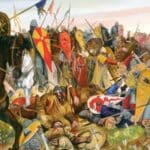
Battles raged across southern England. The struggle came to a head on 18 October 1016 at Assandun in Essex. There, Cnut’s army, hardened by years of war, broke the English line. The field was littered with bodies, including some of the kingdom’s most important lords. Even then, Cnut did not take everything by force.
He and Edmund struck a deal: England would be split, with Edmund ruling the south and Cnut the north. It was a fragile compromise, but fate decided the matter. Just weeks later, on 30 November 1016, Edmund Ironside was dead. Whether from wounds, illness, or something more sinister, no one could say. Cnut now stood as king of all England.

Securing the Throne, 1017–1020
Once Cnut became king of England, his grip on power was far from safe. The country had been at war for decades, and loyalties were fragile. He knew he needed to send a clear message: resistance would not be tolerated. In 1017, at a Christmas gathering, he ordered the execution of Eadric Streona, the infamous ealdorman who had switched sides more times than anyone could count. Other rivals were either killed or forced into exile. By the start of the new year, Cnut had eliminated the most dangerous threats to his rule.
But Cnut also knew that fear alone would not hold England. He needed legitimacy. That same year, he married Emma of Normandy, the widow of Æthelred. This was a masterstroke. By marrying her, he tied himself to the old royal line, gained the backing of Normandy, and secured a queen who already understood the politics of both England and the continent. Emma had lived through invasion and exile, and she would go on to be one of the most influential women of the eleventh century.
Cnut then reorganized the kingdom. He divided England into large earldoms, each ruled by a powerful lord who owed loyalty directly to him. This gave him a structure to control a land that had been fractured for years. He also raised vast sums through taxation, paying off most of his fleet in 1018.
That move was risky but brilliant. It showed the English that he would not keep a foreign army permanently on their soil, while still ensuring the loyalty of his core warriors. At the same time, he began working with the Church, issuing laws that echoed those of earlier English kings and presenting himself as a ruler who would protect both faith and law.

Hooked on the Middle Ages? Get more stories like this one in your inbox.
Building a North Sea Monarchy, 1018–1027
By 1018, Cnut was more than just king of England. When his brother died in Denmark, the crown of his homeland also fell into his hands. Now he ruled on both sides of the North Sea, a realm modern historians refer to as the “North Sea Empire.” One man commanding loyalty in multiple kingdoms linked by water.
That same year, he raised a massive payment from the English to pay off most of his fleet. The exact figure is debated, but whether it was tens of thousands of pounds of silver or something less, it was still one of the heaviest tax burdens ever imposed in early medieval England. The payoff was political. By sending much of the army home, Cnut signaled that his conquest was complete.
Even so, the new order needed constant attention. In 1026, Cnut faced a challenge at the Battle of Helgeå in Sweden, where he fought against Swedish and Norwegian forces. The accounts are messy and contradictory, but what matters is that he held his ground and proved that his rule was not limited to England.

The Killing of Ulf Jarl
During these years, Cnut relied on Ulf Jarl, his brother-in-law, as regent in Denmark. Ulf was married to Cnut’s sister, Estrid, and his position made him one of the most powerful men in the realm. But while Cnut was away, Ulf began to overstep. He set up Cnut’s young son Harthacnut as king in his absence, a move that looked less like loyalty and more like ambition. He was also accused of mishandling the fighting at Helgeå.
When Cnut returned, his patience was gone. At Christmas in Roskilde, after a heated argument, he had Ulf killed inside a church. It shocked many, but it was a deliberate act. Cnut wanted every earl and every noble to understand that no one, not even family, could claim power without his consent.
Rome and Royal Image
At the same time, Cnut worked hard to polish his reputation. In 1027, he traveled to Rome to witness the coronation of the Holy Roman Emperor Conrad II. There, he presented himself not as a Viking outsider but as a Christian ruler, writing back to his subjects in England to announce new privileges for merchants and pilgrims. It was a statement of intent: Cnut wanted to be seen as a king among kings.
Norway, Olaf’s Fall, and Uneasy Rule, 1028–1035
By the late 1020s, Cnut’s ambition pushed further north. Norway was restless under its king, Olaf II, who had made enemies among the nobility. Cnut seized the chance. In 1028, he sailed with a fleet, drawing support from powerful Norwegian lords who preferred Danish overlordship to Olaf’s heavy-handed rule. Olaf was driven into exile, and Cnut added Norway to his growing dominion.
Ælfgifu’s Time in Norway
Cnut could not rule Norway directly, so he turned to his first wife, Ælfgifu of Northampton, and their son Sweyn. The two were sent to govern on his behalf. This period, remembered in the sagas as “Ælfgifu’s time,” gained a reputation for harsh taxation and unpopular rule. Later accounts describe tribute taken in cattle, goods, and even young men pressed into service, which left deep resentment among the Norwegians.
Whether every detail is accurate is uncertain. Saga writers often exaggerated, especially when casting Cnut’s deputies as villains to heighten the contrast with Olaf. But the unpopularity was real, and it set the stage for rebellion.
The Return of Olaf
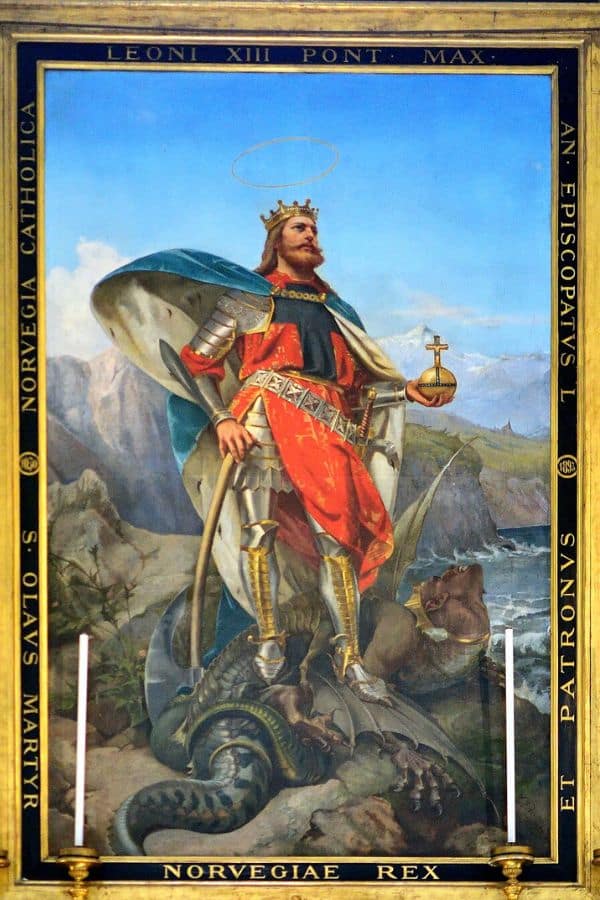
In 1030, Olaf attempted to reclaim his throne. He marched back into Norway with an army, but at the Battle of Stiklestad, he was killed in the fighting. His death, however, was not the end of his influence. Very quickly, stories spread of miracles at his grave.
Within a few years, Olaf was being venerated as a saint. For Cnut, this created a dangerous legacy. He had eliminated a rival king, but the cult of St. Olaf gave Norwegians a rallying point that weakened Danish authority for generations.
Church, Image, and Everyday Rule
While Norway simmered with unrest, Cnut worked to build a different image in England. He wanted to be remembered not just as a conqueror but as a Christian king in the line of earlier rulers like Edgar the Peaceful. To do this, he poured gifts into monasteries and cathedrals, using wealth taken in war to present himself as a patron of the Church. The great Liber Vitae of Winchester even shows him and Emma of Normandy offering a cross to Christ, a visual reminder that their rule was tied to divine approval.

Law was another tool. With the help of Archbishop Wulfstan of York, Cnut issued codes that blended Danish authority with English tradition. These laws covered everything from church rights to punishments for theft, showing continuity with the legal order that English kings had upheld before the Viking invasions.
Coinage carried the message even further. Pennies struck during his reign bore legends like “CNUT REX ANGLORV,” a daily reminder of who ruled the land. Each coin that passed through the hands of merchants, farmers, or soldiers reinforced his authority. In this way, Cnut turned everyday objects into instruments of rule, anchoring his power in both sacred and ordinary life.
Family, Heirs, and the Question of Two Wives
Cnut’s family life was as complex as his politics. Before he became king, he had taken Ælfgifu of Northampton as his consort, a union likely sealed in the old Danish fashion of hand fasting rather than by the Church. With her, he had two sons, Harold and Sweyn. Ælfgifu remained an active figure in his reign.
In 1017, Cnut married Emma of Normandy, the widow of Æthelred. This marriage was solemnized in the Christian way, making her his official queen and bringing him legitimacy in England. With Emma, he had children, including Harthacnut, who would later rule Denmark.
At a time when divorce was not possible under Christian law, this dual arrangement raised eyebrows. But kings played by different rules. By recognizing Emma as queen, Cnut secured the support of her Norman family and tied himself into the old English royal line. By keeping Ælfgifu in power abroad, he maintained the loyalty of those who had followed him since his early campaigns. It was a delicate balance, and when Cnut died, it set the stage for conflict between their sons.
Death and Burial, 1035
Cnut’s reign ended suddenly. On 12 November 1035, he died at Shaftesbury in Dorset. He was still only in his forties, a relatively young age for a king who had fought his way across half of northern Europe. The cause of death is not recorded, which seems so strange for such a man.
His body was taken to Winchester, the old capital of the West Saxon kings. There he was buried in the Old Minster, alongside the rulers he had displaced. It was a symbolic choice. By resting in the same sacred ground as the English royal line, Cnut’s memory was woven into the history of the kingdom he had conquered.
When the Old Minster was demolished in the twelfth century, Cnut’s bones, along with those of other kings, were moved into ornate mortuary chests in Winchester Cathedral. Centuries of upheaval scattered and mixed them, and modern studies have shown that the remains inside are a jumble of different individuals. Somewhere in that mix lie the bones of the Danish king who had once held England, Denmark, and Norway under his command.
Myth vs Reality: The Tide Story
For many people, Cnut is remembered only through a single tale: the king sitting by the sea, commanding the tide to halt, and being drenched as the waves rolled in. The story first appeared a century later, written down by Henry of Huntingdon. In Henry’s version, Cnut stages the scene to prove to his courtiers that no ruler, however powerful, can command the sea. Only God holds that kind of authority.

Over time, the meaning twisted. The tale was retold as if Cnut had been foolish enough to believe he could stop the tide, a caricature that stuck in popular memory. It stripped away the context and left him looking like a vain king who thought himself greater than nature.
The reality is far more interesting. Cnut was a hard, pragmatic ruler who knew the limits of power. He fought, bribed, and schemed his way into becoming one of the most dominant kings of the early Middle Ages. The tide story is just that, a story, nothing more.

Love a good medieval story?
Join our readers and get tales of kings, queens, castles and ordinary medieval lives straight to your inbox.

Kylie Lang is a nationally syndicated travel journalist with bylines on the Associated Press Wire & more, a medieval history writer, and the founder and lead author of Tales of the Middle Ages (talesofthemiddleages.com). She holds a BA (Honours) in History from the University of Kent and is a member of the British Guild of Travel Writers.