Royal affairs in medieval England were rife. A king slips out of the royal apartments after dark, a mistress waits in a manor a few miles off, and half the court knows exactly where he’s gone, but nobody dares say a word until the money starts moving.
Titles get handed out. Manors change hands. A woman who was nobody last Christmas is suddenly holding the ear of the most powerful man in the kingdom, and her rivals are furious.
Table of Contents
Medieval England ran on this stuff. Marriages were treaties, so love, when it turned up, tended to turn up somewhere it wasn’t supposed to. And when a bedchamber affair collided with a treasury or a crown, the aftershocks could last generations.
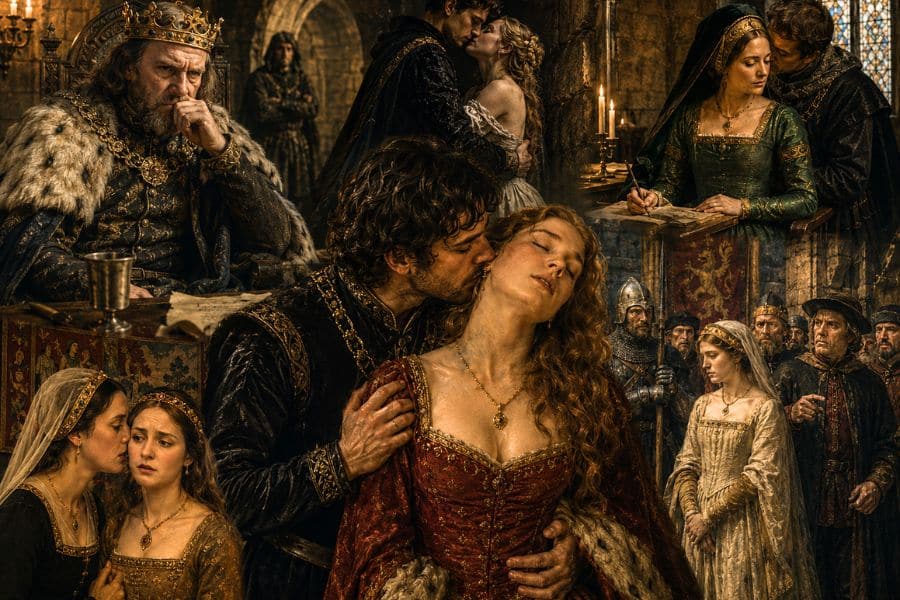
7 Scandalous Royal Affairs in Medieval England
What follows are seven of the most talked about affairs in the Middle Ages, spanning roughly four centuries.
1. Henry II and Rosamund Clifford
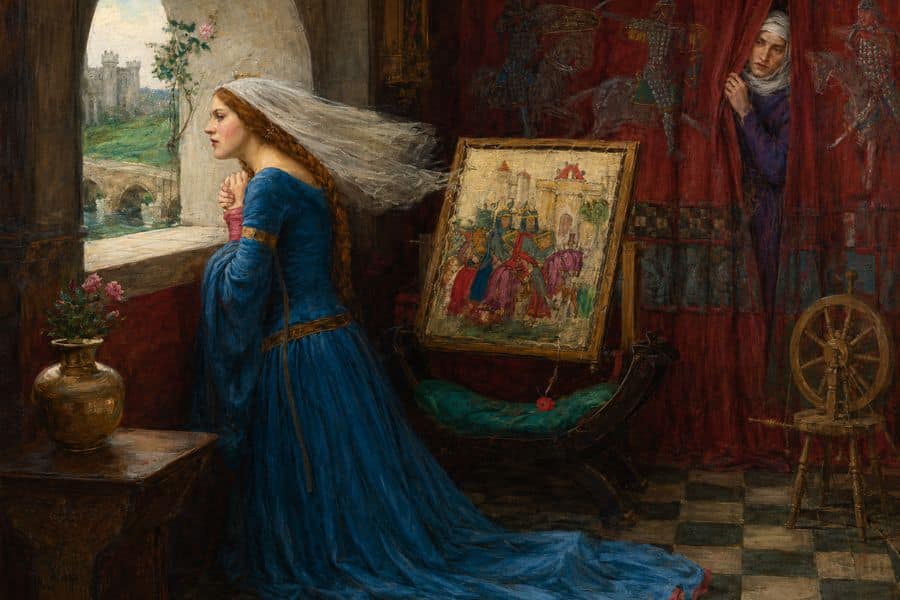
Rosamund Clifford was the daughter of a Marcher lord, Walter de Clifford, and by the late 1160s she was Henry II’s mistress. Whether the relationship began earlier and was kept quiet, or whether Henry only paraded her openly after his rift with Eleanor of Aquitaine, remains debated. What everyone agrees on is that by 1174, when Eleanor was locked up for backing her sons’ rebellion, Rosamund was very much out in the open.
The chronicler Gerald of Wales, writing not long after her death, took a swipe at Henry for calling Rosamund ‘rosa mundi’, the rose of the world, and mocked her instead as ‘rosa immundi’, the rose of unchastity.
Later legends grew around her, including a labyrinth at Woodstock where Henry supposedly hid her, and a poisoning by a jealous Eleanor. Ranulf Higden repeated versions of these tales in the 14th century, though contemporary evidence for any of it is thin.
Rosamund died around 1176 and was buried at Godstow Nunnery, where Henry paid for a fine tomb. Hugh of Lincoln, who visited in 1191, was appalled to find a king’s mistress honored in front of the altar and ordered her remains moved outside the church.
2. Edward II and Piers Gaveston
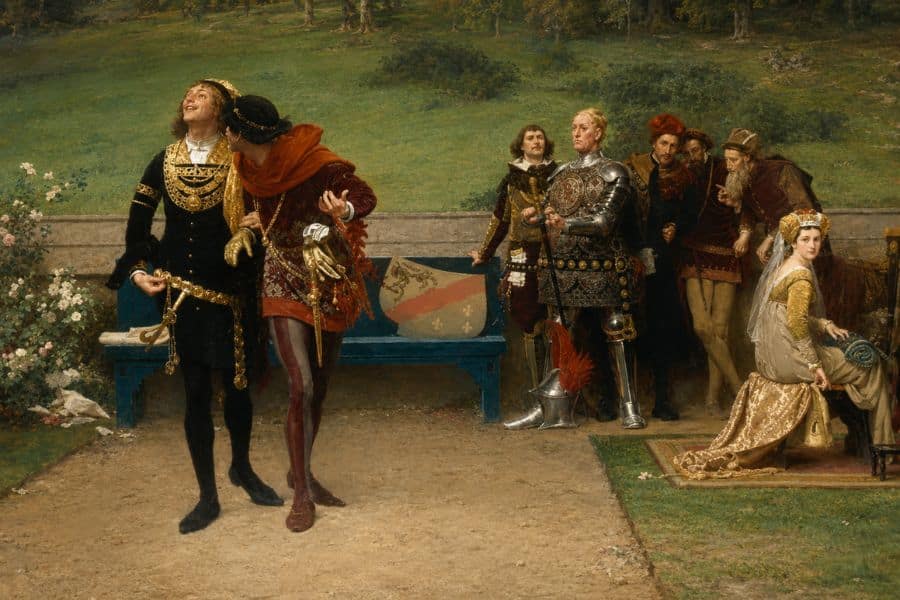
Whether Edward II and Piers Gaveston were lovers in the modern sense is still debated by historians. What’s not in doubt is that contemporaries thought the relationship was improper, excessive, and dangerous to the country.
The Vita Edwardi Secundi, written by an anonymous cleric close to events, described their bond as one of extraordinary intimacy, comparing it to that of David and Jonathan.
Gaveston was a Gascon knight’s son whom Edward had known since boyhood. When Edward became king in 1307, he showered Gaveston with the earldom of Cornwall, jewels that had belonged to the old king, and a marriage to his own niece.
At the coronation, Gaveston carried the crown and reportedly wore purple embroidered with pearls while the great earls stood by in gold. Warwick, as it turned out, had a long memory.
The barons forced Gaveston into exile three times, and each time Edward brought him back, until in 1312 a group of earls led by Warwick and Lancaster seized him at Deddington, dragged him to Blacklow Hill, and had him run through with a sword and beheaded.
Edward’s grief was public and lasting. He kept Gaveston’s embalmed body at King’s Langley for over two years before finally allowing burial in 1315, and he never forgave the men who had killed him.
3. Edward III and Alice Perrers
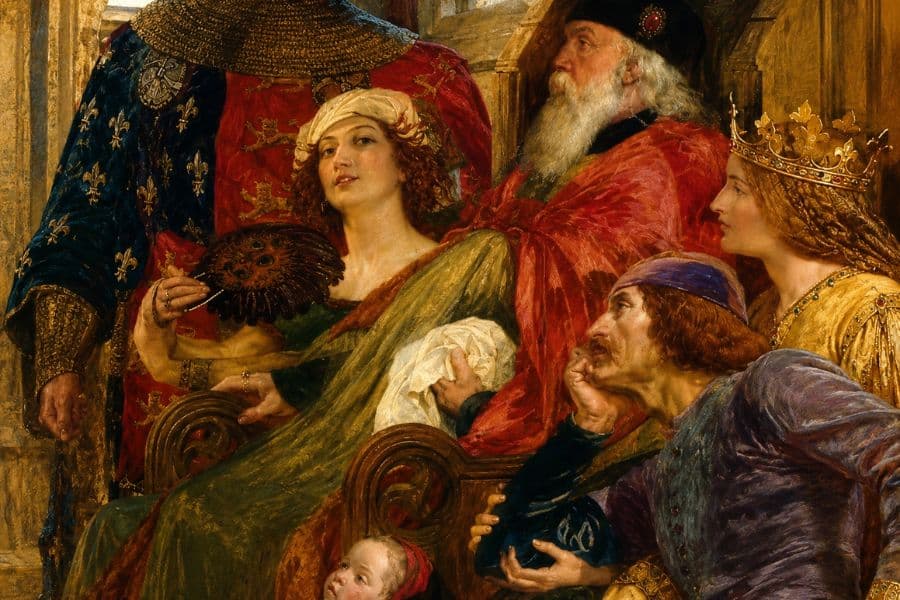
Alice Perrers came to court in the 1360s as a lady-in-waiting to Queen Philippa of Hainault. She was of modest origins, probably the daughter of a Hertfordshire family with connections to the London goldsmiths, and by 1364 she had borne Edward III his first illegitimate child.
Philippa, dying slowly of dropsy, appears to have tolerated the situation. After Philippa’s death in 1369, Alice’s grip on the old king became a public scandal.
The monastic chronicler Thomas Walsingham of St Albans loathed her and wrote about it at length. He accused her of controlling access to the aging king, of sitting beside judges to sway their verdicts, of stripping the rings from Edward’s fingers as he lay dying in 1377.
Some of this is likely spite. Walsingham was a monk with strong views on ambitious women, and Alice was a spectacularly ambitious woman.
The Good Parliament of 1376, led by the Black Prince before his death, put Alice on trial for corruption and banished her from court. She was back within months.
Only Edward’s death the following year ended her power, and even then she fought for years through the courts to hang onto the manors and jewels he’d given her. She died sometime around 1400, still litigating.
Hooked on the Middle Ages? Get more stories like this one in your inbox.
4. Roger Mortimer and Queen Isabella
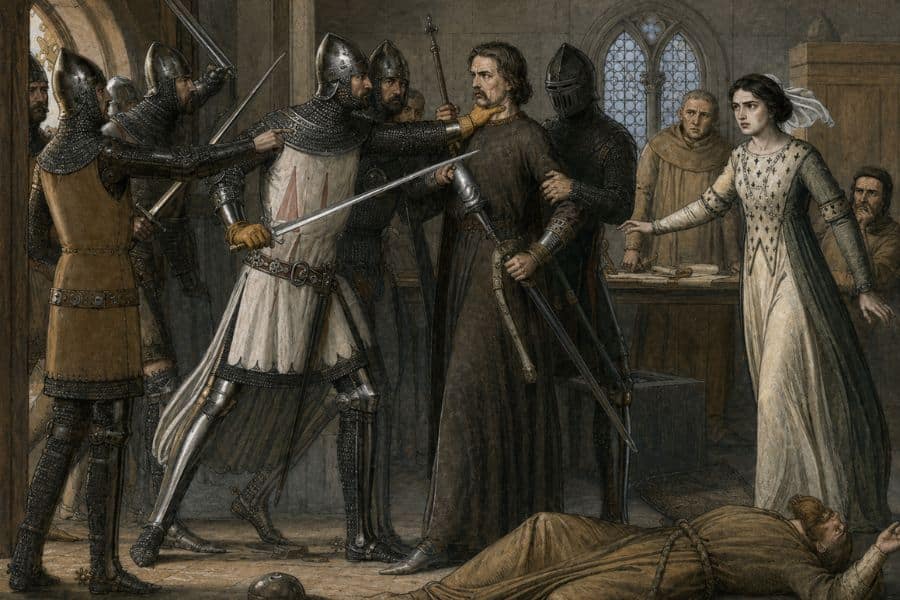
Isabella of France arrived in England in 1308 as a 12-year-old bride for Edward II and spent the next 17 years being humiliated by her husband’s favorites. In 1325, she was sent to France on a diplomatic mission and refused to return.
There she met Roger Mortimer, a Marcher baron who had escaped the Tower of London in 1323 after being imprisoned for rebelling against Edward. By 1326, they were lovers and allies, planning an invasion.
They landed in Suffolk in September 1326 with a small force, gathered support at extraordinary speed, and had Edward II deposed by January 1327.
For the next three years Mortimer ruled England in all but name, with Isabella at his side, while her teenage son Edward III was king in name only. They took lands, titles, and money on a scale that made even Gaveston look restrained by comparison. Mortimer had himself made Earl of March in 1328.
Edward III grew up fast. In October 1330, at Nottingham Castle, the 17-year-old king and a small group of companions came up a secret passage into his mother’s chambers and arrested Mortimer in front of her.
Isabella is said to have cried out, ‘Fair son, have pity on gentle Mortimer.’ He was hanged at Tyburn a month later, his body left on the gallows for two days.
Isabella was not tried. She was pensioned off to Castle Rising and lived there for another 28 years. Her rank saved her, though it couldn’t save her lover.
5. Katherine of Valois and Owen Tudor
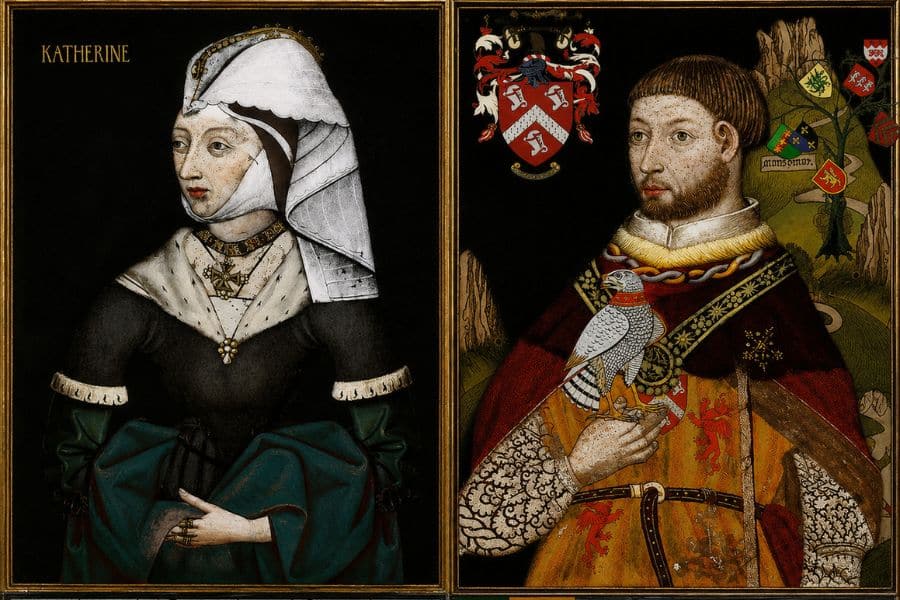
Katherine of Valois was the widow of Henry V, the mother of Henry VI, and the daughter of the mad French king Charles VI. When Henry V died in 1422, she was 20 years old, French, and living in a court full of powerful men who didn’t want her to remarry, since any new husband would gain influence over the infant king.
Parliament passed a statute in 1428 forbidding her to marry without royal consent.
She married anyway, or at least lived as if she had, with a Welshman named Owen Tudor. Owen was a squire in her household, of Welsh gentry stock but no rank to speak of by English standards. It was a real scandal.
The evidence for a formal marriage is contested. It’s documented that they had at least 4 children together, including Edmund and Jasper Tudor, and that their relationship remained hidden until Katherine’s death in 1437.
The reaction, when the truth came out, was ferocious: Owen was imprisoned in Newgate, then Windsor, and escaped and was recaptured more than once before eventually being released and rehabilitated under his stepson Henry VI.
He died at the Battle of Mortimer’s Cross in 1461, beheaded in Hereford marketplace, reportedly saying as the axe came down that the head that had lain in Queen Katherine’s lap would now lie in the executioner’s basket. Their grandson became Henry VII, which is a striking outcome for a scandal everyone had tried to bury.
6. Fair Maid of Kent and Thomas Holland
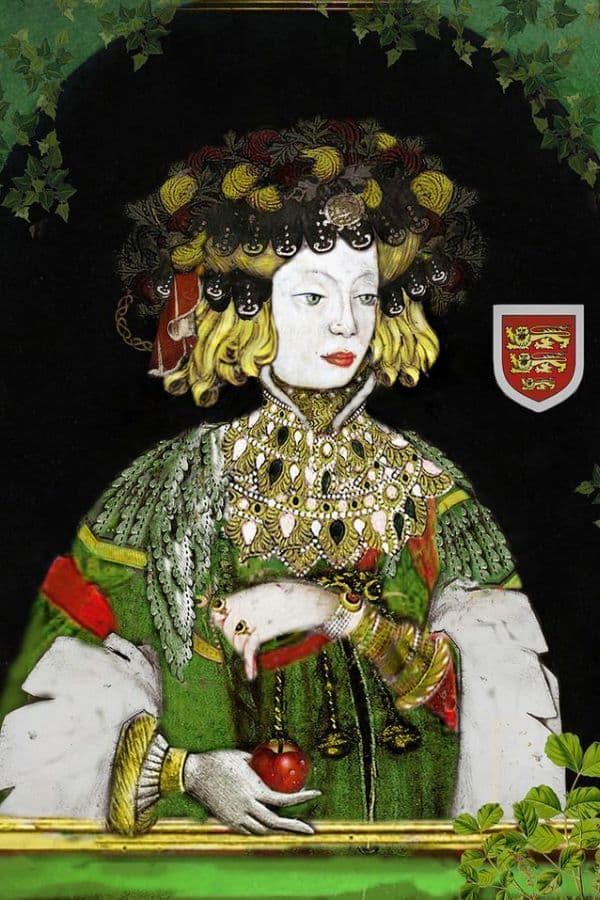
Joan of Kent, granddaughter of Edward I, is best known now as the mother of Richard II and the wife of the Black Prince. Before all that, she was at the center of one of the strangest marital scandals of the 14th century.
In about 1340, aged 12, she secretly married Thomas Holland, a household knight. He then went off to fight in Prussia and France. While he was away, her family married her off to William Montagu, heir to the earl of Salisbury, apparently without her admitting to the earlier match.
Joan lived as Montagu’s wife for around 8 years. When Holland returned from the campaign, wealthy from a share of a ransom, he petitioned the pope to have Joan restored to him as his lawful wife.
Montagu locked her up. The case went to the papal court at Avignon, where Pope Clement VI ruled in November 1349 that Joan’s marriage to Holland was valid and her marriage to Montagu was to be annulled.
She returned to Holland and had 5 children with him. When he died in 1360, she scandalized the court again by marrying Edward, the Black Prince, her cousin, within months, without the papal dispensation such a match required, which had to be obtained retrospectively.
The chronicler Jean Froissart, who knew the English court well, called her the most beautiful woman in England and left the rest to the reader’s imagination.
7. Hugh Despenser the Younger and Edward II
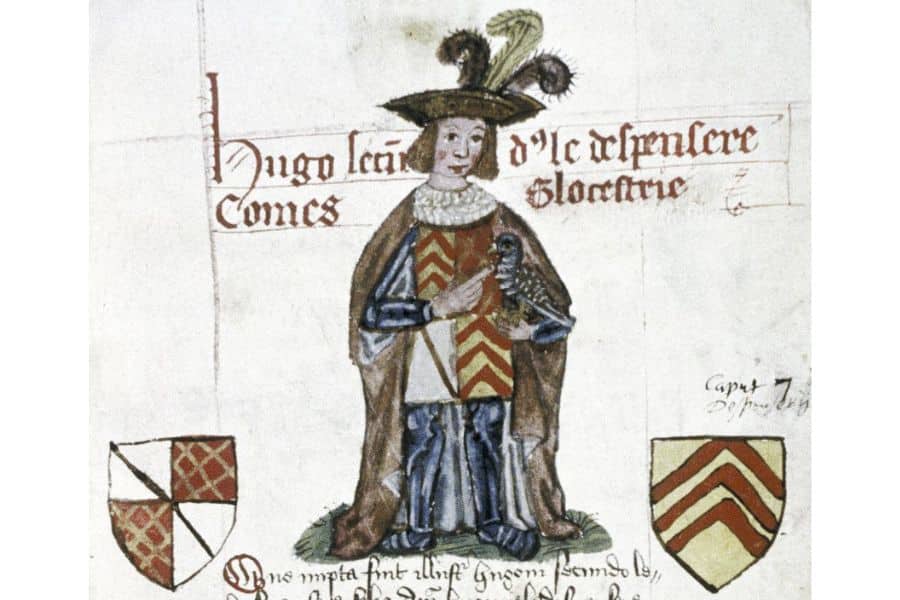
After Piers Gaveston’s death in 1312, Edward II eventually found a new favorite in Hugh Despenser the Younger, and the second scandal was worse than the first.
Despenser was already married to Edward’s niece Eleanor de Clare, which gave him a legitimate place at court, but by the early 1320s his relationship with the king had crossed into something contemporaries found deeply improper.
The Vita Edwardi Secundi calls Despenser the king’s right eye and Edward’s love for him excessive.
What made Despenser more dangerous than Gaveston was greed on a systematic scale. Through Eleanor he claimed Glamorgan, and from there he set about extorting land from other Welsh Marcher lords with a combination of legal trickery, false imprisonment, and outright seizure.
Lady Elizabeth Comyn was held for over a year until she signed over her estates. The Marcher lords rebelled in 1321, forced the Despensers into exile, and were then crushed when Edward brought them back and executed their leaders.
When Isabella and Mortimer invaded in 1326, Despenser was hunted down with them. He was tried at Hereford in November, condemned as a traitor, a thief, and a sodomite, and executed in a manner meant to punish each charge in turn: dragged behind horses, hanged from a 50-foot gallows, castrated, disemboweled, and quartered, with his head sent to London Bridge.
Edward II died at Berkeley Castle in September 1327, in circumstances that historians still argue over. The lurid story of the red-hot poker comes from the later chronicle of Geoffrey le Baker and isn’t accepted by most modern historians as reliable.
## Sources
DNB (Wikisource). https://en.wikisource.org/wiki/DictionaryofNationalBiography,1885-1900/Clifford,_Rosamond .
History of Parliament. https://historyofparliament.com/2020/12/08/the-lost-statute-of-1427-8-or-how-to-solve-a-problem-like-queen-katherine/
Encyclopedia.com – Joan of Kent. https://www.encyclopedia.com/women/encyclopedias-almanacs-transcripts-and-maps/joan-kent-1328-1385
Love a good medieval story?
Join our readers and get tales of kings, queens, castles and ordinary medieval lives straight to your inbox.

Kylie Lang is a nationally syndicated travel journalist with bylines on the Associated Press Wire & more, a medieval history writer, and the founder and lead author of Tales of the Middle Ages (talesofthemiddleages.com). She holds a BA (Honours) in History from the University of Kent and is a member of the British Guild of Travel Writers.
Related posts:
 Isabella of France: History Called Her a She-Wolf The Truth Is Far More Interesting
The She-Wolf Who Invaded England. Isabella of France Would Not Be Tamed
Isabella of France: History Called Her a She-Wolf The Truth Is Far More Interesting
Isabella of France: The She-Wolf Who Would Not Be Tamed & Dared to Take a Throne
Isabella of France: History Called Her a She-Wolf The Truth Is Far More Interesting
The She-Wolf Who Invaded England. Isabella of France Would Not Be Tamed
Isabella of France: History Called Her a She-Wolf The Truth Is Far More Interesting
Isabella of France: The She-Wolf Who Would Not Be Tamed & Dared to Take a Throne