Poitiers is a lovely old city in southwest France, an hour from where I live. It’s now a university town, but it’s a great mix of old and new. The streets are full of old half-timbered medieval buildings, and the squares have cafes and restaurants surrounding them where you can enjoy a coffee and soak up the history that seems to ooze out of every stone.
My interest in Poitiers originally is that it was where Eleanor of Aquitaine had her court, but there is so much more to this town than just Eleanor. Now, there is nothing to suggest that one of the most significant battles of the Hundred Years’ War was fought just outside the city walls in 1356.
Table of Contents
The Battle of Poitiers left a king in chains, a prince in the spotlight, and a whole country reeling. It didn’t end the Hundred Years’ War, but carved a deep scar into its timeline. If Crécy had been a warning, this was a punch to the gut.

The Road to the Battle of Poitiers
By the mid-1300s, England and France were in a full-blown feud that would stretch over a hundred years and reshape both kingdoms. It started in 1337, when Edward III of England decided he had a rightful claim to the French crown. That didn’t go down well with the French king, Philip VI.
The real problem was Gascony, a rich patch of land in southwest France. England still held it, technically as a vassal to the French king, but neither side liked the arrangement. The wine trade from Gascony made a fortune for the English, and they weren’t about to give it up. So when Philip tried to take it back, Edward pushed back harder, and things kicked off.
Over the next few years, English armies landed in France and racked up some serious wins. Crécy in 1346 was a disaster for the French cavalry. Calais fell the next year and stayed under English control for over two centuries. Then the Black Death swept through Europe, slowing the war but not stopping it.
A fragile truce held for a while, but by 1355, it had unraveled completely.

Enter the Black Prince
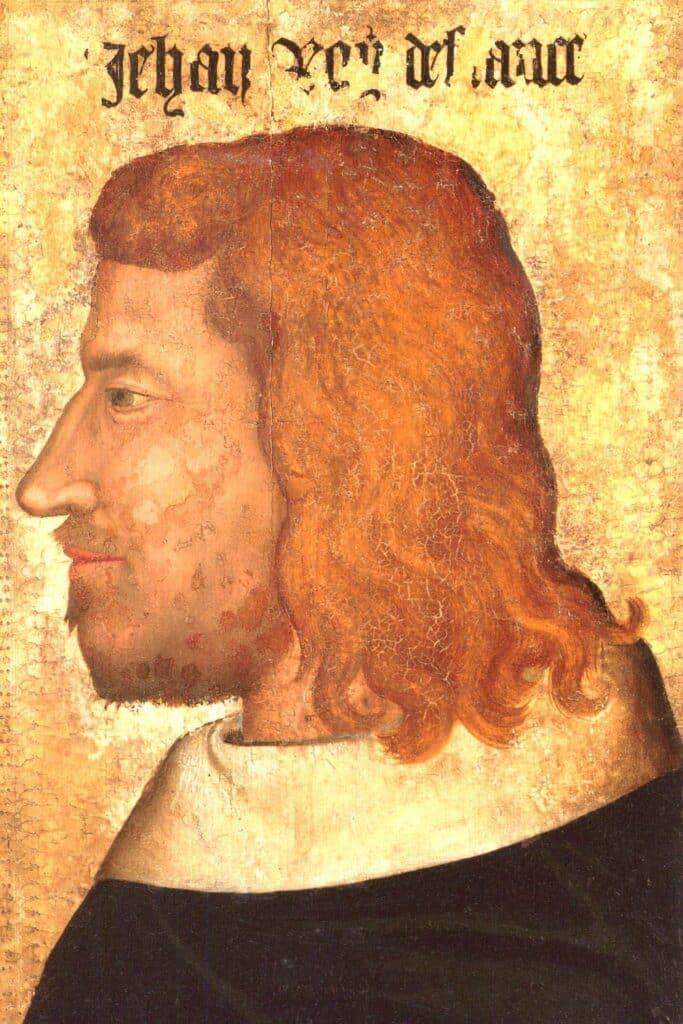
By now, Philip VI was dead and his son, John II, was king of France. John had a reputation for being bold and not terribly patient. He was also under pressure. The royal treasury was in a bad way, and unrest was growing at home. He didn’t help matters when he imprisoned his rival, Charles of Navarre, and executed a few nobles for good measure. The fallout made him even more unpopular, especially among the powerful families he needed onside.
Meanwhile, Edward III sent his son to Gascony to stir things up. Edward of Woodstock, better known as the Black Prince, arrived in Bordeaux in the autumn of 1355 with a few thousand troops and wasted no time.
With help from local lords and Gascon allies, his force grew quickly. Then came the chevauchée, a fast, brutal mounted raid that tore through the French countryside. The Black Prince led his men over 300 miles across southern France, all the way to Narbonne, looting towns, burning farms, and cutting a deep path of destruction. By December, they were back in Gascony, leaving half the region in flames.
The goal was to hit the French where it hurt and force a reaction. The plan worked.
France Tries to Catch Up
Over the winter, the Black Prince kept the pressure on. More towns and castles fell to his forces in early 1356. In some places, the French didn’t even put up a fight. Local commanders either weren’t ready or had no orders to counterattack. The English pushed further into French territory than anyone expected.
At the same time, a second English army had landed in the north. Henry of Lancaster led that one, charging through Normandy and causing more chaos. King John had to rush north to deal with it, but Lancaster slipped away before a battle could happen. That made John look weak, and by the time he turned his focus back to the south, the Black Prince was already deep in the Loire Valley.
By late summer, the French king had had enough. He gathered a massive army and headed south. His plan was straightforward: cut off the Black Prince’s route back to Gascony and force him into a fight. If the English were cornered with no supplies and nowhere to run, they’d have no choice.
The Trap Closes
In August, the Black Prince had already started pulling back. He’d reached the Loire River, hoping to meet with his father or Lancaster. But John moved fast, crossed the river further east, and got between the English and their escape route. That changed everything.
Realizing he was boxed in, the Black Prince turned south. He crossed the Creuse River, moved to Châtellerault, and finally took up a defensive position outside Poitiers.
The French army was closing in, tens of thousands strong, and in high spirits. The English were outnumbered, deep in enemy territory, and running low on supplies. But they were experienced, well-led, and ready to dig in. A fight was coming, and both sides knew it.
Key Figures and Armies at Poitiers
By the time the armies faced off outside Poitiers in September 1356, the leaders on both sides were well known, and the stakes were high.
On the English side was Edward of Woodstock, better known as the Black Prince. He was still young but already experienced. At just sixteen, he had fought at Crécy and earned a reputation for bravery that followed him into every battle after.
His army included English, Welsh, and Gascon troops. Among his closest advisers were Sir John Chandos, a sharp strategist, and Sir James Audley, known for fighting fiercely and leading from the front. Both men had the trust of the Prince and would play critical roles at Poitiers.
Another name worth knowing is Jean de Grailly, the Captal de Buch. A local Gascon lord, he led a cavalry contingent from the region. The Black Prince trusted him with bold and risky moves, and that trust would matter more than ever when the fighting began.

King John II and the French Command
Facing them was King John II of France, sometimes called John the Good. He was around forty-five and had spent much of his life in the saddle. He brought a large and well-equipped army, including three of his sons. The Dauphin Charles was just eighteen, Louis was a little younger, and Philip, the youngest, was only fourteen. None of them had much experience in battle, but they were there to witness what a king’s duty looked like.
John’s commanders included the Marshals of France, Jean de Clermont and Arnoul d’Audrehem, each in charge of elite cavalry units. Walter VI, Count of Brienne and the Constable of France, led the first division, which included infantry, mercenaries, and a group of Scottish knights under Sir William Douglas.
John himself commanded the royal reserve. Around him were the best of the royal household knights and members of the Order of the Star, a group of nobles who had sworn never to retreat. That vow might have sounded noble in theory, but it would become a death sentence for many of them.
Numbers and Strategy
The Black Prince’s army totalled around six thousand. That included roughly three thousand men-at-arms, two thousand longbowmen from England and Wales, and another thousand Gascon infantry, some of whom carried crossbows or throwing spears. They were all mounted for speed but would fight on foot in tight, disciplined lines.
King John’s army was much larger. Modern estimates put it somewhere between fourteen and sixteen thousand. Most were heavily armoured men-at-arms who would also fight dismounted, with two thousand crossbowmen and two thousand more infantry behind them. The only cavalry left mounted were two hand-picked squadrons, around five hundred knights in total, under the Marshals of France. These were the best horses and armour the French had, saved for key moments in the fight.
Despite being outnumbered more than two to one, the English weren’t panicking. They had fought together before, knew their tactics, and had the kind of archers the French had come to dread. On the other hand, King John believed that overwhelming force and the fury stirred up by years of destruction would be enough to win the day.
Both sides were sure of themselves. Neither was planning to back down.

Hooked on the Middle Ages? Get more stories like this one in your inbox.
The Battlefield and English Preparations
The battlefield lay just south of Poitiers, near the village of Nouaillé. The Black Prince’s scouts had already checked it over, and he chose it carefully. He didn’t want a wide open plain. Instead, he pulled his troops back to a low ridge surrounded by woodland and rough terrain that would make life hard for any army trying to launch a direct assault.
To one side was a stream and marshy ground. On the other, baggage wagons were drawn up to form a makeshift barricade. In front, thickets, hedges, and trenches turned the approach into a mess of obstacles. His men dug pits to break up cavalry charges.
He split his force into three main divisions. On the left were about two thousand men under the Earl of Warwick, with support from Gascon cavalry led by the Captal de Buch. On the right, the Earl of Salisbury commanded another two thousand, helped by Sir Robert de Suffolk and others. Archers were placed on the flanks of each division, ready to send arrows sweeping into any attackers from the sides.
The Prince himself held the center with his best fighters and Gascon infantry. At first, he kept this group slightly behind the others, waiting to see where they’d be needed most. And in the woods behind the English lines, one final surprise was waiting. A small cavalry unit, maybe two hundred riders, stayed hidden. Led by the Captal de Buch, they would only move when the time was right.
The French Set the Stage
The French army was hard to miss on the other side of the field. Larger, louder, and full of banners, they moved into position with the confidence of sheer numbers. King John II split his force into four main divisions.
The first, or vanguard, was led by Constable Walter of Brienne. It held the bulk of the French crossbowmen, common infantry, and two elite cavalry groups under the Marshals of France.
Behind them came the second division, commanded by the Dauphin Charles and the Duke of Bourbon. Four thousand dismounted men-at-arms stood ready to follow the first wave and press the attack. The third wave, under Philip, Duke of Orléans, included another three thousand men, many of whom had little real experience in combat.
The final division stayed at the rear. King John kept his best men close and stood ready to move forward if things went well, or take charge if it all fell apart. Flying beside him was the Oriflamme, the sacred royal banner that meant no quarter would be given.
The Calm Before the Storm
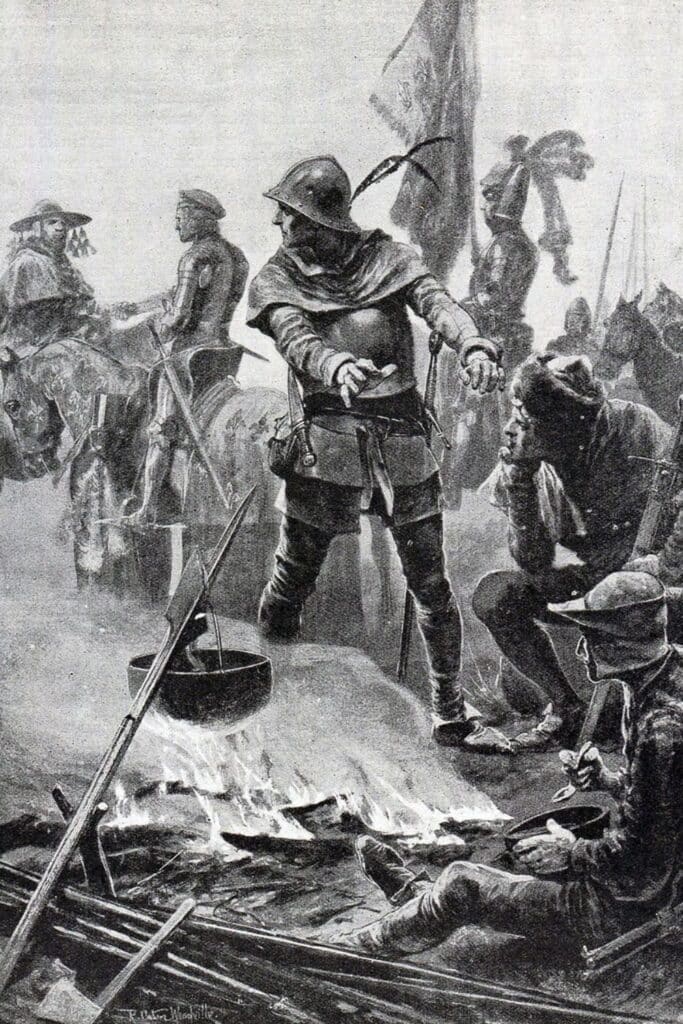
Both sides were in place as the sun rose over the fields on Sunday morning. The gap between them was no more than five hundred yards. For two tense hours, nothing happened. Each side waited, neither willing to make the first move.
During this lull, a papal legate, Cardinal Hélie de Talleyrand, rode between the camps trying to prevent what was about to happen. He urged the Black Prince to consider terms. The English were surrounded and running low on food and water. Withdrawal would be nearly impossible.
The Prince offered to give up his plunder and the towns he had taken in exchange for safe passage back to Gascony. But this was probably more about stalling than surrender. King John’s advisors urged him to accept. A ransom was still possible. A battle didn’t have to happen.
John said no. Whether it was pride, anger, or frustration over the destruction the English had caused, he wasn’t about to let them go. The cardinal gave up. The truce was dead.
The Battle of Poitiers Unleashed
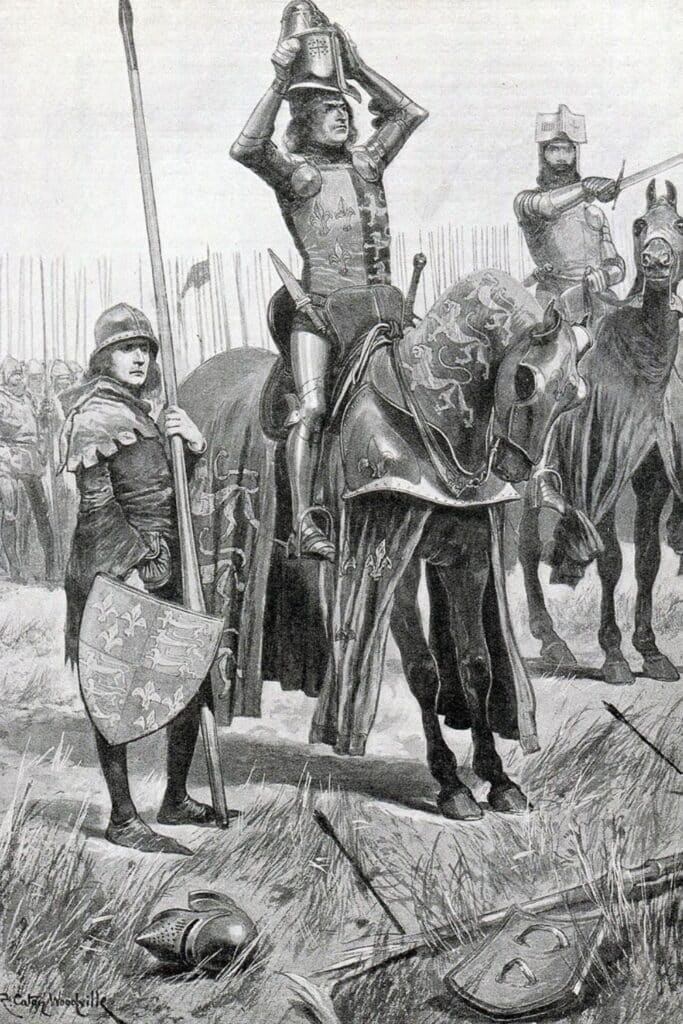
The fighting started with confusion. Late in the morning, the French spotted movement in the English lines. Some banners appeared to pull back, including what may have been the Black Prince’s own. Whether it was a feint or simply troops shifting position, the French took it the wrong way. They thought the English were trying to slip away.
Marshal Audrehem didn’t wait. He ordered a charge. On the other flank, Marshal Clermont followed suit. The French vanguard thundered forward without orders, breaking the carefully planned French formation before the real fighting had even begun.
Cavalry Meets Mud and Arrows
Audrehem’s squadron charged toward the English left but ran straight into marshy ground. Heavy horses floundered in the soft earth, stuck before they could reach the archers. Those longbowmen couldn’t pierce the armored horses or knights at long range, but they had a better idea. They turned their fire on the unarmored French crossbowmen coming up behind.
Then John de Vere saw his chance. The French cavalry’s horses weren’t protected at the rear. He led a group of archers around the marsh and rained arrows into the horses’ hindquarters. The results were devastating. The French charge collapsed. Audrehem was knocked from his horse and taken prisoner. That wing of the French force broke and scattered.
The Choke Point on the Right
On the right, Clermont’s men hit a thick hawthorn hedge. There was only one way through. A narrow gap barely wide enough for four horses. As they tried to push through, English archers and Gascon crossbowmen rose from hidden pits and let loose.
Clermont’s knights did reach the hedge and smashed into the English line, but it was over once they were in close quarters. Arrows poured in from the sides. The knights were pinned. Clermont was killed in the crush, and his men fell back in confusion.
The Vanguard Falls
With both cavalry wings broken, the French vanguard’s infantry pressed forward under Constable Brienne. But they now faced the full fury of English longbows. The crossbowmen tried to hold their own but were outmatched in speed and volume.
Brienne was killed in the chaos, and Sir William Douglas was seriously wounded. The first French division disintegrated. The English held formation. They didn’t chase far. The Black Prince knew more French troops were coming, so he kept his men tight and ready.

The Second Wave Grinds Forward
The Dauphin’s division advanced. Around four thousand men-at-arms pushed through the same narrow lanes and hedges, slowed by their own retreating vanguard.
When they reached the English lines, the fighting turned savage. Both sides dug in. The French pushed hard, at one point breaking through the right flank. But English reserves sealed the breach. Archers shifted to hit the flanks. Leaders like Sir Maurice de Berkeley and the Earl of Suffolk moved along the line, holding the front together.
The French fought hard. The Duke of Bourbon was killed, and the Dauphin’s standard fell. His advisors finally dragged him and his brothers out of the fight. With their banner gone and another commander dead, the division finally broke off and withdrew.
Exhaustion on Both Sides
A lull followed. The field was a mess. Dead and wounded everywhere. English troops were picking through corpses for arrows. French casualties were enormous. English losses were far lighter.
The third French division, led by Duke Philip of Orléans, was supposed to go next. But when Orléans saw the Dauphin retreating, he panicked. Without orders, he fled, taking half his division and the king’s other sons with him.
A few hundred stayed and attacked, but it was half-hearted and easily repelled. They, too, withdrew or were cut down. The French army was falling apart.
King John Makes His Move
But it wasn’t over. King John had pulled back earlier and regrouped. Now he stood with perhaps four thousand men. These were elite fighters, including his royal guard and the knights of the Order of the Star.
John raised the Oriflamme and prepared to lead a final assault. His men were angry and determined. They meant to end it either with victory or death. Morale dipped when the English saw this new force forming under the royal standard. Some thought it was an entirely fresh army. The Black Prince gathered his captains. Waiting might be a mistake. He decided to strike first.
The English Counterattack
While Captal de Buch and his cavalry detachment rode a wide circle through the woods to get behind the French, the Prince ordered a general advance.
Some Englishmen thought the mounted force was deserting and started to panic. The Prince saw it. To steady the lines, he ordered the entire army forward. The English charged out of their positions and met King John’s men head-on.
The shock of the attack rattled the French. Arrows flew again, but the English were nearly out. Once the last were spent, the archers picked up swords and axes and joined the fight.
Now, it was all hand-to-hand. Thousands of armored men locked in a brutal melee. For a while, the French gained ground, and the English center wavered.
Then help arrived.
The Flank and the Rear Collapse
Some of the English from Warwick’s division returned to the field and smashed into the French flank. Then, from the rear, Captal de Buch appeared. His men dismounted and opened fire at close range. Arrows struck from behind. Then his knights charged into the French rear.
It broke the French completely. Panic spread fast. Men began to run, and those who could reach their horses fled.
But King John didn’t. He, his son Philip, and his closest knights formed a final stand near the Miosson River, in a meadow later called Champ d’Alexandre.
The Last Stand of the French King
Surrounded, the king’s guard fought on. Some still hoped to win, while others simply refused to yield. It was a brutal, desperate fight. Many were cut down. The sacred Oriflamme fell, captured by the English.
At last, John’s circle broke. He was found still fighting with his son beside him. His battle axe shattered. He surrendered to a French-speaking English knight named Denis de Morbecque, who called for his safety.
The Battle of Poitiers was over.

Aftermath of a Disaster
King John and his fourteen-year-old son Philip were now prisoners. Alongside them, dozens of France’s most powerful nobles were captured. Thousands more were dead.
Estimates suggest around 2,500 French soldiers were killed and another 2,000 captured. English losses were surprisingly light.
That evening, the battered English army gathered its wounded and took stock. Against impossible odds, they had secured one of the most shocking and complete victories of the Middle Ages.
Aftermath: Triumph and Treaty
The Black Prince invited King John II of France to dine with him the night after the battle. He served the French king himself and refused to sit down at the table, even when John asked him to.
According to the chroniclers, the prince told him he didn’t feel worthy to sit beside someone who had fought so bravely. He tried to offer comfort, reminding John that though the day hadn’t gone his way, he had won great respect.
This wasn’t common. Treating a prisoner this well, even a king, was rare. But it made sense. A captive monarch was worth a fortune in ransom and carried real diplomatic value. Still, even the defeated French noted how well the prince behaved that night. It stuck in people’s minds and shaped his reputation for years.
A Royal March to Bordeaux
In the days that followed, the English marched west with their captives. By October, the Black Prince’s army returned to Bordeaux, weighed down with loot and prisoners.
Months later, Prince Edward sailed to England, bringing King John and other high-ranking nobles with him. In London, John was welcomed with all the ceremony of a royal visit, though he remained a prisoner in every real sense.
He lived in comfort, allowed to move between estates and even go hunting under guard. It may have looked like luxury, but it came with strings attached. Ransom negotiations began almost immediately, and England wasn’t shy about what it wanted.
The Treaty That Nearly Broke France
The first draft of the Treaty of London in 1358 was brutal. Four million gold écus and a vast stretch of French territory were to be handed to England. It was too much. Even with their king held hostage, the French Estates-General refused to agree to it.
Edward III invaded again in 1359, hoping to force France’s hand. He laid siege to Reims, aiming to be crowned king of France there, and even moved toward Paris. But the winter slowed him down. France was in ruins, and both sides were running out of money.
Finally, in May 1360, the Treaty of Brétigny was signed. It was still harsh but more realistic. France agreed to pay a ransom of three million gold écus. One million would be paid upfront, and the rest will be in installments.
To guarantee payment, hostages were handed over. Two of John’s sons and a collection of nobles and city leaders were among them. In return, Edward III dropped his claim to the French crown. But he gained full control over a third of France, including a much larger Aquitaine and the already-held Calais.
Honor and a King’s Return
John was released once the first payment was made. The French even minted a new gold coin, the franc, to mark the moment. But the money didn’t keep flowing. In 1362, John’s son Louis escaped captivity.
John, seeing this as a dishonor, returned to England voluntarily. He said that if honor had disappeared from the world, it should still live in the heart of a king. True to his word, he returned to captivity and died in England in 1364.
His son Charles became King Charles V.

A Fragile Peace and a New Phase
By 1369, the war resumed. Charles accused Edward III of breaking the treaty, and much of the land handed over at Brétigny was taken back in the following years.
However, for England, Poitiers marked the height of its success in the Hundred Years’ War. It had humiliated France, taken its king, and forced a treaty on favorable terms.
The first phase of the war, known as the Edwardian phase, ended in England’s favor. What came next would be harder to hold onto.
France Reels from the Blow
Back in France, the fallout from Poitiers was deep. In 1358, the Jacquerie uprising saw peasants take up arms in revolt. Paris faced its own unrest. The country was exhausted, angry, and leaderless.
Legacy and Historical Impact
The Battle of Poitiers didn’t fade into the background of medieval warfare. It became legendary almost immediately. In England, it joined Crécy and, later, Agincourt as one of the crown jewels of English military history. People told and retold the story of a small force defeating a much larger one, thanks to discipline, tactics, and the deadly rhythm of the longbow.
Poitiers also elevated Edward the Black Prince to almost mythical status. He was the noble knight who graciously served a defeated king dinner and handed out rewards to his men. Chronicles compared him to figures from Arthurian legend.
He wasn’t all gallantry, of course. His later campaign in Limoges showed just how ruthless he could be. But Poitiers sealed his legacy. He died before becoming king, which in some ways left his reputation untouched by age or failure.
A Bitter Lesson for France
For the French, Poitiers was humiliation. Coming on Crécy’s heels made the need for change impossible to ignore. Frontal cavalry charges against well-defended archers no longer worked. After 1356, French commanders grew cautious.
When Charles V came to power, he ditched large battles entirely. Under commanders like Bertrand du Guesclin, the French shifted to harassment, raids, and supply disruption. By 1375, much of the land lost at Brétigny had been clawed back.
Poitiers also forced France to rethink how it raised armies. Moves were made toward training better infantry and slowly building a more stable military structure. The standing army that emerged later had its roots in the aftermath of this defeat. The Order of the Star, whose members vowed not to retreat, was decimated. The order barely survived the battle.
A Financial and Social Blow
The cost of John’s ransom nearly broke the country. Three million gold coins was a staggering amount. To pay it, the French crown turned to the people. Taxes rose, resentment grew, and unrest followed.
The gold franc was created to mark the king’s freedom. But the economic strain and the absence of stable leadership in the years after Poitiers left the country fragile.It remains one of the most dramatic moments in medieval warfare.
Love a good medieval story?
Join our readers and get tales of kings, queens, castles and ordinary medieval lives straight to your inbox.

Kylie Lang is a nationally syndicated travel journalist with bylines on the Associated Press Wire & more, a medieval history writer, and the founder and lead author of Tales of the Middle Ages (talesofthemiddleages.com). She holds a BA (Honours) in History from the University of Kent and is a member of the British Guild of Travel Writers.
Related posts:
 9 Historic Medieval Battles that Reshaped Kingdoms and Destroyed Dynasties
 How Did the Hundred Years’ War Actually Start, and Why Did It Last So Long
 The Battle of Crécy 1346: How a Teenage Prince and a Wall of Arrows Brought France to Its Knees
 The Hundred Years War Battles That Broke France: Mud, Blood, Dysentery, and a King Taken Hostage