
With a mother-in-law like Isabella of France, you have some big shoes to fill, not to mention trying to survive in a cutthroat world of political turmoil. Phillipa’s life as a Queen didn’t begin under the best of circumstances. She was a pawn in a political plot engineered by the She-Wolf herself.
The agreement was that Phillipa, who was only a teenager at the time, would be married to the future King of England. But only if her father helped Isabella overthrow the current king, Edward II, who also happened to be Isabella’s husband. Hardly the most auspicious of starts to a marriage.
Table of Contents
So, how did Phillipa cope? Was her marriage doomed from the start, or did she manage to have a happy medieval marriage? Something that had eluded many queens before her. We’re about to find out as we draw back the curtain on the life of Phillipa of Hainault.

Phillipa’s Early Life
Philippa was born around 1314 in Valenciennes, the capital of Hainaut, a region that now spans the border between Belgium and France. Her father was Count William of Hainaut, who also ruled parts of modern-day Holland, and her mother was Jeanne de Valois, a French princess with serious royal blood.
That connection to the French crown would come back into play later in life, but for now, Philippa was growing up in a court that valued learning, music, and politics. She was well-educated, spoke multiple languages, and from an early age, she showed an interest in literature.
People who met her described her as sweet-natured and thoughtful, with a gentle face. But don’t mistake that for soft. She grew up in a political world, and by her teens, she was already a piece on a chessboard.
In 1326, England’s political turmoil became an opportunity for her family. Queen Isabella of France, furious with her husband Edward II, decided she’d had enough. She crossed the Channel to raise an army and get rid of him. But she needed help. So she cut a deal with Philippa’s father. If he provided the ships and troops to back her up, she’d make sure his daughter married her son, the future king of England.

That was it. No love story, no sweeping gestures. Philippa was twelve and part of a transaction. She wasn’t even mentioned by name in the official paperwork, but was referred to as the daughter of the Count of Hainaut. Not exactly a romantic start. But politics didn’t care about romance.
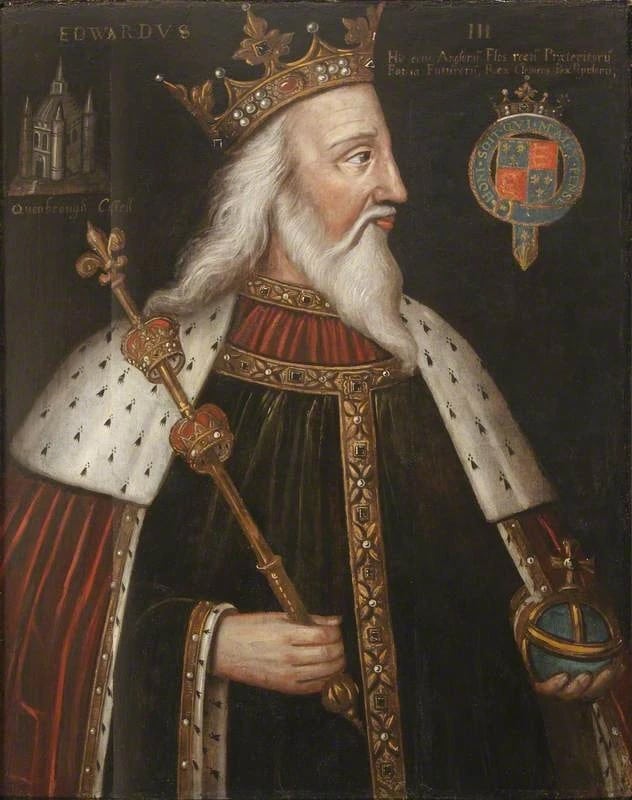
The deal worked. Isabella’s invasion succeeded, Edward II was forced out, and her teenage son became Edward III. A few months later, around Christmas 1327, Philippa arrived in England to meet her future husband. They were both teenagers, strangers really, thrown together by power plays and promises. But against all odds, they got along. Respect grew between them, and maybe even affection.
On January 25, 1328, they were married at York Minster. Philippa was fourteen. Edward was fifteen and already king. The country had just been through years of instability, and their wedding felt like a fresh start. The crowds were hopeful. This young queen, who was swapped for ships and soldiers, was about to embark on one of the most surprising royal partnerships in English history.
Becoming Queen of England
Philippa was queen in name only. She had no real power, no income, and very little freedom to shape her new life. Edward was still a teenager and not really in charge. That job belonged to his mother, Isabella of France, and her right-hand man, Roger Mortimer. They ran the show while Edward played the part of king.
Isabella wasn’t exactly eager to share the spotlight. She delayed Philippa’s coronation, kept her finances locked up, and made sure she stayed firmly on the sidelines. It was a rough start, but she played it smart. She stayed polite, kept her head down, and watched how Isabella moved. What she learned was simple: take too much and the court turns on you. Philippa took notes.
Everything changed in 1330. That summer, at just sixteen, Philippa gave birth to her first child, Edward of Woodstock, the boy who would later be known as the Black Prince. Not long after, her husband finally made his move. Edward had Mortimer arrested and executed, and sent his mother into retirement; the boy king then took control of the throne.
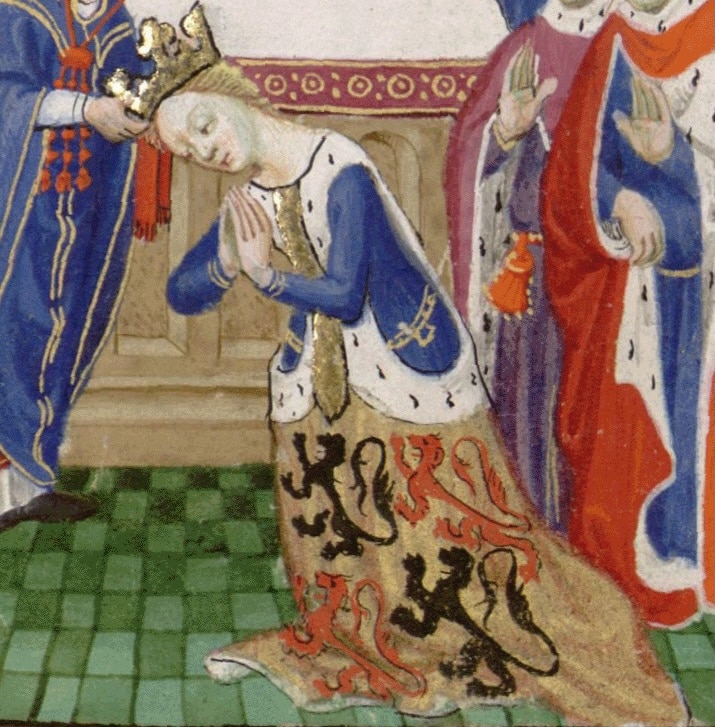
And just like that, Philippa stepped into her real role. She was crowned, given her own household, and finally allowed to act like the queen she was supposed to be. Three years after her wedding, she was no longer a pawn in someone else’s game.
Philippa didn’t waste the opportunity. She didn’t stack the court with her own family or push people out to make room for favorites. She earned respect the slow way, by showing up, staying steady, and treating people with kindness and respect. That made a difference.
Edward trusted her. Over the years, she became one of his most reliable advisers. She spoke up for people in trouble, helped arrange political marriages, and even took charge when Edward was away. He left her in charge of councils. She opened Parliament on his behalf. That kind of trust didn’t come from nowhere.
Philippa knew how to hold power without threatening anyone. She had influence, but never overplayed her hand. It wasn’t showy, but it worked. And in a world where queens were often either ignored or blamed, that was no small thing.
Hooked on the Middle Ages? Get more stories like this one in your inbox.
Queen in the Hundred Years’ War
By 1337, Europe was a chaotic landscape of competing claims, fractured alliances, and kings issuing challenges. It was known as the Hundred Years’ War. Right in the middle of it was Philippa. That year, Edward III claimed the throne of France. The problem? The man already sitting on it was King Philip VI, who also happened to be Philippa’s uncle. So yes, her husband went to war with her mother’s brother. Awkward doesn’t begin to cover it.
Still, Philippa didn’t hesitate. She backed Edward completely. In 1338, she even sent one of her minstrels into Paris as a spy to keep tabs on her uncle’s movements. A musician could slip through cities unnoticed, and the move showed just how far she was willing to go. There was no fence-sitting. Her loyalty was to England.
During those early war years, Philippa was right there alongside Edward. In 1338 and 1339, she followed him to Flanders as he sought to garner support from the Low Countries’ rulers. She gave birth to two sons during that time, Lionel in Antwerp and John (later known as John of Gaunt) in Ghent. She lived in the thick of it, even in war camps.
She also joined Edward in Scotland back in 1333. Her presence didn’t go unnoticed. People respected her grit and the way she handled herself in a world that wasn’t kind to women, let alone queens on the road with an army. She didn’t complain. She kept things running and kept morale high. Feasts, diplomacy, royal presence, it all mattered.
But her biggest moment came in 1346. Edward was off fighting in France, and their son, the Black Prince, was with him. That left England exposed. Sensing an opportunity, King David II of Scotland marched south to invade. Philippa didn’t panic. She went north, gathered the English troops, and prepared to face him head-on. Tradition says she even gave a speech to the army, rallying them before the fight.
On October 17, the Battle of Neville’s Cross took place just outside Durham. The English won, and David II was captured. It was a crushing blow to the Scots and a massive win for Philippa. She had defended the country and handed her husband a captured king. Not bad for someone who technically wasn’t supposed to be running the show.
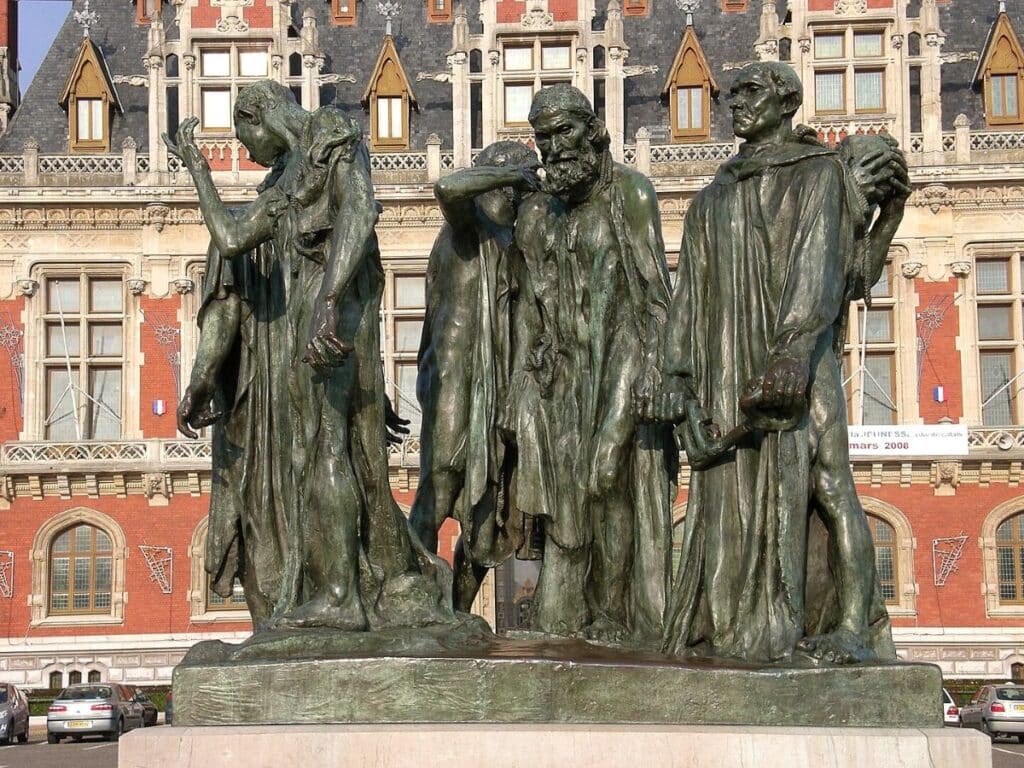
Then came the moment that made her famous across Europe. In 1347, after nearly a year-long siege, Edward’s army took the port city of Calais. He was furious at how long it had held out and ordered the execution of six local leaders as punishment. He wanted them paraded in sackcloth with nooses around their necks, public humiliation followed by death.
No one around him dared argue. Except Philippa.
She pleaded with Edward to show mercy. Chroniclers say she got down on her knees in front of the whole court and begged him to spare the burghers, supposedly while pregnant. Whether or not she was actually pregnant is debated, but what matters is that it worked. Edward backed down. He pardoned the six men.
Some historians believe he may have planned to let them live all along and used the moment to enhance his reputation. Maybe. But either way, it was Philippa’s intervention that became the story. The image of a queen pleading for mercy stuck.
Today, if you go to Calais, you can still see the Rodin sculpture honoring those six men. It doesn’t show Edward or the soldiers. It shows the moment of surrender, heavy with fear. What it doesn’t show, but everyone remembers, is the queen who saved their lives.
A Royal Family and Court Life
Philippa didn’t just focus on war and politics. She poured a lot of her energy into her family, and with twelve children to raise, it’s no wonder. Between 1330 and 1355, she gave birth to five daughters and seven sons. It didn’t just secure the future of the Plantagenet line; it helped shape generations of dynastic chaos later on, especially when her grandkids and great-grandkids started fighting over who should sit on the throne during the Wars of the Roses.
But Philippa wasn’t a distant figure sending her children off to tutors or governesses. She kept the younger ones close and was hands-on in their upbringing, which wasn’t typical for a queen. Her son Edmund stayed in her care until he was thirteen, which raised some eyebrows at court. Even her older daughters didn’t get shipped off too quickly. She kept them home well into their late teens.
She extended that care beyond her kids, too. When her son John of Gaunt married Blanche of Lancaster, Philippa helped guide her through pregnancy and early married life. She created a steady family dynamic, something rare in royal households. And it paid off. Edward never faced rebellion from his sons, unlike Henry II..
Sadly, Philippa outlived seven of her twelve children, not unlike Eleanor of Aquitaine before her, who outlived eight of her ten children.. Some died in infancy. Others, like her daughter Joan, died suddenly from plague while traveling to marry the heir of Castile. Her daughter-in-law, Joan of Kent, married to the Black Prince, also died young.
Life at court under Philippa had its fair share of spectacle. She loved clothes and jewelry and didn’t hold back when it came to spending. One chronicler joked that she and Edward practically invented fashion, and by the sounds of it, they didn’t do anything halfway. At one point, she racked up debts worth what would be millions today, mostly on silks, gems, and fur-lined robes. But pageantry was a political tool. A glittering court sent a message to rival kings and would-be rebels that England was a powerful and prosperous nation.
Even with all the royal spending, Philippa didn’t forget charity. She gave generously, and one of her most enduring contributions was her patronage of the Hospital of St. Katharine’s by the Tower of London, which cared for the poor. She also backed The Queen’s College at Oxford, which was founded in her honor in 1341. She helped fund it and kept it under her protection. Education mattered to her.
She was just as influential in the arts. Having grown up with French poetry and courtly storytelling in Hainaut, she brought that cultural flavor to England. She supported Jean Froissart, one of the most famous chroniclers of medieval Europe. He joined her court around 1361 and later wrote about the life and battles of Edward’s reign. After Philippa died, Froissart wrote a heartfelt tribute to her. It’s partly thanks to her that we have such vivid accounts of the time.
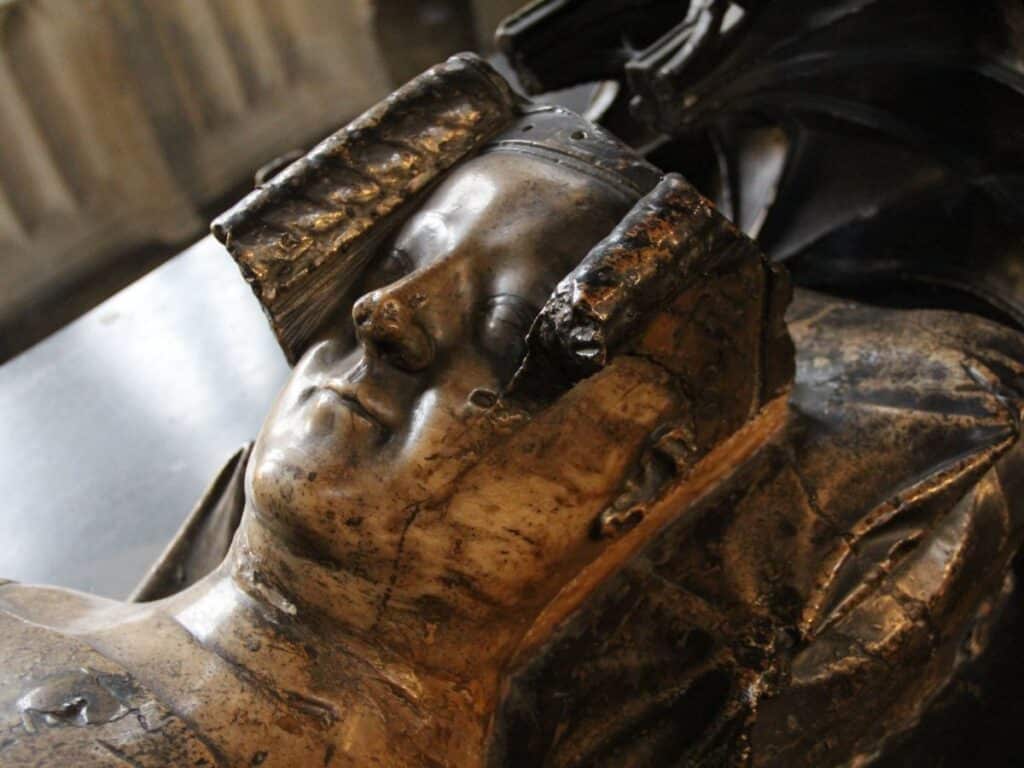
Even her tomb tells a story. She commissioned it before her death and hired Jean de Liège, a sculptor from Brabant, to carve her effigy in alabaster for Westminster Abbey. It’s not the usual queen-as-idealized-beauty image. Instead, it shows Philippa as she really was in later life: round-faced, middle-aged, and kind-looking. It’s one of the first truly realistic royal tombs in England.
Final Years and Death
By the 1350s, after years of travel, childbearing, and war, Philippa’s health began to fade. In 1358, she took a bad fall during a hunt and broke her shoulder. It never healed properly. From that point on, she lived with constant pain. Over the next decade, her body gave out slowly. She spent more time in bed, often too weak to walk. But she didn’t step away from her role.
Even when she was ill, she stayed involved. In 1368, from her sickbed, she tried to arrange a marriage for her widowed son, John of Gaunt. The plan fell through, but the Count of Flanders responded with such respect that it was clear Philippa’s reputation still carried weight across Europe.
By the summer of 1369, it was clear she was dying. She was staying at Windsor Castle when her condition worsened. Plague was moving through the country again, but it wasn’t the plague that took her. It was simply the end of a long, relentless life. Her youngest son, Thomas of Woodstock, was just 14 and stayed by her side. So did Edward. After 41 years of marriage, he wasn’t ready to say goodbye.
Philippa died on August 15, 1369. She was likely 55. News of her death sent waves through the royal court and across the country. She had been England’s queen for four decades, and people genuinely mourned her.
Her funeral didn’t happen right away. It took months to prepare. When it finally took place in January 1370, the ceremonies lasted six days. Edward made sure no expense was spared. He spent around £3,000 on her tomb, a staggering amount at the time. She was buried in Westminster Abbey, close to the shrine of Edward the Confessor, and it’s still there.
Around the tomb, there were once dozens of tiny bronze statues representing their children and family shields. Most are gone now, lost to time or damage, but the monument is still one of the Abbey’s most important.
Edward lived on for another eight years. He took a mistress in those final years, Alice Perrers, a name that still raises eyebrows among medieval historians; however, some say it was loneliness that drove him to her. When he died in 1377, he was buried in the same Abbey, not far from Philippa.
Love a good medieval story?
Join our readers and get tales of kings, queens, castles and ordinary medieval lives straight to your inbox.

Kylie Lang is a nationally syndicated travel journalist with bylines on the Associated Press Wire & more, a medieval history writer, and the founder and lead author of Tales of the Middle Ages (talesofthemiddleages.com). She holds a BA (Honours) in History from the University of Kent and is a member of the British Guild of Travel Writers.
Related posts:
 Isabella of France: History Called Her a She-Wolf The Truth Is Far More Interesting
Isabella of France: The She-Wolf Who Would Not Be Tamed & Dared to Take a Throne
Isabella of France: History Called Her a She-Wolf The Truth Is Far More Interesting
Isabella of France: History Called Her a She-Wolf The Truth Is Far More Interesting
Isabella of France: The She-Wolf Who Would Not Be Tamed & Dared to Take a Throne
 The Rise, Fall, and Fightback of Elizabeth Woodville