
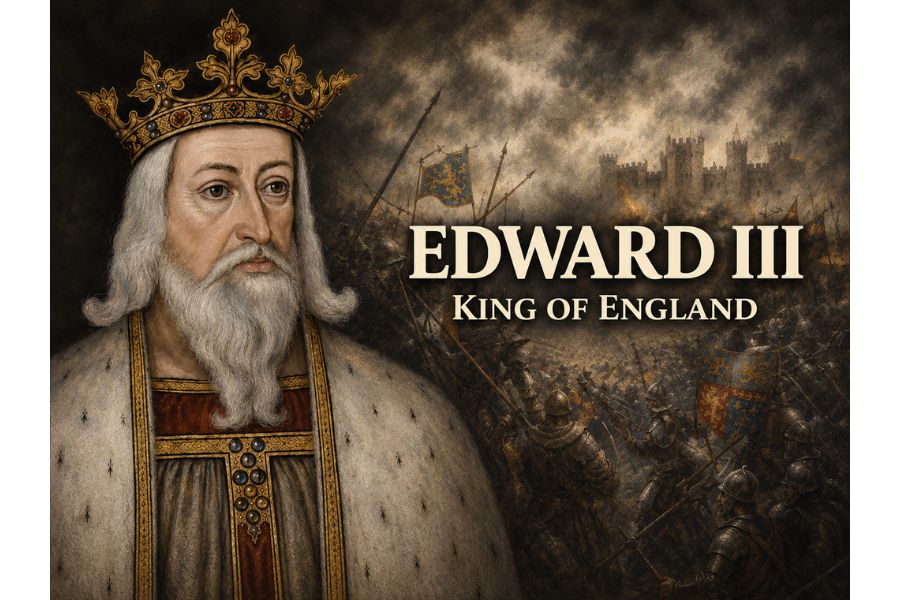
On the night of 19 October 1330, a group of young men crept through a secret passage into Nottingham Castle. They were after Roger Mortimer, the man who’d ruled England in everything but name for almost four years. Their leader was a seventeen-year-old king who’d had enough of being a puppet. His name was Edward III.
In another chamber of that same castle, Edward’s mother was screaming. Isabella of France, the woman who’d invaded England with Mortimer, deposed her husband, and installed her teenage son on the throne, knew exactly what the noise meant. The story goes that she cried out, “Fair son, have pity on gentle Mortimer.” He didn’t. Mortimer was dragged off to London and hanged at Tyburn a month later, his body left swinging for two days.
Table of Contents
Isabella was a different problem. Edward couldn’t hang his own mother, and he didn’t try. What he did with her, and what he made of the throne she’d handed him, says a great deal about the king he became. He owed her the crown, but he also spent the next 47 years proving he was nothing like her.
The Inheritance Isabella Built
When Isabella sailed for France in 1325, she was the consort of a king most of England had given up on. Edward II had lost Scotland at Bannockburn, alienated his barons, executed his cousin Thomas of Lancaster, and made the Despensers the most hated family in the country.
Isabella had been humiliated, stripped of her lands, separated from her children, and treated as an enemy alien in her own household. She crossed the Channel on diplomatic business and refused to come back.
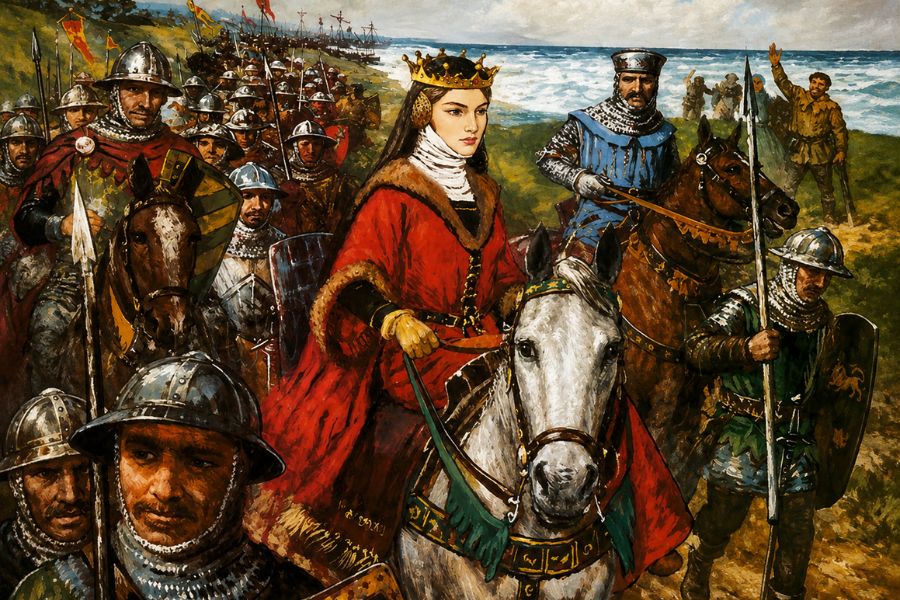
What she did next was something no English queen had ever done. She took a lover in Roger Mortimer, an escaped traitor living in exile in Paris, raised an army with the help of the Count of Hainault, and invaded England in September 1326.
Her price for Hainault’s help was a marriage contract: her thirteen-year-old son Edward would marry Philippa, the Count’s daughter. The deal that would shape English history for the next half-century was made before Edward had any say in it.
The invasion collapsed Edward II’s regime in weeks. The Despensers were butchered, Hugh the Younger castrated and hanged from a fifty-foot gallows in Hereford while the crowd watched. Parliament was forced to depose the king in January 1327, the first time an anointed English monarch had been removed from the throne.
Edward III was crowned at Westminster on 1 February, two months past his fourteenth birthday. His mother and Mortimer ruled in his name.
Growing Up in a Captive Court
For the first three and a half years of his reign, Edward III was a king on parchment only. Mortimer and Isabella controlled the regency council, the treasury, and the boy himself. They paid themselves so much from the royal coffers that contemporary chroniclers were openly horrified.
Mortimer took the title Earl of March in 1328 and began to behave like a sovereign, walking ahead of the king in processions, sitting beside him at feasts, and building a vast personal landholding in the Welsh Marches.
The humiliations were piling up. In September 1327, Edward II died at Berkeley Castle under circumstances that nobody quite believed. The official story was natural causes, but within months, rumors of murder were everywhere, and the regime around the young king was the obvious culprit.
Whether or not Edward III ever knew exactly what happened to his father, he grew up in the shadow of that suspicion. His mother had probably been complicit in killing his father.
Then came the Treaty of Northampton in 1328, which recognized Robert the Bruce as King of Scots and renounced English overlordship. Edward’s sister Joan, only seven years old, was packed off to marry the Bruce’s son David as part of the deal.
The English called it the “shameful peace.” Edward, by all accounts, agreed. He was being trained to rule a country that his own mother was busy giving away. I’ve always thought this is the part most TV adaptations miss. Edward wasn’t a passive boy waiting for his cue; oh no, he was watching, counting, and remembering.

Hooked on the Middle Ages? Get more stories like this one in your inbox.
The Coup at Nottingham
By the autumn of 1330, the situation had become impossible. Mortimer had executed Edward’s uncle, the Earl of Kent, on a charge of treason that was almost certainly a setup. Kent had been tricked into believing Edward II was still alive and plotting his rescue.
His execution in March 1330 sent a message to every adult member of the royal family: Mortimer would kill anyone who threatened his position, royal blood or not. Edward III, now seventeen and married to Philippa with a son on the way, had to be next on the list.
The coup was planned in absolute secrecy. Edward gathered a small group of trusted men, including William Montagu, who would become one of the great figures of his reign.
The castellan of Nottingham Castle, William Eland, knew of an underground passage that led from outside the walls directly into the keep. On the night of 19 October, Montagu and about two dozen others climbed up through the tunnel while Edward waited at the top, having slipped out of his own apartments earlier.
They burst into the chamber where Mortimer was meeting with his council. Two of Mortimer’s knights were killed in the brief fight. Mortimer himself was seized and dragged out.
Edward had Mortimer taken to London under heavy guard, and a parliament was called at Westminster in November, and Mortimer was charged with fourteen offenses, including the murder of Edward II and the judicial killing of the Earl of Kent.
He was not allowed to speak in his own defense, and on 29 November 1330, he was drawn to Tyburn on an ox-hide and hanged, the first man to be executed at what would become England’s most infamous gallows site. His body was left up for two days as a warning. Edward III, three months short of his eighteenth birthday, was finally king in more than name.

The Mother He Refused to Punish
Here’s where Edward III did something interesting. He could have put his mother on trial, stripped her of everything, paraded her through London, shut her up in a nunnery, or worse. Plenty of medieval rulers would have done exactly that. The chronicles offer no record of Edward ever publicly blaming Isabella for anything, not Mortimer’s tyranny, not the Treaty of Northampton, not even his father’s death.
Instead, he had her quietly removed from court. She was sent to Castle Rising in Norfolk, a substantial fortress where she lived in considerable comfort for the rest of her life. She kept her household, her hunting privileges, her books, and an income that grew rather than shrank as the years went on.
By the late 1330s, Edward was visiting her regularly, sometimes bringing his children. Her granddaughter, also named Isabella, became one of her closest companions. The dowager queen attended court occasionally and was treated with full royal honors when she did.
The political wisdom of this was clear. Putting Isabella on trial would have meant airing every detail of the regime’s crimes, including the murder of Edward II. It would have raised awkward questions about the legitimacy of Edward III’s own accession. His title to the throne ran through his mother, so to condemn her was to weaken himself.
There was probably also something more personal in it. Isabella had been the parent who acted, who protected him, who made him king when his father had been driving the country off a cliff. She’d also done terrible things, and Edward seems to have decided, very early on, that the way to handle her was silence.
She died at Hertford Castle in August 1358, almost 28 years after the coup at Nottingham. Edward gave her a magnificent funeral and had her buried at the Greyfriars church in Newgate, in the cloak she had worn at her wedding to his father half a century earlier.
Building a King Out of the Wreckage
What Edward III did with the throne over the next four decades is the reason he sits near the top of every serious ranking of English kings. He launched what became known as the Hundred Years’ War in 1337, claiming the French throne through his mother.
He won the Battle of Crecy in 1346 with a smaller army, using longbows in a way that rewrote European warfare. His son, the Black Prince, captured the King of France at Poitiers in 1356. The Treaty of Brétigny in 1360 gave England a third of France and a king’s ransom for John II, amounting to three million gold crowns.
At home, Edward rebuilt the relationship between the crown and the nobility that his father and grandfather had wrecked. He founded the Order of the Garter in 1348, gave his magnates a real share in government, and presided over parliaments that began to resemble the institution we recognize today.
He didn’t execute his own aristocracy; instead, he made them rich, gave them victories abroad, and tied them to his court through tournaments, ceremony, and shared military glory. The Black Death killed perhaps a third of England’s population in 1348-49, and his reign survived even that.
Much of what Edward built was a deliberate reversal of what he’d grown up with. His father had been a king who couldn’t control his nobles. Edward made himself the first among them, the leader of a military caste rather than a target of it. His mother had handed away English claims to Scotland and France, and Edward spent his entire adult life clawing them back, with mixed results in Scotland and spectacular early success in France.
The French claim itself, the one that justified the war that defined his reign, came directly from Isabella. She was the daughter of Philip IV of France, and when her three brothers died without male heirs between 1316 and 1328, the French throne passed to a cousin under Salic law.
Edward’s lawyers argued that the crown could pass through the female line. The war he fought for the next 23 years was, in a real sense, his mother’s inheritance pressed by her son.
What Edward Owed and What He Refused
It’s tempting to draw a neat line and say Edward III became great by rejecting Isabella. That’s too simple. He owed her almost everything: the crown, the marriage to Philippa that produced thirteen children and a stable royal house, the French claim that drove his foreign policy, and the practical lesson in how a determined ruler could break a king who’d lost his nobility.
She showed him, by negative example, what kind of court not to run. She also showed him, by her actions in 1326, that politics in 14th-century Europe ran on personal will and the willingness to act.
What he refused was her method. Edward never had a favorite who eclipsed him the way Mortimer had eclipsed her. He kept his queen close, his children closer, and his nobles inside a structure of honor and reward that made rebellion seem unthinkable for most of his reign.
He didn’t murder rivals in the dark. When he killed, he did so through parliament and the courts, as English kings were supposed to. The contrast with the regime that raised him was constant and deliberate.
The last years of his reign were sad ones. Philippa died in 1369, and the Black Prince predeceased him in 1376, leaving the succession to a nine-year-old grandson, the future Richard II.
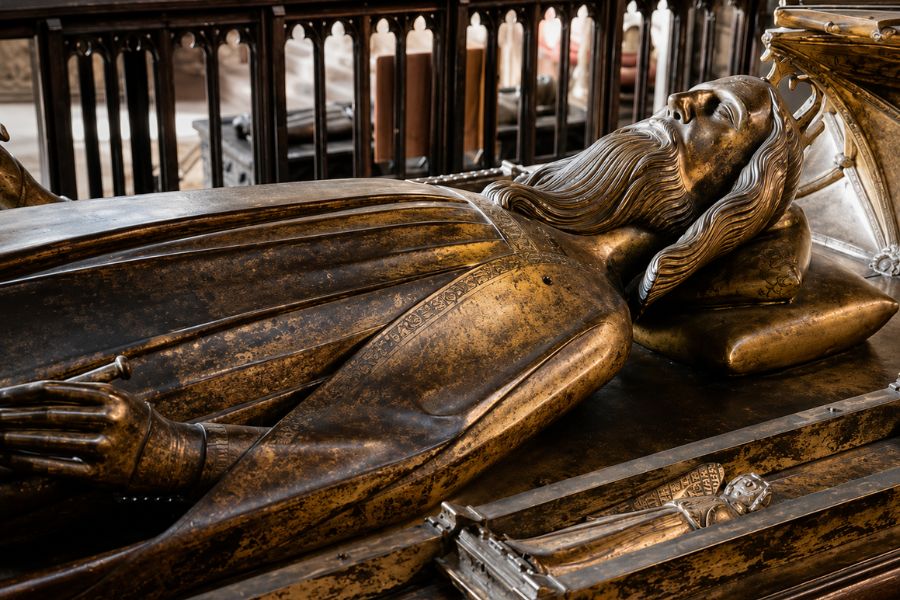
Edward fell under the influence of a mistress, Alice Perrers, who stripped rings from his fingers as he lay dying at Sheen in June 1377. The court he’d built so carefully began to fray at the edges. He was buried at Westminster Abbey beside Philippa, his tomb effigy showing a serene old king with a forked beard, nothing of the seventeen-year-old who’d climbed up out of a tunnel at Nottingham to take back his own throne.
His mother had been dead for nineteen years by then. He had outlived her, outlasted her enemies, and built something on the foundation she had laid. He had also never, in all the documents that survive, written down what he actually thought of her.
Love a good medieval story?
Join our readers and get tales of kings, queens, castles and ordinary medieval lives straight to your inbox.

Kylie Lang is a nationally syndicated travel journalist with bylines on the Associated Press Wire & more, a medieval history writer, and the founder and lead author of Tales of the Middle Ages (talesofthemiddleages.com). She holds a BA (Honours) in History from the University of Kent and is a member of the British Guild of Travel Writers.
Related posts:
 September 4, 925: The Day England’s First King, Æthelstan, Was Crowned, But Was He?
 Sweyn Forkbeard: The First Viking King of England
 The Battle of Poitiers: The Black Prince’s Boldest Victory and the Capture Of a French King
 The Rise and Fall of George Villiers, the King’s Favorite: From the Bedchamber to the Assassin’s Blade