Imagine being asked to hand over a quarter of everything you own because a king you’ve never laid eyes on got himself captured on the way home from a war he chose to fight. No appeal, no payment plan, no asking nicely. The tax collectors arrive, they take what they take, and if you can’t pay in coin, they’ll take it in silver plate, wool, or the candlesticks off your church altar.

That was England in 1193 and 1194. Richard I, the Lionheart, was sitting in a German castle waiting for his own subjects to buy him back, and the bill that landed at home was the largest sum of money ever demanded from the English kingdom up to that point. 150,000 marks. Roughly two or three times the entire annual royal revenue.
Table of Contents
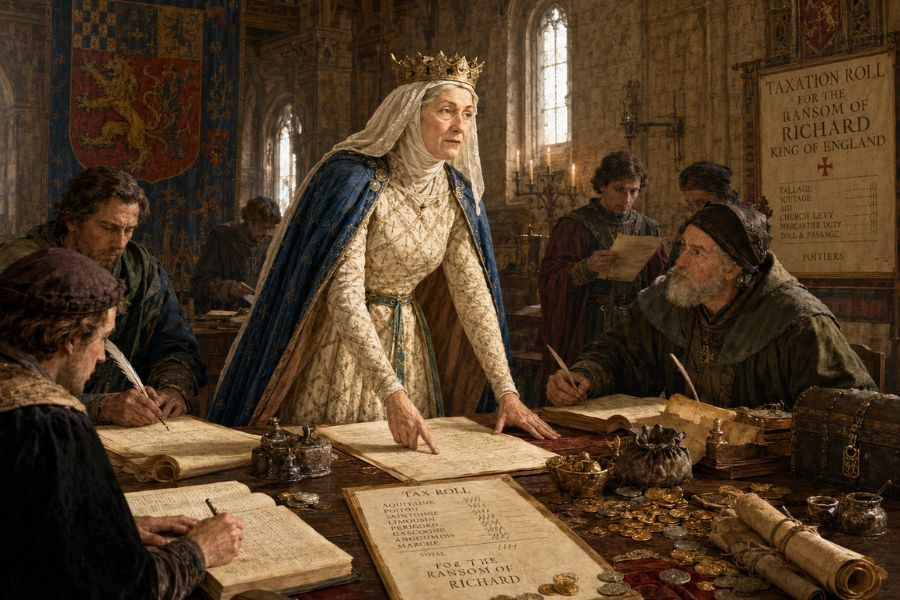
Eleanor of Aquitaine, his mother, who was 67 at the time, stage-managed the entire thing to ensure the country didn’t collapse. It was no picnic, and the political wrangling with Emperor Henry VI would have defeated a lesser woman.
How Richard Ended Up in a German Cell
Richard had spent two years on the Third Crusade, and by late 1192, he was finally heading home. The trip went badly almost from the start. Storms scattered his fleet in the Adriatic, and Richard ended up trying to cross Europe overland in disguise, dressed as a pilgrim or a merchant, depending on which chronicler you believe.
The trouble was that he’d made enemies of pretty much everyone whose territory lay between him and the Channel.
Leopold V, Duke of Austria, was top of that list. At the siege of Acre in 1191, Richard had reportedly torn down Leopold’s banner from the city walls, a public insult Leopold had no intention of forgetting.
When Richard’s small party was spotted near Vienna in December 1192, Leopold had him arrested and locked up in Dürnstein Castle on the Danube. Within months, Leopold had handed his prisoner over to a bigger fish: Henry VI, Holy Roman Emperor, who saw at once what a king was worth on the open market.
The initial demand was 100,000 marks of silver. It crept up to 150,000 by the time negotiations were done, with 200 hostages thrown in as security for the balance. To put that figure in some kind of perspective, a skilled craftsman might earn two or three pence a day. A mark was worth 13 shillings and 4 pence.
This was a sum no medieval English king had ever had to raise, and the people who would raise it had no say in the matter at all.

The Woman Who Ran England While the King Sat in Chains
With Richard absent and his brother John already busy trying to seize the throne for himself, the job of actually getting the ransom together fell largely on Eleanor of Aquitaine. She was around 67 at this point, which in the 12th century was ancient, and she had spent 16 years of her life imprisoned by her own husband, Henry II.
None of that seems to have slowed her down. From the moment she heard her favorite son was a prisoner, she ran the operation, writing furious letters to the Pope, summoning councils, and putting her name on the tax orders that would strip the country bare.
Working alongside her were Hubert Walter, the new Archbishop of Canterbury and the most competent administrator England had seen in a generation, and a small group of justiciars who handled the practical mechanics. Between them, they invented, on the fly, a system of national taxation more thorough than anything previously attempted in England. It would set precedents for centuries.
They also had to fight a parallel war against John, who had allied himself with Philip II of France and was openly hoping his brother would rot in a German cell forever. Philip and John, between them, offered Henry VI an enormous bribe to keep Richard locked up, a sum supposedly matching the ransom itself.
Eleanor’s response was to move faster, raise harder, and pay the emperor before her younger son could outbid him. The story of the ransom is really the story of an old woman racing a treacherous prince to the finish line.
What 25 Percent Looked Like in Reality
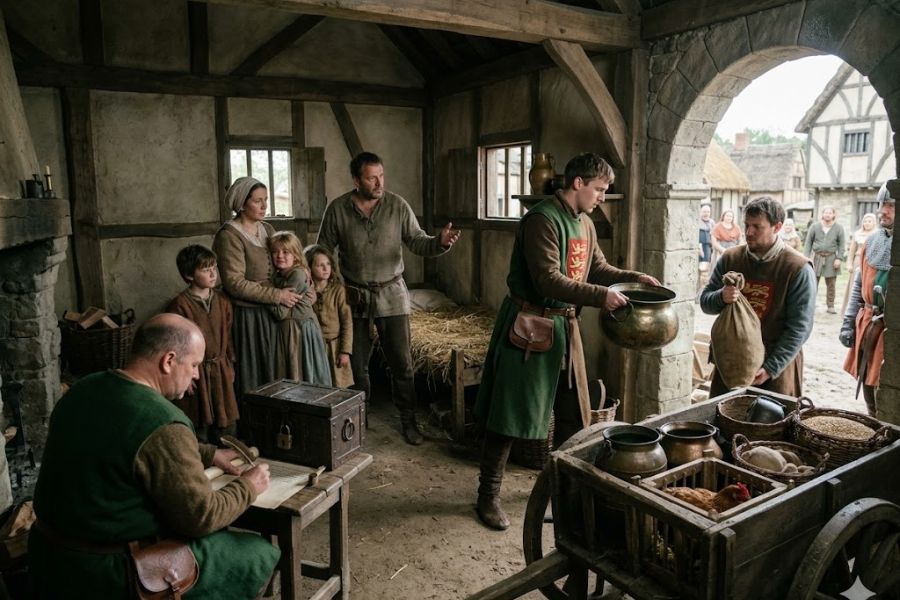
The new taxation system was essentially a 25 percent tax on income and movable goods. Not 25 percent of profit, but 25 percent of everything you owned that wasn’t nailed down. Grain in the barn, sheep in the pen, the brass pot on the hearth, the silver brooch your mother left you.
Assessors came round, valued what they saw, and took a quarter of the total in coin or in kind. Alongside the income tax came a separate levy on knights’ fees, a scutage of 20 shillings on each fee, which hit the landed classes especially hard.
Towns were assessed for lump sums, which they then had to divide among their inhabitants, in whatever way they could manage. The Cistercian and Gilbertine monasteries, exempt from most ordinary taxes, were ordered to hand over their entire wool clip for the year. For abbeys whose whole economy ran on wool exports to Flanders, this was catastrophic. Some had to borrow heavily from Jewish moneylenders or Italian merchants just to keep the lights on.
Churches were stripped of plate. Gold and silver chalices, crosses, candlesticks, reliquaries, anything that could be melted down went into the pot. Chroniclers at the time, mostly monks themselves, wrote about it with real bitterness. Ralph of Diceto, dean of St Paul’s, kept careful note of the church treasures that were carted off.
William of Newburgh recorded the sense among ordinary clergy that the kingdom was being skinned alive for a king they’d barely seen since his coronation. Richard had been in England for about four months out of the four years of his reign by the time he was captured. The people paying for his freedom had every reason to feel they were funding a stranger.
The Practical Machinery of Squeezing a Country Dry
Getting a quarter of England’s movable wealth into Eleanor’s hands required machinery that didn’t yet exist, so they built it. In every county, a panel of assessors was appointed, usually four knights and a clerk, who went from village to village making sworn inquests into what people owned.
The figures were sealed in chests, kept under lock by chosen officials, and only opened in front of witnesses. Two sets of keys, two sets of records. The level of bureaucratic caution gives you some idea of how much temptation was floating about.
The silver that came in was sent to St Paul’s in London, where it was weighed, recorded, and packed for shipment. Hubert Walter oversaw the process personally. Coin had to be assayed for purity, because the emperor wasn’t going to accept clipped pennies or debased foreign silver. Plate had to be melted down and recast as ingots.
The whole operation ran for months, with armed escorts moving silver along the roads to London under the eyes of officials who knew that any shortfall would mean their own ruin.
Even so, they couldn’t get the full sum together by the deadline. About 100,000 marks made it to Germany in early 1194, enough to satisfy the emperor that the rest would follow, along with those 200 hostages held as collateral.
Some of those hostages, sons of nobles and burgesses of London among them, stayed in German custody for months and in some cases years after Richard’s release. Their families had to keep paying for their upkeep abroad on top of everything else.

What It Cost Beyond the Coin
Richard was freed in February 1194 and back in England by March, where he was hurriedly re-crowned at Winchester to remind everyone he was still the king. He stayed for about two months, then sailed to Normandy to fight Philip II, and never set foot in England again.
The country that had bankrupted itself to retrieve him saw him for a grand total of around six months across his entire ten-year reign.
The financial aftermath rippled out for years. The exchequer rolls from the late 1190s show a kingdom still scraping for cash, with Richard demanding fresh levies to fund his French wars almost as soon as the ransom was settled.
Hubert Walter spent the rest of the decade inventing new ways to raise money, including the carucage, a tax on ploughlands that became a model for later medieval taxation.
The administrative habits formed during the ransom years, the sworn inquests, the sealed chests, and the central audit at Westminster fed directly into the systems that would eventually produce things like the great inquisitions of John’s reign and, further down the line, parliamentary taxation.
A generation of English peasants and townspeople had been taxed harder than their grandparents could have imagined, to ransom a king who treated England as a piggy bank for his wars in France.
When John inherited the throne in 1199 and tried to keep squeezing on the same scale to fund his own disastrous campaigns, he found a country with no more give in it.
The barons who eventually forced him to seal Magna Carta in 1215 came from families who had lived through the ransom years and remembered exactly what unchecked royal demands looked like when they arrived at the kitchen door with an assessor and an empty sack.


Kylie Lang is a nationally syndicated travel journalist with bylines on the Associated Press Wire & more, a medieval history writer, and the founder and lead author of Tales of the Middle Ages (talesofthemiddleages.com). She holds a BA (Honours) in History from the University of Kent and is a member of the British Guild of Travel Writers.