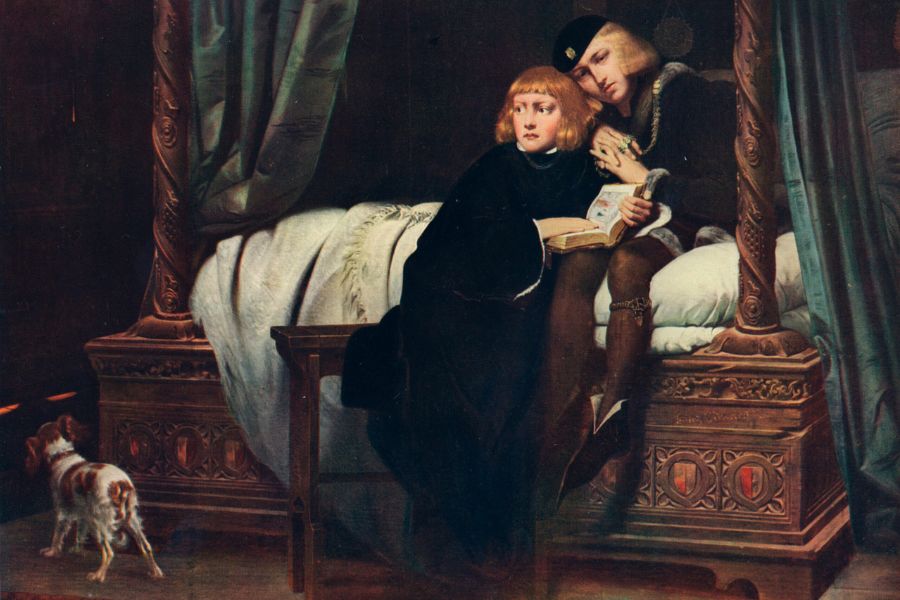
In the summer of 1674, workmen digging near the White Tower made a discovery that shook the nation. Hidden beneath a staircase lay two small skeletons, their bones tangled together, thought to be the Princes in the Tower.
Word spread quickly, and whispers turned to certainty: these were the long-lost princes, Edward V and his younger brother Richard, whose disappearance in 1483 had haunted England for generations.
Table of Contents
The mystery of the princes had hung over the Tudor and Stuart courts like a ghost story told in hushed tones. Two young heirs to the throne had vanished behind the walls of the Tower of London, and no one had ever seen them again. Now, nearly two centuries later, their supposed remains had come to light in the very place where they were last seen alive.
How the Bodies of the Princes in the Tower Were Discovered
The reign of Charles II was a dramatic chapter in the Tower of London’s story. It was under his rule that the last coronation procession set out from the Tower to Westminster, and the public was finally allowed a glimpse of the Crown Jewels. It was also the era of the infamous Colonel Blood, who almost pulled off a daring theft of those jewels in 1671.
Yet none of these events captured imaginations quite like what happened a few years later, when workers clearing part of the old royal palace stumbled upon two small skeletons that many believed were the lost princes.
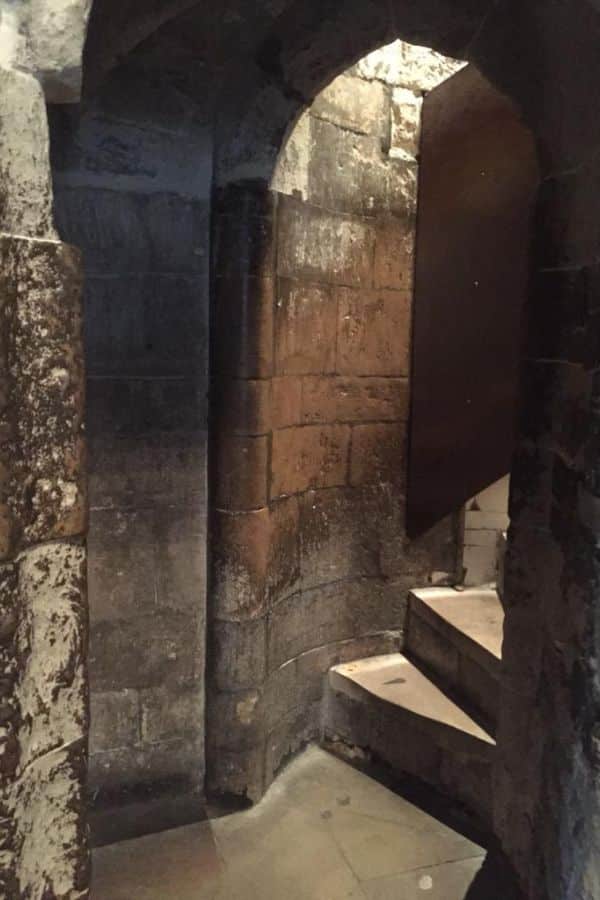
The discovery came during major building works near the White Tower. After the Great Fire of 1666, authorities were determined to make the fortress safer for storing gunpowder, and many of the ramshackle medieval and Tudor structures were being torn down. It was during this demolition, beneath a staircase once leading from the royal lodgings to a chapel, that the bones were uncovered.

John Knight, the king’s surgeon, later reported that they were found about ten feet below ground. Most historians today agree the site was likely just south of the White Tower, close to the Chapel of St John.
Lord De Ros, writing in 1866, recorded that Charles II ordered a mulberry tree to be planted where the skeletons were found. The gesture was short-lived, as the tree soon died after a new staircase was built nearby, but it shows how seriously the king took the find.
The details of the bones lying near a staircase added weight to one of the most infamous accusations in English history. In his account of Richard III, written decades earlier, Sir Thomas More claimed the princes had been murdered by their uncle and buried “at the stair foot” beneath a pile of stones.
More had no first-hand knowledge, and his account likely reflected Tudor-era politics rather than fact, but his words seemed eerily close to what the workmen uncovered.
John Knight later wrote that there was little doubt about who the remains belonged to once they were uncovered. The skeletons were described as those of “two striplings” found in what appeared to be a wooden chest, and their size seemed to match the ages of the lost princes, about thirteen and eleven.
The scene, though, was far from a respectful discovery. The bones had been badly disturbed, with one of the skulls broken, most likely by the tools of the laborers digging through the ground. At first, the find was treated with little care. The remains were thrown aside along with the rubble as the work continued.
Only after someone made the connection to Edward and Richard did the gravity of the discovery sink in. Realizing what they might have uncovered, workers scrambled to search through the debris and recover every fragment they could.
Hooked on the Middle Ages? Get more stories like this one in your inbox.
A Royal Burial
Once the discovery was reported, Sir Thomas Chichley wasted no time in bringing the news to King Charles II. According to John Knight, the king accepted that the remains were most likely those of the princes and ordered that they be given a proper royal burial. The bones were to be placed in a marble urn and laid to rest among England’s royal dead in the Chapel of King Henry VII at Westminster Abbey.
Plans for the reburial moved ahead quickly and with great ceremony. On 18 February 1675, Sir Christopher Wren, already renowned for his work on St Paul’s Cathedral and the redesign of Hampton Court, received a royal warrant to design the urn. The task of creating it fell to Joshua Marshall, the king’s Master Mason, whose work included the Monument to the Great Fire of London and the statue of Charles I at Charing Cross.
The urn was installed in 1678, nearly two centuries after the boys vanished behind the Tower walls. Its Latin inscription tells the story as it was believed at the time.
“ Here lie the relics of Edward V, King of England, and Richard, Duke of York… whose bones, long enquired after and wished for, after 191 years in the rubbish of the stairs (those lately leading to the Chapel of the White Tower) were on the 17th day of July 1674, by undoubted proofs discovered, being buried deep in that place.”

Past Discoveries
The 1674 discovery was not the first time bones linked to the lost princes had surfaced within the Tower’s walls. In 1623, workers reportedly found the remains of a child in a “high desolate turret,” believed by some to be one of the boys. And earlier still, two skeletons were said to have been uncovered in a bricked-up chamber near the royal lodgings.
Neither of these earlier finds caused much stir at court. There’s no record of royal involvement, and it seems the discoveries were dismissed without investigation. That silence speaks volumes. If the monarchy had believed they were genuine, they almost certainly would have intervened.
So why did Charles II treat the 1674 discovery so differently? Perhaps because the timing was right. England was nearly two centuries removed from the bloody dynastic battles that caused the princes’ disappearance, and a king whose own claim to the throne had once been contested may have seen value in bringing closure to one of the monarchy’s darkest stories.

What Lay Behind the King’s Decision
The reasons behind Charles II’s decision to embrace the discovery as that of the lost princes are impossible to pin down with certainty. It may have been a calculated display of loyalty to his royal lineage, a public gesture meant to reinforce his legitimacy after years of civil war and upheaval.
It also seems likely that the story of the murdered princes struck a deeply personal chord. Edward V’s fate as a deposed king must have felt uncomfortably familiar to a man whose own father had been overthrown and executed within living memory.
By giving the supposed remains of Edward and Richard a royal burial in Westminster Abbey, Charles was rewriting a narrative that had long haunted the monarchy. The reburial became a symbol of wrongs put right, just as the newly remade Crown Jewels and the revived coronation procession from the Tower were statements of a restored order.
In placing the bones among England’s kings, Charles presented himself as a ruler who not only reclaimed the throne but also mended the wounds left by centuries of dynastic bloodshed.
We will never know exactly who those skeletons were, so the mystery continues, and we remain as fascinated with the Princes in the Tower as we always were.
Love a good medieval story?
Join our readers and get tales of kings, queens, castles and ordinary medieval lives straight to your inbox.

Kylie Lang is a nationally syndicated travel journalist with bylines on the Associated Press Wire & more, a medieval history writer, and the founder and lead author of Tales of the Middle Ages (talesofthemiddleages.com). She holds a BA (Honours) in History from the University of Kent and is a member of the British Guild of Travel Writers.