It might be called the Hundred Years’ War, but did you know it actually lasted for 116 years, not 100? And I’m pretty sure there wasn’t a battle for every day of those 116 years.
What we do know is that it started on 24 May 1337, when Philip VI of France confiscated the English-held duchy of Guyenne, and Edward III of England responded by claiming the French crown through his mother, Isabella of France.
Table of Contents
It lasted so long because it wasn’t one war at all but a string of separate ones, broken up by truces and treaties that never settled the underlying question of who ruled what.
But as with most things in history, there’s so much more to it than that. It was a mess of feudal loyalty, wool money, longbows, and a French princess nobody wanted on the throne.
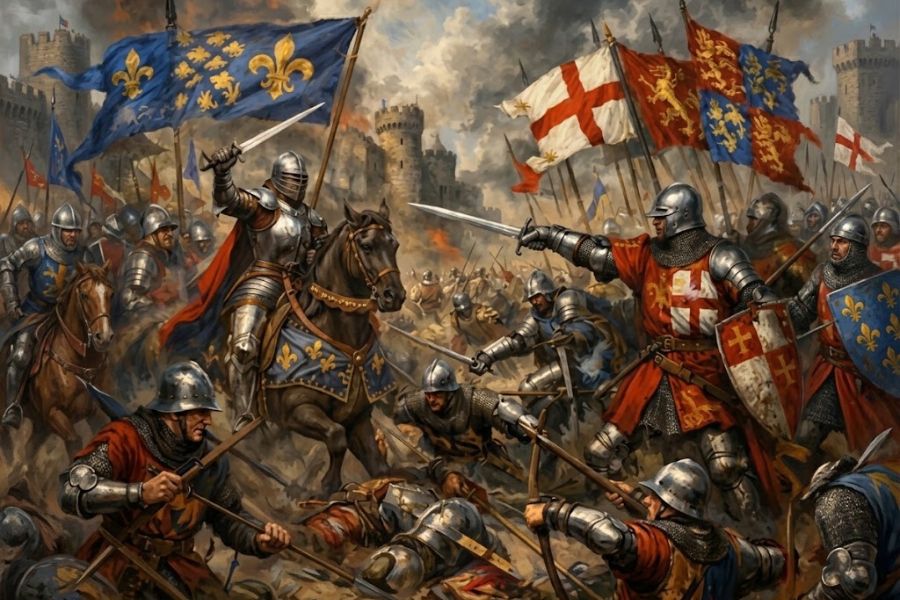
How Did the Hundred Years’ War Actually Start?
On 24 May 1337, Philip VI of France sat down and formally confiscated the duchy of Guyenne, the last substantial chunk of English-held territory in France, on the grounds that his vassal Edward III had sheltered a French fugitive and generally behaved like a rebel.
Edward, who’d spent years dodging the humiliation of paying homage to the French king for lands he considered his by inheritance, treated the confiscation as the last straw and, later that year, denounced Philip as a usurper and pressed his own claim to the French crown.
The real trigger came from a much older problem. Ever since William the Conqueror crossed the Channel in 1066, the kings of England had held enormous tracts of French land, first Normandy, then through Eleanor of Aquitaine the vast southwestern duchy that became Guyenne.
Holding it meant kneeling as a vassal to the French king, which the English kings hated and the French kings exploited. Every generation produced a fresh quarrel over homage, jurisdiction, appeals to the Paris courts, and the loyalty of Gascon lords who liked English wine markets and disliked French tax collectors.
Jonathan Sumption, in the first volume of his history of the war, Trial by Battle, sets the confiscation of Guyenne against decades of that slow-burn friction. The Gascon lands made a duke into a rebel by definition, because you could not be both a sovereign king in England and a submissive vassal in Bordeaux for very long without something snapping. In 1337 it snapped.
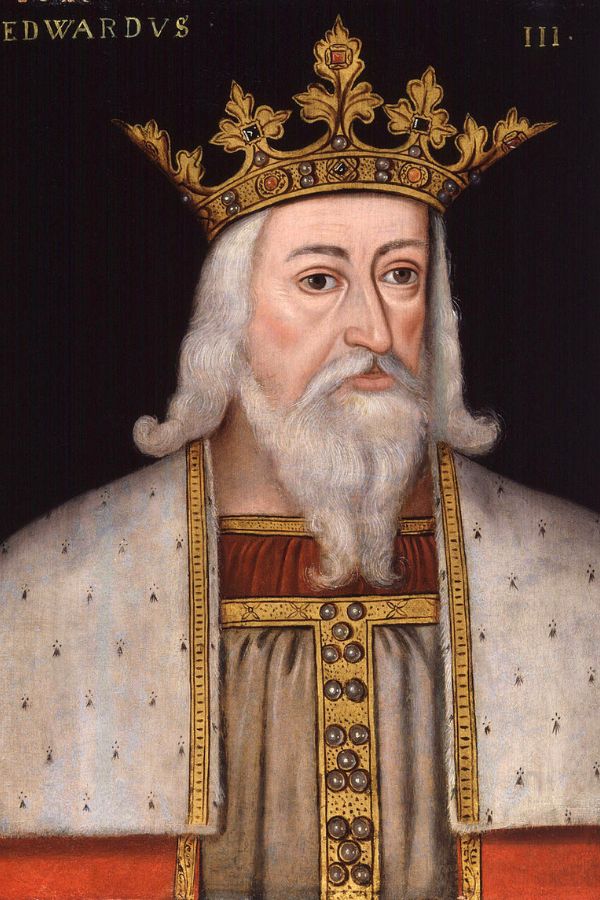
Why Did Edward III Claim the French Throne?
Edward III claimed France because his mother, Isabella of France, was the daughter of Philip IV, which made Edward the nearest male relative of the last direct Capetian king, Charles IV.
When Charles died in 1328 without a son, the direct male line that had ruled France for over 300 years ended. The French magnates gathered, weighed their options, and chose Charles’s cousin Philip of Valois, who became Philip VI. Edward, at 15 and still under his mother’s regency, was in no position to object.
By the time Edward pressed the claim seriously in 1337, the French had reached for a legal argument to shut him out: the so-called Salic law, which held that the crown could not descend through a woman.
Christopher Allmand, in his overview The Hundred Years War: England and France at War c.1300-c.1450, points out that the Salic argument was largely a retrospective invention, patched together by French jurists in the 15th century to give the earlier decision a legal skeleton it had not really had at the time.
In 1328 the choice of Philip VI was as much political as legal. The great lords of France were never going to hand the crown to a 15-year-old English king with a domineering mother.
Whether Edward truly wanted Paris is a separate question. Most historians read his claim as at least partly a bargaining lever, something to lay on the table so he could pick it up in exchange for full sovereignty in Aquitaine.
The trouble with bargaining chips that grand is that they take on a life of their own. Once Edward styled himself King of France and quartered the fleur-de-lys on his arms, backing down became almost impossible, and his descendants kept the title, uselessly, until 1801.
Who Was Fighting, and What Were They Really Fighting Over?
The war had two tangled hearts. One was the English-held lands in France, particularly Gascony, which the French kings wanted to swallow and the English kings refused to give up. The other was the question of who should legitimately wear the French crown.
The two questions kept collapsing into each other, which is why the fighting never quite ended when it should have.
Underneath that sat money, and specifically wool. England’s economy in the 14th century ran on the export of raw wool to the weaving towns of Flanders, and Flanders sat awkwardly under French overlordship while its cloth merchants depended entirely on English fleeces.
When Edward III slapped an embargo on wool exports in 1336, he pulled the Flemish towns into his orbit and gave himself a continental base. Philip, in turn, courted the Scots, who had their own long quarrel with the English and were happy to open a second front.
Over the generations, the cast grew. Scotland was in the French camp from the start under the Auld Alliance. Brittany split into rival ducal factions, one English-backed, one French-backed, and fought its own civil war inside the larger one.
Burgundy swung between the two sides depending on the duke and the decade, and by the early 15th century a Burgundian alliance with England would come close to finishing France off.
Castile weighed in with a formidable fleet on the French side. What began as a quarrel between two kings over homage and inheritance became, in effect, a European war fought in Aquitaine, Normandy, Brittany, Flanders, the Channel, and northern Spain.
Why Did the Hundred Years’ War Last 116 Years?
The Hundred Years’ War lasted 116 years because it was never one continuous war. Historians usually break it into three phases: the Edwardian War (1337 to 1360), the Caroline War (1369 to 1389), and the Lancastrian War (1415 to 1453).
Between and even within those phases came long truces, formal peace treaties, royal marriages meant to settle the quarrel, and years in which the two kingdoms mostly left each other alone. The famous name papers over decades in which nothing much happened at all.
The practical reason campaigns stopped was almost always money. Medieval armies were ruinously expensive to keep in the field, and neither crown had a tax base that could sustain years of continuous war.
Edward III borrowed so heavily from Italian bankers in the 1340s that he bankrupted the Bardi and Peruzzi houses of Florence when he defaulted. Campaigns ended when the treasury emptied, the soldiers went home, and the diplomats moved in.
The underlying quarrel was never solved, so the next generation reopened it as soon as the coffers allowed.
The 1360 Treaty of Bretigny was meant to end it. Edward renounced his claim to the French crown in return for full sovereignty over a hugely enlarged Aquitaine and the enormous ransom of King John II, who had been captured at Poitiers.
Within a decade, Charles V of France, patient and clever, had picked the treaty apart clause by clause and reopened the war in 1369 on the pretext of hearing appeals from Gascon lords.
Half a century later, when the French monarchy had collapsed into civil war between Armagnacs and Burgundians, Henry V of England reopened it again in 1415 because the moment was too good to miss. Each generation inherited the quarrel and, when the chance arose, picked it up where the last had left it.

Hooked on the Middle Ages? Get more stories like this one in your inbox.
The Battles Everyone Remembers: Crecy, Poitiers and Agincourt
Three battles carry the war in popular memory, and all three were catastrophic English victories against much larger French armies. At Crécy on 26 August 1346, Edward III’s outnumbered force, dug in on a slope in Picardy, cut down wave after wave of French knights with the English longbow.
Jean Froissart, whose Chronicles remain the great narrative source for the war’s first decades, described a French cavalry that could barely reach the English line before it was shot to pieces.
Ten years later, on 19 September 1356, Edward’s son, the Black Prince, did it again at Poitiers and captured the French king, John II, in person. John’s ransom was set at three million gold crowns, an astronomical sum that helped drive France to accept the Treaty of Bretigny four years later.
Agincourt, on 25 October 1415, followed the same pattern. Henry V, retreating toward Calais with an exhausted, dysentery-ridden army, was cornered by a French force several times larger and won again, on ground that funneled the French men-at-arms into a killing zone of English arrows and stakes.
The longbow did not win these battles by itself; terrain, French tactical errors, and English discipline all played their part, but the weapon made the pattern possible. A trained longbowman could put 10 or 12 arrows in the air a minute, and a company of them turned a hillside into something no cavalry charge could cross intact.
Around the set-piece battles ran the slower, grimmer business of siege warfare. The year-long Siege of Calais from 1346 to 1347 mattered more in the long run than Crecy itself. Once Calais fell, England held it for over 200 years, using it as a bridgehead into France, a garrison town, a customs post for the wool trade, and a base for raids inland.

How Did France Turn It Around and Win?
For nearly a century the pattern held: English armies won the battles, French kings ran out of money to keep fighting, treaties patched the quarrel, and the next generation started again. What broke the pattern was Joan of Arc.
In the spring of 1429, with English and Burgundian forces holding most of northern France and besieging Orléans, an illiterate teenage girl from the Lorraine village of Domrémy talked her way into the court of the disinherited dauphin, Charles, and persuaded him to let her lead a relief force.

Orléans was relieved on 8 May. Within months, Charles had been crowned Charles VII at Reims, in the traditional coronation city that the English had been unable to keep him out of. Joan was captured, sold to the English, and burned at Rouen in 1431, but the momentum did not go with her.
Charles VII, often written off in his early years as weak and indecisive, turned out to be a patient rebuilder. He reformed his army, taxes, and artillery, made peace with Burgundy in 1435 at the Treaty of Arras, and set about clawing back territory.
Normandy fell to the French in 1450 after the Battle of Formigny, where French cannon broke an English force whose longbowmen suddenly found themselves outranged. Aquitaine, English for 300 years, was retaken in 1453 after the Battle of Castillon, where the veteran English commander John Talbot was killed leading a charge into massed French gunfire.
Castillon is where the war effectively ended, though no treaty marked it. England lost every French possession except the Pale of Calais, which it held for another century before losing it too. The country that had once ruled from the Scottish border to the Pyrenees was, at last, an island kingdom.
Why Is It Even Called the Hundred Years’ War?
Nobody in the 14th or 15th centuries called this the Hundred Years’ War. The name is a 19th-century invention, coined by French historians looking back on the whole tangled series of conflicts and giving it a single, memorable label.
The real span, from Philip VI’s confiscation of Guyenne on 24 May 1337 to the French victory at Castillon on 17 July 1453, runs 116 years, four months, and a handful of days.
Inside that span sit truces that ran for years at a time, the great Treaty of Bretigny that briefly ended the war entirely, royal marriages between the two houses, and whole generations who lived their lives between the famous battles without ever seeing an English or French army in the field.
The reality was episodic, expensive, and often distant from the daily lives of the people whose taxes paid for it.
What the War Left Behind in England and France
The war remade both kingdoms, and neither the English nor the French monarchy that emerged in the late 15th century looked much like the one that had gone in.
In France, decades of English occupation, civil war between Armagnacs and Burgundians, and the wholesale slaughter of the nobility at Agincourt hollowed out the old aristocratic class and left the crown, under Charles VII and then Louis XI, unusually strong.
The French monarchy emerged from the war with a permanent standing army, a professional artillery train that was the best in Europe, and the taxes to pay for both.
England came out poorer, angrier, and politically unstable. The cost of the war had drained the treasury, the loss of French lands humiliated a warrior aristocracy that had defined itself by them for centuries, and returning captains, with their retinues of veteran soldiers and nothing left to fight for abroad, went home to fight each other. Within two years of Castillon, the Wars of the Roses had broken out.
Christopher Allmand traces how both kingdoms hardened through the war into something recognizably more national and less feudal, with subjects who thought of themselves as English or French in ways their great-grandparents largely had not.
The human cost sat on the peasants. Taxed to exhaustion to pay for the campaigns, robbed and burned out by soldiers roaming the countryside between them, whole regions of France, particularly Normandy and the Île-de-France, were depopulated and derelict by the middle of the 15th century.
The chivalric age that Froissart wrote up so lovingly for his aristocratic patrons looked very different from the village end of a chevauchee, where an English raiding column stripped the barns, burned the houses and moved on.
When the last English troops sailed from Bordeaux in 1453, the men who had done the killing went home. The people who had lived on the ground stayed and rebuilt, on what was left.
Frequently Asked Questions
How did the Hundred Years’ War start?
The Hundred Years’ War started on 24 May 1337, when Philip VI of France confiscated the English-held duchy of Guyenne in southwestern France. Edward III of England answered by reviving his own claim to the French crown, passed to him through his mother, Isabella of France. The immediate spark was feudal, but the underlying quarrel over English land in France went back generations.
Why did the Hundred Years’ War last so long?
The Hundred Years’ War lasted 116 years because it was never one unbroken conflict, but a chain of separate wars stitched together by truces and treaties that solved nothing. Medieval armies drained a treasury fast, so fighting stopped when money ran out rather than when the dispute ended. Each new generation of kings reopened the same quarrel, and so the war outlived everyone who first waged it.
Why did Edward III claim the French throne?
Edward III claimed the French throne because his mother, Isabella of France, was the daughter of Philip IV, which made Edward the nearest male relative of Charles IV, the last direct Capetian king. When Charles died in 1328 without a son, French magnates chose Philip VI instead, arguing the crown could not pass through a woman. Edward’s claim was partly genuine and partly a lever to gain leverage over his lands in Gascony.
How many years did the Hundred Years’ War actually last?
The Hundred Years’ War actually lasted 116 years, running from 24 May 1337 to 19 October 1453. The tidy name is a 19th-century invention, and nobody living through it thought of the fighting as a single war. Long truces and royal marriages broke up the campaigns, so a peasant could easily be born, live, and die during a stretch when no army was in the field at all.
Who won the Hundred Years’ War?
France won the Hundred Years’ War, driving the English out of nearly all their French territory by 1453. England had won the celebrated battles, Crécy, Poitiers and Agincourt, yet lost the war, keeping only the port of Calais on the continent. The turning point came in 1429 when Joan of Arc lifted the English siege of Orleans and revived the cause of Charles VII, who finished the job at Castillon.
What role did the longbow play in the Hundred Years’ War?
The longbow gave England its early dominance in the Hundred Years’ War, cutting down French cavalry charges at Crécy in 1346 and again at Poitiers and Agincourt. Massed ranks of archers could loose arrows far faster than a crossbowman could reload, and the wall of shafts broke the armored horsemen who were the pride of the French army.
## Sources
Primary sources
Froissart, Jean. Chronicles. c.1370-1400.
Secondary sources
Allmand, Christopher. The Hundred Years War: England and France at War c.1300-c.1450. Cambridge: Cambridge University Press, 2001.
Sumption, Jonathan. The Hundred Years War, Volume 1: Trial by Battle. Faber & Faber, 1990.
Wikipedia – English claims to the French throne. https://en.wikipedia.org/wiki/EnglishclaimstotheFrench_throne
Wikipedia – English claims to the French throne. https://en.wikipedia.org/wiki/EnglishclaimstotheFrench_throne
Wikipedia – Auld Alliance. https://en.wikipedia.org/wiki/Auld_Alliance
Lumen Learning – The Hundred Years’ War. https://courses.lumenlearning.com/suny-fmcc-worldhistory/chapter/the-hundred-years-war/
Wikipedia – Battle of Crécy. https://en.wikipedia.org/wiki/BattleofCr%C3%A9cy
World History Encyclopedia – Battle of Poitiers. https://www.worldhistory.org/article/1511/battle-of-poitiers-1356-ce/
Love a good medieval story?
Join our readers and get tales of kings, queens, castles and ordinary medieval lives straight to your inbox.

Kylie Lang is a nationally syndicated travel journalist with bylines on the Associated Press Wire & more, a medieval history writer, and the founder and lead author of Tales of the Middle Ages (talesofthemiddleages.com). She holds a BA (Honours) in History from the University of Kent and is a member of the British Guild of Travel Writers.
Related posts:
 The Battle of Crécy 1346: How a Teenage Prince and a Wall of Arrows Brought France to Its Knees
 The Medieval Power Play of Philip Augustus and the Fall of Three English Plantagenet Kings
 Joanna of Castile: the Mad Queen of Spain
 The Hundred Years War Battles That Broke France: Mud, Blood, Dysentery, and a King Taken Hostage