A good warhorse in the 13th century could cost more than a village priest earned in a decade. A full set of mail, a sword, a lance, a shield, a riding horse, a packhorse, a squire to look after them, and a servant to look after the squire, and you were looking at a sum that could swallow an entire manor’s annual income.
Knighthood looks glittering from the outside. Tournaments, banners, the William Marshal sort of glory. The financial reality was closer to a man drowning slowly in his own debts while trying to keep his spurs polished.
Table of Contents
This is the story of what it actually cost to be a medieval knight, and what happened to the men who couldn’t keep up.
The Horses That Could Bankrupt a Medieval Knight
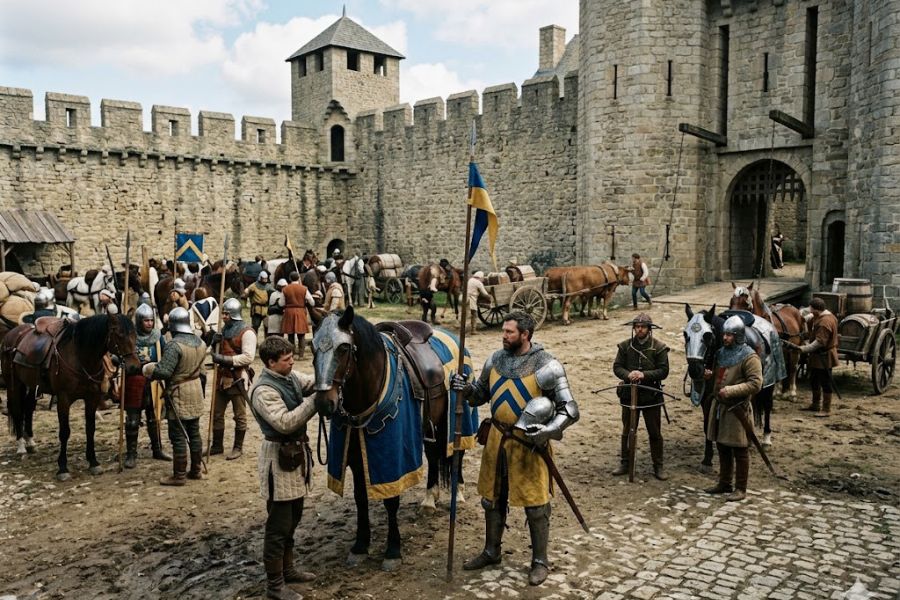
A knight needed horses, plural. The destrier was the warhorse, the prestige animal, the one trained to bite and kick and charge in a line. Beside the destrier sat the courser, a faster mount used for harder riding and sometimes for battle when the destrier wasn’t available.
Then came the palfrey, a smooth-gaited riding horse for the road, and at least one rouncey or sumpter for baggage. A serious knight on campaign might travel with four or five animals before you counted the squires’ mounts.
The prices recorded in English exchequer rolls and continental accounts are eye-watering. In the late 12th and 13th centuries, a quality destrier could cost anywhere from 20 to 80 pounds, with the finest animals reaching well over 100 pounds.
A skilled archer or a foot soldier earned around two pence a day, but a laborer earned less. Do the arithmetic, and a single warhorse represented twenty, thirty, sometimes fifty years of a working man’s wages. King Edward I paid 70 marks (about 47 pounds) for one horse in 1277, and his accounts show he considered that a reasonable purchase.
And these animals died. They died of colic, of battlefield wounds, of bad fodder on long marches, of being ridden into ditches in the dark. A knight who lost his destrier at a tournament or in a skirmish had to replace it, and the replacement was no cheaper than the first.
The system of restor, where a lord compensated a knight for a horse lost in his service, existed precisely because the loss was otherwise catastrophic. Most surviving household accounts I’ve read, in summary, show lords arguing over restoration payments for years after the fact. The horse was the single largest line item in the medieval military budget, and it kept dying.

Armor, Weapons, and the Cost of Looking the Part
A mail hauberk in the 12th century, the long shirt of riveted iron rings that reached past the knees, took a skilled smith months to make. Each ring was drawn, cut, linked, and riveted by hand. The going rate fluctuated wildly by region and period, but a good hauberk could cost as much as a small farm.
By the late 13th and 14th centuries, as plate began to appear over and then alongside mail, the bill grew rather than shrank. A full harness of plate from a Milanese or Nuremberg workshop in the 15th century could cost the equivalent of several years of a knight’s manorial income.
Then the weapons. A sword needed a scabbard, a belt, a buckle, fittings, and replacement when the blade chipped or warped. Lances snapped in a single charge and were treated as consumables, ordered by the dozen for tournaments.
Helms went out of fashion as quickly as armor styles changed, and a knight wearing a great helm from his grandfather’s day at a tournament in 1320 looked exactly as ridiculous as he sounds.
Fashion mattered, as did heraldry. The surcoat had to be made fresh, dyed in the right colors, and embroidered with the correct arms. None of this was cheap.
The wider kit ate money in smaller bites. Spurs (gilt if you could manage it), saddles, bridles, caparisons for the horse, padded gambesons under the mail, gauntlets, mail chausses for the legs, a dagger, a mace or war hammer if you fancied one, tents for campaign, cooking gear, chests to transport everything.
An ordinance from the French crown in the 14th century lists the equipment a man-at-arms was expected to bring to muster, and reading it feels less like a kit list and more like an itemized invoice for ruin.

The Retinue Nobody Talks About
A knight alone was almost useless. He needed people, and people needed to be fed, paid, and housed. At minimum, a working knight kept a squire, often a young man of gentle birth learning the trade, plus a groom or two for the horses, an armorer or at least a man who could repair mail, and a servant for the baggage.
On campaign, the establishment grew. A knight banneret, who led a small company under his own banner, might travel with twenty or thirty people in his immediate household before counting the men-at-arms he’d raised.
Household accounts from the period, the rolls kept by stewards for noble families, give a sense of the running cost. Bread, ale, salted fish, beef, oats for the horses, candles, firewood, livery cloth for the servants twice a year, shoes, and medical care when a man was injured.
The Beauchamp family accounts from the 14th century, the Berkeley accounts, and the household rolls of Eleanor de Montfort, all show a constant outflow that didn’t pause when there was no war on. Servants ate every day, and knights who took the field with their lord were paid wages on top of board.
I find the wages section of these accounts the most telling. A knight bachelor on campaign in the late 13th century earned two shillings a day from the crown. His squire earned a shilling.
The men-at-arms below them earned less. Looks generous until you remember the knight was expected to provide his own horses, kit, food on the road, and replacements for anything broken. The wages didn’t cover the cost of going to war, but they softened the blow.

How Medieval Knights Paid for Any of This
Land was the answer, in theory. A knight held his fief from a lord in exchange for military service, traditionally forty days a year. The income from the manor, rents from tenants, profits from the demesne, fees from the manor court, and mill dues were supposed to fund the kit.
In practice, a single knight’s fee often didn’t generate enough. By the 13th century, the income threshold the English crown used to define a knight (those holding land worth 20 pounds or more) had become a trap. Many men of that income could barely afford the equipment the title required, and the crown kept lowering the threshold to force more of them to take up knighthood, which is why distraint of knighthood, fining men who refused the rank, became such a useful royal revenue stream.
When the manors didn’t cover it, knights borrowed. Jewish moneylenders in 12th and 13th-century England held the loans of much of the gentry, which is one reason their expulsion by Edward I in 1290 had such a complicated political afterlife.
Lombard and Florentine bankers picked up the slack on the continent and increasingly in England. Monasteries lent money against land, sometimes against future harvests, sometimes against a knight’s expected ransom income from war.
Tournaments, in the William Marshal mold, were one of the few ways a poor but skilled knight could actually claw his way out of debt by capturing other knights and ransoming their horses and armor. Marshal’s biographer claims he captured five hundred knights over his tourneying career. Even allowing for exaggeration, that would have been a lot of money.
The other lifeline was a good war. Real war, with proper ransoms. The English nobility who fought at Crécy and Poitiers came home rich, or richer than they’d been, and the French nobility who lost paid for it across generations.
The capture of John II of France in 1356 saddled the French crown with a ransom that took decades to settle and ruined any number of provincial lords expected to contribute. War was a lottery. You either won big and rebuilt your estates, or you came home with no horse, no armor, and a fresh debt to a Florentine banker who didn’t care about your pedigree.
When the Money Ran Out
The records are full of knights who simply couldn’t keep up. The English plea rolls and exchequer pipe rolls show men selling off corners of their inheritance, mortgaging manors to abbeys, granting away advowsons and mill rights to raise cash.
A 13th-century knight named Adam de Stratton, who started as a clerk and ended up enormously wealthy through moneylending, made his fortune partly from gentry borrowers who couldn’t repay. He was eventually disgraced for fraud, but the borrowers stayed ruined.
Some knights gave up the rank entirely. Others sank into the class of armigerous gentry without ever being formally dubbed, sidestepping the costs. Some took service in a great household as retainers, trading independence for a steady wage and a place at someone else’s table.
The career of a household knight, salaried and equipped by his lord, looks much less romantic than the free-roving figure of legend, but it was how most working knights actually lived. William Marshal himself, before he became earl of Pembroke, spent decades as a household knight in the Young King’s retinue, dependent on his lord’s favor for every horse he rode.
And then there were the ones who ended badly. A 14th-century knight named Sir John de Annesley appears in the records suing for the return of land he’d lost to debt. Others surface in monastic chronicles as borrowers whose souls were prayed for in exchange for the lands they’d handed over in lieu of repayment.
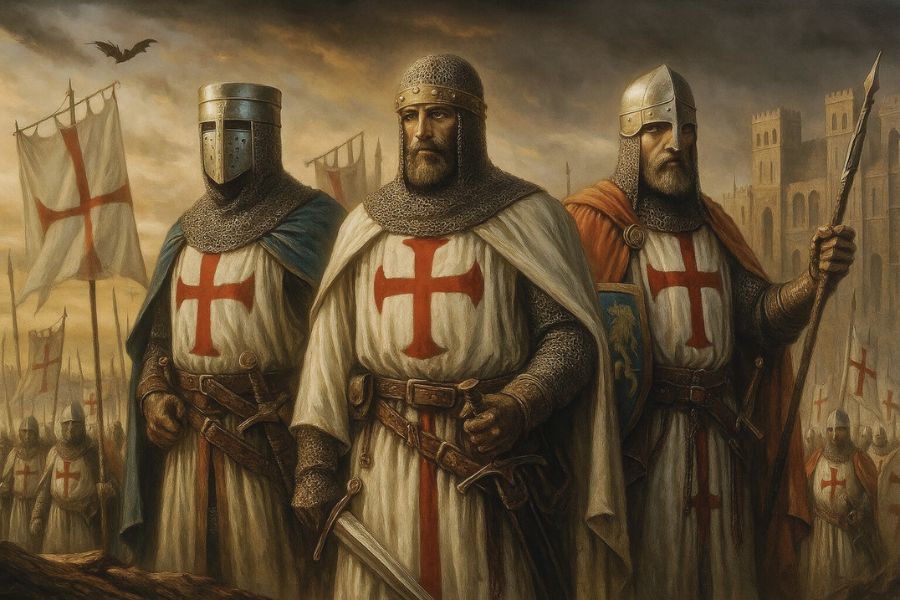
The Templars and Hospitallers held mortgages from knights who never returned from crusade, and quietly absorbed the estates. I once spent an afternoon in a small English parish church looking at a brass for a 15th-century knight, his armor finely engraved, his feet on a lion, and read in the guidebook that his widow had been forced to sell three manors within a year of his death to clear what he owed.
The image of the knight, the banner, the destrier, the gleaming helm was held up by a financial scaffolding that creaked constantly and often collapsed. Behind every figure on a tomb brass sat a steward with a ledger, a Florentine banker with a contract, and a wife or widow trying to work out which manor would have to go next.
Related posts:
 The Best and Worst Kings of the Middle Ages That the History Books Rarely Talk About
 September 4, 925: The Day England’s First King, Æthelstan, Was Crowned, But Was He?
 15 Medieval Movies to Watch if You Love History, the Middle Ages and Being Transported to Another Era
 William the Conqueror: Separating Fact from Fiction