Did you know a duke once called off an entire siege because his men wanted to get the harvest in? It’s true, although it’s not how you imagine a siege being called off, is it?

I love finding stories like this, because it’s nothing like what the textbooks tell you. Sieges are supposed to end with a starving garrison and a gate flung open at midnight, but the real ones ended over weather, tempers, letters, and things that had nothing to do with soldiers at all.
Table of Contents
Hollywood is wonderful, but it does tend to play a little fast and loose with the truth. My imagination goes into overdrive after I’ve watched a medieval movie, which, whilst being fun, doesn’t give me a true depiction of what actually happened.
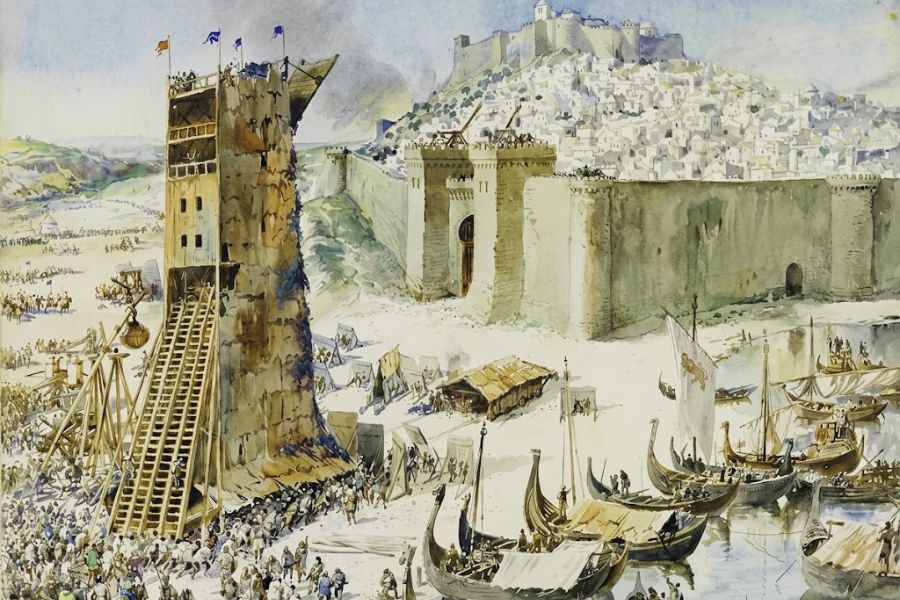
7 Medieval Sieges That Ended in Unusual Ways
To prove my point, below are seven medieval sieges that didn’t end the way the movies love to depict. And, as I often find, the truth is more interesting than the fiction created by those wishing to entertain us.
1. Antioch, 1098: The Besiegers Became the Besieged, Then Won Anyway
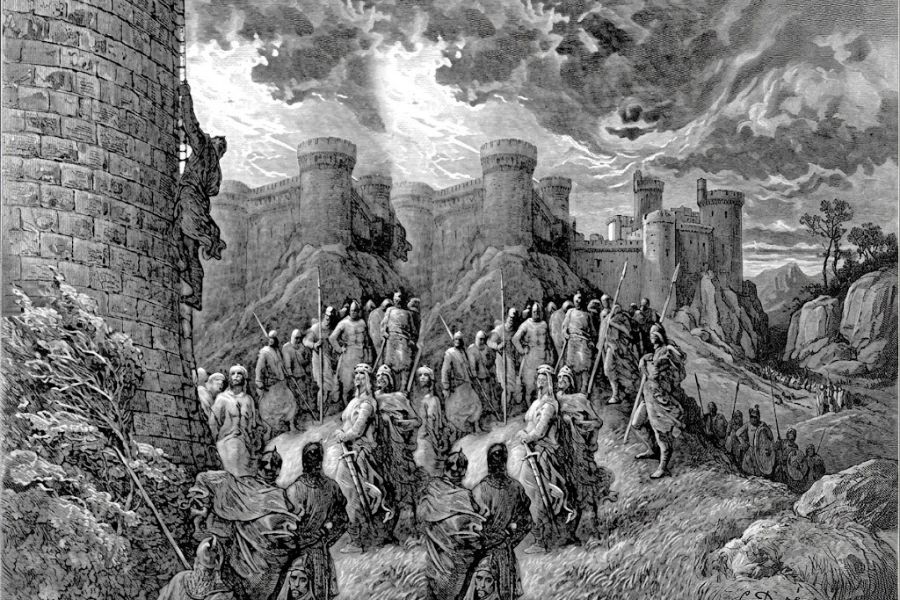
Bohemond of Taranto and the Frankish army sat outside the walls for seven months through the winter of 1097 to 1098, starving in their own camp while the Turkish garrison inside ate well.
Fulcher of Chartres, who was there, describes men boiling leather and eating thistles. Horses died in such numbers that the knights became infantry.
Bohemond finally got in through treachery, bribing an Armenian tower captain called Firouz to lower a ladder on the night of 2 June 1098. The Crusaders poured over the walls and took the city in hours.
Two days later Kerbogha of Mosul arrived with a massive relief army and trapped them inside the place they’d just captured. Now the besiegers were the besieged, in a city stripped bare of food, with a Turkish citadel still holding out above them.
What happened next is one of the strangest turns in medieval warfare. A Provençal pilgrim named Peter Bartholomew claimed that a vision had shown him the Holy Lance buried under the floor of St Peter’s Cathedral.
They dug, and they found something. Raymond of Aguilers, the chronicler attached to Raymond of Toulouse, writes that the discovery lit a fire under the garrison. On 28 June they marched out of the gates in ragged battle order and broke Kerbogha’s army in the field.
Steven Runciman, in his History of the Crusades, treats the Lance episode with skepticism. Thomas Asbridge is more sympathetic. Both agree that whatever the men believed, it worked.
2. Kenilworth, 1266: The Longest English Siege Ended With a Committee
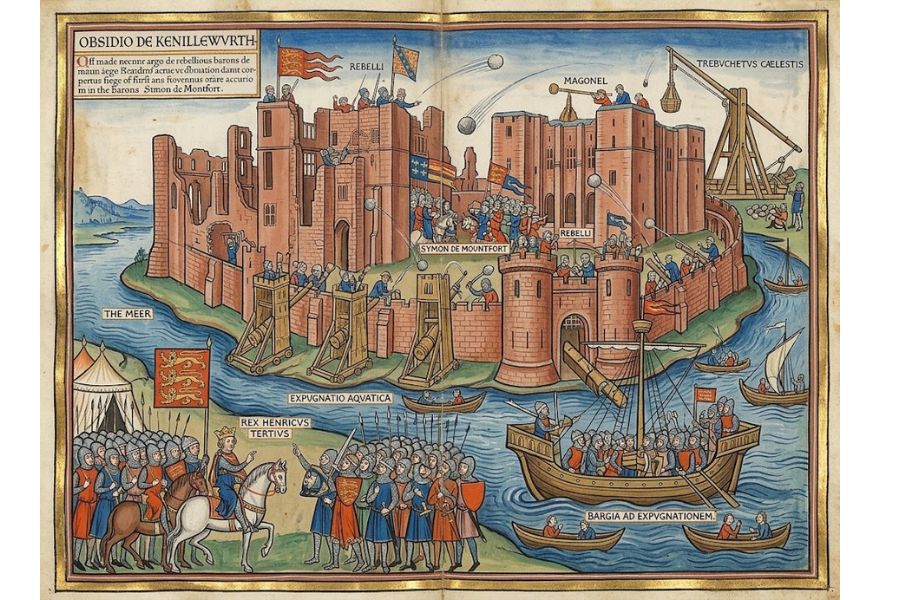
After the battle of Evesham in 1265, the sons and supporters of the dead Simon de Montfort holed up in Kenilworth Castle and refused to come out. Kenilworth was Simon’s own fortress, ringed by an artificial lake his father-in-law King John had helped create, and it was as close to impregnable as any castle in England. Henry III sat down in front of it in June 1266 with the full weight of the royal army.
What followed was 172 days of expensive, embarrassing failure. The king brought up siege engines and the garrison shot them to pieces. He tried an assault by boat across the lake and the boats were sunk.
He tried excommunication, which the defenders answered by dressing one of their own as a bishop and pretending to excommunicate him back. The Dunstable annalist and Thomas Wykes both describe a stalemate that was steadily wreaking havoc on Henry’s finances.
The ending was a legal document, not a storming. The Dictum of Kenilworth, drafted by a committee of bishops and barons in October 1266, offered the disinherited rebels a route to buy back their confiscated lands over a set number of years.
The garrison held out another two months to see if Simon de Montfort the Younger would arrive with relief. He didn’t. They surrendered on 14 December 1266 on the terms of the Dictum, walking out with their lives and a payment plan. The longest siege on English medieval soil closed with a settlement about compensation.
3. Château Gaillard, 1204: A Latrine Shaft Ended Richard the Lionheart’s Masterpiece

Richard I built Château Gaillard above the Seine at Les Andelys between 1196 and 1198 and reportedly called it his fair daughter. It was the most advanced castle in Europe, three baileys stacked one behind the other, with concentric walls and machicolations before anyone else was using them at scale.
Richard is supposed to have said he could hold it if the walls were made of butter. Then he died in 1199, and John lost Normandy in stages.
Philip II of France arrived beneath the walls in August 1203 and settled in for a proper siege. Roger of Wendover describes the outer bailey falling first, after months of undermining. The middle bailey held. Philip’s engineers ran out of ideas.
What cracked it, on the night of 6 March 1204, was a group of French soldiers who found an unguarded latrine shaft leading up into the chapel of the middle bailey. They climbed the sewage chute, dropped into the chapel, and made enough noise that the defenders thought the whole army was inside.
The garrison panicked, retreated to the inner bailey, and were cornered there within weeks. William the Breton, Philip’s own chronicler, tells the latrine story with obvious relish.
4. Neuss, 1475: Charles the Bold Walked Away From His Own Siege

Charles the Bold of Burgundy sat down in front of the small Rhineland town of Neuss on 29 July 1474 with what Philippe de Commynes calls the finest army in Christendom.
He wanted the Archbishopric of Cologne as a stepping stone to a Burgundian kingdom stretching from the North Sea to the Alps. Neuss had maybe 3,000 defenders under Hermann of Hesse. Charles had upwards of 15,000 men, Italian gunners, and the finest siege train in Europe.
He stayed there for 11 months. The garrison held. Commynes, who witnessed the whole thing, records that the Burgundian camp grew into a small city, with wooden houses and streets, and that Charles refused to leave because doing so would look like defeat.
The town was reduced to eating dogs and boiled leather. It still didn’t fall.
In June 1475, Emperor Frederick III finally raised a relief army and marched on the Rhine. Rather than fight, Charles accepted a face-saving arrangement brokered by a papal legate: the garrison came out with honors, the town returned to imperial control, and Charles marched away with nothing to show for the biggest siege of the 15th century.
He was dead within eighteen months, killed at Nancy in January 1477. Richard Vaughan’s biography treats Neuss as the campaign that broke the Burgundian state before its founder even realized it.
5. Calais, 1436: A Flemish Militia Went Home for the Harvest

When Philip the Good of Burgundy switched sides in 1435 and joined the French against the English, one of the first things he promised was to take Calais. The town had been English since 1347, and it was the pride of the English crown across the Channel.
Philip mustered the largest army Burgundy had ever put in the field, drawing heavily on the militias of Ghent, Bruges, and Ypres, and sat down before Calais in July 1436.
It didn’t go well. Enguerrand de Monstrelet, the Burgundian chronicler, describes a siege plagued from the start by supply problems and squabbling between the French and Flemish contingents.
The English governor, Edmund Beaufort, kept the sea lanes open and reinforcements trickled in. The Burgundian bombards arrived late, and some were the wrong caliber for their shot.
When word reached camp in late July that Humphrey, Duke of Gloucester, was landing with a relief army, the Ghent contingent simply packed up their tents and walked away.
Their contracts specified a set number of weeks’ service, and they wanted to be back for the harvest. The rest of the Flemish militias followed within days.
The greatest siege army western Europe had put together in a generation collapsed because the townsmen inside it decided the campaign wasn’t worth their harvest, and their duke had no way to make them stay.
6. Harlech, 1461 to 1468: The Garrison That Forgot to Surrender

After the Yorkist victory at Towton in March 1461, most Lancastrian resistance in England folded within a year. Harlech Castle in Gwynedd, held by Dafydd ap Ieuan ap Einion for Margaret of Anjou, did not fold.
It sat on a rock above the sea, supplied by ship from Ireland and France, and Dafydd simply refused to give it up. Yorkist forces blockaded the castle on and off for seven years while the garrison inside held Christmas feasts and raided the surrounding countryside.
The song Men of Harlech is traditionally associated with the siege, though the tune we know is much later. It’s documented that between 1461 and 1468, Harlech was the last Lancastrian stronghold in Britain, and that Dafydd used it as a base for guerrilla operations across north Wales. Edward IV sent three separate expeditions to take it, and each one failed for want of supply lines.
It was William Herbert, Earl of Pembroke, who finally cracked it in August 1468. He brought 7,000 men through the Welsh mountains in one of the harder logistical operations of the Wars of the Roses, cutting Harlech off from its resupply routes at last. Dafydd walked out on terms after a few weeks and Edward IV, reportedly impressed by his stubbornness, pardoned him.
The garrison that had held out longer than any other in medieval British history surrendered because their commander finally decided he’d made his point.
7. Orleans, 1429: A Teenage Girl Turned Up and the English Left
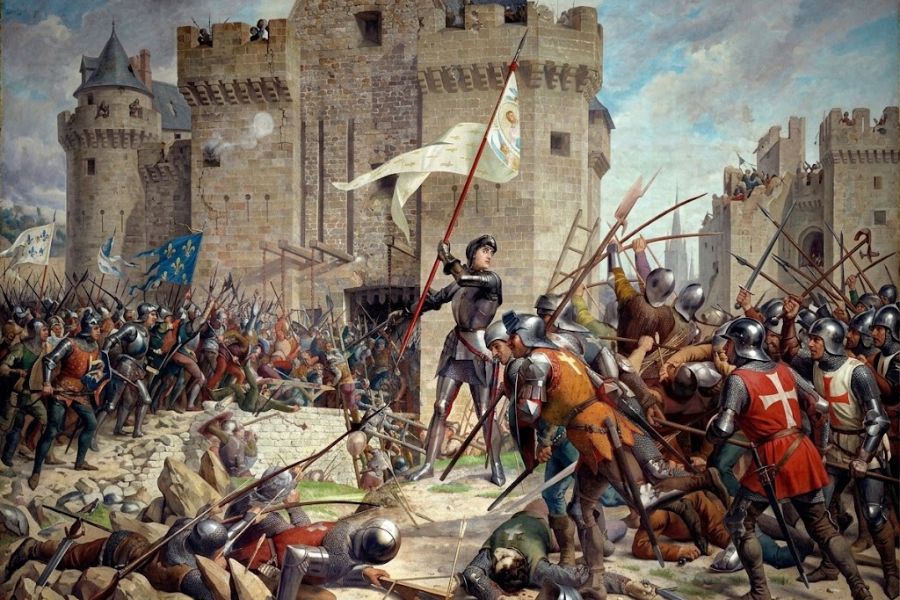
By October 1428 the English under Thomas Montagu, Earl of Salisbury, had thrown a ring of bastilles around Orleans and were slowly strangling the city. Salisbury was killed by a cannonball almost at once, and command passed to William de la Pole, but the strategy held.
Through the winter of 1428 to 1429 the garrison and citizens inside Orleans were on shrinking rations, and the French relief attempts, including the humiliating Battle of the Herrings in February 1429, all failed.
Everything the professional soldiers on both sides knew about siege warfare said Orleans would fall by summer. It didn’t. On 29 April 1429 a 17-year-old peasant girl called Jeanne d’Arc rode into the city in armor she’d been given at Chinon, carrying a banner she’d designed herself, and within nine days the English had abandoned every one of their bastilles and pulled back down the Loire.
What happened between those two dates is still argued about. Regine Pernoud’s work on the trial and rehabilitation records shows that Jeanne herself directed some of the assaults, especially the storming of Les Tourelles on 7 May, when she was wounded by a crossbow bolt through the shoulder and came back to the fight the same afternoon.
Kelly DeVries treats her contribution as chiefly a matter of morale, arguing the French had numerical parity and simply needed someone willing to attack. Either way, one of the most methodical sieges of the Hundred Years War came apart in a week because a girl from Domremy walked in the front gate.


Kylie Lang is a nationally syndicated travel journalist with bylines on the Associated Press Wire & more, a medieval history writer, and the founder and lead author of Tales of the Middle Ages (talesofthemiddleages.com). She holds a BA (Honours) in History from the University of Kent and is a member of the British Guild of Travel Writers.
Related posts:
 Which English Castles Are Worth Visiting for Medieval History?
 The Medieval Siege: What It Actually Took to Starve Out a Castle, and How Long People Could Hold On
 The Tragic Life of Charles II of Spain: Illness, Inbreeding, and the Fall of a Dynasty
 15 Medieval Movies to Watch if You Love History, the Middle Ages and Being Transported to Another Era