
Elizabeth I is easily recognizable in portraits with her pale skin, red wig, and a mouth carefully positioned so it never seemed to show a tooth. That’s because, yes, Elizabeth I really did have badly decayed, discolored teeth by her sixties, and two foreign diplomats described them in person.
A French ambassador in 1597 called them yellow, uneven, and partly missing. A German visitor the following year wrote simply that they were black, blaming the English love of sugar.
Table of Contents
We can’t prove how bad they were in any given year, because only a handful of accounts survive, and the artists commissioned to paint portraits of Elizabeth were strictly instructed not to show her teeth. So let’s see what the history books really tell us.
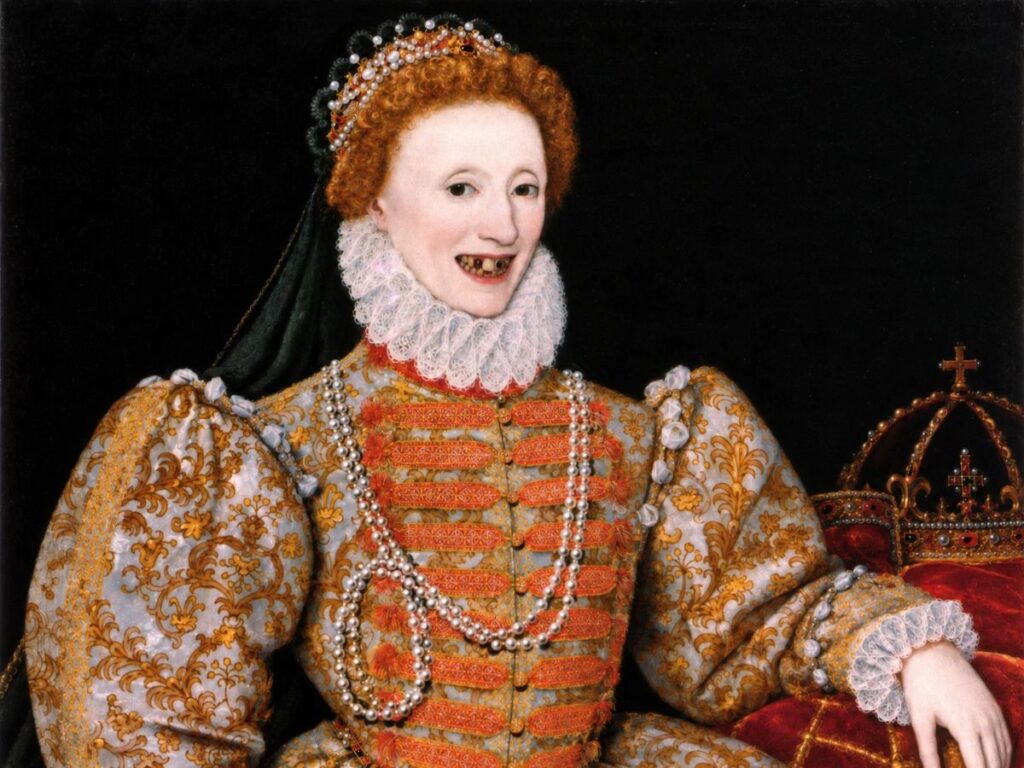
Did Elizabeth I Really Have Black Teeth?
Yes, by the end of her reign, Elizabeth I had severely decayed and discolored teeth, and we know this because two independent eyewitnesses from two different countries met her in person within 12 months of each other and both wrote it down.
One was the French ambassador André Hurault de Maisse in December 1597. The other was the German traveler Paul Hentzner in 1598. Neither had a reason to flatter her, and neither was repeating the other.
What we don’t really know is how far back the decay went, how many teeth she’d actually lost at any given point, and how much the famous description of them as black was a translator’s choice rather than Hentzner’s own word.
Only a handful of descriptions of her teeth survive across a 44-year reign, most of which are from her last few years.
What the Eyewitnesses Actually Wrote
Henri IV of France sent André Hurault de Maisse to England in the autumn of 1597. He kept a detailed journal of his audiences with Elizabeth, which the Nonesuch Press published in English in 1931, translated by G. B. Harrison and R. A. Jones.
On December 8, 1597, after an audience at Whitehall, he wrote that her teeth were very yellow and unequal, and that many were missing, so that one couldn’t understand her easily when she spoke quickly. She was 64.
Paul Hentzner, a lawyer from Brandenburg traveling as tutor to a young nobleman, saw her the following year at Greenwich. In his Latin itinerary, published in 1612, he described her teeth as sooty, and added that this was a defect the English seemed subject to, from their too great use of sugar.
The quotation that has echoed down the centuries, that her teeth were black, comes from the 1797 English translation, almost two hundred years later. His original word was fuliginous: sooty, dusky, smoke-stained. Darker than yellow, certainly, but not the coal black the later translation suggests.
Hentzner saw a mouth badly stained and visibly damaged. He didn’t see teeth deliberately painted. Alison Plowden, who collected contemporary descriptions of Elizabeth in As They Saw Her, includes the de Maisse passage alongside Hentzner’s, and together they give us the closest thing we have to a medical note on the queen’s mouth.
Was It the Sugar?
Hentzner blamed the sugar for Elizabeth’s terrible teeth, and he was mostly right. Sugar arrived in Tudor England as an expensive luxury, shipped from plantations in Madeira and the Canaries and later the Caribbean, and the court poured it into everything.
It went into wine, into sauces, into elaborate sugar sculptures called subtleties that were brought out between courses at a feast. A pound of refined sugar cost more than most Londoners earned in a week. Serving it in quantity told your guests exactly how rich you were.
Elizabeth had a famously sweet tooth. She’s reported to have cleaned her teeth with a paste of sugar and honey, rubbed on with a cloth, which was the Tudor idea of dental hygiene and the worst possible thing she could have done.
Fermentable sugars feed the bacteria in the mouth that produce acid, and acid strips enamel. Scrubbing a sugar paste over her teeth every day would have accelerated the damage her diet was already doing.
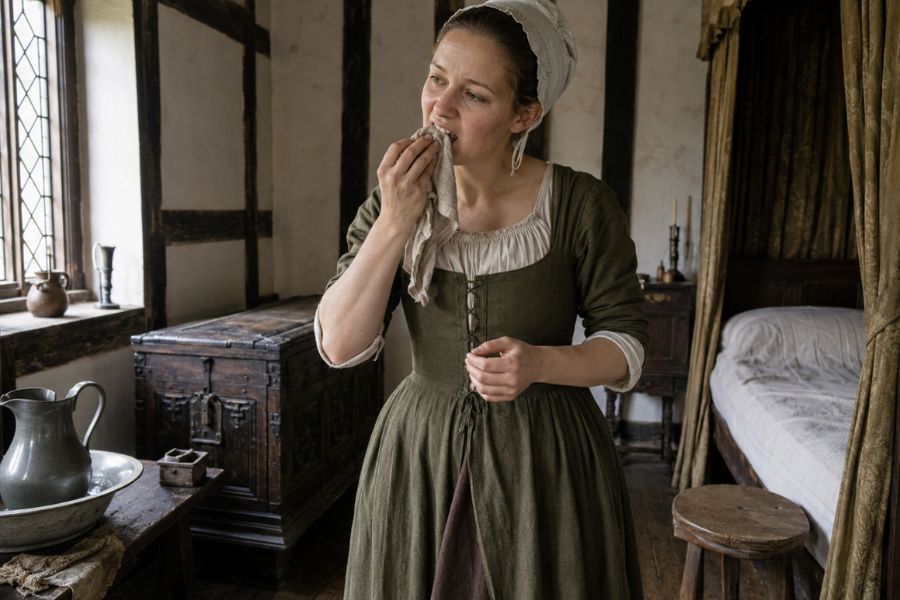
Tudor dentistry offered no real defense. Barber-surgeons pulled rotten teeth with pliers, and that was essentially the extent of the trade. There was no filling, no cleaning as we would recognize it, no treatment for decay short of extraction.
Several contemporary accounts say Elizabeth was terrified of the tooth-drawers, and in 1578 the Bishop of London reportedly volunteered to have one of his own teeth in front of her to persuade her to undergo the same procedure.
A queen who feared extraction, ate sugar daily, and lived into her late sixties was always going to end up with the mouth de Maisse described.
Hooked on the Middle Ages? Get more stories like this one in your inbox.
Why Her Portraits Never Show the Damage
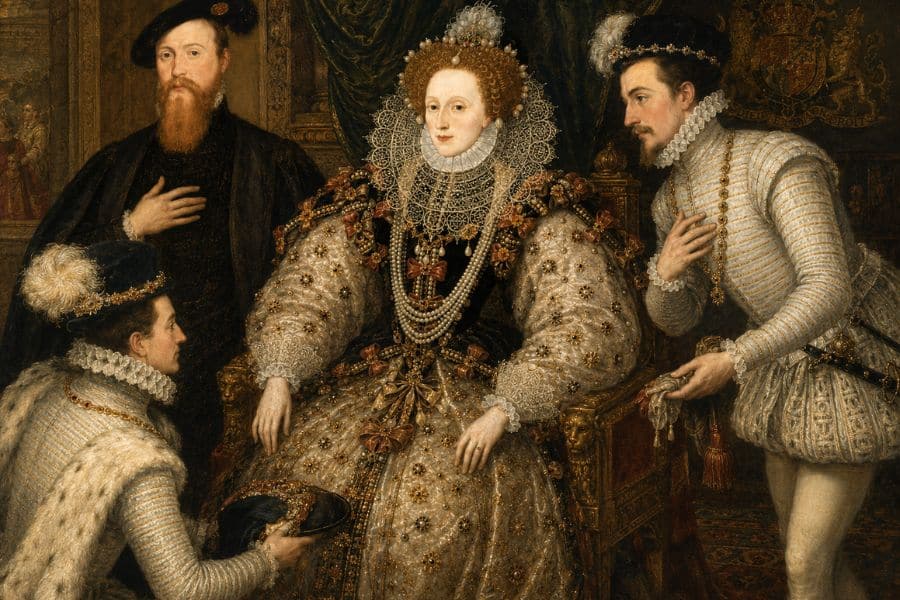
If you look through the portraits of Elizabeth painted in the 1590s, you won’t find a single one that shows a tooth. The lips are always closed, the mouth small and composed, the face smooth and curiously ageless. That was deliberate.
By the time Elizabeth reached her sixties, nobody painted her from life anymore. Her face was far too important to leave to chance, so the court gave artists an approved pattern to copy, and that was that.
Nicholas Hilliard, her go-to miniature painter, was one of the artists who churned out what the art historian Roy Strong later called the Mask of Youth.
It’s basically the face of a woman in her thirties stuck onto a queen nearer seventy, with no lines, no sagging and certainly no bad teeth. Was it how she really looked in her prime, or just how she wanted to be remembered? I’d say a bit of both.
This wasn’t vanity for its own sake. Elizabeth ruled a Protestant country surrounded by Catholic powers, with no heir or husband to steady the succession. Her body was a political instrument, and the appearance of strength, youth and continuity on it was part of how she held the throne.
A portrait showing a 65-year-old woman with sunken cheeks and missing teeth would have given her enemies something to work with. A portrait showing a flawless, timeless queen gave them nothing.
Elizabeth was famous for her Latin, her Greek, her sharp retorts to ambassadors and her stirring addresses to Parliament. By the end of her life, delivering those words took effort the portraits were designed to erase.
Were Black Teeth Really a Tudor Fashion?
According to many stories, the queen’s rotten teeth became so admired that fashionable women at court blackened their own on purpose, to look as though they too could afford all that sugar. It’s a great story, and has been repeated in TV Shows, and more Tudor books than I can count. It’s also, when you go looking for the source, surprisingly thin.
It’s true that sugar was a status food, and that decayed teeth could, among the elite who could afford to ruin them, be read as a sign of wealth. The weaker part is the leap from that to a deliberate craze for soot-blackening at the Tudor court.
You’ll often read that Elizabeth’s ladies blackened their teeth to look like her, but I’ve never seen a scrap of Tudor evidence for it. No English writer of the time mentions anyone doing it, and I’d expect someone to have noticed.
Compare that with Japan, where women blackened their teeth for centuries with a dye made from iron and vinegar. They called it ohaguro, and it’s so well recorded that the Meiji government had to ban it for the nobility in 1870. Tudor England has nothing like that. So until someone turns up a letter or a diary that says otherwise, I’m putting this one down as a story that grew in the retelling.
Wealthy Tudors ate a great deal of sugar, their teeth suffered, and because everyone else at that social level had the same brown-and-black mouth, it stopped being hidden. That’s a long way from a fashion in the active sense of the word.
The queen set a beauty standard for pale skin, plucked foreheads and red hair, and women at court copied all three with lead, tweezers and dye.
Her teeth were a consequence of her diet, not a look anyone sensible would have chosen to imitate.
We don’t know how many teeth Elizabeth lost, or when, or in what order. Her body was buried in Westminster Abbey in 1603, placed in the vault of her half-sister Mary and later moved to the tomb commissioned by James I, and her remains haven’t been examined in the way the bones of some of her relatives have.
The skeletal remains attributed to her mother, Anne Boleyn, and to her aunt Mary Tudor, Henry VIII’s sister, reportedly showed good teeth. Rotten teeth weren’t universal in the Tudor family or in the period.
They were a disease of the rich, which Elizabeth was, and a disease of long life, which Elizabeth also was. She outlived almost everyone she had grown up with. She also outlived most of her teeth.
The queen wasn’t toothless, as some of the more lurid retellings suggest. She wasn’t grinning a mouth of coal-black stumps at startled ambassadors. She was an elderly woman with yellow, uneven, sooty teeth, several of them gone, who found quick speech difficult and preferred to keep her mouth closed when she could.
Frequently Asked Questions
Did Elizabeth I really have black teeth?
Elizabeth I’s teeth may have been black, but we don’t know for certain. Some had decayed and discolored badly by her sixties, and two foreign diplomats who saw them in person confirm it.
What caused Elizabeth I’s teeth to rot?
What caused Elizabeth I’s teeth to rot was mainly sugar, which arrived in 16th-century England as a costly luxury and was consumed in huge quantities at court. The queen had a famous sweet tooth, and she reportedly cleaned her teeth with a sugar-and-honey paste that only accelerated the damage.
Why don’t Elizabeth I’s portraits show her bad teeth?
Elizabeth I’s portraits don’t show her bad teeth because by the 1590s her image was tightly controlled and painted to a youthful, closed-mouth template known as the Mask of Youth. The closed mouth in royal portraits was a deliberate choice.
Did people really blacken their teeth to copy Elizabeth I?
People blackening their teeth to copy Elizabeth I is a popular claim, but the evidence for it is thin, late, and often secondhand. Sugar was an elite luxury in Tudor England, so decayed teeth could mark wealth among the rich without anyone needing to fake them. Whether anyone actually sooted their teeth on purpose to imitate the queen is uncertain.
Love a good medieval story?
Join our readers and get tales of kings, queens, castles and ordinary medieval lives straight to your inbox.

Kylie Lang is a nationally syndicated travel journalist with bylines on the Associated Press Wire & more, a medieval history writer, and the founder and lead author of Tales of the Middle Ages (talesofthemiddleages.com). She holds a BA (Honours) in History from the University of Kent and is a member of the British Guild of Travel Writers.