Beauty standards at the Tudor court were not as whimsical as you might think. A woman’s appearance was measured not only against ideals of pale skin, light eyes, and fair hair but also against her health. A glowing complexion suggested she was free of disease and capable of bearing children, which mattered more than romance or attraction.

Looks could define alliances, reputations, and power at court. Behind every flattering description of rosy cheeks or luminous hair was a judgment of whether a woman could strengthen a dynasty or weaken it. Look at what happened to Anne of Cleves.
Table of Contents
It is easy to imagine how suffocating that must have been. Women were appraised like thoroughbreds, praised when they fit the standard, scrutinized when they did not. So, who were the women who passed this rigorous inspection to be classed as beauties, and where would you fall after inspection?

Medieval Roots of Tudor Beauty Ideals
Pale skin, fair or reddish hair, and blue or green eyes formed the core of what was considered beautiful in the Tudor court. Light skin signaled rank. If your face did not burn or freckle under the sun, people assumed you did not work the fields. That read as wealth, protection, and status.
Fair or reddish hair drew praise in romance literature and court poetry. Writers compared blond strands to fine gold and treated light eyes as rare and desirable. The link between light features and high birth ran deep.
Religious imagery fed the ideal. Paintings and manuscripts often presented noble women with luminous skin. The message was purity and order, not labor and exposure. Medieval physicians believed the body’s humors showed on the skin. A balanced body produced a clear face with gentle color in the cheeks.
Health sat at the center. Smooth skin and a steady glow suggested freedom from disease. In a world of outbreaks and high mortality, that mattered. Fertility shaped the judgment. A healthy look implied the ability to carry children and secure heirs.
Together, these beliefs transformed a woman’s appearance into evidence. Pale skin, light eyes, and fair hair signaled class. Clear color signaled health and fertility. The Tudor court adhered to that checklist and utilized it.
Would You Pass as a Beauty in the Tudor Court
Answer five quick questions. Pick one option for each. Then see how a Tudor court might have judged your look.
3 Tudor Women Considered to be Beauties
Not every woman at Henry VIII’s court was praised for her looks, but a few stood out as the very picture of what the age admired. Mary Tudor, Catherine of Aragon, and Bessie Blount each earned reputations as great beauties, though their stories reveal how appearance was tied to power, politics, and survival.
Mary Tudor

Mary Tudor, the daughter of Henry VII and Elizabeth of York, was one of the few women described as meeting every Tudor ideal. Erasmus, the great scholar, said of her, “Nature never formed anything more beautiful.” Contemporary accounts agree. She had pale skin, reddish-gold hair, and blue eyes. More importantly, she radiated health. Ambassadors wrote about her glow and the color in her cheeks as if they were evidence of political strength.
The Venetian ambassador went so far as to say she had no equal in England. “She was very beautiful and has not her match in England. She is tall, fair, of light complexion with a color.” She became a living example of what it meant to be considered beautiful by Tudor standards. Her beauty was a testament to her family’s success in producing a healthy and desirable princess who could strengthen alliances.
Catherine of Aragon
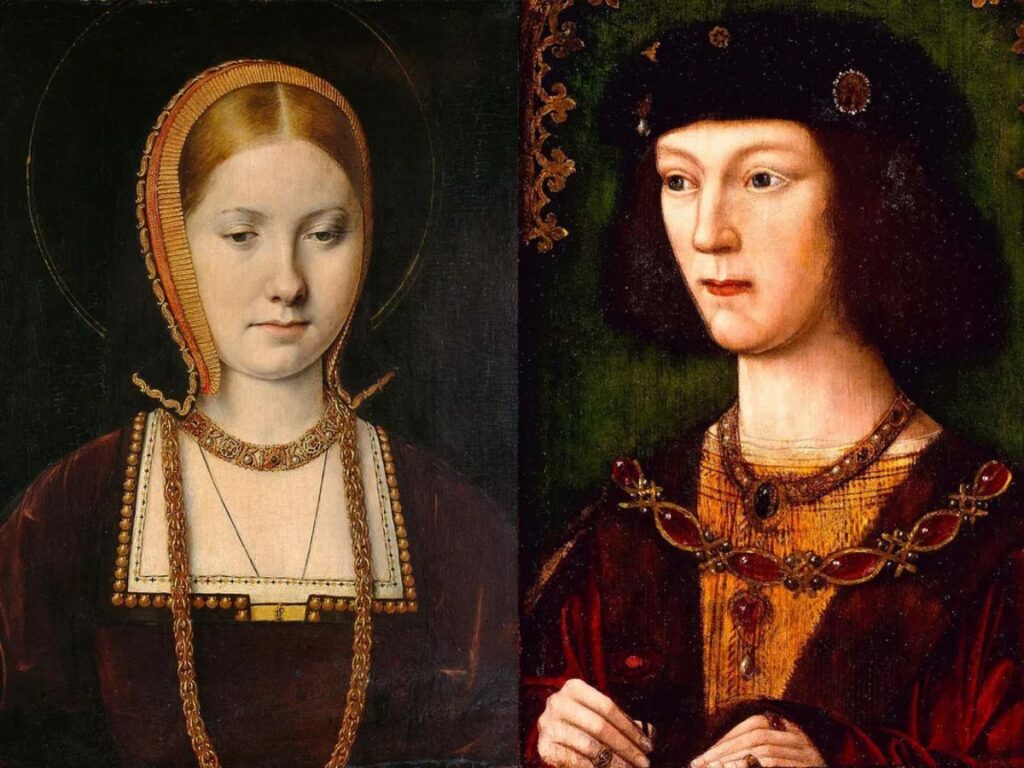
Catherine of Aragon carried herself with dignity and, by Tudor standards, fit the mold of a queen who looked the part. Descriptions of her show her as having pale skin, light reddish hair, and fair eyes, all qualities that matched the ideals inherited from the medieval world.
Her coronation with Henry VIII gave spectators the chance to see her in full display. One chronicler described her. “Her person apparelled in white satin embroidered, her hair hanging down to her back of a very great length, beautiful and goodly to behold.”
Contemporary observers also praised her hair as one of her most notable features. In a court where long, fair, and abundant hair was tied to youth and fertility, Catherine’s loose hair at the coronation was a calculated message: the new queen was healthy, fertile, and ready to bear heirs.
Bessie Blount

Bessie Blount never wore a crown, but her beauty made her unforgettable in Tudor circles. She was a lady-in-waiting to Catherine of Aragon and caught Henry VIII’s attention early in his reign. When compared to Anne Boleyn, one contemporary bluntly said that Bessie was more beautiful.
She had the qualities the court admired most. Descriptions suggest fair skin, light features, and a natural glow that align with the Tudor ideal. Her beauty was not just idle praise. It brought her influence and, for a time, a position of power as Henry’s mistress. She even bore the king a son, Henry FitzRoy, who was acknowledged and raised with noble rank.
Bessie’s story illustrates the significant weight that beauty carried at court. She had no crown, no official place in the dynasty, yet her looks and fertility gave her a foothold in one of the most cutthroat courts in Europe.

I’m Kylie Lang. A travel journalist specializing in France. I’ve been fascinated by the Middle Ages for as long as I can remember. Based in the rural French countryside, I spend my days visiting medieval castles, wandering through medieval villages, and researching the real stories behind history’s most infamous figures.